📌 Key Takeaways
- Healthcare wearable integration connects supported wearable devices with healthcare applications and clinical systems.
- It can support remote patient monitoring, chronic disease management, elderly care, rehabilitation, and wellness applications.
- APIs, data standardization, and interoperability are essential for reliable data exchange.
- Security, privacy, consent, and data accuracy must be considered throughout development.
- Integration cost depends on device compatibility, application scope, backend requirements, and healthcare system connectivity.
Introduction
Healthcare wearable integration connects wearable devices and health-monitoring technologies with healthcare applications, patient management platforms, and clinical systems. It allows health-related data such as heart rate, activity levels, sleep patterns, blood oxygen readings, and other measurements to move into a centralized digital healthcare environment.
For hospitals, healthcare startups, remote care providers, and digital health businesses, wearable integration can support continuous patient monitoring, improve access to health information, and help care teams review relevant patient data. However, successful integration requires more than connecting a device to an application. It also involves data synchronization, API connectivity, interoperability, security, and reliable data management.
AppCrex provides healthcare software development and integration services to businesses looking to connect wearable technologies with their digital healthcare solutions.
What Is Healthcare Wearable Integration?
Healthcare wearable integration is the process of connecting wearable devices with healthcare software so that health-related information can be collected, transferred, stored, and displayed within an application or clinical system.
Wearable devices use sensors to capture different types of information. Depending on the device, this may include heart rate, physical activity, sleep duration, blood oxygen saturation, body temperature, or other measurements.
The collected information can be synchronized with a mobile healthcare application, remote patient monitoring platform, or healthcare management system.
For example, a patient using a connected health-monitoring device may share selected readings with a healthcare application. The application can organize the information into a dashboard where authorized healthcare professionals can review relevant trends.
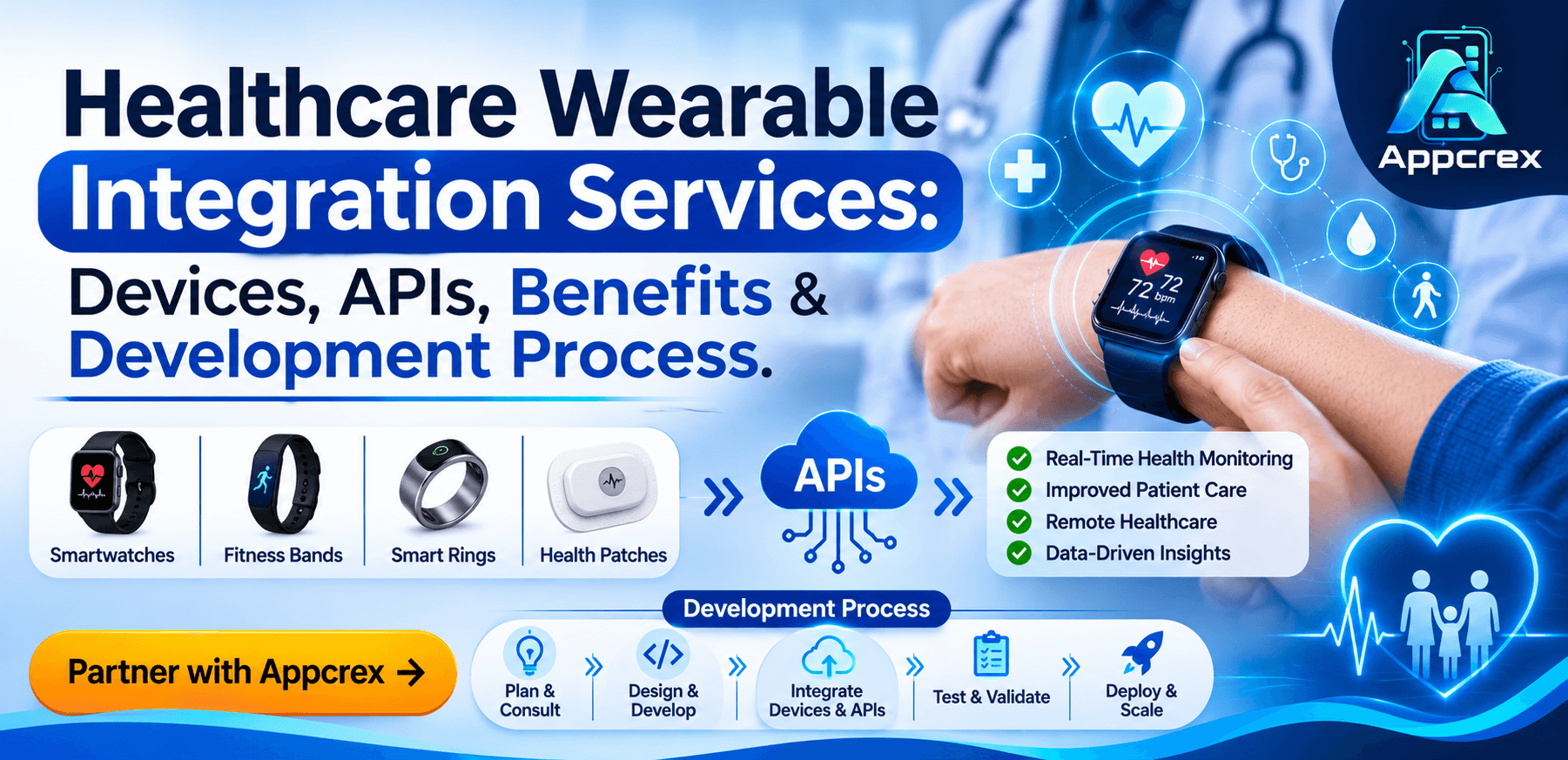
A typical healthcare wearable integration solution connects four major components:
- Wearable device: Captures health or activity measurements.
- Integration layer: Transfers and processes information through supported APIs or device communication methods.
- Healthcare application: Displays patient data and provides monitoring features.
- Clinical system: Stores or receives relevant information when integration with an EHR or EMR is required.
The goal is to make useful health information available in the right system while maintaining data accuracy, security, and appropriate access controls.
How Healthcare Wearable Integration Works?
Healthcare wearable integration generally follows a structured data flow. The exact process depends on the device, application, data source, and healthcare system involved.
1. Data Collection from Wearable Devices
Wearable devices collect information through built-in sensors. These sensors may measure movement, heart rate, sleep activity, or other health-related indicators.
Some devices collect information continuously, while others capture readings at specific intervals or when users initiate a measurement.
2. Data Transmission
The device transfers collected information through a supported communication method. Common options include Bluetooth Low Energy, Wi-Fi, and internet-connected synchronization services.
In some cases, a mobile application acts as an intermediary between the wearable device and the healthcare platform.
3. API-Based Data Integration
An integration layer receives information through available APIs, software development kits, or supported device interfaces.
The system must handle authentication, data permissions, API responses, rate limits, and synchronization errors.
4. Data Processing and Standardization
Different wearable devices may represent similar measurements in different formats. The integration layer processes incoming information and maps it into a consistent structure.
This step may include unit conversion, timestamp normalization, duplicate detection, validation, and device-source identification.
5. Healthcare Application Synchronization
Processed information is sent to the healthcare application or monitoring dashboard. Users and authorized care teams can view relevant readings, historical trends, and available monitoring information.
6. Clinical System Integration
When required, selected information can be transferred to an electronic health record or electronic medical record system.
The integration must follow the receiving system’s data model, access rules, and interoperability requirements.
Types of Healthcare Wearable Devices That Can Be Integrated
Healthcare businesses may work with different categories of wearable devices depending on their patient population and monitoring requirements.
Smartwatches and Fitness Trackers
Smartwatches and fitness trackers can collect activity and wellness-related information, including:
- Daily steps and movement
- Heart rate measurements
- Exercise duration
- Sleep patterns
- Activity levels
- Selected oxygen saturation readings, where supported
These devices can support wellness applications, activity tracking, and selected remote monitoring workflows. Their measurements should not automatically be treated as clinically validated readings.
Continuous Glucose Monitoring Devices
Continuous glucose monitoring systems measure glucose levels at regular intervals through dedicated sensors.
Integration can help authorized users review glucose trends, historical readings, and related information within a healthcare application. Device compatibility, data access permissions, and intended clinical use must be evaluated before implementation.
Connected Blood Pressure Monitors
Connected blood pressure monitors can transfer systolic and diastolic readings, along with measurement timestamps, into a healthcare application.
This can support blood pressure tracking and remote monitoring programs when the device and workflow are suitable for the intended use.
ECG Monitoring Devices
Certain wearable or portable ECG devices capture electrical activity of the heart.
Integration may allow ECG recordings or associated measurements to be transferred into a compatible application for review. Clinical interpretation should be handled through an appropriately designed and validated medical workflow.
Sleep Monitoring Devices
Sleep monitoring devices collect information such as sleep duration, movement, and selected sleep-related measurements.
Healthcare applications can organize this information into historical reports that support wellness tracking or appropriate clinical monitoring programs.
Medical Wearable Sensors
Specialized medical wearables may monitor specific physiological parameters or support particular patient-care workflows.
These integrations often require additional attention to device specifications, data accuracy, intended use, validation, and applicable regulatory requirements.
What Health Data Can Be Integrated?
The type of information available depends on the wearable device, sensor capabilities, user permissions, and data access interfaces.
| Data category | Examples | Potential application |
|---|---|---|
| Heart activity | Heart rate, selected ECG data | Monitoring and historical review |
| Blood pressure | Systolic and diastolic readings | Blood pressure tracking |
| Glucose | Glucose readings and trends | Diabetes management workflows |
| Physical activity | Steps, movement, exercise duration | Fitness and rehabilitation tracking |
| Sleep | Sleep duration and patterns | Sleep tracking and wellness |
| Oxygen saturation | SpO2 readings | Selected monitoring workflows |
| Temperature | Device-supported temperature readings | Health tracking where appropriate |
| Respiratory data | Device-supported respiratory measurements | Selected respiratory monitoring workflows |
Not every wearable captures every measurement. Data quality, sensor limitations, device validation, and the intended use of the information must be considered before it is used in a healthcare workflow.
Also Read : Patient Portal Software Development Company: Complete Guide to Features, Cost & Development Process
Healthcare Wearable Integration Use Cases
Wearable integration can support different healthcare applications. Its value depends on how the collected information fits into an actual care or business process.
Remote Patient Monitoring
Remote patient monitoring allows healthcare providers to review selected patient measurements outside traditional clinical settings.
Wearable devices can transfer readings into a monitoring platform, where authorized staff can review trends and identify information that may require attention.
For example, a patient enrolled in a monitoring program may share regular blood pressure readings through a connected device. The healthcare team can review the available history according to the program’s monitoring protocol.
Chronic Disease Management
People managing long-term conditions may need regular tracking of selected health measurements.
Wearable and connected medical devices can help collect relevant information over time. Healthcare applications can organize these readings into reports that patients and care teams can review.
The specific data sources and monitoring frequency should be selected according to the patient’s needs and the clinical program.
Elderly Care and Assisted Living
Wearable integration can support selected elderly-care workflows by helping authorized caregivers review activity information, available health measurements, or device-generated alerts.
Applications may also include configurable notifications for missed measurements or device connectivity problems.
These systems should have clear consent, access permissions, escalation procedures, and safeguards against treating every device alert as a medical emergency.
Cardiac Health Monitoring
Compatible wearable devices can capture selected heart-related measurements.
A healthcare platform can organize available readings and recordings for review by authorized professionals. The solution should clearly distinguish device-generated information from clinically interpreted results.
Fitness and Preventive Healthcare
Healthcare and wellness applications can integrate activity, exercise, and sleep information to provide users with a consolidated view of their daily habits.
These features may support wellness programs, lifestyle tracking, and preventive health initiatives.
Post-Surgery and Rehabilitation Monitoring
After a procedure or during rehabilitation, connected devices may help collect activity and other relevant measurements.
A healthcare application can present this information to patients and authorized care teams, supporting follow-up workflows and progress tracking where appropriate.
Remote Patient Monitoring Integration
Remote patient monitoring is one of the important use cases for healthcare wearable integration.
A remote monitoring solution typically connects patient devices, a mobile application, a backend platform, and a healthcare dashboard.
A practical workflow may look like this:
- A healthcare provider enrolls a patient in a monitoring program.
- The patient connects a compatible wearable or medical device.
- The device collects selected measurements.
- The application transfers available information to the backend.
- The platform validates and organizes the incoming data.
- Authorized healthcare professionals review readings and trends.
- Configured notifications help staff identify events that require review.
- The care team follows its established clinical communication and escalation process.
A reliable remote monitoring platform should also handle missing readings, disconnected devices, delayed synchronization, and inaccurate or incomplete data.
Integration alone does not guarantee continuous monitoring or emergency response. Those capabilities require appropriate operational procedures, staffing, and clinical oversight.
Healthcare APIs and Integration Architecture
APIs are essential for connecting wearable devices and healthcare applications with other software systems.
The integration architecture depends on the device’s available interfaces, the receiving healthcare platform, and the business requirements.
Device APIs and SDKs
Some wearable technologies provide APIs or software development kits that allow applications to access permitted device information.
An integration solution may use these interfaces to retrieve readings, manage permissions, and synchronize available data.
Bluetooth Low Energy Integration
Bluetooth Low Energy can support communication between nearby wearable devices and mobile applications.
It is useful when an application needs to receive information directly from a compatible device. The implementation must account for pairing, connectivity interruptions, background operation, and device compatibility.
Cloud-Based Data Synchronization
Some wearable ecosystems synchronize device information with cloud-based services.
A healthcare application may retrieve permitted information through supported APIs. This approach can simplify access to data from compatible devices but introduces dependencies on API availability, permissions, and service limitations.
FHIR-Based Healthcare Data Exchange
Fast Healthcare Interoperability Resources (FHIR) is a healthcare data exchange standard designed to support interoperability between healthcare systems.
Depending on the data and implementation, selected wearable measurements may be mapped into appropriate FHIR resources, such as Observation.
FHIR can help standardize the exchange of healthcare information, but it does not automatically make every wearable device or application interoperable. Data mapping, terminology, profiles, authentication, and receiving-system requirements still need to be addressed.
Also Read : Electronic Health Records (EHR) Integration: Complete Guide to Benefits, Process, Cost & Challenges
EHR and EMR Integration
Healthcare businesses may need wearable information to appear in an existing electronic health record or electronic medical record system.
This requires mapping relevant measurements, patient identifiers, timestamps, device information, and other required fields to the receiving system.
Only appropriate and authorized data should be transferred into the clinical record.
Data Security, Privacy and Compliance
Healthcare wearable integration involves personal health information, so security and privacy must be considered throughout development.
Important safeguards include:
Data encryption: Protect sensitive information during transmission and storage using appropriate encryption methods.
Authentication and authorization: Verify users and systems before allowing access to health information.
Role-based access control: Give healthcare professionals, administrators, patients, and caregivers access according to their responsibilities.
Consent management: Record user permissions and provide clear controls for data sharing and revocation where applicable.
Audit logging: Maintain records of important access and system activities.
Secure API communication: Use appropriate authentication, access tokens, and API security controls.
Data retention policies: Define how long information is stored and how it is securely handled when no longer required.
Risk assessment: Evaluate potential threats across devices, mobile applications, APIs, cloud infrastructure, and connected healthcare systems.
For solutions handling electronic protected health information in the United States, applicable HIPAA requirements must be evaluated based on the organization’s role and the nature of the information. HIPAA’s Security Rule requires appropriate administrative, physical, and technical safeguards for ePHI. Requirements should be assessed for the actual implementation rather than treating a technology feature as automatic compliance.
Similarly, software that controls a medical device or analyzes medical-device data may have regulatory implications depending on its intended function. These requirements should be reviewed before development and deployment.
Healthcare Wearable Integration Development Process
A structured development process helps reduce compatibility issues and makes the integration easier to maintain.
Step 1: Define Business and Integration Requirements
Start by identifying the purpose of the integration.
Determine which devices need to connect, what information should be collected, who will access it, and which healthcare systems need to receive the data.
Step 2: Evaluate Device Compatibility
Review the supported device models, operating systems, APIs, SDKs, communication methods, and data access permissions.
Device compatibility should be confirmed before committing to the integration architecture.
Step 3: Design the Integration Architecture
Plan how information will move between the wearable device, mobile application, backend services, and healthcare platform.
The architecture should address data synchronization, authentication, error handling, scalability, and system availability.
Step 4: Develop APIs and Data Mapping
Build the integration layer and map incoming device data into the required application structure.
This may include unit normalization, timestamp handling, patient matching, duplicate detection, and validation rules.
Step 5: Integrate Healthcare Applications
Connect the processed data with the required mobile application, web dashboard, patient portal, or clinical system.
The interface should make readings understandable and distinguish current measurements from historical information.
Step 6: Implement Security Controls
Configure authentication, authorization, encryption, audit logs, consent management, and appropriate data retention policies.
Security requirements should be reviewed throughout development, not only before launch.
Step 7: Test Device and Data Reliability
Test the integration with supported devices and realistic usage scenarios.
Important test cases include device disconnection, delayed synchronization, duplicate readings, invalid data, API failures, permission changes, and application updates.
Step 8: Deploy and Monitor
Deploy the integration in the intended environment and monitor API performance, synchronization failures, device compatibility, and application reliability.
Ongoing maintenance is important because device software, APIs, operating systems, and healthcare system requirements can change.
Common Challenges in Healthcare Wearable Integration
Healthcare wearable integration can involve technical and operational challenges that need to be addressed early.
Device fragmentation: Different devices may use different interfaces, data formats, and synchronization methods. A compatibility strategy helps manage this complexity.
Inconsistent data formats: Similar measurements may arrive in different units or structures. Data normalization and validation are essential.
Connectivity interruptions: Wearables may disconnect, lose network access, or stop synchronizing. Applications should support retry mechanisms and clear connection-status indicators.
Data accuracy: Sensor limitations, incorrect usage, and environmental conditions can affect readings. Applications should preserve source information and avoid presenting uncertain measurements as confirmed clinical results.
API limitations: Some interfaces have access restrictions, rate limits, or changing requirements. Integration planning should account for these dependencies.
Patient identity matching: Data must be associated with the correct patient account. Reliable identity management and verification are important to prevent incorrect record association.
Privacy and compliance: Healthcare information requires appropriate safeguards, access policies, and consent workflows.
Addressing these challenges during architecture and testing can improve reliability after deployment.
Also Read : HIPAA-Compliant Healthcare App Development: Complete Guide
Factors Affecting Healthcare Wearable Integration Cost
The cost of healthcare wearable integration depends on the number of devices, integration complexity, healthcare systems involved, security requirements, and application functionality.
There is no single fixed price that applies to every project.
Important cost factors include:
| Cost factor | What affects the cost |
|---|---|
| Device integration | Number of devices, compatibility, and available interfaces |
| API development | Authentication, data retrieval, synchronization, and API complexity |
| Data processing | Normalization, validation, mapping, and storage |
| Mobile application | Patient-facing screens, device pairing, and monitoring features |
| Backend development | Data pipelines, dashboards, and infrastructure |
| EHR/EMR integration | Receiving-system APIs, data mapping, and interoperability requirements |
| Security | Access controls, encryption, logging, and risk assessment |
| Testing | Device testing, integration testing, and reliability validation |
| Maintenance | API updates, device compatibility, monitoring, and support |
A basic integration with one supported data source may require less work than an enterprise solution connecting multiple devices, clinical systems, and patient monitoring workflows.
Ongoing expenses may include cloud hosting, API usage, monitoring, maintenance, and security reviews.
For an accurate estimate, businesses should define the required devices, data types, target platforms, user roles, and clinical system integrations before requesting a development proposal.
How to Choose a Healthcare Wearable Integration Partner?
Choosing the right development partner is important because wearable integration involves multiple systems and sensitive information.
Consider the following points before starting a project:
- Healthcare software experience: Review experience with healthcare applications, patient portals, monitoring platforms, and connected systems.
- API integration expertise: Confirm the ability to work with device APIs, SDKs, and healthcare interoperability interfaces.
- Data security approach: Understand how the development team handles authentication, access control, encryption, and audit logging.
- Device compatibility planning: Ask how the team evaluates supported devices and manages changes to device interfaces.
- Scalable architecture: Ensure the proposed system can support future devices, users, and integrations.
- Testing and maintenance: Discuss device testing, API monitoring, issue resolution, and long-term support.
- Clear project scope: Confirm deliverables, assumptions, integrations, timelines, and responsibilities before development begins.
A capable integration partner should understand both the technical requirements and the healthcare workflow the solution is intended to support.
Why Choose AppCrex for Healthcare Wearable Integration?
AppCrex helps businesses develop and integrate healthcare software based on their operational and technical requirements.
Our approach focuses on connecting digital health applications with the systems and data sources they need to support their workflows.
Our healthcare software development and integration capabilities can include:
- Wearable device and healthcare application integration
- Custom healthcare API development
- Patient monitoring application development
- Healthcare data synchronization
- EHR and EMR integration
- Backend and cloud integration
- Secure user access and data management
- Integration testing and ongoing maintenance
We begin by understanding the devices, healthcare applications, data requirements, and business objectives involved in the project. Based on these requirements, the development approach can be planned around compatibility, security, interoperability, and future scalability.
Whether you are building a remote patient monitoring platform or connecting wearable data with an existing healthcare application, AppCrex can help plan and develop the required integration solution.
FAQs
1. What is healthcare wearable integration?
Healthcare wearable integration connects wearable devices with healthcare applications and systems. It allows supported health-related measurements to be transferred, organized, and displayed for patients or authorized healthcare professionals.
2. Which wearable devices can be integrated with healthcare applications?
Depending on available interfaces and compatibility, healthcare applications can integrate smartwatches, fitness trackers, connected blood pressure monitors, glucose monitoring devices, ECG devices, sleep monitors, and specialized medical wearables.
Supported information may include heart rate, activity levels, sleep patterns, blood pressure, glucose readings, oxygen saturation, temperature, and selected ECG data. The available measurements depend on the device and its data access capabilities.
4. Can wearable devices integrate with EHR and EMR systems?
Yes. Wearable data can be transferred to compatible EHR and EMR systems through supported interfaces and APIs. The integration requires appropriate patient matching, data mapping, permissions, and validation.
5. How does wearable integration support remote patient monitoring?
It allows selected patient measurements to be transferred from connected devices to a remote monitoring platform. Authorized healthcare teams can review available readings and follow their established monitoring and escalation procedures.
6. What role do APIs play in healthcare wearable integration?
APIs allow applications and systems to exchange permitted information. They can support data retrieval, authentication, synchronization, and communication between wearable services and healthcare platforms.
7. Is healthcare wearable integration secure?
It can be designed with security controls such as encryption, authentication, role-based access, audit logging, and consent management. The complete solution must be assessed against the privacy and security requirements applicable to its users and data.
8. What is FHIR in healthcare wearable integration?
FHIR is a healthcare data exchange standard that helps different healthcare systems share information using defined resources and interfaces. It can support the exchange of selected wearable measurements when appropriate data mapping and implementation profiles are used.
9. How long does healthcare wearable integration take?
The timeline depends on the number of devices, API availability, application requirements, healthcare system integrations, security needs, and testing scope. A single-device integration is generally less complex than a multi-device enterprise platform.
10. How much does healthcare wearable integration cost?
The cost depends on device compatibility, API development, data processing, mobile and backend functionality, clinical system integration, security, and maintenance. A project-specific estimate requires a clearly defined integration scope.
11. Can wearable data be used for clinical decisions?
That depends on the device, measurement quality, intended use, validation, and applicable regulatory requirements. Consumer wellness readings should not automatically be treated as clinically validated information. Appropriate clinical review is important.
12. Can an existing healthcare application be connected to wearable devices?
Yes, if the application and target devices provide suitable integration options. The existing architecture, API availability, data permissions, and compatibility should be evaluated before implementation.
Conclusion
Healthcare wearable integration is helping digital healthcare businesses connect device-generated information with applications and monitoring systems. When implemented properly, it can make relevant health measurements easier to access, organize, and review.
However, a successful solution requires more than device connectivity. Businesses need a reliable integration architecture, compatible APIs, accurate data handling, secure information exchange, and appropriate clinical workflows.
AppCrex helps businesses develop healthcare applications and integration solutions that connect wearable technologies with digital health platforms. If you are planning a new healthcare wearable integration project or want to connect devices with an existing application, contact AppCrex to discuss your requirements and development approach.