📌 Key Takeaways
- Define the wallet’s business model before choosing features or technology.
- Build reliable transaction processing, security, and reconciliation into the architecture.
- Evaluate Mada, SADAD, and other integrations according to the intended services and provider requirements.
- Budget for engineering, security, integrations, compliance advice, and ongoing operations.
- Confirm applicable SAMA requirements before offering regulated financial services in Saudi Arabia.
Introduction
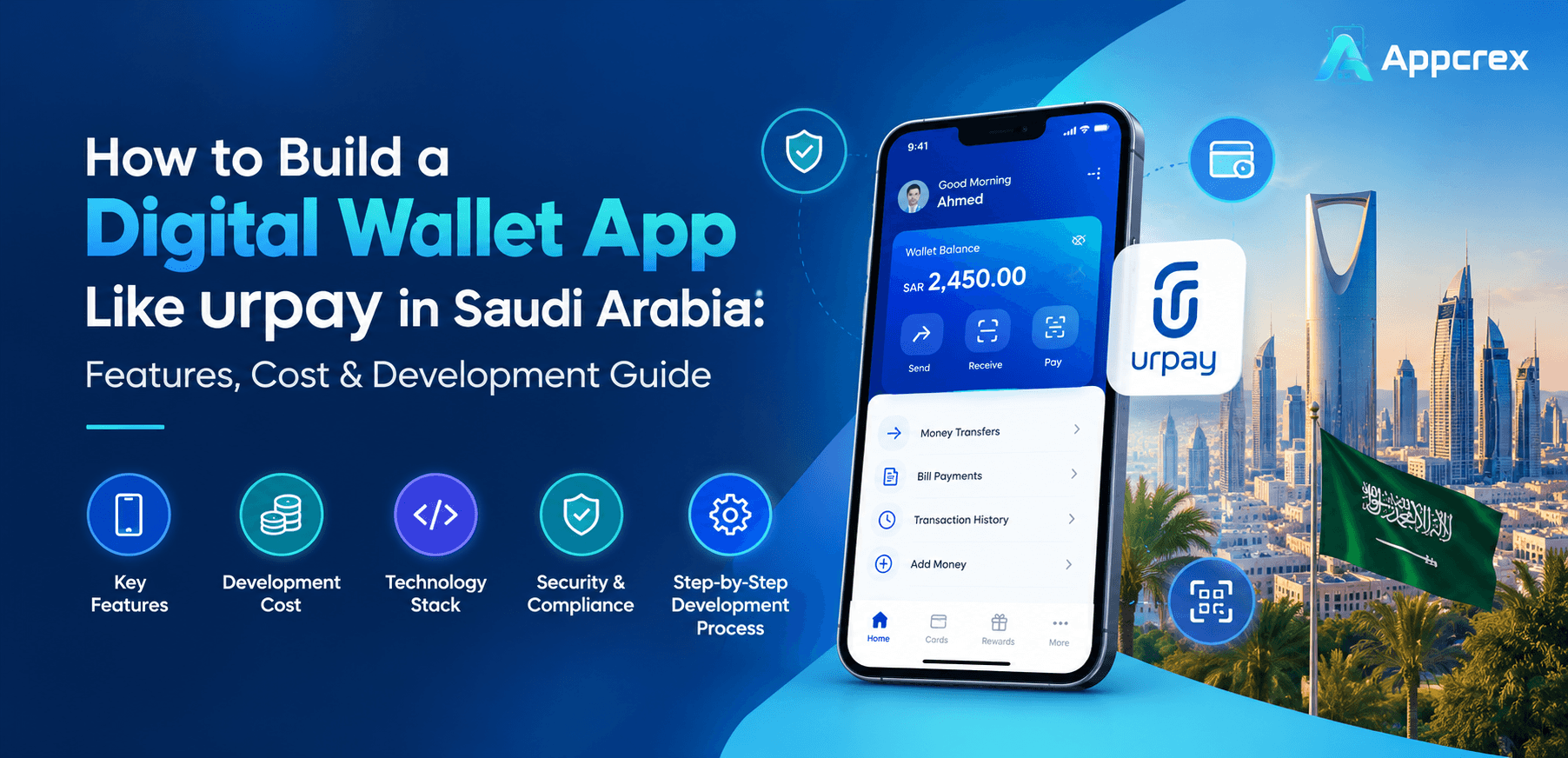
Building a digital wallet app like urpay in Saudi Arabia requires a clear fintech business model, secure payment processing, reliable technology, and a thorough understanding of local regulatory requirements. Businesses planning to enter the digital payments market need to consider more than app design. They must also plan identity verification, transaction management, financial integrations, data protection, and ongoing operations.
A digital wallet can help users manage supported payments, transfer funds, pay bills, and access other financial services through a mobile application. For businesses, the opportunity lies in creating a secure and convenient digital payment experience for a specific customer segment.
This guide explains how to build a digital wallet app like urpay in Saudi Arabia, including essential features, development steps, technology choices, estimated costs, payment integrations, and SAMA compliance considerations.
What Is urpay and How Does a Digital Wallet App Work?
urpay is a digital wallet brand associated with Saudi Arabia’s digital payments market. It provides a useful reference for businesses exploring how to bring financial services together in a mobile experience.
A digital wallet app allows users to access supported payment and financial services through their smartphones. Depending on the product and its authorized operating model, these services may include money transfers, bill payments, payment transactions, and transaction history.
Digital wallet app development involves building the user-facing application and the systems behind it. These systems can include identity verification, payment integrations, transaction processing, customer support, security controls, and administrative tools.
A typical digital wallet transaction follows this process:
- Download and registration: Users install the application and create an account.
- Identity verification: The app completes the verification checks required for the service.
- Wallet setup: The customer receives access to the wallet functionality available to their account.
- Payment or transfer initiation: The user chooses a supported transaction and confirms the details.
- Transaction validation: Backend systems check the request, applicable limits, available funds or payment source, and risk controls.
- Payment processing: The authorized financial provider processes the transaction.
- Confirmation: The application displays the transaction status and records the activity.
- Monitoring and support: The platform supports reconciliation, customer queries, and investigation of relevant exceptions.
The exact flow depends on whether the wallet uses stored electronic money, links to external accounts, or relies on partner-provided payment services.
Why Build a Digital Wallet App in Saudi Arabia?
Saudi Arabia’s digital finance ecosystem presents opportunities for fintech businesses that can address real customer needs. However, entering this market requires product differentiation, suitable financial partnerships, and a compliant operating model.
1. Growing use cases for digital payments
Customers may want convenient ways to make payments, transfer funds, pay bills, and track transactions. A well-designed digital wallet can bring supported services into a single interface.
2. Opportunities for fintech startups
Startups and established businesses can explore wallet products for consumer payments, merchant transactions, employee benefits, loyalty programs, or specialized customer groups.
The strongest opportunity usually comes from solving a specific problem rather than launching a wallet with every possible feature from day one.
3. Convenient customer experiences
A wallet can reduce payment friction through saved preferences, clear transaction confirmations, accessible history, and a straightforward interface.
Arabic and English language support may also be valuable for products serving different customer groups in Saudi Arabia.
4. Merchant payment opportunities
Depending on the business model and available partnerships, digital wallet platforms may support merchant payments, transaction reporting, refunds, and reconciliation.
These capabilities can help merchants manage digital transactions and provide customers with additional payment options.
5. Alignment with Saudi Arabia’s fintech ecosystem
Saudi Arabia’s Financial Sector Development Program and Vision 2030 provide broader context for the country’s financial-sector development.
Businesses evaluating open banking should review the official Saudi Open Banking Program to understand the relevant framework and determine whether those capabilities fit their proposed product.
Types of Digital Wallet Apps You Can Build
Before starting digital wallet app development, decide which type of wallet best fits your target users and business model.
Closed wallets
A closed wallet generally allows customers to use stored value or credits within the issuing business’s own ecosystem. It may suit specific retail or service-based use cases, subject to the applicable rules.
Semi-closed wallets
A semi-closed wallet can support payments across participating merchants or approved networks, depending on its permissions and arrangements.
Open wallets
An open wallet may support a broader range of payment and withdrawal services through authorized financial providers. The available services depend on the applicable regulatory framework.
Peer-to-peer payment wallets
P2P wallets focus on transfers between eligible users. They may include recipient management, transfer status, notifications, and transaction records.
Mobile payment wallets
These wallets focus on making digital payments through supported methods, which may include contactless payments, online payments, or QR-based transactions.
Multi-service digital wallets
A broader wallet may combine several supported services, such as payments, transfers, bill payments, rewards, and financial integrations.
The type of wallet you choose will affect development complexity, integration requirements, compliance planning, and the overall project budget.
Essential Features of a Digital Wallet App Like urpay
A successful wallet should prioritize features that make transactions secure, understandable, and convenient. The exact feature set should follow the product’s business model and applicable requirements.
1. User registration and onboarding
The registration process should be straightforward while collecting the information required for the service.
Common capabilities include:
- Mobile number or email verification
- Secure account creation
- Arabic and English language options
- Guided onboarding
- Terms and privacy disclosures
- Verification status tracking
Clear onboarding helps users understand what information is needed and what they can do after registration.
2. KYC and identity verification
Know Your Customer (KYC) processes help establish a customer’s identity and support relevant financial crime prevention controls.
Depending on the service and approved verification arrangements, the app may support:
- Identity document capture
- Electronic identity verification
- Document validation
- Liveness checks where appropriate
- Manual review for exceptional cases
- Verification status notifications
The development team should integrate suitable verification services and design the workflow around the applicable requirements.
3. Wallet balance and transaction history
Users should be able to understand their account activity without confusion.
Useful features include:
- Balance display
- Transaction history
- Search and filters
- Transaction references
- Payment receipts
- Pending, completed, and failed statuses
- Downloadable statements where supported
Financial records must be maintained by reliable backend systems. A mobile interface should never be treated as the authoritative source of financial balances.
4. Money transfers and payments
Where supported by the product and authorized partners, customers may be able to send or receive money, pay bills, or make other eligible transactions.
Potential capabilities include recipient management, transfer confirmation, transaction limits, status tracking, and notifications.
The backend must also account for failed requests, duplicate submissions, delayed responses, reversals, and transaction reconciliation.
5. Payment gateway integration
Payment gateway integration connects the wallet or associated application to supported payment services.
The appropriate integration depends on the product’s purpose. A wallet used for merchant payments may have different requirements from one designed around account transfers or bill payments.
Businesses should evaluate providers based on supported payment methods, commercial terms, security requirements, technical documentation, and eligibility for their proposed business model.
6. Bill payments and recurring payments
If included in the product, bill payment features can help users manage eligible recurring expenses.
Possible capabilities include saved billers, payment reminders, transaction receipts, and payment status tracking.
Recurring payments should provide clear consent and cancellation controls, along with suitable handling for failed or interrupted payments.
7. Notifications and alerts
Notifications help users stay informed about transactions and account activity.
Common examples include:
- Successful payment confirmations
- Incoming transfer notifications
- Failed transaction alerts
- Security and login warnings
- Verification updates
- Service notifications
Sensitive information should not be exposed unnecessarily in push notifications.
8. Biometric authentication
Depending on the device and risk model, a wallet may support fingerprint or facial authentication alongside other security mechanisms.
Biometrics should be implemented using appropriate device security capabilities and should not replace the need for secure account recovery and transaction controls.
9. AI-powered fraud detection
AI and machine learning can help identify unusual transaction patterns, suspicious account activity, or potentially fraudulent behavior.
Such systems require suitable data, carefully evaluated models, monitoring, and human review where appropriate. AI should support—not replace—necessary financial controls and investigation procedures.
10. Customer support and dispute management
Customers need a clear way to report failed transactions, suspected fraud, account access problems, and other issues.
A support system may include ticket creation, transaction-linked complaints, status tracking, escalation, and secure communication.
11. Loyalty and rewards integration
Some digital wallet business models use eligible cashback offers, discounts, or reward points to encourage engagement.
Reward rules should be transparent, and any financial incentive must be assessed against applicable regulations and commercial agreements.
Admin Dashboard and Backend Requirements
A digital wallet is not just an iOS or Android application. It also needs backend services and administrative tools to manage customers, transactions, integrations, and operational issues.
| Component | Purpose |
|---|---|
| Customer management | Manage customer profiles and support requests |
| Transaction management | Track transactions and investigate exceptions |
| Risk monitoring | Review alerts and suspicious activity |
| Compliance workflows | Support relevant reviews, records, and reporting |
| Reconciliation | Match internal records with financial partner records |
| Customer support | Manage complaints and escalations |
| Analytics | Monitor operational metrics and service performance |
| Access control | Restrict staff permissions and record sensitive actions |
Administrative systems should follow least-privilege access principles. Sensitive actions should be logged, monitored, and protected through appropriate approval procedures.
Also Read : Generative AI Development Company Saudi Arabia: Services, Cost, Use Cases & Development Process
How to Build a Digital Wallet App Like urpay in Saudi Arabia?
Step 1: Define the business model
Start by identifying your target users and the problem your digital wallet will solve.
Decide whether the product will focus on consumer payments, merchant transactions, transfers, bill payments, or another specific use case.
Define the services you intend to provide before deciding which features to build.
Step 2: Review Saudi regulatory requirements
Regulatory planning should begin before the full development project.
Saudi Central Bank requirements depend on the actual services offered and the business’s operating structure. Determine whether your proposed activities require authorization or must be delivered through an appropriately authorized partner.
Review the official SAMA Rules for Electronic Wallets and obtain qualified Saudi regulatory advice.
A software development agreement does not itself authorize a business to operate a regulated financial service.
Step 3: Research customers and competitors
Analyze customer needs, existing wallet experiences, payment preferences, fees, onboarding processes, and customer complaints.
Use this research to identify a meaningful product advantage. For example, you may focus on a specific merchant segment, simplify an existing workflow, or improve the experience for a clearly defined audience.
Step 4: Prepare product requirements
Create a product requirements document covering:
- User journeys and transaction flows
- Required features and permissions
- Payment and identity integrations
- Security requirements
- Error handling and reconciliation
- Reporting and administration
- Operational support
- Launch criteria
This step helps control scope and reduces costly changes later.
Step 5: Design the UI/UX
Create wireframes and prototypes for registration, identity verification, the wallet dashboard, payments, transaction history, and support.
For Saudi Arabia, consider Arabic and English interfaces, right-to-left layouts, accessibility, local number formatting, and clear transaction messages.
Step 6: Select the technology stack
Choose technologies based on security, integration requirements, team expertise, maintainability, and expected transaction volume.
The architecture should support reliable transaction processing, secure API communication, monitoring, and controlled access to sensitive information.
Step 7: Develop the app and backend
Build the mobile applications, backend services, administrative dashboard, and required integration layer.
Financial transaction handling should account for idempotency, validation, transaction states, error recovery, audit logging, and reconciliation.
Step 8: Integrate payment and verification services
Work with appropriate providers to connect payment processing, identity verification, notifications, and other required services.
Confirm the providers’ eligibility requirements, supported services, commercial terms, and technical approval processes.
Step 9: Test the complete system
Test payment flows, failed transactions, duplicate requests, network interruptions, identity verification, account permissions, and recovery procedures.
Security testing should include relevant API testing, vulnerability assessments, access control reviews, and independent testing where appropriate.
Step 10: Prepare for launch
Before launch, confirm that required authorizations, partner arrangements, technical approvals, customer support, and operational procedures are in place.
Prepare incident response, monitoring, dispute handling, business continuity, and rollback plans.
Step 11: Monitor and improve
After launch, monitor transaction success rates, onboarding completion, application performance, support requests, and security alerts.
Use these insights to improve the product while maintaining appropriate financial controls.
Technology Stack for Digital Wallet App Development
The technology stack should be selected according to the product’s functionality and integration requirements.
| Layer | Potential technologies |
|---|---|
| iOS development | Swift |
| Android development | Kotlin |
| Cross-platform development | Flutter or React Native |
| Backend development | Java, Node.js, Python, or .NET |
| Database | PostgreSQL or another suitable transactional database |
| APIs | Secure REST APIs and appropriate event-driven integrations |
| Cloud infrastructure | A suitable cloud environment with required security controls |
| Identity verification | Approved verification providers |
| Payment integration | Providers that support the intended transaction flows |
| Monitoring | Centralized logs, metrics, alerts, and incident monitoring |
| Testing | API testing, mobile testing, security assessments, and automated testing |
Flutter and React Native can support cross-platform app development, while Swift and Kotlin can support native iOS and Android implementations.
The best choice depends on product requirements, integration needs, engineering expertise, and long-term maintenance. Framework selection alone does not guarantee security or reduce the complexity of financial backend development.
How to Integrate Mada, SADAD, and Local Payment Methods?
For a digital wallet targeting Saudi Arabia, local payment requirements should be considered during product planning.
Mada and SADAD have different purposes. Mada is associated with Saudi Arabia’s national payment network, while SADAD supports bill payment services. Their suitability depends on the specific wallet functionality and available provider arrangements.
Mada integration
Businesses evaluating Mada-related payment capabilities should identify an appropriate payment provider or acquiring partner and confirm which transactions the proposed integration supports.
The implementation may need secure transaction processing, payment confirmation, error handling, refunds where applicable, and reconciliation.
SADAD integration
For bill payment functionality, businesses should determine which SADAD services are relevant and confirm the integration requirements with an appropriate authorized provider.
Depending on the supported service, the integration may include bill inquiries, payment initiation, transaction status updates, and reconciliation.
Other local payment methods
Additional options may include eligible bank transfers, card payments, or other payment services supported by the wallet’s financial partners.
Do not assume that every method is available to every wallet provider. Confirm eligibility, technical access, and applicable obligations before including these integrations in the product scope.
Digital Wallet App Development Cost in Saudi Arabia
The cost to develop a digital wallet app in Saudi Arabia depends on its features, integrations, platform strategy, security requirements, and operating model.
The following figures are illustrative software development planning estimates, not verified Saudi market averages or vendor quotations. Licensing, regulatory advice, partner charges, payment processing fees, and ongoing operations may be additional.
| App complexity | Illustrative development cost | Indicative timeline |
|---|---|---|
| Prototype or proof of concept | SAR 30,000–70,000 | 3–6 weeks |
| Limited-scope wallet MVP | SAR 120,000–250,000 | 3–5 months |
| More comprehensive wallet | SAR 250,000–600,000 | 5–9 months |
| Enterprise-grade platform | SAR 600,000–1,200,000+ | 9–15+ months |
Actual estimates can fall outside these ranges. A prototype does not provide a production-ready financial service, and an MVP can still require substantial integration, security, and operational work.
Factors affecting the development cost
Feature complexity: Transfers, bill payments, merchant functionality, rewards, and analytics increase the development scope.
Platform selection: Separate native apps may require more duplicated work than a shared cross-platform approach, although the best choice depends on requirements.
Payment gateway integration: Each integration can involve implementation, testing, partner coordination, and commercial fees.
KYC integration: Identity verification services may involve setup costs and ongoing per-verification charges.
Security requirements: Secure architecture, independent testing, monitoring, and incident response planning add effort.
Regulatory planning: Legal advice, partner due diligence, compliance workflows, and operational controls may sit outside the software development budget.
Maintenance: Infrastructure, monitoring, security updates, support, and future improvements continue after launch.
When evaluating a digital wallet app development company, request an itemized proposal that separates engineering, integrations, testing, infrastructure, external services, and maintenance.
Digital Wallet App Business Models and Revenue Streams
A wallet’s revenue model should align with its customers, services, commercial agreements, and applicable regulations.
Transaction or merchant fees
Some business models earn revenue from eligible merchant transactions or payment services. Fees and revenue-sharing arrangements must be transparent and commercially agreed.
Business subscriptions
A provider serving businesses may charge for merchant dashboards, reporting, account management, or additional operational tools.
Value-added services
Additional services may include reconciliation tools, merchant integrations, or other features offered through suitable arrangements.
Partner-based revenue
A business may receive revenue through approved financial service partnerships. Availability depends on the product and the relevant agreements.
Premium features
Optional premium functionality may generate recurring revenue if it provides genuine value and is permitted under the applicable framework.
Do not assume that transfers, foreign exchange, lending, interchange, or other financial activities will generate revenue automatically. Each option depends on permissions, partners, and applicable regulations.
Also Read : How Much Does It Cost to Develop a Mobile App in Saudi Arabia? Complete Guide (2026)
Regulatory Requirements and Security for Digital Wallet Apps in Saudi Arabia
Regulatory compliance should be part of the product design from the beginning.
The Saudi Central Bank publishes rules for electronic wallets and regulates relevant payment services. The requirements applicable to a particular product depend on the activities performed, the entity operating it, and the relevant legal framework.
Important areas to review include:
Determine whether the proposed service requires authorization or must be delivered through an appropriately authorized provider.
KYC and customer due diligence
Implement customer verification and relevant review processes appropriate to the intended services.
Anti-money laundering controls
Assess transaction monitoring, suspicious activity escalation, and applicable recordkeeping obligations.
Data protection
Review applicable Saudi data protection requirements, including how personal and financial information is accessed, processed, retained, and secured.
Transaction security
Use appropriate authentication, encryption, access controls, fraud monitoring, and secure payment integrations.
Auditability and operational resilience
Maintain suitable records, monitor critical systems, and prepare procedures for incidents, service interruptions, complaints, and recovery.
Businesses should consult the official SAMA Electronic Wallet Rules and qualified Saudi legal or regulatory advisers before offering regulated services.
Common Challenges in Digital Wallet App Development
Data security and fraud prevention
Wallets handle sensitive financial information, making account protection, transaction monitoring, and fraud response essential.
Payment failures and reconciliation
Timeouts, duplicate requests, delayed confirmations, and reversals can create inconsistencies if the transaction architecture is poorly designed.
Financial partner integrations
Payment and identity providers may have technical requirements, approval processes, and commercial dependencies that affect project timelines.
Regulatory readiness
Treating compliance as a final step can lead to redesign, launch delays, or an operating model that does not support the planned service.
Scalability and performance
The platform must continue to process transactions reliably as usage grows, while maintaining monitoring and recovery capabilities.
Budget management
Unclear requirements, underestimated integration effort, and ongoing service charges can increase costs. Define scope, assumptions, exclusions, and maintenance responsibilities early.
How to Choose a Digital Wallet App Development Company?
Choosing the right development partner is important for a financial product where reliability and security matter.
Before hiring a team, evaluate:
- Fintech experience: Review relevant financial, payment, or security-sensitive projects.
- Backend expertise: Confirm knowledge of transaction processing, reconciliation, audit logging, and error recovery.
- Integration experience: Discuss payment provider APIs, KYC services, and external dependencies.
- Security practices: Ask about secure coding, access controls, vulnerability testing, and incident support.
- Regulatory awareness: Check whether the team can coordinate with your legal and compliance advisers without making unsupported licensing promises.
- Transparent estimates: Request a defined scope, milestones, assumptions, exclusions, and acceptance criteria.
- Post-launch support: Clarify responsibilities for monitoring, maintenance, updates, and technical incidents.
- Ownership and documentation: Establish contractual terms for source code, credentials, documentation, and third-party licenses.
A reliable digital wallet app development company should explain the trade-offs between a limited MVP and a broader financial platform, including costs that fall outside software engineering.
FAQs
Q. How much does it cost to develop a digital wallet app like urpay in Saudi Arabia?
The cost depends on functionality, integrations, security requirements, and the operating model. A limited-scope MVP may have an illustrative software budget of SAR 120,000–250,000, while a more comprehensive platform can cost substantially more. These figures exclude many potential regulatory, partner, and operational expenses.
Q. How long does it take to build a digital wallet app?
A limited-scope MVP may take approximately three to five months to develop. A more complex platform may take nine months or longer, depending on integrations, testing, security, partner approvals, and regulatory readiness.
Q. What features should a digital wallet app include?
Common features include registration, identity verification, supported payment flows, transaction history, notifications, account security, customer support, and an administrative dashboard. The final list should match the product’s business model and applicable requirements.
Q. What is the role of KYC in digital wallet app development?
KYC helps verify customer identities and supports applicable customer due diligence and financial crime prevention controls. The implementation should follow the requirements relevant to the wallet’s services and operating model.
Q. Can a digital wallet app integrate Mada and SADAD?
Potentially, depending on the intended services, provider arrangements, and integration eligibility. Mada and SADAD serve different purposes, so businesses should confirm the relevant technical and commercial requirements with suitable providers.
Q. Which technology is best for digital wallet app development?
Flutter or React Native can support cross-platform mobile applications, while Swift and Kotlin are options for native development. Backend technologies may include Java, Node.js, Python, or .NET. The choice should reflect security, integration, and maintainability requirements.
Q. What regulations apply to digital wallets in Saudi Arabia?
Relevant requirements may include SAMA authorization, customer identification, anti-money laundering controls, security, and applicable data protection obligations. The exact requirements depend on the proposed service and operating structure.
Q. How can a digital wallet app generate revenue?
Possible models include eligible merchant fees, business subscriptions, value-added services, and approved partner revenue. Available revenue streams depend on commercial agreements and the applicable regulatory framework.
Q. What is the difference between a digital wallet and a mobile banking app?
A digital wallet generally focuses on supported payment and wallet services. A mobile banking application provides services associated with a bank and its accounts. Capabilities can overlap, so the distinction depends on the provider and the services offered.
Conclusion
Building a digital wallet app like urpay in Saudi Arabia requires a practical business strategy, secure technology, suitable financial partnerships, and careful regulatory planning.
Start by identifying the customer problem your wallet will solve. Define the services you intend to provide, confirm the relevant operating requirements, and prioritize the features needed for a secure first release. A clear scope and realistic budget will help your team make better decisions about integrations, technology, and long-term maintenance.
AppCrex can help businesses plan and develop custom mobile applications, backend systems, API integrations, and digital product experiences. If you are exploring digital wallet app development in Saudi Arabia, contact the AppCrex team to discuss your requirements and define a suitable development roadmap.