📌 Key Takeaways
- AI governance creates accountability for how AI systems are selected, developed, and used.
- Risk-based controls matter: safeguards should reflect each system’s potential impact.
- Security and privacy must be built in from the beginning, especially for sensitive data and AI agents.
- Frameworks provide structure, not automatic compliance: assess applicable standards and legal requirements.
- Continuous monitoring is essential because AI systems, risks, and business needs change over time.
Introduction
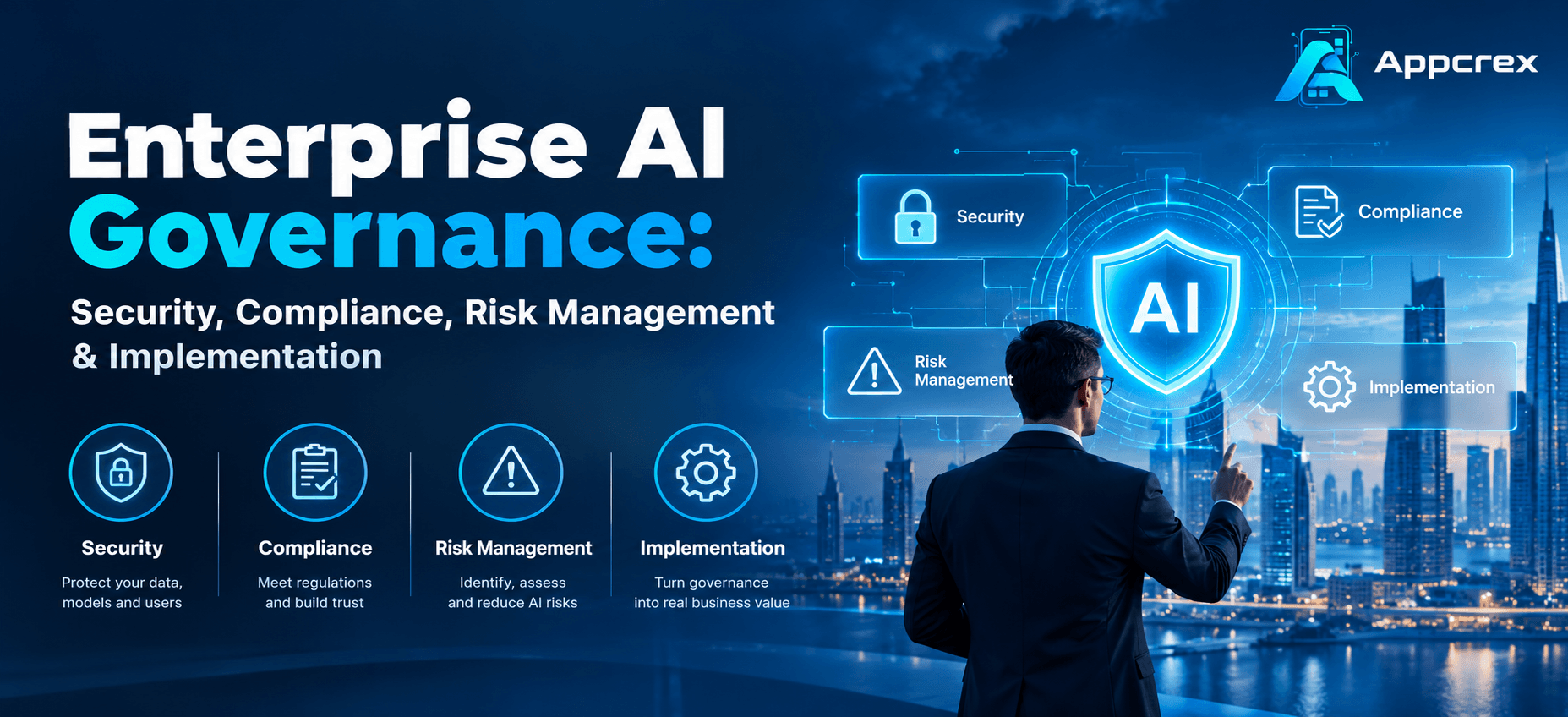
Artificial intelligence is helping businesses automate workflows, improve decision-making, and deliver better customer experiences. However, as organizations adopt AI across departments, they also face growing challenges related to data privacy, cybersecurity, inaccurate outputs, regulatory compliance, and accountability. Enterprise AI governance provides a structured approach to managing these risks while helping businesses use AI responsibly and securely.
An effective AI governance framework defines how AI systems are selected, developed, deployed, monitored, and evaluated throughout their lifecycle. It establishes clear responsibilities, protects sensitive information, and helps organizations align AI initiatives with business objectives and applicable regulations.
Whether a company is implementing generative AI, integrating AI agents into business operations, or building custom AI-powered applications, governance is essential for scaling AI with confidence.
In this guide, we explore enterprise AI governance frameworks, AI risk management, security and compliance requirements, implementation steps, business use cases, and consulting costs to help organizations develop a practical AI governance strategy.
What Is Enterprise AI Governance?
Enterprise AI governance is the set of policies, processes, roles, and technical controls that guide how an organization selects, develops, deploys, monitors, and manages artificial intelligence systems.
It helps businesses ensure that AI systems are secure, reliable, transparent, fair, and aligned with business objectives. It also defines who is responsible when an AI system produces an incorrect result, exposes sensitive information, or makes a decision that creates business or legal risks.
For example, a company using AI to screen job applications needs rules for handling candidate data, checking for bias, reviewing AI-generated recommendations, and allowing human intervention. An organization using generative AI to answer customer questions needs safeguards against inaccurate answers, data leakage, and unauthorized access.
In simple terms, enterprise AI governance answers five questions:
-
What AI systems can our organization use?
-
What data can those systems access?
-
Who approves and monitors AI-related decisions?
-
How do we identify and reduce AI risks?
-
How do we demonstrate that AI is being used responsibly?
A well-designed AI governance framework connects business leadership, IT, security, legal, compliance, and development teams through a consistent approach.
Why Is AI Governance Important for Businesses?
AI can improve productivity, customer service, forecasting, and decision-making. However, deploying AI without appropriate oversight can introduce risks that are difficult to identify after a system reaches production.
Enterprise AI governance provides a structured way to manage these risks while allowing teams to continue innovating.
1. Protect sensitive business data
AI applications may process customer records, employee information, financial data, contracts, or proprietary documents. Without clear data policies, employees might submit confidential information to unapproved AI tools or grant AI systems more access than they need.
Governance policies can define approved tools, data classification rules, access permissions, retention requirements, and acceptable use.
2. Improve AI security
AI systems face traditional cybersecurity threats as well as risks specific to AI, such as prompt injection, malicious inputs, model manipulation, and unintended disclosure through connected data sources.
AI security governance helps organizations establish security testing, identity controls, monitoring, incident response, and safeguards for AI integrations.
3. Reduce inaccurate or biased decisions
AI models can generate incorrect answers or produce unfair outcomes when their data, design, or evaluation methods are inadequate.
Governance introduces testing, performance thresholds, human review, and escalation procedures. These controls are especially important for high-impact decisions involving employment, lending, insurance, healthcare, and access to essential services.
4. Support regulatory and contractual obligations
Businesses may need to consider privacy laws, sector-specific requirements, customer contracts, and AI-related regulations in the markets where they operate.
An AI governance program helps teams identify applicable obligations and maintain documentation. However, a framework alone does not automatically make a business legally compliant.
5. Build customer and stakeholder trust
Customers and business partners increasingly want to understand how AI affects decisions, how their data is handled, and whether a human can review important outcomes.
Clear policies and transparent processes help businesses explain how their AI systems work and how problems are addressed.
6. Scale AI across the enterprise
Without shared standards, different departments may adopt overlapping tools, duplicate work, or introduce inconsistent security practices.
An enterprise AI governance framework creates common approval processes and reusable controls. This makes it easier to expand successful AI projects across departments without treating every new deployment as an entirely separate initiative.
What Are the Key Components of an Enterprise AI Governance Framework?
An effective AI governance framework combines organizational accountability, risk management, technical safeguards, and continuous monitoring.
The exact controls should reflect the organization’s industry, AI use cases, data sensitivity, and applicable legal requirements.
| Component | What it covers | Business benefit |
|---|---|---|
| AI policies and accountability | Approved uses, responsibilities, approval rules | Clear ownership |
| AI risk assessment | Business, operational, ethical, and technical risks | Earlier risk detection |
| Data governance | Data quality, access, privacy, retention | Better data protection |
| AI security | Authentication, testing, monitoring, incident response | Reduced security exposure |
| Responsible AI | Fairness, explainability, human oversight | More accountable decisions |
| Model lifecycle management | Testing, deployment, versioning, monitoring | More reliable AI |
| Compliance and documentation | Requirements, records, assessments, evidence | Easier audits and reviews |
| Third-party AI management | Vendor reviews, contracts, data handling | Better supplier oversight |
AI policies and accountability
Businesses should document which AI tools and use cases are approved, restricted, or prohibited. They should also identify who can approve new systems and who is accountable for their performance.
For larger organizations, an AI governance committee may include representatives from leadership, engineering, cybersecurity, legal, compliance, and relevant business units.
Data governance and privacy
AI governance should define where training data, prompts, uploaded documents, and model outputs are stored and processed. It should also establish access controls, retention periods, data quality checks, and procedures for handling personal or confidential information.
Where applicable, organizations should assess privacy requirements before sending data to external AI providers.
AI security and technical controls
Technical controls may include encryption, role-based access, logging, secure APIs, vulnerability assessments, model evaluation, and restrictions on what an AI agent can do.
For example, an AI assistant that can read financial records should not automatically receive permission to approve payments or modify customer accounts.
Human oversight and accountability
Not every AI output requires the same level of human review. A system that summarizes internal meeting notes may need relatively light controls, while an AI tool supporting a consequential lending or hiring decision may require stronger review and escalation.
The governance policy should define when human approval is required and how users can challenge or correct an AI-assisted decision.
Continuous monitoring and improvement
AI governance does not end when a system is launched. Models, data, user behavior, regulations, and business requirements can change.
Organizations should monitor performance, security incidents, complaints, drift, and policy violations. They should also reassess systems after major model updates, new integrations, or changes in how the system is used.
What Are the Most Common Enterprise AI Risks?
AI risk management is a core part of enterprise AI governance. Businesses should evaluate risks before deployment and continue reviewing them throughout the AI system lifecycle.
| AI risk | Example | Recommended control |
|---|---|---|
| Data leakage | An employee submits confidential data to an unapproved AI tool | Approved tools, data controls, employee training |
| Prompt injection | Malicious instructions manipulate an AI assistant connected to internal documents | Input handling, access boundaries, adversarial testing |
| Hallucinations | An AI assistant provides incorrect policy or product information | Retrieval checks, evaluations, citations where appropriate, human escalation |
| Algorithmic bias | An AI-supported process disadvantages a group of applicants | Representative testing, fairness assessments, human review |
| Unauthorized actions | An AI agent changes records without proper permission | Least-privilege access, approval gates, action limits |
| Model drift | Performance declines as real-world data changes | Monitoring, periodic evaluation, retraining where appropriate |
| Vendor dependency | A provider changes its model, terms, or service availability | Vendor reviews, contingency plans, portability assessment |
| Regulatory gaps | A system is deployed without evaluating applicable requirements | Legal review, system classification, documented controls |
How can businesses reduce generative AI risks?
Generative AI systems need controls that address the way they process instructions, retrieve information, and produce new content.
Practical safeguards include:
-
Restricting access to sensitive data and internal systems.
-
Testing models against malicious or misleading inputs.
-
Grounding responses in approved sources when accuracy matters.
-
Evaluating outputs for quality, safety, and policy violations.
-
Requiring human approval before high-impact or irreversible actions.
-
Keeping logs and creating a clear incident-response process.
These measures can reduce risk, but no single control guarantees that an AI system will always behave correctly.
AI Governance vs. AI Risk Management vs. AI Compliance
These terms are related, but they serve different purposes. Understanding the difference helps businesses build a governance program without duplicating work.
| Area | Main purpose | Example |
|---|---|---|
| Enterprise AI governance | Establishes overall policies, ownership, and oversight | Creating an AI approval committee |
| AI risk management | Identifies, assesses, treats, and monitors AI risks | Testing an AI hiring tool for bias |
| AI compliance | Addresses applicable legal, regulatory, and contractual obligations | Reviewing whether an AI use case falls under specific regulatory requirements |
| AI security | Protects AI systems, data, infrastructure, and connected tools | Restricting an AI agent’s access to financial systems |
| Responsible AI | Encourages trustworthy, accountable, and appropriate AI use | Providing human review for consequential decisions |
How do they work together? AI governance sets the direction and assigns responsibility. AI risk management identifies and addresses potential harms. Compliance activities help establish whether the organization meets its applicable obligations, while security and responsible AI practices provide important safeguards.
A mature program coordinates all these activities rather than treating them as separate initiatives.
How to Implement Enterprise AI Governance: Step-by-Step Process?
A practical AI governance implementation should begin with the organization’s actual AI use cases, risks, and business objectives. Businesses do not always need to create a large governance department before getting started.
Step 1: Inventory existing AI systems
Start by identifying AI systems already in use across the organization. Include formally approved projects, employee use of external AI tools, AI features embedded in business software, and third-party AI services.
For each system, document:
-
Business purpose and accountable owner.
-
AI model or provider.
-
Types of data processed.
-
Connected applications and permissions.
-
Intended users and affected stakeholders.
-
Current safeguards and known limitations.
This inventory provides visibility into potential risks that might otherwise remain hidden.
Step 2: Classify AI use cases by risk
Not every AI application requires the same level of oversight. A company can prioritize systems according to their potential impact on people, sensitive data, critical operations, finances, and legal obligations.
For example, an internal brainstorming assistant may require basic data and access controls. An AI system supporting credit decisions, medical workflows, or employee selection may require deeper assessments and more formal oversight.
Risk classification should be based on the context of the system, not simply the model name or whether it uses generative AI.
Step 3: Define governance policies and ownership
Create clear rules for AI procurement, development, testing, deployment, acceptable use, monitoring, and retirement.
Assign responsibilities across relevant teams. Business owners should understand the purpose and impact of their AI systems. Technical teams should manage implementation and testing. Security, privacy, legal, and compliance teams should review issues within their areas of responsibility.
Also define approval thresholds, exception procedures, escalation paths, and who can suspend an AI system when serious issues arise.
Step 4: Establish data and security controls
Review the data each AI system can access and determine whether that access is necessary.
Implement appropriate controls such as:
-
Role-based access and least-privilege permissions.
-
Encryption and secure API connections.
-
Data classification and retention policies.
-
Approved AI providers and third-party assessments.
-
Protection against unauthorized data disclosure.
-
Logging and monitoring for sensitive operations.
AI agents that can send messages, update databases, or trigger transactions need additional safeguards around their actions and permissions.
Step 5: Test AI systems before deployment
Testing should cover more than whether the system produces a useful answer. It should also assess reliability, privacy, security, fairness where relevant, and performance under unexpected conditions.
For generative AI, test for hallucinations, prompt injection, unsafe outputs, and unauthorized retrieval of information. For predictive models, evaluate performance across relevant data groups and scenarios.
Define measurable acceptance criteria before launch. If a system fails a critical test, improve it or limit its use rather than assuming the problem will disappear in production.
Step 6: Establish compliance and documentation processes
Determine which laws, regulations, industry requirements, and contractual obligations apply to each AI use case.
Depending on the situation, documentation may include system descriptions, risk assessments, data sources, testing results, human oversight procedures, vendor information, and records of important changes.
Organizations operating across countries should assess the rules relevant to their actual markets and roles. A general-purpose AI policy is not a substitute for jurisdiction-specific legal review.
Step 7: Deploy with monitoring and human oversight
Launch the system with controls appropriate to its risk level. Monitor accuracy, availability, security events, user feedback, and other relevant performance indicators.
For high-impact applications, define when a human must review an output, approve an action, or intervene in a decision. Ensure staff know how to report problems and how to stop or escalate unsafe behavior.
Step 8: Review and improve continuously
Review governance controls at planned intervals and after material changes, such as a model replacement, new data source, new business use, or major incident.
Use monitoring results and audit findings to update policies, testing procedures, and staff training. This keeps governance aligned with how AI is actually used.
Enterprise AI governance implementation checklist
Which AI Governance Frameworks and Standards Should Businesses Know?
Several established frameworks and standards can help organizations organize AI governance. They serve different purposes, so businesses should select and combine them according to their needs.
1. NIST AI Risk Management Framework
The NIST AI Risk Management Framework (AI RMF) helps organizations manage risks associated with AI systems. Its core functions are Govern, Map, Measure, and Manage.
-
Govern: Establish policies, responsibilities, and organizational oversight.
-
Map: Understand the context, intended use, and potential impacts of AI.
-
Measure: Assess risks and evaluate system performance.
-
Manage: Prioritize risks and take appropriate action.
NIST describes the framework as voluntary and intended to support trustworthiness throughout the AI lifecycle. Its AI RMF 1.0 is being revised, so organizations should consult the official resource for current developments.
Official resource: NIST AI Risk Management Framework.
2. ISO/IEC 42001
ISO/IEC 42001:2023 specifies requirements for establishing, implementing, maintaining, and continually improving an AI management system.
It can help organizations formalize AI policies, management responsibilities, risk-related processes, performance evaluation, and continual improvement. It applies to organizations that develop, provide, or use AI systems, regardless of industry.
Businesses considering certification should distinguish between implementing the standard and obtaining certification through an appropriate certification process.
Official resource: ISO/IEC 42001 official standard.
3. EU AI Act
The EU AI Act establishes a legal framework for AI in the European Union, including requirements that vary according to factors such as the system, its risk category, and the organization’s role.
Businesses should not assume that every AI system is regulated in the same way. They should assess whether the Act applies to their activities, identify relevant obligations, and verify the implementation timeline with official EU guidance.
The European Commission provides information on the Act’s regulatory framework, governance, and enforcement.
Official resource: European Commission: AI Act regulatory framework.
How should a business choose an AI governance framework?
| Business need | Useful starting point |
|---|---|
| Structure AI risk assessment and management | NIST AI RMF |
| Establish a formal AI management system | ISO/IEC 42001 |
| Assess obligations relating to the EU AI Act | Official EU guidance and qualified legal advice |
| Improve security and privacy controls | Existing information security and privacy programs, extended to AI-specific risks |
These resources can complement one another. None should be treated as a universal substitute for applicable laws, technical testing, or professional legal advice.
Enterprise AI Governance Use Cases Across Industries
AI governance requirements depend on the business function, the information being processed, and the potential consequences of an AI output.
Healthcare
Healthcare organizations may use AI to support administrative workflows, summarize records, assist clinical teams, or improve operational planning. Governance should address patient privacy, output reliability, clinical validation, access permissions, and appropriate professional oversight.
AI used in clinical decision-making may require substantially stronger evaluation and controls than an internal scheduling assistant.
Banking and financial services
Banks and financial institutions may apply AI to fraud detection, customer support, document processing, risk analysis, and financial operations.
Governance priorities include data protection, explainability where needed, bias evaluation, transaction permissions, audit trails, and human review for consequential decisions. AI recommendations should not bypass established financial controls.
Retail and e-commerce
Retail businesses may use AI for product recommendations, demand forecasting, customer service, inventory planning, and personalization.
Governance can help ensure that customer data is handled appropriately, product information remains accurate, and AI-generated recommendations follow business and privacy policies.
Human resources
AI tools can assist with recruitment administration, employee training, and workforce planning. However, systems that influence hiring, promotion, or performance evaluation can affect people’s opportunities.
Organizations should assess potential bias, document the system’s intended role, involve qualified human reviewers, and verify applicable employment and AI regulations.
Manufacturing and logistics
Manufacturers and logistics providers may use AI for predictive maintenance, quality inspection, demand planning, and route optimization.
Governance should address sensor and operational data quality, system reliability, access controls, monitoring, and contingency procedures when AI recommendations are unavailable or incorrect.
SaaS and enterprise software
SaaS providers may embed AI assistants, automated workflows, and agentic capabilities into their products.
Their governance programs should consider tenant data separation, permissions, customer disclosures, model-provider dependencies, logging, and controls over actions taken by AI agents.
For organizations building AI-powered applications, governance should be part of product architecture from the beginning. AppCrex’s app development services can be a relevant starting point for businesses planning custom digital products that include AI capabilities.
What Are the Main Challenges in AI Governance?
AI governance can be difficult when an organization has multiple AI providers, distributed teams, legacy systems, and unclear ownership.
Shadow AI and unapproved tools
Employees may adopt AI tools without involving IT or security teams. A practical response combines approved tools, clear acceptable-use policies, employee training, and appropriate technical controls.
Simply prohibiting AI without providing workable alternatives can encourage employees to use it outside approved processes.
Limited visibility into AI systems
Companies may not know which applications use AI, what data flows to external providers, or which models power embedded features.
An AI inventory and procurement review process help improve visibility. Contracts with vendors should clarify relevant data-handling practices, security responsibilities, and notification procedures.
Balancing innovation with oversight
Excessive approval steps can slow useful projects, while weak controls can expose the business to unnecessary risks.
A risk-based approach is more practical: use streamlined review for low-impact applications and stronger review for sensitive or consequential use cases.
Measuring AI governance effectiveness
Counting policies alone does not show whether governance is working. Organizations need indicators tied to actual outcomes.
Useful metrics can include:
-
Percentage of known AI systems with assigned owners.
-
Percentage of high-risk systems with current risk assessments.
-
Completion rates for required security and performance tests.
-
Time taken to resolve AI-related incidents.
-
Number of unauthorized AI tools identified.
-
Percentage of deployed systems reviewed on schedule.
-
Frequency of policy exceptions and unresolved findings.
Metrics should help decision-makers identify problems and improve controls, not simply create reporting overhead.
Best Practices for Responsible Enterprise AI Implementation
Businesses can make AI governance more effective by following a few consistent principles.
1. Start with business objectives. Define the problem AI should solve and how success will be measured before selecting a model or vendor.
2. Use risk-based controls. Match the depth of testing, approval, and monitoring to the potential impact of each use case.
3. Make ownership explicit. Every production AI system should have a responsible business owner and clear technical accountability.
4. Apply least-privilege access. Give AI applications and agents only the permissions needed for their assigned tasks.
5. Keep humans involved where it matters. Define meaningful review and escalation procedures for decisions that may significantly affect people or business operations.
6. Test continuously. Evaluate systems before deployment and after material changes. Monitor real-world performance rather than relying only on initial testing.
7. Train employees. Explain approved tools, confidential-data rules, limitations of AI outputs, and how to report incidents.
8. Review third-party providers. Assess security, privacy, reliability, contractual terms, and dependency risks before adopting external AI services.
9. Document important decisions. Maintain appropriate records of risk assessments, approvals, tests, incidents, and changes.
10. Improve the framework over time. Update governance processes as the organization’s AI usage, risk profile, and regulatory obligations evolve.
These practices help make AI governance part of day-to-day operations rather than a policy document that is rarely used.
How Much Do Enterprise AI Governance Consulting Services Cost?
The cost of enterprise AI governance consulting depends on the size of the organization, the number of AI systems, the complexity of existing infrastructure, regulatory requirements, and the level of implementation support needed.
There is no single standard price for an AI governance program. A limited assessment for one AI application is different from building an enterprise-wide AI management system with multiple business units, security controls, audits, and ongoing monitoring.
The following figures are illustrative planning estimates, not verified market averages or AppCrex quotations.
| Project scope | Illustrative budget (USD) | Typical activities |
|---|---|---|
| Initial AI governance assessment | $5,000–$15,000 | AI inventory, gap analysis, initial risk review |
| Governance framework design | $15,000–$40,000 | Policies, roles, risk methodology, approval processes |
| Governance implementation | $25,000–$75,000+ | Technical controls, documentation, testing, monitoring setup |
| Complex enterprise program | $75,000–$150,000+ | Multi-team rollout, multiple systems, advanced controls and integration |
Actual costs can fall outside these ranges. External legal advice, formal audits, certification activities, third-party software, and ongoing managed services may be charged separately.
What affects AI governance implementation cost?
-
Number of AI systems: Each additional system may require discovery, classification, testing, and documentation.
-
Data sensitivity: Personal, financial, healthcare, and proprietary information can require more extensive controls.
-
Technical complexity: AI agents and systems connected to enterprise databases may need additional permissions management and security testing.
-
Regulatory exposure: Organizations operating in multiple jurisdictions may need additional assessments and specialist advice.
-
Existing maturity: Businesses with established cybersecurity, privacy, and risk-management processes may be able to reuse some controls.
-
Ongoing support: Monitoring, periodic assessments, employee training, and policy updates add recurring costs.
How can businesses control AI governance costs?
Begin with an inventory and prioritize the AI systems with the greatest potential impact. Reuse existing security and compliance processes where appropriate, establish shared policies, and introduce controls in phases.
Avoid purchasing complex governance platforms before understanding the organization’s actual requirements. In some cases, existing identity, security, documentation, and monitoring tools can support the initial program.
For accurate budgeting, request a scope-based assessment that separates one-time implementation work from recurring operational costs.
How to Choose an Enterprise AI Governance Consulting Partner?
The right partner should understand both AI technology and the business processes surrounding it. A governance engagement should produce practical controls that teams can implement, measure, and maintain.
Before choosing an AI consulting company, evaluate these factors.
Technical and governance expertise
Ask whether the team understands AI model evaluation, data governance, cybersecurity, model lifecycle management, and responsible AI practices. Experience with frameworks such as NIST AI RMF and ISO/IEC 42001 can be useful when relevant to your requirements.
Industry and regulatory understanding
A partner should understand the context in which your AI systems operate. Requirements for a healthcare application, a financial product, and an internal knowledge assistant can differ significantly.
Confirm whether legal interpretation or formal compliance opinions are included in the engagement. Technical consultants should not be assumed to replace qualified legal counsel.
Practical implementation capabilities
A good governance plan should move beyond recommendations. Depending on scope, the partner should be able to help with AI inventories, risk assessments, technical safeguards, testing workflows, documentation, and monitoring.
Security and integration capabilities
Review how the partner approaches access control, sensitive data, third-party models, APIs, and enterprise integrations. If AI is embedded in a custom application, governance requirements should be considered during architecture and development—not added only after deployment.
Clear deliverables and measurable outcomes
Ask for a written scope with deliverables, milestones, responsibilities, assumptions, and acceptance criteria. The engagement should make clear what the organization will be able to manage or measure when the work is complete.
AppCrex works on digital product and AI-related development needs. Businesses planning an AI-powered application can explore AppCrex app development services and discuss the technical requirements, security considerations, and governance controls appropriate to their project.
FAQs
Q. What is enterprise AI governance?
Enterprise AI governance is the framework of policies, responsibilities, processes, and controls that guides how an organization develops, purchases, deploys, and monitors AI systems. Its purpose is to support responsible AI use while managing security, privacy, operational, ethical, and regulatory risks.
Q. Why do businesses need an AI governance framework?
Businesses need an AI governance framework to manage AI-related risks, protect sensitive information, clarify accountability, evaluate model performance, and support applicable compliance obligations. It also helps organizations expand AI adoption consistently across teams.
Q. What is the difference between AI governance and AI risk management?
AI governance establishes the overall policies, ownership, and oversight for AI. AI risk management focuses on identifying, assessing, prioritizing, treating, and monitoring specific risks. Risk management is therefore an important part of a broader AI governance program.
Q. Which AI governance frameworks are commonly used?
Organizations may use the NIST AI Risk Management Framework to structure AI risk management, ISO/IEC 42001 to establish an AI management system, and relevant legal frameworks such as the EU AI Act to assess applicable obligations. The appropriate combination depends on the organization’s operations, use cases, and regulatory exposure.
Q. Is AI governance mandatory for every business?
Not every AI governance framework is legally mandatory for every business. However, specific AI uses may be subject to applicable laws, regulations, privacy obligations, sector requirements, or contractual commitments. Organizations should assess their actual circumstances instead of assuming that one rule applies to all AI systems.
Q. How long does AI governance implementation take?
The timeline depends on the project scope, number of AI systems, existing controls, and level of documentation required. A focused assessment may take weeks, while a company-wide implementation can take several months or longer. These are broad planning expectations, not guaranteed delivery timelines.
Q. How much does AI governance consulting cost?
Costs depend on the scope of work, technical complexity, risk level, and need for ongoing support. A limited assessment generally requires less effort than an enterprise-wide governance program. Businesses should request a scoped proposal with implementation costs and recurring expenses clearly separated.
Q. How can companies govern generative AI and AI agents?
Companies should define approved use cases, control data access, test for hallucinations and prompt injection, monitor outputs, and restrict agent permissions. High-impact actions should have appropriate approval gates, logging, and escalation procedures.
Q. What should an AI governance policy include?
An AI governance policy should cover approved and prohibited uses, data handling, accountability, risk assessment, security, human oversight, vendor management, testing, monitoring, incident reporting, and periodic review. Its requirements should reflect the organization’s specific risks and applicable obligations.
Q. Can small and medium-sized businesses implement AI governance?
Yes. Smaller businesses can start with a basic AI inventory, approved-tool policy, data protection rules, assigned ownership, and a risk-based review process. They can expand the framework as AI adoption and business complexity increase.
Conclusion: Build a Responsible Enterprise AI Governance Strategy
Enterprise AI governance is an important foundation for organizations that want to scale AI while managing security, privacy, reliability, and compliance risks. It brings business leadership, technical teams, and risk stakeholders together around clear responsibilities and measurable controls.
The most effective approach is practical and risk-based: identify existing AI systems, classify their risks, establish ownership, implement appropriate safeguards, test performance, and monitor systems after deployment. Organizations should also review relevant standards and legal obligations based on their markets and use cases.
Whether your business is adopting generative AI, integrating AI into enterprise software, or developing custom AI-powered applications, governance should be part of the implementation strategy from the start.
Planning an AI-powered business solution? AppCrex can help you explore your application development requirements, technical architecture, and AI integration needs.
Get in Touch with AppCrex to discuss your project.