📌 Key Takeaways
- AI personalization makes app experiences more relevant to individual users.
- Recommendation engines are only one part of a broader personalization strategy.
- E-commerce, fintech, healthcare, travel, SaaS and media can all use AI personalization.
- Data quality, model selection, integrations and real-time requirements strongly affect development cost.
- Privacy, transparency and user control should be designed into personalization from the beginning.
Introduction
Users no longer expect every person to see the same app experience. Whether someone is shopping online, booking a hotel, managing finances, learning a new skill, or watching content, they increasingly expect an app to understand their interests and surface information that is relevant to them.
This is where AI personalization in apps comes in.
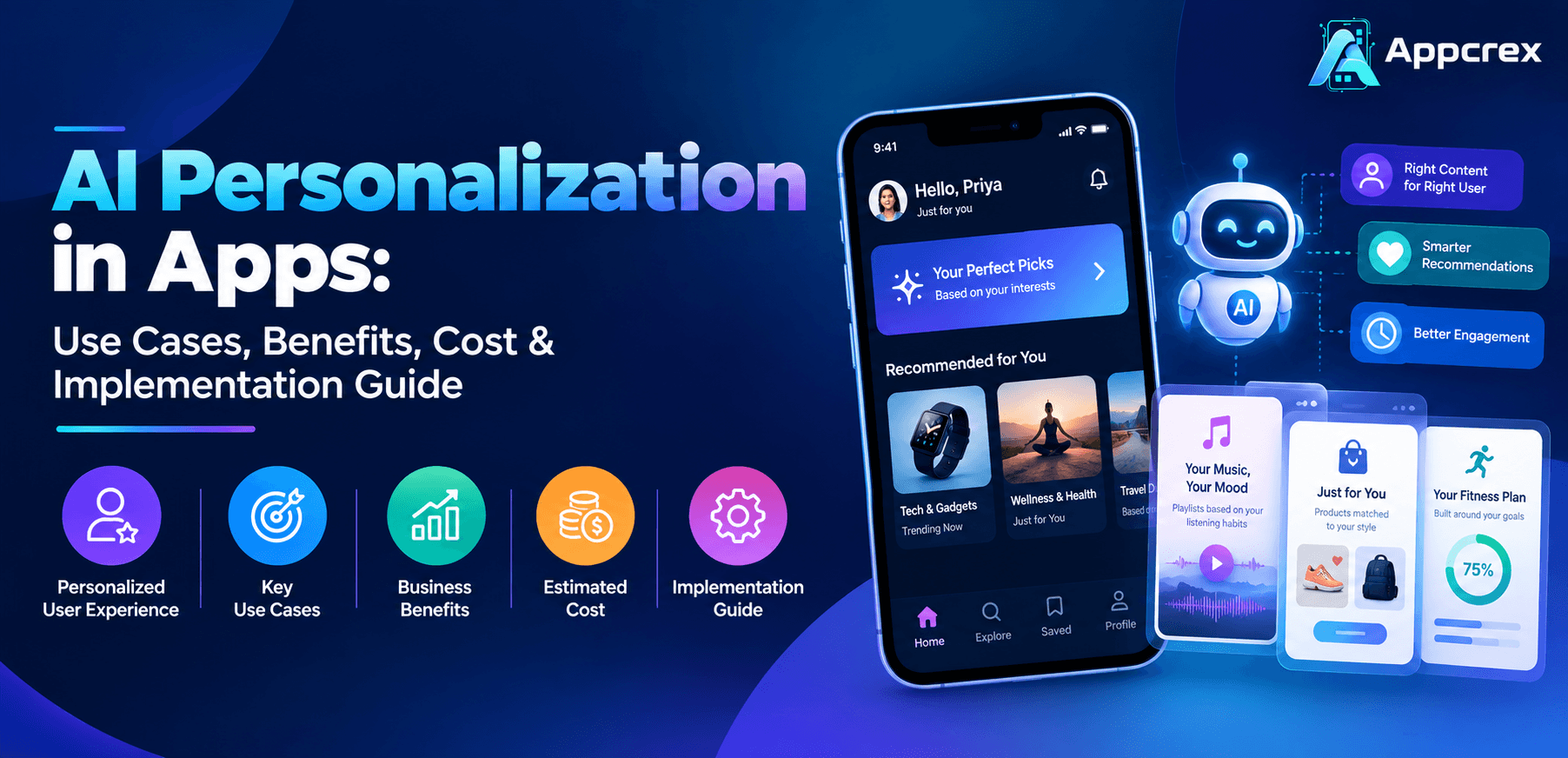
AI personalization uses artificial intelligence, machine learning, user behavior data, contextual signals, and recommendation models to create more relevant experiences for individual users. Instead of showing identical products, content, offers, or services to everyone, the app can adapt what each person sees based on their behavior and preferences.
Modern recommendation systems are being applied across e-commerce, entertainment, education, travel, fintech, healthcare, social platforms, and other digital services.
For businesses, AI personalization can become more than a user-experience feature. It can influence product discovery, engagement, retention, conversion, and customer loyalty.
This guide explains what AI personalization is, how it works, its use cases, benefits, technology architecture, implementation process, development cost, and challenges.
Just Read : AI App Development Guide: Features, Cost & Process (2026)
What Is AI Personalization in Apps?
AI personalization is the process of using artificial intelligence and machine learning to customize an application’s content, recommendations, products, services, messages, or user experience for individual users.
A traditional app might show:
“Popular Products”
An AI-powered personalized app may instead show:
“Recommended for You”
based on a user’s previous searches, purchases, browsing behavior, preferences, location, device, time of day, and other relevant signals.
For example, an e-commerce app can recommend products based on previous purchases. A streaming application can suggest movies or music. A travel app can recommend destinations based on previous searches.
The system continuously learns from user interactions and can update recommendations as user preferences change.
AI Personalization vs Traditional Personalization
Traditional personalization often depends on simple rules.
For example:
- If the user purchased running shoes, show running products.
- If the user selected English, display English content.
- If the user is located in Dubai, show Dubai-related services.
AI personalization can process many signals simultaneously and identify patterns that are difficult to define manually.
It can analyze:
- Search history
- Clicks
- Purchases
- Views
- Likes
- Skips
- Time spent
- Location
- Device
- Session behavior
- Previous interactions
- Product attributes
- Contextual information
The objective is not simply to collect more data. The objective is to use relevant data to make the app experience more useful.
Just Read : AI App Development in the UK: Use Cases, Cost, Features & Development Guide
How Does AI Personalization Work in Mobile and Web Apps?
A typical AI personalization system follows a continuous data-to-recommendation cycle.
1. Collect User Interaction Data
The application records relevant events such as:
- Products viewed
- Articles opened
- Videos watched
- Searches performed
- Purchases completed
- Items added to cart
- Content liked or skipped
- Features used
- Session duration
The type of data depends on the application.
A banking app, for example, would use different signals from a streaming app.
2. Build User Profiles
The system creates a behavioral or preference profile for each user.
This profile can include:
- Interests
- Purchase patterns
- Content preferences
- Frequently used features
- Preferred categories
- Engagement patterns
- Historical interactions
The profile can change over time as the user’s behavior changes.
3. Analyze Behavior With AI and Machine Learning
Machine learning models analyze relationships between users, content, products, services, and behaviors.
Common approaches include:
- Collaborative filtering
- Content-based filtering
- Hybrid recommendation systems
- Context-aware recommendations
- Ranking models
- Deep learning
- Predictive analytics
Hybrid systems can combine multiple approaches to improve personalization.
4. Generate Recommendations
The system produces a ranked list of products, content, services, or actions that may be relevant to the user.
For example:
User → Behavior Data → ML Model → Ranking → Personalized Results
5. Learn From New Interactions
The process does not stop after the recommendation.
If the user clicks, purchases, skips, saves, or ignores something, that interaction can become another signal.
This allows the system to continuously improve personalization.
AI Personalization Use Cases Across Industries
One of the biggest advantages of AI personalization is that it is not limited to one industry.
1. AI Personalization in E-Commerce
E-commerce is one of the most obvious use cases.
An AI-powered shopping application can personalize:
- Product recommendations
- Search results
- Home-page products
- Offers
- Discounts
- Product bundles
- Recently viewed products
- Cross-selling
- Upselling
- Shopping notifications
For example, instead of displaying the same products to every customer, the app can prioritize products based on individual browsing and purchasing behavior.
2. AI Personalization in FinTech
FinTech applications can use personalization to make financial products and information more relevant.
Potential use cases include:
- Personalized financial insights
- Product recommendations
- Investment suggestions
- Spending analysis
- Personalized alerts
- Credit-related recommendations
- Savings suggestions
- Financial education content
Financial personalization requires particularly careful handling of data, permissions, security and regulatory requirements.
3. AI Personalization in Healthcare Apps
Healthcare applications can use AI personalization to deliver more relevant experiences.
Examples include:
- Personalized health content
- Appointment reminders
- Medication reminders
- Wellness recommendations
- Patient education
- Personalized dashboards
- Health engagement programs
Healthcare applications need stronger privacy, security and compliance controls because they may process sensitive information.
AI should also be used within an appropriate clinical and regulatory framework rather than presented as a substitute for professional medical judgment.
4. AI Personalization in Travel Apps
Travel platforms can personalize the entire discovery experience.
For example, an AI-powered travel app can recommend:
- Destinations
- Hotels
- Flights
- Activities
- Restaurants
- Travel packages
- Local experiences
Recommendations can consider previous searches, budget preferences, travel dates, destinations and booking behavior.
5. AI Personalization in Education Apps
EdTech platforms can create personalized learning journeys.
An AI-powered education app can analyze:
- Course progress
- Quiz performance
- Learning speed
- Topics completed
- Mistakes
- Preferred learning formats
It can then recommend:
- Courses
- Lessons
- Practice exercises
- Revision material
- Learning paths
This allows two students using the same application to receive different learning recommendations.
6. AI Personalization in Media and Entertainment
Streaming and entertainment platforms are heavily suited to personalization.
Possible features include:
- Personalized home feeds
- Movie recommendations
- Music recommendations
- Content discovery
- Personalized playlists
- Genre recommendations
- Similar-content suggestions
- AI-generated collections
Recommendation and personalization systems are now a major application area for machine learning across digital media and entertainment.
7. AI Personalization in SaaS Applications
SaaS products can also personalize the user interface and workflows.
Examples include:
- Personalized dashboards
- Recommended features
- Smart onboarding
- Automated workflow suggestions
- Personalized reports
- Recommended integrations
- Next-best actions
For enterprise SaaS, personalization can be implemented at both the individual-user and organization level.
8. AI Personalization in Marketplaces
Marketplace applications can personalize experiences for both sides of the platform.
For buyers:
- Product recommendations
- Seller recommendations
- Search ranking
- Personalized offers
For sellers:
- Product insights
- Customer segments
- Recommended pricing actions
- Demand predictions
This can be particularly useful when a marketplace contains thousands or millions of products or services.
What Are the Benefits of AI Personalization?
AI personalization can create value for both users and businesses.
Better User Experience
Users see information that is more relevant to their interests instead of navigating through a generic interface.
Improved Product Discovery
Personalized recommendations can help users discover products, services or content they might otherwise miss.
Higher Engagement
Relevant content can encourage users to spend more time interacting with an application.
Better Conversion Opportunities
When recommendations are aligned with user intent, businesses can create more relevant purchase or subscription opportunities.
Improved Retention
An app that continuously becomes more useful to a user can create stronger reasons to return.
More Intelligent Marketing
Businesses can personalize notifications, offers, campaigns and content instead of sending identical messages to every customer.
Continuous Learning
Machine learning systems can adapt as user preferences and behavior change.
However, personalization should not be treated as an automatic guarantee of higher conversion or retention. Results depend on data quality, model design, product experience, experimentation and how recommendations are measured.
Key Components of an AI Personalization System
A production-grade AI personalization platform normally contains several interconnected components.
| Component | Purpose |
|---|---|
| User Data Layer | Collects relevant behavioral signals |
| Event Tracking | Records clicks, searches, purchases and interactions |
| User Profile | Represents preferences and behavior |
| Data Pipeline | Processes and prepares data |
| ML Models | Predict preferences and user interests |
| Recommendation Engine | Generates relevant recommendations |
| Ranking Layer | Determines the order of results |
| API Layer | Delivers recommendations to the application |
| Analytics | Measures performance |
| Admin Dashboard | Allows businesses to monitor the system |
| MLOps | Handles model monitoring, testing and retraining |
The complexity of these components depends on whether personalization is a simple feature or a core part of the product.
Also Read : DeepTech & AI App Development in Cambridge: Technologies, Use Cases, Cost & Development Guide
AI Personalization Architecture
A typical architecture can look like this:
Mobile/Web App → API → Data Collection → Data Pipeline → ML Model → Recommendation Engine → Ranking → Personalized Experience
For larger platforms, additional components may include:
- Data warehouse
- Feature store
- Model training infrastructure
- Real-time event processing
- Recommendation cache
- Experimentation platform
- Model monitoring
- Analytics dashboard
- Privacy and consent management
Real-time personalization generally requires more infrastructure than batch-based recommendations.
What AI Models Can Be Used for Personalization?
There is no single model that works for every application.
Collaborative Filtering
This approach uses relationships between users and items.
For example, if users with similar behavior liked several products, the system may recommend those products to another user with similar behavior.
Content-Based Filtering
The system recommends items based on their characteristics and the user’s previous preferences.
For example, if someone repeatedly reads articles about artificial intelligence, the application can recommend similar topics.
Hybrid Recommendation Systems
Hybrid systems combine different approaches.
They can use:
- User behavior
- Product/content attributes
- Context
- Historical interactions
- Machine learning predictions
This can be useful for applications with diverse data sources.
Context-Aware Personalization
Recommendations can also consider context such as:
- Time
- Location
- Device
- Current session
- Weather
- User intent
The right architecture depends on the application and available data rather than simply choosing the most sophisticated model.
How to Implement AI Personalization in an App?
A practical implementation process usually involves the following stages.
Step 1: Define the Personalization Objective
Start with a business problem.
For example:
- Increase product discovery
- Improve content engagement
- Reduce search time
- Improve retention
- Increase subscription conversion
Avoid starting with “we need AI” without defining what the AI needs to accomplish.
Step 2: Identify Data Sources
Determine which data can legitimately and usefully support personalization.
Possible sources include:
- App events
- CRM
- Purchase history
- Search data
- Product catalog
- Content metadata
- User preferences
Step 3: Design the Data Pipeline
The data needs to be collected, cleaned, processed and made available to the recommendation system.
Poor-quality or incomplete data can significantly affect personalization quality.
Step 4: Select the Recommendation Approach
Choose between:
- Rule-based personalization
- Collaborative filtering
- Content-based recommendation
- Hybrid models
- Deep learning
- Real-time ranking
A simple rules-plus-ML approach may be enough for an MVP.
Step 5: Develop the Recommendation Engine
The development team builds the logic responsible for generating and ranking recommendations.
Step 6: Integrate the AI Layer With the App
The recommendation engine is connected with the mobile or web application through APIs.
The interface may then display:
- Recommended for You
- Popular With You
- Because You Viewed
- Similar Products
- Continue Learning
- Suggested Services
Step 7: Test and Evaluate
Recommendations should be tested against measurable objectives.
Useful metrics can include:
- Click-through rate
- Conversion rate
- Engagement
- Retention
- Session duration
- Recommendation acceptance
- Revenue per user
Step 8: Continuously Improve the Model
Personalization is not a one-time development task.
The system should be monitored, evaluated and improved as user behavior changes.
How Much Does AI Personalization Development Cost?
The cost to develop AI personalization depends heavily on the scope.
A basic personalization feature using existing AI/ML services is significantly different from a custom recommendation platform requiring large-scale data pipelines and real-time model serving.
For global planning purposes, an indicative range can be:
| AI Personalization Project | Estimated Cost | Typical Timeline |
|---|---|---|
| Basic Personalization Feature | $15,000–$40,000 | 2–4 months |
| Custom Recommendation MVP | $40,000–$80,000 | 3–5 months |
| Advanced AI Personalization | $80,000–$150,000+ | 5–8 months |
| Enterprise Personalization Platform | $150,000–$300,000+ | 8–12+ months |
These are planning estimates rather than fixed market prices. Current 2026 industry estimates similarly show a wide range for recommendation and personalization systems, with data pipelines, integrations, model complexity and infrastructure among the major cost drivers.
What Increases AI Personalization Development Cost?
The budget can increase when the project requires:
- Large-scale behavioral data processing
- Custom ML models
- Real-time recommendations
- Advanced ranking
- Multiple recommendation algorithms
- Complex backend integrations
- CRM/ERP integration
- Large product catalogs
- Enterprise security
- Multi-tenant architecture
- On-device AI
- MLOps
- Model monitoring
- Custom analytics
- High availability infrastructure
One important consideration is that the AI build is not the entire cost. Hosting, inference, data processing, monitoring, model improvement and maintenance can create ongoing operational expenses after launch.
How Long Does It Take to Build AI Personalization?
A simple recommendation feature may be developed in a few months.
A more advanced platform can require significantly longer.
Basic Personalization
2–4 months
Suitable for:
- Basic recommendations
- Existing AI APIs
- Limited data
- Simple user profiles
Custom Recommendation MVP
3–5 months
Can include:
- User behavior tracking
- Recommendation engine
- Analytics
- Personalized feeds
- Admin controls
Advanced Platform
5–8 months
May include:
- Multiple ML models
- Real-time personalization
- Advanced ranking
- Large datasets
- Experimentation
- MLOps
Enterprise Platform
8–12+ months
May require:
- Enterprise integrations
- High-scale infrastructure
- Advanced security
- Governance
- Multi-region deployment
- Continuous model monitoring
AI Personalization for Mobile Apps
AI personalization can be integrated into both Android and iOS applications.
A business can choose:
Native App Development
Native Android and iOS applications provide platform-specific control and performance.
React Native
React Native app development can be used when a business wants to develop Android and iOS applications with a shared codebase while connecting them to an AI personalization backend.
Flutter
Flutter is another cross-platform option for applications requiring personalized feeds, recommendations and AI-powered features across multiple platforms.
The AI recommendation engine itself can remain backend-based while Android, iOS, web or other clients consume personalized results through APIs.
Privacy and Security in AI Personalization
Personalization depends on user information, which makes privacy an important part of the architecture.
Businesses should consider:
- Consent management
- Data minimization
- Encryption
- Access controls
- Secure APIs
- Data retention policies
- User controls
- Audit logging
- Anonymization where appropriate
The personalization-versus-privacy tension is an active area of research, with transparency and user control increasingly important when AI systems use personal data.
For global products, privacy requirements can also vary by market and type of data being processed. Legal and compliance requirements should therefore be reviewed for the jurisdictions in which the application operates.
Challenges of AI Personalization
Building a recommendation system is not simply about connecting an AI model to an application.
Cold-Start Problem
A new user has little or no behavioral history.
The system therefore needs alternative signals such as:
- Selected interests
- Popular content
- Demographics where appropriate and lawful
- Context
- Initial onboarding preferences
Poor Data Quality
Incomplete or inaccurate data can result in poor recommendations.
Recommendation Bias
If the model repeatedly recommends the same type of content, users may see less variety.
Privacy Concerns
Collecting too much personal information can create security, regulatory and trust issues.
Model Drift
User preferences and product catalogs change, so models may need ongoing evaluation and retraining.
Infrastructure Costs
Real-time personalization at large scale requires appropriate data processing, model serving, storage and monitoring infrastructure.
How Businesses Can Get Better Results From AI Personalization?
Successful personalization starts with the product strategy, not the AI model.
A practical approach is to:
- Start with one high-value use case.
- Collect only relevant data.
- Build reliable event tracking.
- Launch a measurable MVP.
- Compare personalized and non-personalized experiences.
- Monitor recommendation quality.
- Gradually introduce more advanced models.
- Give users meaningful control over their experience.
For many businesses, a simpler recommendation system that works reliably can create more value than an unnecessarily complex AI architecture.
Future of AI Personalization in Apps
The next generation of personalization is moving beyond simple product or content recommendations.
Emerging directions include:
- Real-time personalization
- Generative AI recommendations
- Conversational personalization
- AI-powered search
- Context-aware experiences
- Predictive personalization
- On-device AI
- Personalized AI assistants
- Dynamic user interfaces
- Multimodal personalization
The broader direction is toward applications that adapt dynamically to user intent rather than simply displaying a fixed set of recommendations.
However, more advanced personalization also makes responsible data use, transparency and user control increasingly important.
FAQs
Q. What is AI personalization in an app?
AI personalization uses artificial intelligence and machine learning to customize content, recommendations, products, services or experiences based on user behavior, preferences and context.
Q. How does AI personalization work?
It typically collects relevant interaction data, builds user profiles, analyzes patterns using machine learning models, generates recommendations and learns from new user interactions.
Q. How much does AI personalization development cost?
A basic personalization feature may start around $15,000–$40,000, while advanced custom systems can cost $80,000–$150,000+ and enterprise platforms can exceed $150,000. Actual pricing depends on data, integrations, AI architecture, scale and security requirements.
Q. Can AI personalization be added to an existing mobile app?
Yes. An AI personalization engine can be integrated into an existing Android, iOS, React Native, Flutter or web application through APIs and backend services.
Q. Which industries use AI personalization?
Common applications include e-commerce, fintech, healthcare, travel, education, SaaS, marketplaces, media, entertainment and social platforms.
Q. Do I need a custom AI model for personalization?
Not necessarily. An MVP may use existing machine learning services or simpler recommendation approaches. A custom model becomes more relevant when the application has sufficient data and requires advanced personalization or large-scale optimization.
Q. What is the difference between AI personalization and an AI recommendation engine?
An AI recommendation engine is usually a component that selects and ranks relevant items. AI personalization is broader and can include recommendations, personalized search, content feeds, notifications, offers, interfaces and user journeys.
Q. Can AI personalization work in real time?
Yes. Real-time personalization can update recommendations based on current session behavior, searches, clicks and other signals. It generally requires more advanced data pipelines and infrastructure.
Conclusion
AI personalization is becoming an important capability for applications that want to deliver more relevant and adaptive user experiences.
Instead of showing identical content, products or services to every user, businesses can use behavioral data, machine learning and contextual signals to create experiences that evolve with individual users.
The right approach does not necessarily mean building the most complicated AI system. A successful implementation starts with a clearly defined business objective, reliable data, an appropriate recommendation strategy, strong backend architecture and measurable outcomes.
Whether you are building an e-commerce marketplace, fintech platform, healthcare application, travel product, SaaS platform or entertainment app, AI personalization can be designed around the specific needs of your users and business.
Build an AI-Personalized App With AppCrex
AppCrex helps businesses develop AI-powered mobile and web applications, including personalized experiences, recommendation engines, machine learning integrations, AI-powered search, intelligent automation and custom backend systems.
If you are planning to add AI personalization to an existing application or build a new AI-powered product from scratch, our team can help with strategy, UI/UX, AI architecture, development, integrations, testing and deployment.
Talk to AppCrex about your AI personalization project and get a custom development estimate.