Introduction
The healthcare industry is becoming increasingly digital, and medicine delivery is one of the areas where mobile technology can make everyday healthcare more convenient. Customers can now search for medicines, upload prescriptions, choose a pharmacy, make payments, and track deliveries without visiting a physical store.
This has created a growing opportunity for pharmacies, healthcare startups, pharmacy chains, and entrepreneurs to build an on-demand medicine delivery app.
However, developing a medicine delivery platform is more complex than building a standard ecommerce or food delivery application. The product may need prescription management, pharmacy verification, inventory synchronization, secure payments, delivery tracking, healthcare integrations, data security, and HIPAA compliance considerations depending on the business model.
For businesses targeting the United States, the platform may also need to account for pharmacy licensing, prescription requirements, state-specific considerations, healthcare data protection, and secure handling of sensitive information.
In this guide, we explain how to develop an on-demand medicine delivery app, including its business models, features, development process, technology stack, integrations, security requirements, HIPAA compliance, development cost, timeline, and future opportunities.
What Is an On-Demand Medicine Delivery App?
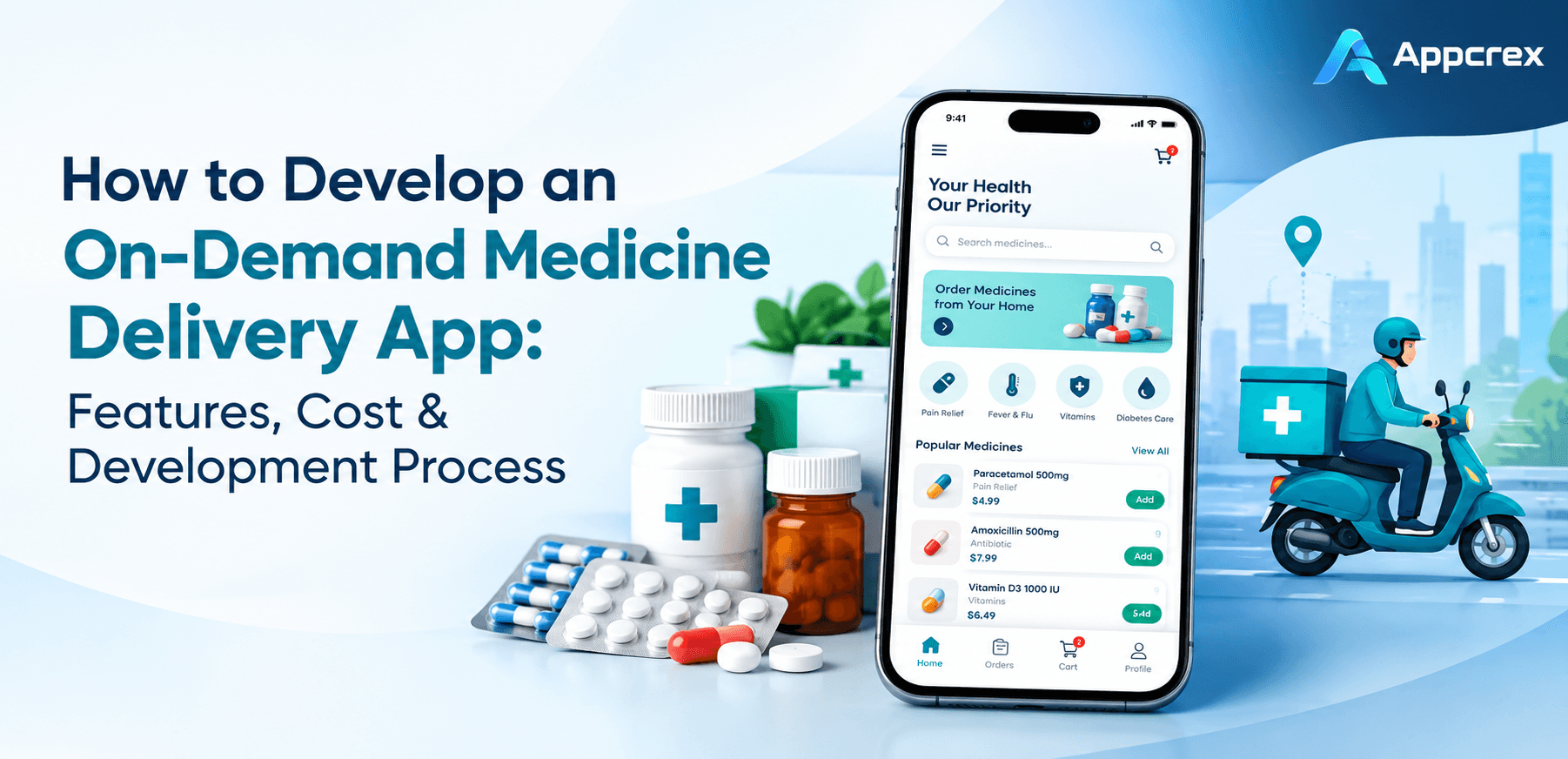
An on-demand medicine delivery app is a digital platform that allows customers to find medicines and healthcare products, upload prescriptions when required, place orders, make payments, and receive products at their preferred location.
Depending on the business model, the platform may connect:
- Customers
- Pharmacies
- Pharmacists
- Doctors or healthcare providers
- Delivery partners
- Administrators
A basic medicine delivery application may offer medicine search, prescription upload, cart, payment, and delivery tracking.
A more advanced platform can support multiple pharmacies, real-time inventory, pharmacist verification, recurring prescriptions, telemedicine integration, AI-powered search, prescription OCR, analytics, and enterprise healthcare integrations.
This is why businesses often work with an experienced on-demand app development company rather than treating the product as a simple ecommerce application.
Why Build an On-Demand Medicine Delivery App?
Medicine delivery apps can create value for several participants in the healthcare ecosystem.
For Customers
Customers can:
- Search medicines online
- Upload prescriptions
- Compare available products
- Order medicines
- Schedule deliveries
- Track orders
- Reorder frequently used medicines
For Pharmacies
Pharmacies can use the platform to:
- Receive digital orders
- Manage inventory
- Process prescriptions
- Manage customers
- Coordinate deliveries
- Analyze sales
For Healthcare Businesses
Healthcare companies can connect medicine fulfillment with broader digital services such as:
- Telemedicine
- Digital prescriptions
- Patient management
- Healthcare CRM
- Appointment booking
- Remote consultations
This means medicine delivery can become part of a larger healthcare app development ecosystem.
Medicine Delivery App Business Models
Before development begins, you need to select the right business model.
Your business model directly influences the application’s features, architecture, number of dashboards, integrations, and overall development cost.
1. Single-Pharmacy App
A pharmacy or pharmacy chain can build its own branded medicine delivery application.
The pharmacy manages:
- Products
- Inventory
- Pricing
- Orders
- Prescriptions
- Customers
- Delivery
This model is generally simpler than a multi-vendor marketplace.
2. Multi-Pharmacy Marketplace
A multi-pharmacy platform connects customers with multiple pharmacies.
Each pharmacy can have its own dashboard to manage:
- Medicine catalog
- Inventory
- Orders
- Pricing
- Prescription verification
- Delivery
- Revenue
The platform owner can earn through commissions, subscriptions, transaction fees, or other monetization models.
3. Hyperlocal Medicine Delivery App
A hyperlocal model focuses on pharmacies and customers within a particular geographic area.
For example, a startup could launch in:
- New York
- Los Angeles
- Chicago
- Houston
- Dallas
- San Francisco
- Boston
- Seattle
- Miami
After validating the business model in one market, the company can expand into additional cities.
4. Hybrid Model
A hybrid platform combines company-owned inventory with third-party pharmacies.
This provides more flexibility but also requires more complex inventory synchronization, pharmacy management, order routing, and fulfillment logic.
How Does an On-Demand Medicine Delivery App Work?
A typical customer journey looks like this:
Search Medicine → Select Product → Upload Prescription if Required → Pharmacy Verification → Payment → Order Processing → Delivery Assignment → Live Tracking → Delivery
If the application is integrated with telemedicine app development, the workflow can become:
Doctor Consultation → Digital Prescription → Pharmacy Selection → Medicine Order → Payment → Delivery Tracking
This creates a connected healthcare experience where consultation and medicine fulfillment can happen through one digital ecosystem.
Essential Features of an On-Demand Medicine Delivery App
A complete medicine delivery platform usually contains multiple applications and dashboards.
Customer App Features
The customer application should make it easy to search, order, pay, and track medicines.
User Registration and Login
Customers should be able to create accounts using:
- Phone number
- OTP
- Password
- Social login where appropriate
Medicine Search
Search should support:
- Medicine names
- Brand names
- Generic names
- Categories
- Product types
Advanced search can use AI to understand spelling variations and natural-language queries.
Medicine Details
Each medicine page can include:
- Product name
- Manufacturer
- Description
- Dosage information where appropriate
- Price
- Availability
- Prescription requirement
- Related products
Prescription Upload
Customers can upload prescriptions using:
- Camera
- Image upload
- Document upload
The pharmacy or authorized staff can then review the prescription.
Shopping Cart
Customers can add multiple eligible products to a cart and review:
- Product price
- Quantity
- Delivery fee
- Discounts
- Taxes
- Final amount
Secure Payments
The app can support suitable payment methods such as:
- Credit/debit cards
- Digital wallets
- Other supported payment methods
Order Tracking
Customers should be able to see:
- Order confirmed
- Prescription verified
- Order prepared
- Picked up
- Out for delivery
- Delivered
Reorder
Customers can quickly reorder frequently purchased medicines where appropriate.
Notifications
Push notifications, SMS, or email can provide updates about:
- Order confirmation
- Prescription status
- Payment
- Delivery
- Refill reminders
Pharmacy Dashboard
The pharmacy dashboard is essential for managing daily operations.
Features can include:
- Pharmacy registration
- License information
- Product management
- Inventory management
- Pricing
- Prescription verification
- Order management
- Customer management
- Delivery management
- Sales analytics
- Revenue reports
- Staff accounts
For a multi-vendor marketplace, every pharmacy can receive its own secure account.
Delivery Partner App
The delivery app can provide:
- Delivery partner registration
- Identity verification
- Availability status
- Assigned orders
- Pickup location
- Customer address
- Navigation
- Delivery status
- Proof of delivery
- Earnings
- Delivery history
GPS and mapping APIs can support real-time location tracking and route planning.
Admin Panel
The admin panel gives the platform owner centralized control.
It can include:
- Customer management
- Pharmacy management
- Delivery partner management
- Product management
- Prescription monitoring
- Order management
- Payments
- Commissions
- Promotions
- Reports
- Analytics
- Notifications
- Support management
- Content management
- User roles and permissions
For enterprise healthcare app development, the admin panel can also include advanced audit logs, reporting, security controls, and integration monitoring.
Prescription Management and Verification
Prescription handling is one of the most important differences between a medicine delivery application and a standard ecommerce platform.
A typical workflow can be:
- Customer selects a prescription medicine.
- App requests a prescription.
- Customer uploads the document.
- Authorized pharmacy staff reviews it.
- The prescription is approved, rejected, or sent for clarification.
- The pharmacy processes the order.
- The delivery workflow begins.
OCR can be used to extract information from prescription images and reduce manual data entry.
However, automated OCR or AI should support the workflow rather than automatically replacing required professional verification.
Advanced Features for Medicine Delivery Apps
Once the MVP is validated, businesses can introduce more advanced capabilities.
AI-Powered Medicine Search
AI can understand:
- Spelling variations
- Generic names
- Brand names
- Categories
- Natural-language searches
Prescription OCR
OCR can extract relevant information from prescription documents and send it to the appropriate verification workflow.
Medicine Refill Reminders
Customers can receive reminders when it may be time to reorder regularly used medicines.
AI Customer Support
An AI assistant can help customers with:
- Order status
- Delivery information
- Product availability
- App navigation
- Frequently asked questions
Clinical or professional healthcare questions should be handled through appropriate healthcare professionals or approved workflows.
Inventory Forecasting
AI and analytics can help pharmacies understand demand patterns and plan inventory.
Route Optimization
Delivery systems can analyze location and delivery information to improve routing and estimated delivery times.
Subscription and Recurring Orders
For eligible products and business models, customers can manage recurring orders or subscription plans.
Telemedicine App Development Integration
A medicine delivery platform can become much more valuable when integrated with telemedicine app development.
Instead of making customers use separate services, a healthcare platform can provide:
Consultation → Prescription → Pharmacy → Payment → Delivery
For example, a customer could:
- Book a virtual consultation.
- Speak with a healthcare professional.
- Receive a digital prescription where appropriate.
- Send the prescription to a pharmacy.
- Select available medicine.
- Pay through the app.
- Track delivery.
This approach allows businesses to combine telemedicine app development, healthcare app development, and medicine delivery into one broader digital healthcare platform.
HIPAA Compliance for Medicine Delivery Apps
HIPAA compliance is an important consideration for U.S. healthcare applications, but it should not be treated as a generic checkbox.
Whether HIPAA applies depends on the application’s role, the data it handles, and its relationship with covered entities or business associates.
For example, an app developed for or provided on behalf of a covered healthcare entity may have business-associate responsibilities if it creates, receives, maintains, or transmits protected health information on that entity’s behalf.
Therefore, businesses should evaluate the application’s data flows and relationships before development begins.
Important HIPAA-Oriented Technical Considerations
Data Encryption
Sensitive information should be protected during transmission and stored securely.
Role-Based Access Control
Users should only have access to information required for their specific responsibilities.
Secure Authentication
Use appropriate authentication, session management, password controls, and MFA where required.
Audit Logs
Important activities involving sensitive information should be recorded for monitoring and security investigations.
Secure APIs
APIs connecting pharmacies, healthcare systems, payment services, telemedicine platforms, and other systems should be protected.
Data Minimization
Collect and retain only the information required for the intended workflow.
Privacy-Aware Analytics
Analytics and tracking should be carefully evaluated when healthcare or sensitive information is involved.
A development partner should therefore consider HIPAA compliance requirements during architecture, database design, APIs, cloud infrastructure, authentication, and testing, rather than adding them immediately before launch.
Also Read : How Does a Medicine Delivery App Work?
Healthcare App Development and Medicine Delivery
Medicine delivery can be developed as a standalone application or as part of a larger healthcare app development ecosystem.
A broader healthcare platform could combine:
- Doctor appointments
- Telemedicine
- Digital prescriptions
- Medicine delivery
- Patient profiles
- Health records
- Lab booking
- Pharmacy services
- Health reminders
- AI-powered assistance
This creates more opportunities for healthcare businesses that want to build a comprehensive digital health platform.
Integrations Required for Medicine Delivery App Development
Depending on the business model, the platform may need several third-party integrations.
| Integration | Purpose |
|---|---|
| Payment Gateway | Secure online payments |
| Maps API | Location and navigation |
| GPS | Delivery tracking |
| SMS/Email | OTP and transactional communication |
| Push Notifications | Order updates |
| OCR | Prescription processing |
| Pharmacy/POS APIs | Inventory synchronization |
| Healthcare APIs | Healthcare data exchange |
| Telemedicine APIs | Virtual consultations |
| Cloud Services | Storage and scalable infrastructure |
| Analytics | Business and operational insights |
| Customer Support | Chat and support management |
Technology Stack for Medicine Delivery App Development
A typical technology stack can include:
Mobile Development
- Flutter
- React Native
- Swift
- Kotlin
Backend
- Node.js
- Python
- Java
- .NET
Database
- PostgreSQL
- MySQL
- MongoDB
Cloud
- AWS
- Microsoft Azure
- Google Cloud
API Architecture
- REST
- GraphQL
AI and Automation
- OCR
- NLP
- Machine Learning
- Computer Vision
- Recommendation systems
The final technology stack should depend on the project’s scale, integrations, security requirements, expected traffic, and long-term roadmap.
How to Develop an On-Demand Medicine Delivery App?
Step 1: Define the Business Model
Decide whether you want:
- Single-pharmacy application
- Multi-pharmacy marketplace
- Hyperlocal medicine delivery
- Hybrid platform
This decision affects the entire technical architecture.
Step 2: Define User Roles
Identify all users:
- Customers
- Pharmacies
- Pharmacists
- Delivery partners
- Administrators
- Healthcare professionals, if telemedicine is included
Step 3: Define the MVP
A practical MVP can include:
- Customer registration
- Medicine search
- Prescription upload
- Cart
- Checkout
- Payment
- Pharmacy dashboard
- Delivery management
- Order tracking
- Admin panel
Advanced AI, telemedicine, analytics, and enterprise integrations can be introduced later.
Step 4: Create UI/UX Design
Design separate experiences for:
- Customers
- Pharmacies
- Delivery partners
- Admins
The customer journey should remain simple, especially around prescription upload, checkout, and delivery tracking.
Step 5: Develop the Backend
The backend handles:
- Users
- Products
- Pharmacies
- Inventory
- Prescriptions
- Orders
- Payments
- Delivery
- Notifications
- Integrations
Step 6: Build Mobile Applications
Depending on the project, develop:
- Customer app
- Pharmacy app
- Delivery app
The business can choose native or cross-platform development depending on its requirements.
Step 7: Integrate APIs and Third-Party Services
Connect:
- Payment services
- Maps
- Notifications
- OCR
- Pharmacy systems
- Healthcare systems
- Telemedicine
- Analytics
Step 8: Security and Compliance Testing
Test:
- Authentication
- Authorization
- APIs
- Data protection
- Access controls
- Application performance
- Infrastructure security
If HIPAA applies to the business model, the relevant requirements should be evaluated as part of the overall compliance program.
Step 9: Launch and Scale
A startup can launch in one city or service area, monitor performance, improve the application, and then expand.
How Much Does It Cost to Develop an On-Demand Medicine Delivery App?
The question “How much does it cost to develop an on-demand medicine delivery app?” does not have one fixed answer.
The final cost depends on:
- Number of platforms
- Number of applications
- Pharmacy dashboard
- Delivery app
- Admin panel
- Prescription management
- Payment integrations
- Pharmacy/POS integrations
- Telemedicine
- Healthcare APIs
- AI and OCR
- Real-time tracking
- Security
- Compliance requirements
- Geographic coverage
For a USA-focused project, the following ranges can be used for initial planning:
| App Type | Estimated Cost | Development Timeline |
|---|---|---|
| Basic MVP | $25,000–$45,000 | 3–5 months |
| Standard Medicine Delivery App | $45,000–$80,000 | 5–8 months |
| Advanced Multi-Pharmacy Platform | $80,000–$150,000+ | 8–12 months |
| Enterprise Healthcare Platform | $150,000–$300,000+ | 12–18+ months |
These are indicative estimates. A single-pharmacy MVP and a nationwide multi-pharmacy healthcare platform should not be expected to have the same budget.
Medicine Delivery App Development Cost Breakdown
A typical budget can be distributed across several areas:
| Development Area | Approximate Impact |
|---|---|
| Discovery & Planning | 5–10% |
| UI/UX Design | 10–15% |
| Mobile Development | 20–30% |
| Backend Development | 20–25% |
| Pharmacy & Admin Panels | 10–20% |
| Integrations | 5–15% |
| Testing & Security | 10–15% |
| Deployment | 3–5% |
The exact percentage changes according to the project’s architecture.
What Increases the Cost of Medicine Delivery App Development?
Multiple Platforms
Building separate native iOS and Android applications can increase development effort.
Multiple User Panels
A complete platform may require:
- Customer app
- Pharmacy dashboard
- Delivery app
- Admin panel
- Doctor/healthcare interface
Telemedicine
Adding doctor consultations, scheduling, video calling, digital prescriptions, and healthcare workflows increases complexity.
AI and OCR
AI-based prescription processing, intelligent search, recommendations, and analytics require additional development and testing.
Multi-Pharmacy Architecture
A marketplace needs vendor management, inventory synchronization, commissions, pharmacy onboarding, and additional administrative functionality.
Healthcare Integrations
EHR, pharmacy, telemedicine, and healthcare APIs can increase both development and testing requirements.
Security and Compliance
Security architecture, audits, access control, encryption, monitoring, and applicable compliance requirements can increase project effort.
How to Reduce Medicine Delivery App Development Cost?
Reducing cost should focus on controlling scope rather than removing important security or healthcare functionality.
Start With an MVP
Build only the features required to validate the business.
Launch in One Location
Start in one city before expanding nationwide.
Use Cross-Platform Development
Flutter or React Native may reduce duplicated development effort when appropriate.
Use Third-Party Integrations
Payments, maps, notifications, and other infrastructure can often be integrated instead of built from scratch.
Add AI in Later Phases
AI can be introduced after the core medicine delivery workflow has been validated.
Medicine Delivery App Monetization Models
Pharmacy Commission
Charge pharmacies a percentage of completed orders.
Delivery Fee
Charge customers based on delivery distance, speed, or service type.
Subscription
Offer premium customer plans with benefits such as discounted delivery or recurring-order functionality.
Pharmacy Subscription
Pharmacies can pay monthly or annually for advanced platform capabilities.
Featured Listings
Eligible pharmacies or healthcare businesses can pay for promotional visibility where appropriate.
Enterprise Licensing
The platform can be licensed to pharmacy chains, healthcare organizations, or other enterprises.
Medicine Delivery App Development in the USA
For businesses targeting the United States, the development strategy should consider the operational and regulatory environment of the target market.
Potential launch locations include:
- New York
- Los Angeles
- Chicago
- Houston
- Dallas
- San Francisco
- Boston
- Seattle
- Miami
- Washington, D.C.
Instead of launching nationwide immediately, a startup may choose a focused geographic launch and expand after validating pharmacy partnerships, customer demand, delivery operations, and product-market fit.
A U.S.-focused medicine delivery app development company should also be prepared to discuss:
- Pharmacy workflows
- Prescription management
- State-specific considerations
- Healthcare data security
- HIPAA applicability
- Payment systems
- Delivery logistics
- Healthcare integrations
- Telemedicine
Challenges in Developing a Medicine Delivery App
Prescription Verification
Prescription workflows need appropriate review and authorization.
Pharmacy Licensing
Businesses need to understand the applicable licensing requirements for the jurisdictions in which they operate.
Healthcare Data Security
Sensitive healthcare information requires careful handling, access controls, and security architecture.
Inventory Accuracy
Incorrect stock information can result in failed orders and poor customer experiences.
Delivery Operations
Medicine delivery may involve geographic, timing, packaging, or product-specific requirements.
Customer Trust
Customers need confidence in the pharmacy, prescription handling, payment security, product information, and delivery process.
Future of On-Demand Medicine Delivery Apps
The future of medicine delivery will likely involve greater integration with the broader digital healthcare ecosystem.
Potential features include:
- AI-powered medicine search
- Prescription OCR
- Automated refill reminders
- Predictive inventory management
- Voice-based search
- AI customer support
- Telemedicine
- Digital prescriptions
- Healthcare API integrations
- Personalized experiences
- Intelligent delivery routing
- Advanced healthcare analytics
Instead of operating as a standalone delivery service, future platforms can combine healthcare app development, telemedicine app development, pharmacy management, and on-demand delivery into one ecosystem.
Why Choose an On-Demand App Development Company?
An on-demand medicine delivery platform combines several technical systems:
Mobile Apps + Backend + Pharmacy Management + Healthcare APIs + Payments + GPS + Delivery + Security + Analytics
An experienced on-demand app development company can help define the business model, architecture, MVP, integrations, security strategy, and scaling roadmap.
For healthcare businesses, it is also useful to choose a team with experience in:
- Healthcare app development
- Telemedicine app development
- Pharmacy app development
- HIPAA-oriented architecture
- AI integration
- API development
- Cloud infrastructure
- iOS development
- Android development
- Enterprise software
This becomes especially important when the goal is to scale from a local pharmacy application into a multi-city or nationwide healthcare platform.
FAQs
Q. How much does it cost to develop an on-demand medicine delivery app?
A basic medicine delivery MVP can cost approximately $25,000–$45,000. A standard platform may cost $45,000–$80,000, while advanced multi-pharmacy platforms can reach $80,000–$150,000+. Enterprise healthcare platforms may require $150,000–$300,000+, depending on features, integrations, security, compliance, and scale.
Q. How long does it take to develop a medicine delivery app?
A basic MVP can take around 3–5 months. A standard application may take 5–8 months, while an advanced multi-pharmacy platform can require 8–12 months or more.
Q. What features should a medicine delivery app have?
Core features include medicine search, product details, prescription upload, pharmacy management, inventory, cart, payment, delivery tracking, notifications, customer support, and an admin panel.
Q. Can I integrate telemedicine into a medicine delivery app?
Yes. Telemedicine app development can be integrated so customers can consult healthcare professionals, receive prescriptions where appropriate, and then continue to pharmacy fulfillment and medicine delivery.
Q. Does HIPAA apply to medicine delivery apps?
HIPAA applicability depends on the app’s function, the data it handles, and its relationship with covered entities or business associates. Businesses should evaluate these requirements before development and launch.
Q. What is a HIPAA-compliant healthcare app?
A HIPAA-compliant healthcare app is designed and operated with the applicable HIPAA Privacy, Security, and Breach Notification requirements in mind when those rules apply. Compliance involves more than encryption and should be evaluated across data handling, access, security, policies, and business relationships.
Q. Can AI be used in a medicine delivery app?
Yes. AI can be used for prescription OCR, medicine search, customer support, inventory forecasting, refill reminders, analytics, and delivery optimization.
Q. Can I build a multi-pharmacy medicine delivery platform?
Yes. A multi-vendor architecture can allow multiple pharmacies to manage their products, inventory, prescriptions, orders, and deliveries through separate dashboards.
Q. Can I launch a medicine delivery app in the USA?
Yes, but the business should evaluate pharmacy licensing, prescription requirements, state-specific requirements, healthcare data protection, HIPAA applicability, and other applicable obligations before launch.
Q. What is the difference between a medicine delivery app and a telemedicine app?
A medicine delivery app focuses primarily on pharmacy ordering and fulfillment. A telemedicine app focuses on remote healthcare consultations. They can also be combined into a broader digital healthcare platform.
Conclusion
Developing an on-demand medicine delivery app can help pharmacies, healthcare startups, and entrepreneurs create a convenient digital channel for medicine fulfillment.
But a successful platform requires much more than a product catalog and checkout system. It needs pharmacy management, prescription workflows, inventory, secure payments, delivery operations, customer support, data security, and scalable backend infrastructure.
For the U.S. market, businesses should also consider pharmacy licensing, prescription requirements, healthcare data protection, and the applicability of HIPAA based on the platform’s specific business relationships and data flows.
Adding telemedicine app development can further expand the platform by connecting consultations, prescriptions, pharmacy fulfillment, and delivery into one digital healthcare journey.
From a development perspective, starting with a focused MVP can help control the initial medicine delivery app development cost while leaving room for future features such as AI, OCR, multi-pharmacy support, healthcare integrations, advanced analytics, and nationwide delivery.
Build Your On-Demand Medicine Delivery App With AppCrex
Looking to develop an on-demand medicine delivery app in the USA?
AppCrex can help you build customer applications, pharmacy dashboards, delivery apps, admin panels, healthcare integrations, telemedicine functionality, AI-powered features, secure APIs, and scalable backend infrastructure.
Whether you need a single-pharmacy MVP, multi-vendor medicine marketplace, pharmacy delivery platform, or complete digital healthcare ecosystem, AppCrex can help transform your idea into a scalable application.
Talk to AppCrex about your on-demand medicine delivery app development project today.