📌 Key Takeaways
- On-demand grocery apps connect customers, stores, shoppers, and delivery operations.
- Real-time inventory and substitutions are especially important for grocery platforms.
- Customer, store, driver, and admin systems usually work together.
- AI can improve recommendations, forecasting, search, and delivery operations.
- A focused MVP can be launched first and expanded into multiple US cities later.
Introduction
Grocery shopping has changed significantly with the growth of mobile commerce and on-demand delivery. Instead of driving to a supermarket, walking through multiple aisles, waiting at checkout, and carrying bags home, customers can now select groceries through an app and have them delivered to their doorstep.
But what happens behind the scenes after a customer taps “Place Order”?
An on-demand grocery app connects customers, grocery stores, shoppers or delivery drivers, payment systems, inventory, and an administration platform. Every part needs to communicate properly for the order to move from a customer’s phone to their doorstep.
For businesses planning to enter this market, understanding how these apps work is important before investing in grocery app development.
In the USA, platforms such as Instacart and DoorDash demonstrate different versions of this model. Instacart connects customers with retailers and personal shoppers, while DoorDash offers grocery delivery and pickup from participating stores.
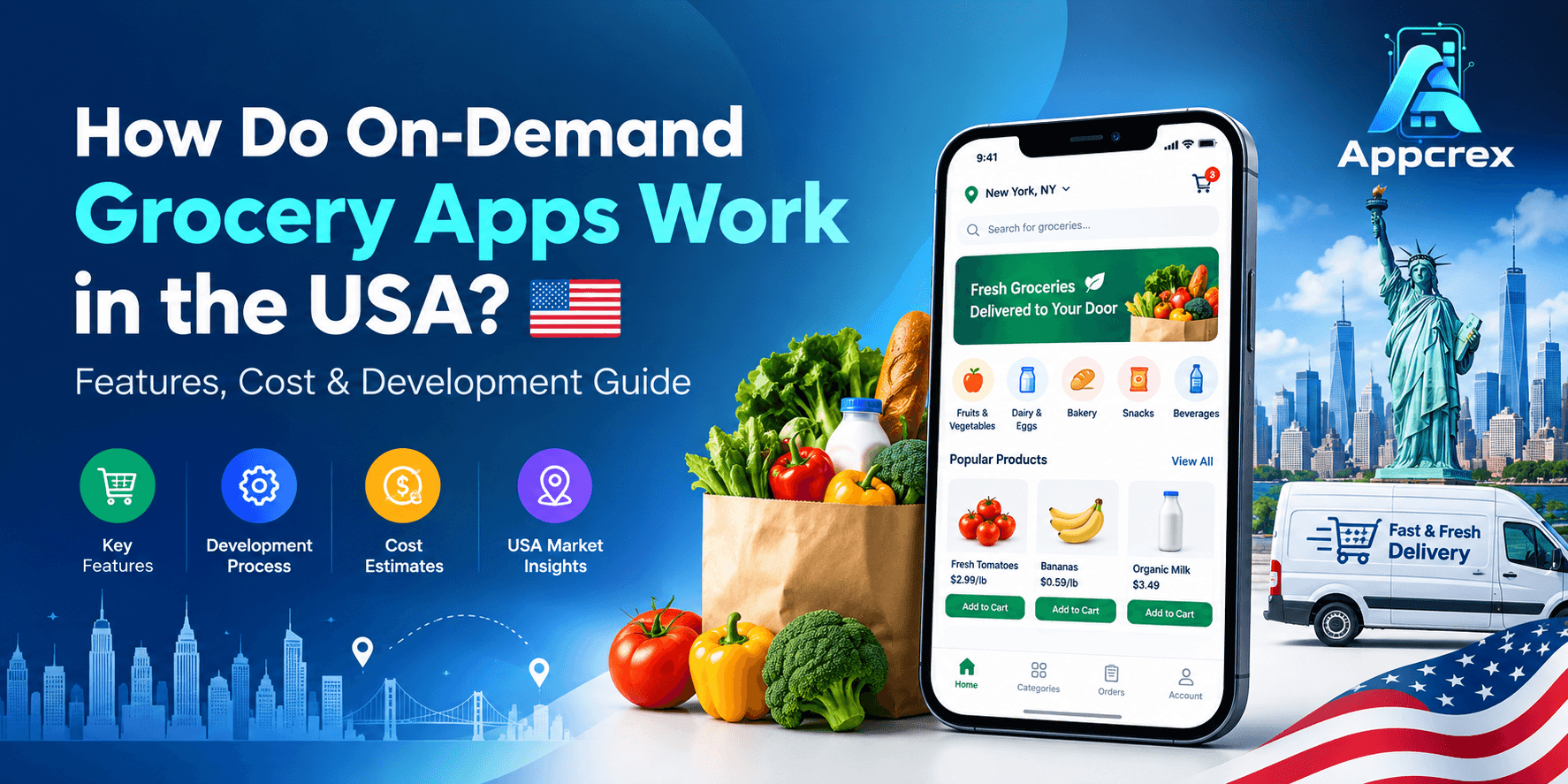
This guide explains how on-demand grocery apps work, what happens after an order is placed, the technology behind them, important features, development costs, and how businesses can build their own grocery delivery platform.
What Is an On-Demand Grocery App?
An on-demand grocery app is a mobile or web-based platform that allows customers to order groceries and everyday essentials from participating stores and receive them through delivery or pickup.
The basic process looks like this:
Customer → Grocery App → Store/Shopper → Order Processing → Delivery → Customer
Depending on the business model, the store may prepare the order itself, a personal shopper may pick the products from the store, or a delivery partner may handle the final-mile delivery.
For example, Instacart’s model connects customers with personal shoppers who pick products from participating retailers and deliver them. Customers can also choose pickup at supported locations.
DoorDash also supports grocery delivery and pickup through participating grocery stores and retailers.
Just Read : Milk Delivery App Development Company: Complete Guide to Features, Cost & Development Process
How Does an On-Demand Grocery App Work?
The complete process can be divided into several stages.
1. Customer Opens the App
The process starts when a customer opens the grocery application.
The app may use the customer’s location to identify:
- Nearby grocery stores
- Available products
- Delivery areas
- Delivery times
- Store-specific pricing
- Promotions
- Pickup options
Location is particularly important because grocery availability and delivery times can vary by store and service area.
2. Customer Selects a Grocery Store
Depending on the platform, customers may see one store, multiple stores, local supermarkets, specialty stores, or a marketplace containing different retailers.
A large grocery marketplace can allow customers to browse different retailers from the same application.
This is one of the ways a grocery app differs from a simple grocery store ordering application.
3. Customer Searches for Products
The customer searches or browses for products such as:
- Fruits and vegetables
- Dairy products
- Meat and seafood
- Bakery products
- Frozen foods
- Beverages
- Snacks
- Household products
- Personal care products
- Pet supplies
Modern grocery applications can provide filters, recommendations, categories, search suggestions, and personalized results.
Instacart, for example, allows customers to search for individual products or browse by department before adding items to their cart.
4. Products Are Added to the Cart
Once customers find what they need, they add products to the shopping cart.
The cart generally shows:
- Product name
- Quantity
- Price
- Discounts
- Estimated taxes
- Delivery charges
- Service fees
- Total amount
Customers can update quantities or remove products before checkout.
5. Customer Selects Substitution Preferences
Grocery delivery has one challenge that normal e-commerce does not always face: products can be unavailable when the shopper reaches the store.
For example, a customer may order a particular brand of milk, but that product may be out of stock.
The app can allow customers to:
- Select a replacement
- Allow the shopper to choose a replacement
- Reject substitutions
- Request a refund
DoorDash’s grocery experience, for example, supports customer-selected substitutions or refunds when items are unavailable.
This functionality can significantly improve the customer experience.
6. Customer Places the Order
At checkout, the customer confirms:
- Delivery address
- Contact information
- Delivery instructions
- Delivery time
- Payment method
- Substitution preferences
- Order details
After payment or order confirmation, the platform creates an order record.
The order then moves into the store, shopper, and delivery workflow.
7. The Store Receives the Order
The grocery store or fulfillment team receives the order through its merchant dashboard or integrated POS/order management system.
The store can see:
- Customer information
- Products
- Quantities
- Special instructions
- Delivery time
- Substitution preferences
- Order status
The store then prepares the order or makes it available for a shopper.
8. Shopper or Store Employee Picks the Items
There are several ways this stage can work.
Store-Fulfilled Model
Store employees collect the products and prepare the order.
Personal Shopper Model
An independent or dedicated shopper receives the order and goes through the store to select the products.
Dark Store Model
The business operates a dedicated fulfillment facility where employees pick and pack grocery orders.
The right model depends on the business strategy, geographical coverage, inventory structure, and expected order volume.
9. Inventory Is Checked in Real Time
Inventory management is one of the most important components of grocery app development.
The platform needs to know whether products are:
- Available
- Low in stock
- Out of stock
- Temporarily unavailable
For larger grocery businesses, the app can integrate with the store’s POS, ERP, inventory management system, or warehouse software.
This helps reduce situations where customers order products that are no longer available.
10. Substitution or Refund Is Managed
If an item is unavailable, the system follows the customer’s substitution preference.
For example:
Requested Product: Organic Almond Milk
Status: Out of stock
Replacement: Similar brand
Price Difference: Adjusted
Customer: Notified
The customer may approve or reject the replacement depending on the platform’s workflow.
This small feature can have a major impact on customer satisfaction.
11. Order Is Packed
Once all products are collected, the order is packed.
The system can update the status to:
Order Confirmed → Shopping → Packed → Ready for Delivery
The customer can receive push notifications at important stages.
12. Delivery Driver Receives the Order
The delivery system assigns the order to an available driver or delivery partner.
The assignment can consider:
- Driver location
- Distance
- Delivery zone
- Driver availability
- Order size
- Estimated delivery time
- Vehicle type
A smart dispatch system can automatically assign suitable orders to available drivers.
13. Driver Picks Up the Grocery Order
The driver reaches the store or fulfillment location and collects the packed order.
The driver’s application can show:
- Pickup location
- Customer address
- Order number
- Delivery instructions
- Navigation
- Customer contact options
- Delivery status
14. Real-Time Delivery Tracking
Once the driver starts the delivery, GPS tracking can provide real-time or periodic location updates.
Customers may see:
- Driver location
- Estimated arrival time
- Delivery status
- Route progress
Real-time tracking has become an expected feature in many on-demand delivery applications.
15. Customer Receives the Order
The driver delivers the groceries to the customer’s selected address.
Depending on the platform, delivery can include:
- Doorstep delivery
- Contactless delivery
- Signature confirmation
- OTP verification
- Photo proof of delivery
After completion, the order is marked as delivered.
16. Rating, Review, and Support
After delivery, the customer can rate:
- Grocery store
- Products
- Shopper
- Delivery driver
- Overall experience
The app can also provide customer support for:
- Missing products
- Damaged products
- Incorrect items
- Late delivery
- Refunds
- Payment problems
This creates a feedback loop that helps the platform improve its service.
Main Components of an On-Demand Grocery App
A professional grocery delivery platform usually contains more than one application.
The main components are:
Customer App
Used by customers to:
- Browse groceries
- Search products
- Place orders
- Pay online
- Track delivery
- Manage addresses
- Receive notifications
- Request refunds
- Rate orders
Store or Merchant App
Used by grocery businesses to:
- Manage products
- Update inventory
- Receive orders
- Process orders
- Manage prices
- Handle substitutions
- Track sales
Delivery Driver App
Used by drivers to:
- Accept deliveries
- View pickup details
- Navigate to stores
- View customer locations
- Update delivery status
- Contact customers
- Confirm delivery
Admin Panel
The admin dashboard gives the business centralized control over the platform.
It can manage:
- Customers
- Stores
- Products
- Orders
- Drivers
- Payments
- Promotions
- Delivery zones
- Refunds
- Reports
- Support tickets
How Grocery App Payments Work?
Payment is another important part of the grocery application.
The app may support:
- Credit cards
- Debit cards
- Digital wallets
- Apple Pay
- Google Pay
- Other supported payment methods
The platform may authorize the customer’s payment when the order is placed and adjust the final amount if products are substituted, removed, or priced differently.
The payment architecture should also support:
- Refunds
- Partial refunds
- Payment verification
- Transaction history
- Secure tokenization
- Payment reconciliation
The exact payment flow depends on the business model and payment provider.
How Does Grocery Delivery Routing Work?
Once an order is ready, the system needs to determine how it should be delivered.
A delivery management system can use:
- GPS
- Maps APIs
- Geolocation
- Route optimization
- Traffic information
- Driver availability
- Delivery zones
For example, if several grocery orders are going to nearby locations, the platform can use routing logic to improve delivery efficiency.
For larger operations, route optimization becomes particularly important because fuel costs, driver time, and delivery speed directly affect profitability.
Role of AI in On-Demand Grocery Apps
AI can be added to grocery platforms in several practical ways.
Personalized Recommendations
The system can recommend products based on:
- Previous orders
- Search history
- Shopping patterns
- Frequently purchased products
Demand Forecasting
AI can analyze historical sales to estimate future demand.
This can help businesses plan inventory and reduce stockouts.
Smart Search
Customers can search using natural language rather than exact product names.
Delivery Prediction
Machine learning can help estimate delivery times based on historical data, traffic, distance, and operational conditions.
Fraud Detection
AI can help identify unusual transactions or suspicious account activity.
Customer Support
AI chatbots can handle common questions related to:
- Order status
- Refunds
- Delivery
- Product availability
- Account information
Business Models for Grocery Delivery Apps
There are several ways to build a grocery delivery business.
Marketplace Model
The platform connects customers with multiple grocery stores and earns revenue through commissions, service fees, delivery fees, or other charges.
Inventory-Led Model
The business owns or controls inventory and fulfills customer orders directly.
Subscription Model
Customers pay a recurring membership fee for benefits such as reduced delivery charges or other perks.
Hybrid Model
The platform combines marketplace stores with its own fulfillment infrastructure.
The best model depends on the target market, logistics capabilities, inventory strategy, and customer expectations.
How Much Does It Cost to Build an On-Demand Grocery App?
The development cost depends on the number of apps, features, integrations, design complexity, backend architecture, and delivery infrastructure.
A general estimate is:
| Project Type | Estimated Development Cost |
|---|---|
| Basic Grocery MVP | $25,000 – $45,000 |
| Medium Grocery Platform | $45,000 – $80,000 |
| Advanced Grocery Platform | $80,000 – $150,000+ |
| Enterprise Grocery Ecosystem | $150,000 – $300,000+ |
These are general estimates rather than fixed project quotes.
A platform with only a customer application and basic admin panel will cost less than a complete ecosystem containing customer, store, driver, admin, inventory, payment, AI, analytics, and logistics systems.
Factors That Affect Grocery App Development Cost
The major cost factors include:
- Number of applications
- Android and iOS development
- UI/UX design
- Backend development
- Store management
- Inventory integration
- Payment integration
- GPS and maps
- Driver dispatch
- Real-time tracking
- AI features
- Third-party APIs
- Admin dashboard
- Cloud infrastructure
- Security
- Testing
- Maintenance
How Long Does It Take to Build a Grocery Delivery App?
A basic grocery delivery MVP may take approximately 3–5 months.
A medium-sized platform can take around 5–8 months, while an advanced multi-role grocery platform can require 8–12 months or longer.
The timeline depends on the scope rather than simply the number of screens.
For example, real-time tracking, multiple stores, inventory synchronization, payment workflows, driver dispatch, and third-party integrations can significantly increase development time.
On-Demand Grocery Apps in the USA
The US market provides several examples of grocery delivery models.
Instacart connects shoppers with local and national retailers and provides delivery and pickup options. Its current platform says it serves customers across the U.S. and Canada and works with a broad network of retailers and stores.
DoorDash also operates grocery delivery and pickup, connecting customers with participating grocery stores and retailers.
The USDA Economic Research Service reported that about one in five people who usually shop for groceries in their household had purchased groceries online at least once in the previous month in its nationally representative 2022 data, with time constraints being a leading reason for online grocery shopping.
This creates opportunities for businesses that want to develop differentiated grocery technology rather than simply build another general-purpose grocery marketplace.
Grocery App Development in Major US Locations
Businesses across major US technology and commercial markets can build grocery delivery platforms for local or multi-city operations.
Grocery App Development Company USA
A Grocery App Development Company in USA can help businesses build customer apps, merchant systems, driver applications, admin dashboards, inventory integrations, payment systems, and delivery technology.
New York
New York can be a suitable market for grocery platforms targeting dense urban neighborhoods, local stores, specialty grocery businesses, and fast delivery.
Los Angeles
Grocery applications in Los Angeles may need strong location services, delivery-zone management, store discovery, and efficient routing because of the city’s large geographic footprint.
Chicago
Chicago-based grocery platforms can serve customers across different neighborhoods and support local grocery stores, supermarkets, and specialty retailers.
Houston
A grocery delivery platform in Houston may benefit from multi-zone delivery management, store partnerships, and scalable logistics infrastructure.
Phoenix
For businesses targeting Phoenix, location-based store discovery and delivery-zone management can be important parts of the application.
Philadelphia
Philadelphia provides opportunities for grocery applications focused on neighborhood-level delivery and local retail partnerships.
San Antonio
Businesses can build grocery delivery platforms for local stores, supermarkets, and specialty grocery categories.
San Diego
San Diego-focused grocery apps can combine store discovery, scheduled delivery, same-day ordering, and location-based logistics.
Dallas
Dallas businesses can develop grocery applications supporting multiple stores, delivery zones, drivers, and centralized operations.
San Jose and Silicon Valley
Businesses in San Jose and the wider Silicon Valley ecosystem may be interested in AI-powered grocery platforms, automation, predictive analytics, and scalable commerce infrastructure.
Austin
Austin can be targeted with grocery applications built around local retailers, scheduled delivery, specialty products, and technology-driven customer experiences.
Seattle
Seattle-based businesses can develop grocery delivery platforms with strong integrations, subscription models, logistics automation, and personalized shopping.
Boston
Boston grocery platforms can focus on dense urban delivery, local stores, scheduled orders, and technology-enabled fulfillment.
Miami
Miami-focused grocery applications can support local grocery stores, specialty food businesses, multilingual experiences, and flexible delivery options.
Atlanta
Atlanta-based businesses can build grocery delivery platforms supporting multi-store operations, delivery zones, and scalable logistics.
Washington, DC
Businesses serving Washington, DC can develop grocery applications for neighborhood stores, supermarkets, and on-demand delivery services.
How to Build an On-Demand Grocery App?
Building a grocery app should start with the business model rather than the technology.
Step 1: Define the Business Model
Decide whether you want to build:
- Grocery marketplace
- Single-store app
- Multi-store platform
- Dark-store delivery model
- Grocery subscription platform
- Grocery + convenience delivery platform
Step 2: Identify Your Target Market
Choose the cities, neighborhoods, customer segments, and grocery categories you want to serve.
For a US launch, you may start with one city such as New York, Los Angeles, Chicago, Dallas, Houston, Miami, Seattle, or Austin before expanding.
Step 3: Define the MVP
Focus on essential functionality:
- Customer app
- Store dashboard
- Driver app
- Admin panel
- Product catalog
- Cart
- Checkout
- Payment
- Order management
- Delivery tracking
Advanced features can be introduced after the core system is validated.
Step 4: Design the UI/UX
The grocery shopping experience should make it easy to:
- Find products
- Compare products
- Add items
- Modify quantities
- Choose substitutions
- Select delivery time
- Complete checkout
Step 5: Develop the Platform
The development team builds:
- Mobile applications
- Backend
- APIs
- Database
- Admin panel
- Store dashboard
- Driver application
Step 6: Integrate Payments and Logistics
Connect payment providers, maps, notifications, inventory systems, and delivery tools.
Step 7: Test the Complete Workflow
Testing should cover the entire journey:
Product Search → Cart → Payment → Store Processing → Picking → Packing → Driver Assignment → Delivery → Completion
Step 8: Launch and Scale
Launch in a defined geographical area first.
After analyzing customer behavior, order volume, delivery performance, and operational costs, the platform can expand into additional cities.
Why Choose AppCrex for Grocery App Development?
AppCrex helps businesses build custom grocery delivery applications and on-demand platforms for startups, retailers, grocery businesses, and enterprises.
Our grocery app development services can include:
- Customer mobile app
- Store/merchant app
- Delivery driver app
- Admin dashboard
- Grocery marketplace development
- Inventory management
- Payment integration
- GPS and live tracking
- Route optimization
- Push notifications
- AI integration
- Analytics dashboards
- API development
- ERP/POS integration
- Cloud deployment
- Maintenance and support
Whether you are launching in New York, Los Angeles, Chicago, Houston, Dallas, Miami, Seattle, Boston, Atlanta, Austin, San Diego, Phoenix, or another US market, the platform can be designed around your target customers and delivery model.
FAQs
Q. How do on-demand grocery apps work?
Customers browse groceries through an app, add products to a cart, place an order, and choose delivery or pickup. The store or shopper prepares the order, a driver handles delivery when applicable, and the customer can track the order through the application.
Q. What are the main components of a grocery delivery app?
A complete platform usually includes a customer app, store or merchant dashboard, delivery driver app, and admin panel.
Q. How much does it cost to build an on-demand grocery app?
A basic grocery MVP may cost around $25,000–$45,000, while an advanced or enterprise platform can cost $80,000–$300,000+ depending on features, integrations, and complexity.
Q. How long does it take to develop a grocery delivery app?
A basic MVP may take approximately 3–5 months. More advanced platforms can take 8–12 months or longer.
Q. Can I build a grocery app for multiple US cities?
Yes. The backend can be designed to support multiple stores, delivery zones, cities, drivers, inventory systems, and administrative teams.
Q. Can AI be added to a grocery delivery app?
Yes. AI can be used for recommendations, smart search, demand forecasting, fraud detection, customer support, inventory planning, and delivery prediction.
Q. Can grocery apps integrate with existing POS or inventory systems?
Yes. APIs can connect grocery applications with POS, ERP, inventory, payment, logistics, and other business systems.
Q. Can I hire a grocery app development company in the USA?
Yes. Businesses can work with a grocery app development company in USA or a global development partner depending on their budget, technical requirements, communication preferences, and project scope.
Conclusion
An on-demand grocery app is much more than a digital shopping catalog. Behind every successful order, multiple systems work together—from product discovery and inventory to payment, picking, driver assignment, GPS tracking, and final delivery.
For businesses entering the US grocery delivery market, the right technology architecture can make it easier to manage stores, customers, drivers, inventory, and orders from one connected platform.
Whether you are building a grocery marketplace for New York or Los Angeles, a local grocery delivery platform in Chicago or Houston, or a scalable multi-city solution across the USA, starting with a clear business model and focused MVP can help control development costs and reduce unnecessary complexity.
Build Your On-Demand Grocery App with AppCrex
Looking for a Grocery App Development Company USA or an On-Demand App Development Company USA?
AppCrex can help you build custom grocery delivery applications with customer apps, store dashboards, driver apps, admin panels, payments, GPS tracking, inventory integration, AI features, and scalable backend technology.
Talk to AppCrex today to discuss your grocery app idea, target US market, features, development timeline, and budget.