📌 Key Takeaways
- Smart city software connects urban systems, devices, data, and services.
- UAE smart-city projects can use IoT, AI, GIS, cloud, mobile apps, and analytics.
- Dubai and Abu Dhabi offer strong opportunities for connected digital solutions.
- Development costs can range from around $30,000 for an MVP to $250,000+ for advanced platforms.
- Custom architecture is important when integrating multiple city systems and technologies.
Introduction
The UAE has become one of the most technology-focused markets for smart infrastructure, digital government services, connected transportation, sustainable utilities, and data-driven urban management. As cities become more connected, governments, real estate developers, infrastructure companies, transport operators, and private businesses need software that can bring data, devices, services, and people together through a unified digital ecosystem.
This is where smart city software development in the UAE comes into play.
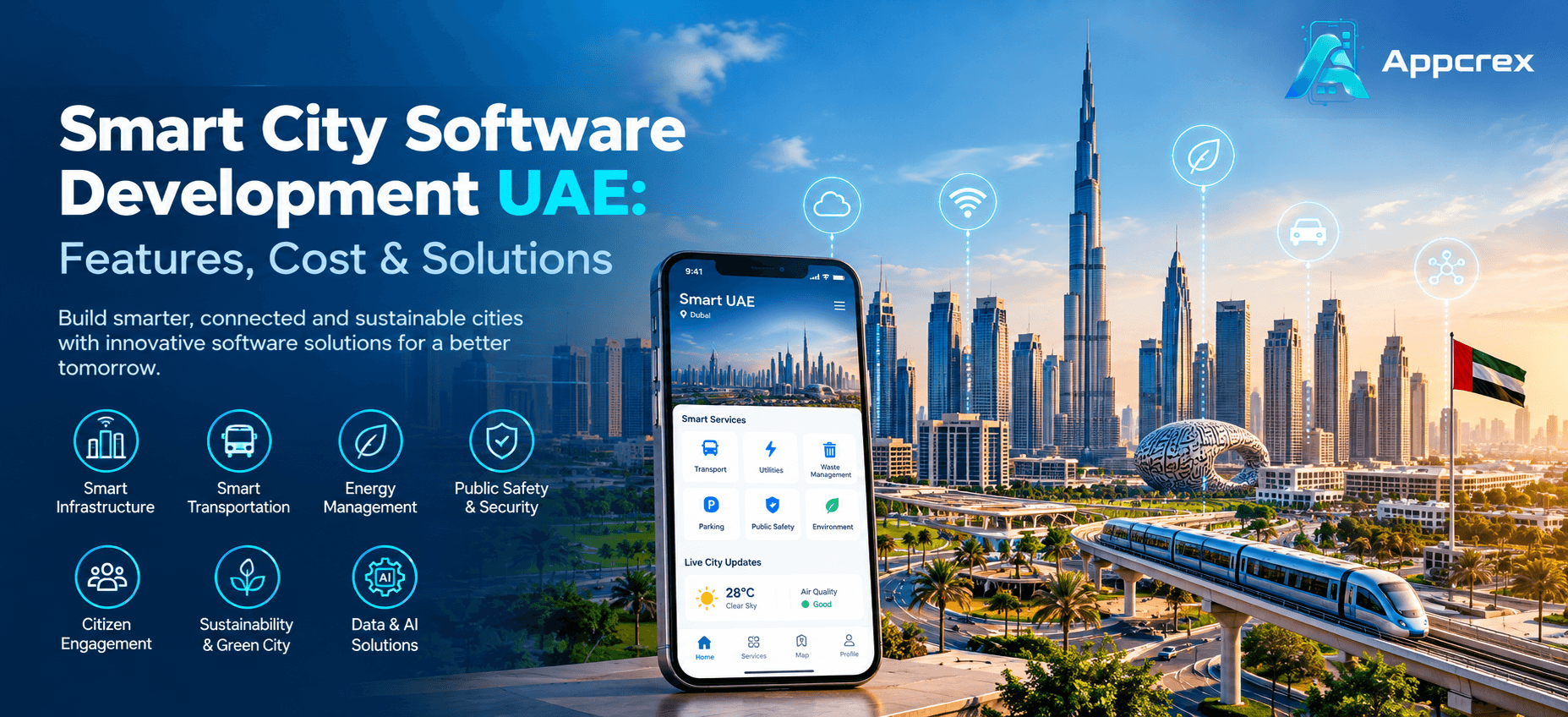
A smart city platform can connect IoT devices, sensors, mobile applications, government services, transportation systems, buildings, utilities, security systems, and analytics into a centralized environment. Businesses can use these platforms to monitor operations in real time, automate repetitive processes, improve resource utilization, and deliver better digital experiences.
Dubai’s Digital Strategy specifically focuses on digital infrastructure, data, cybersecurity, digital services, and AI, while Abu Dhabi has developed connected government platforms and digital services such as TAMM and Abu Dhabi Connect.
If you are planning to build a smart city platform or connected urban solution in the UAE, this guide explains the major features, technologies, development process, solutions, and estimated cost.
What Is Smart City Software Development?
Smart city software development involves building digital platforms and applications that connect different components of an urban environment.
Instead of managing transportation, utilities, public services, buildings, parking, waste management, security, and infrastructure through disconnected systems, smart city software creates a connected technology layer.
A typical smart city ecosystem may combine:
- IoT sensors
- Artificial intelligence
- Cloud infrastructure
- Mobile applications
- Web dashboards
- Geographic Information Systems (GIS)
- Big data analytics
- Digital payments
- Smart transportation
- Building management systems
- Energy monitoring
- Security systems
- Government service platforms
The objective is not simply to create another mobile application. The objective is to create an interconnected system that can collect information, process it, and help organizations make faster and more informed decisions.
Why Smart City Software Is Important in the UAE
The UAE has invested heavily in digital transformation and connected urban services.
Dubai’s digital initiatives include smart applications, data-sharing infrastructure, IoT initiatives, cybersecurity programs, digital government services, and AI-enabled services. The UAE Government also maintains dedicated digital-city initiatives covering Dubai, Abu Dhabi, Sharjah, and smart sustainable cities.
Abu Dhabi has also developed connected digital services. Its Abu Dhabi Connect initiative enables government entities to exchange digital information, while TAMM provides a unified platform for government services.
For businesses, this creates opportunities to develop software for:
- Smart buildings
- Smart transportation
- Smart parking
- Smart utilities
- Energy management
- Waste management
- Public safety
- Healthcare
- Tourism
- Retail
- Real estate
- Construction
- Logistics
- Government services
Smart City Software Development Solutions in UAE
Smart city software is not one single product. Depending on the project, a development company can build an integrated platform or individual smart-city solutions.
1. Smart City Management Platform
A centralized platform can provide city administrators with a single dashboard to monitor different urban operations.
It can integrate:
- Traffic data
- Energy consumption
- Water usage
- Parking
- Public transportation
- Waste collection
- Environmental sensors
- Emergency alerts
- Public services
- Connected buildings
This type of platform can become the central control layer of a smart-city ecosystem.
2. Smart Transportation Software
Transportation is one of the most important areas of smart-city development.
A smart transportation platform can provide:
- Real-time vehicle tracking
- Traffic monitoring
- Route optimization
- Public transport tracking
- Fleet management
- Smart parking
- Digital ticketing
- Intelligent traffic signals
- EV charging integration
- Transportation analytics
AI can also analyze historical and real-time transportation data to identify congestion patterns and support better route planning.
3. Smart Parking Solutions
Smart parking software connects parking spaces with sensors, mobile applications, payment systems, and management dashboards.
Users can:
- Find available parking
- Reserve parking spaces
- Make digital payments
- Receive parking notifications
- Navigate to parking locations
Administrators can monitor occupancy, parking revenue, violations, and usage patterns.
4. Smart Building Management Software
Smart buildings can use connected sensors and automation systems to monitor and control building operations.
Features may include:
- HVAC monitoring
- Lighting automation
- Energy monitoring
- Access control
- Security integration
- Occupancy monitoring
- Maintenance alerts
- Fire and safety monitoring
- Equipment monitoring
Smart building software can be particularly useful for commercial properties, hotels, residential communities, malls, hospitals, and large office complexes.
5. Smart Energy Management
Energy management is another important smart-city application.
Software can collect data from smart meters and IoT devices to monitor:
- Electricity consumption
- Solar energy production
- Building energy usage
- Peak demand
- Equipment efficiency
- Abnormal consumption
AI-powered analytics can identify unusual patterns and help organizations improve energy efficiency.
6. Smart Waste Management
Smart waste management systems can connect bins, collection vehicles, GPS systems, and management dashboards.
Sensors can provide information about waste-bin capacity. The system can then help optimize collection routes instead of sending vehicles to every location on a fixed schedule.
This can support:
- Route optimization
- Bin-level monitoring
- Collection scheduling
- Vehicle tracking
- Fuel monitoring
- Driver management
- Waste analytics
7. Smart Water Management
Smart water software can monitor consumption, pressure, leakage, and infrastructure performance.
Potential features include:
- Smart water meters
- Leakage detection
- Consumption monitoring
- Pressure monitoring
- Automated alerts
- Water usage analytics
- Infrastructure monitoring
Such systems can be integrated with IoT devices and centralized dashboards.
8. Smart Public Safety Software
Public safety platforms can connect different data sources to help authorized teams monitor incidents and respond more efficiently.
Possible integrations include:
- Emergency alerts
- CCTV systems
- IoT sensors
- Incident management
- Location tracking
- Emergency response workflows
- Access control
- Environmental monitoring
Security and privacy should be treated as core architectural requirements rather than features added at the end.
Key Features of Smart City Software
The features depend on the project’s scope, but a comprehensive smart city platform can include the following.
Real-Time Monitoring
A centralized dashboard can display live information from connected devices and systems.
Administrators can monitor:
- Traffic
- Energy
- Water
- Parking
- Waste
- Buildings
- Vehicles
- Environmental conditions
IoT Device Integration
IoT integration allows software to communicate with sensors and connected devices.
A platform may receive data from:
- Temperature sensors
- Smart meters
- Parking sensors
- GPS devices
- Cameras
- Air-quality sensors
- Motion sensors
- Water sensors
- Building systems
GIS and Location Intelligence
GIS integration allows organizations to visualize urban information on interactive maps.
For example, a dashboard could show:
- Traffic incidents
- Parking availability
- Utility infrastructure
- Waste bins
- Public transport
- Smart buildings
- Emergency incidents
Mobile Applications
Smart city mobile applications can provide digital services directly to residents, visitors, employees, and businesses.
Depending on the project, users could:
- Report issues
- Pay for services
- Find parking
- Access transportation
- Receive alerts
- Track service requests
- Access government services
- View community information
AI-Powered Analytics
AI can turn large volumes of city data into useful insights.
Potential applications include:
- Predictive maintenance
- Traffic prediction
- Energy forecasting
- Demand forecasting
- Anomaly detection
- Automated incident classification
- Predictive equipment failure
- Intelligent recommendations
Automated Alerts
The platform can generate alerts when predefined conditions are detected.
For example:
- Abnormal energy consumption
- Water leakage
- Traffic congestion
- Equipment failure
- Parking capacity reached
- Sensor malfunction
- Security event
Digital Payments
Smart-city applications may require integrated payment functionality for:
- Parking
- Transportation
- Public services
- Utilities
- Permits
- Community services
The exact payment architecture should be designed around the relevant UAE requirements and the service provider’s operational model.
Analytics and Reporting
Administrators can use dashboards and reports to evaluate:
- Resource consumption
- Operational costs
- Service usage
- Traffic patterns
- Infrastructure performance
- Revenue
- Maintenance activity
- Citizen requests
AI in Smart City Software Development
AI is becoming an important layer in smart-city systems because cities generate huge amounts of data.
Instead of simply displaying data, AI can help identify patterns and recommend actions.
Predictive Maintenance
AI can analyze equipment data to identify signs of potential failure before an expensive breakdown occurs.
Traffic Prediction
Historical traffic data, current traffic conditions, weather information, and other variables can be analyzed to support congestion forecasting.
Energy Forecasting
AI models can estimate future energy demand based on historical usage, building occupancy, weather, and other relevant factors.
Smart Customer Support
AI chatbots and virtual assistants can help residents and visitors find information, submit requests, or navigate digital services.
Anomaly Detection
Machine-learning models can identify unusual activity across connected systems and send alerts to authorized teams.
Smart City Software Architecture
A scalable smart-city platform usually requires several interconnected layers.
Device Layer
This layer contains sensors, cameras, meters, GPS devices, smart appliances, and other connected hardware.
Connectivity Layer
It manages communication between devices and software using appropriate networks and protocols.
Data Layer
The system collects, stores, processes, and organizes information generated by connected devices.
Application Layer
This includes:
- Web dashboards
- Mobile applications
- Admin panels
- Citizen portals
- Business portals
- Government service interfaces
Intelligence Layer
AI and analytics process data and generate insights, predictions, alerts, and recommendations.
Security Layer
Security should cover authentication, authorization, encryption, monitoring, logging, and access management throughout the system.
Technology Stack for Smart City Software
A technology stack depends on the project’s requirements, existing infrastructure, and integration environment.
A typical stack may include:
Frontend: React.js, Angular, Vue.js
Mobile: Flutter, React Native, Swift, Kotlin
Backend: Node.js, Python, Java, .NET
Databases: PostgreSQL, MySQL, MongoDB, Redis
Cloud: AWS, Microsoft Azure, Google Cloud
AI/ML: Python, TensorFlow, PyTorch and relevant machine-learning frameworks
Maps & GIS: Google Maps Platform, Mapbox, OpenStreetMap, GIS platforms
IoT: MQTT, REST APIs, device-management platforms and relevant IoT protocols
Analytics: Power BI, custom dashboards, cloud analytics services
For large UAE smart-city projects, the architecture should also be designed for interoperability because the platform may need to communicate with existing government, building, transportation, utility, and enterprise systems.
Smart City Software Development Process in UAE
Building a smart-city platform requires more planning than developing a standard business application.
Step 1: Define the Smart City Use Case
First identify the problem you want to solve.
For example:
- Traffic management
- Parking
- Energy
- Waste
- Public safety
- Building management
- Citizen services
Step 2: Requirements and System Planning
The development team identifies users, devices, integrations, workflows, dashboards, data sources, and security requirements.
Step 3: UX/UI Design
Interfaces are designed for different user groups such as:
- City administrators
- Residents
- Operators
- Government employees
- Maintenance teams
- Businesses
Step 4: Backend and API Development
The backend handles data processing, user management, workflows, integrations, notifications, and business logic.
Step 5: IoT Integration
Sensors and connected devices are integrated with the software platform.
Step 6: AI and Analytics
AI models and analytical dashboards can be added according to the project’s objectives.
Step 7: Mobile and Web Development
Citizen-facing applications and administrative dashboards are developed.
Step 8: Security and Testing
The platform is tested for performance, reliability, access control, API security, data protection, and device connectivity.
Step 9: Deployment
The system is deployed on suitable cloud or infrastructure environments.
Step 10: Monitoring and Continuous Improvement
Smart-city systems generate continuous data, so ongoing monitoring, optimization, maintenance, and feature enhancement are important.
How Much Does Smart City Software Development Cost in UAE?
The cost depends heavily on the number of modules, integrations, IoT devices, AI capabilities, security requirements, mobile applications, dashboards, and infrastructure involved.
A general estimate is:
| Smart City Solution | Estimated Development Cost |
|---|---|
| Basic Smart City MVP | $30,000 – $60,000 |
| Medium Smart City Platform | $60,000 – $120,000 |
| Advanced Smart City Platform | $120,000 – $250,000+ |
| Enterprise/City-Wide Platform | $250,000 – $500,000+ |
These are development estimates rather than fixed UAE project quotations. A city-wide platform involving thousands of devices, multiple government integrations, advanced analytics, and high-availability infrastructure can require substantially more investment.
Factors That Affect Smart City Software Cost
The major cost drivers include:
- Number of modules
- Number of users
- IoT device integrations
- Mobile application development
- Web dashboards
- AI/ML requirements
- GIS integration
- Third-party APIs
- Payment integration
- Cloud infrastructure
- Cybersecurity
- Data migration
- Government integrations
- Multi-language support
- Maintenance and support
Smart City Software Development Timeline
The development timeline depends on project complexity.
| Project Type | Approximate Timeline |
|---|---|
| Basic MVP | 3–5 months |
| Medium Platform | 5–8 months |
| Advanced Platform | 8–12+ months |
| Enterprise/City-Wide Solution | 12–18+ months |
Hardware procurement, field deployment, government integrations, compliance reviews, and third-party dependencies can extend the overall project timeline.
Smart City Software for Dubai and Abu Dhabi
Smart City Software Development Dubai
Dubai provides a strong environment for smart-city software because of its established digital infrastructure, smart mobility initiatives, connected services, data programs, and digital government ecosystem. The official Dubai Digital Strategy includes digital infrastructure, data, cybersecurity, digital city services, and digital competitiveness among its pillars.
Potential Dubai solutions include:
- Smart parking
- Smart mobility
- Property technology
- Smart buildings
- Tourism platforms
- Energy management
- Waste management
- Digital government services
- AI-powered city analytics
Smart City Software Development Abu Dhabi
Abu Dhabi has developed several connected digital government initiatives. TAMM provides a unified government-services platform, while Abu Dhabi Connect supports digital information exchange between government entities.
Smart software opportunities can include:
- Government service platforms
- Smart infrastructure
- Smart buildings
- Mobility
- Energy management
- Environmental monitoring
- Digital communities
- Healthcare technology
Smart City Software Development for UAE Businesses
Smart-city technology is not limited to government organizations.
Private companies can also build connected solutions for:
- Real estate developers
- Property management companies
- Construction companies
- Logistics companies
- Transportation operators
- Hotels
- Hospitals
- Shopping malls
- Universities
- Industrial facilities
- Facility management companies
For example, a UAE property developer could build a smart community platform that combines visitor management, parking, security, maintenance requests, energy monitoring, digital payments, and resident services into one application.
Why Choose AppCrex for Smart City Software Development?
AppCrex can help businesses and organizations design and develop custom smart-city software based on their operational requirements.
Our development capabilities can cover:
- Custom smart city platforms
- IoT application development
- AI and machine learning
- Smart mobility solutions
- Smart parking applications
- Smart building software
- GIS and location-based applications
- Mobile app development
- Web dashboards
- Cloud-based platforms
- API and third-party integrations
- Enterprise software development
- Data analytics
- Ongoing maintenance and support
Instead of using a one-size-fits-all product, a custom platform can be designed around your existing infrastructure, devices, workflows, users, and future expansion plans.
FAQs
Q. How much does smart city software development cost in the UAE?
Smart city software can cost approximately $30,000 for a basic MVP and exceed $250,000 for advanced enterprise platforms. Large city-wide systems can cost significantly more depending on IoT infrastructure, integrations, AI, security, and deployment requirements.
Q. How long does it take to build smart city software?
A basic smart-city MVP may take around 3–5 months, while an advanced platform can take 8–12 months or longer. Enterprise and city-wide projects may require 12–18 months or more.
Q. Can smart city software integrate with IoT devices?
Yes. Smart-city platforms can integrate sensors, smart meters, GPS devices, cameras, environmental sensors, parking systems, building systems, and other connected devices.
Q. Can AI be added to smart city software?
Yes. AI can support predictive maintenance, traffic forecasting, anomaly detection, energy forecasting, intelligent automation, document processing, and AI-powered customer support.
Q. Can you build smart city software for Dubai?
Yes. A custom platform can be developed for Dubai-based businesses, property developers, infrastructure operators, transportation companies, and other organizations requiring connected urban solutions.
Q. Can smart city software support Arabic and English?
Yes. A multilingual architecture can be implemented to support Arabic and English interfaces, depending on the requirements of the project.
Q. Is smart city software only for government organizations?
No. Private companies can also use smart-city technologies for smart buildings, communities, transportation, logistics, energy management, security, real estate, hospitality, and facility management.
Conclusion
Smart city software development in the UAE is moving beyond individual applications toward connected ecosystems that combine IoT, AI, cloud platforms, data analytics, mobility, digital services, and intelligent infrastructure.
For businesses, the opportunity is not limited to building a resident-facing app. A well-designed smart city solution can become a complete operational platform connecting buildings, transportation, utilities, sensors, employees, customers, and administrators.
Whether you need a smart parking solution, IoT-powered building platform, intelligent transportation system, city management dashboard, or a larger connected-city ecosystem, the right architecture and development strategy can help create a scalable solution for the UAE market.
Build Your Smart City Solution with AppCrex
Looking for a smart city software development company in the UAE? AppCrex can help you build custom smart-city platforms with IoT, AI, cloud, mobile applications, GIS, analytics, APIs, and enterprise integrations.
Contact AppCrex to discuss your smart city software development project and turn your connected-city idea into a scalable digital solution.