
📌 Key Takeaways
- A SHEIN-like clothing app in Australia can cost around A$35,000–A$450,000+, depending on complexity.
- An MVP can start around A$35,000–A$70,000 with core shopping and order-management features.
- AI chatbot, recommendations and visual search can substantially increase development costs.
- iOS app development can be launched first if your target audience and business strategy justify an iPhone-first approach.
- A phased MVP app development strategy can help validate the fashion business before investing in advanced marketplace and AI functionality.
Introduction
Sports betting platforms have evolved from simple online wagering websites into sophisticated mobile-first products that combine real-time sports data, live odds, secure wallets, personalized experiences, risk management, and compliance systems.
For operators entering a licensed sports betting market, the technology behind the application is just as important as the betting interface. A modern sportsbook needs to process constantly changing odds, validate bets, manage settlements, protect transactions, and remain stable during major sporting events when traffic can increase sharply.
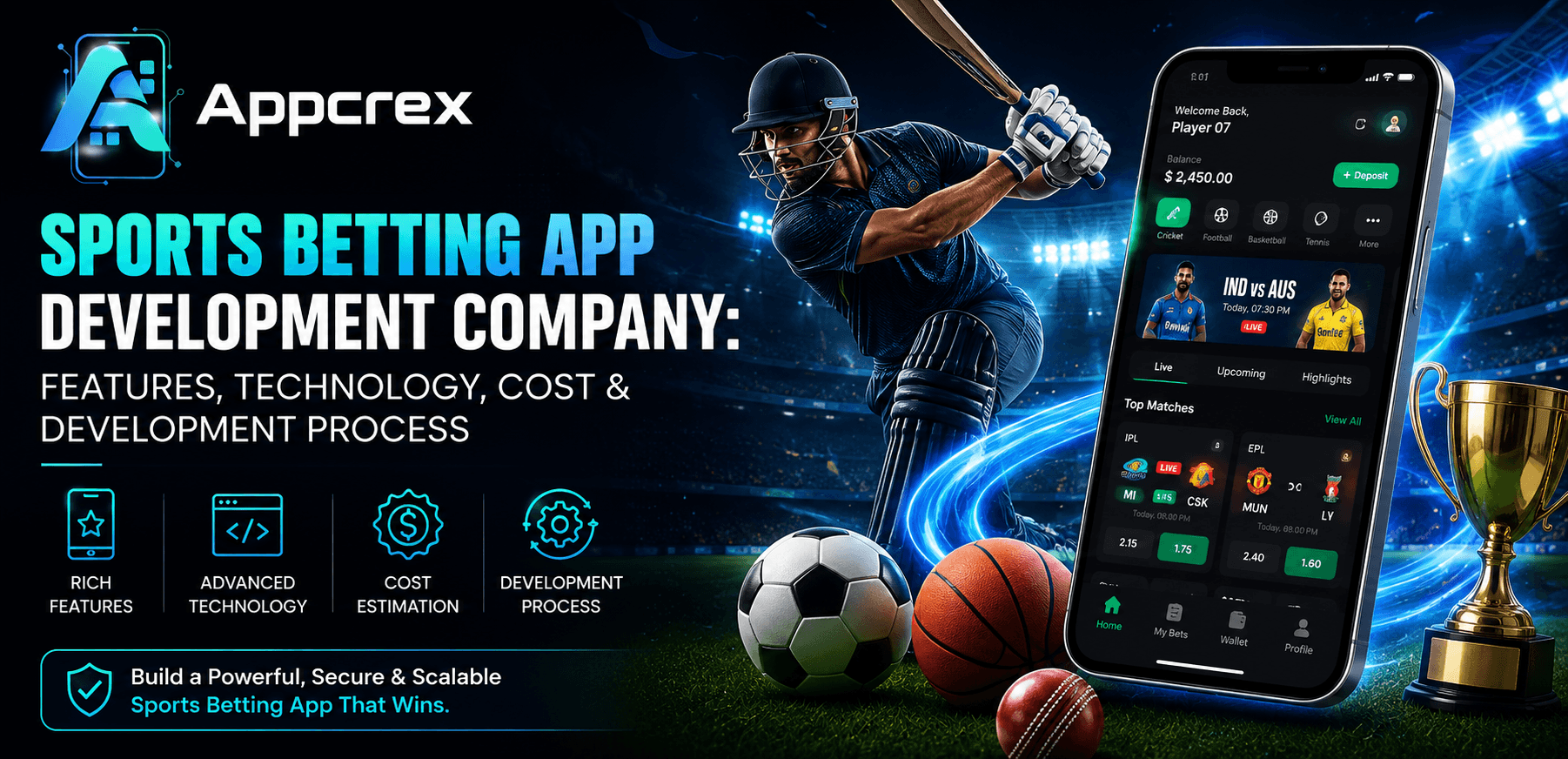
At AppCrex, we approach sports betting app development as a complete technology product—covering mobile apps, sportsbook backend, real-time APIs, wallet systems, admin dashboards, analytics, security, and compliance-oriented functionality. AppCrex already provides mobile, AI, custom software and digital product development services for businesses across global markets.
Important: Sports betting is regulated differently across countries and jurisdictions. The application should be developed for a properly licensed operator and configured according to the applicable laws, platform rules, age restrictions, geolocation requirements, and responsible-gambling obligations.
What Is Sports Betting App Development?
Sports betting app development involves building a digital sportsbook where users can browse sporting events, view available markets and odds, place permitted wagers, manage their accounts, and track outcomes.
Unlike a normal sports application, a sportsbook requires several real-time systems working together.
These can include:
- Sports data and odds feeds
- Betting market management
- Bet slip
- Bet validation
- Live/in-play updates
- Settlement engine
- User wallet
- Payment integration
- KYC and age verification
- Geolocation controls
- Risk management
- Responsible-gambling controls
- Notifications
- Admin and trading dashboard
- Reporting and audit logs
Modern sportsbook architectures commonly use real-time odds feeds, wallet infrastructure, KYC/geolocation systems, risk controls and responsible-gambling features as core components.
Sports Betting App Development Services
A professional sports betting app development company can build the complete ecosystem rather than only the customer-facing mobile application.
Custom Sportsbook App Development
Build a branded sportsbook application around your target market, sports catalogue, betting markets and business requirements.
The application can support:
- Football
- Cricket
- Basketball
- Tennis
- Baseball
- Rugby
- Hockey
- MMA
- Esports
- Other permitted sporting categories
The exact sports and betting markets should be determined by the operator’s licensing and jurisdiction.
iOS Sports Betting App Development
An iOS app development company can build a native iPhone sportsbook using technologies such as Swift and SwiftUI.
Important components can include:
- Secure login
- Biometric authentication
- Live odds
- Bet slip
- Push notifications
- Account management
- Wallet interface
- Transaction history
- Responsible-gambling controls
- Real-time event updates
Android Sports Betting App Development
Android applications can be developed using Kotlin or a suitable cross-platform framework.
The Android version can share the same backend infrastructure as iOS while providing a platform-specific user experience.
Web Sportsbook Development
For operators that want broader accessibility, a responsive sportsbook website can work alongside mobile applications.
The web platform can connect to the same:
- Odds engine
- User database
- Wallet
- Payment infrastructure
- Settlement system
- Risk engine
- Admin panel
Live Betting App Development
Live or in-play betting requires particularly fast data processing because event information and available markets can change rapidly.
A real-time architecture can use streaming technologies and WebSockets to deliver updates to the application.
Live betting systems may include:
- Live odds
- Market suspension
- Event updates
- Cash-out where legally and commercially supported
- Automated settlement
- Real-time notifications
Sportsbook development providers commonly use real-time odds ingestion and low-latency infrastructure for these requirements.
Key Features of a Sports Betting App
The feature set depends on the business model and jurisdiction, but a modern sportsbook can include several important components.
User Registration & Account Management
Users can create accounts, verify their identity where required, manage personal information and review account activity.
The registration flow can integrate:
- Email verification
- Phone verification
- Identity verification
- Age verification
- Two-factor authentication
- Biometric login where supported
Sports & Event Discovery
The home screen can organize events by:
- Sport
- League
- Tournament
- Date
- Live events
- Upcoming events
- Popular markets
A strong navigation system becomes particularly important when hundreds or thousands of events are available.
Odds & Betting Markets
The application can display permitted betting markets with continuously updated odds.
The backend needs to handle changes such as:
- Odds updates
- Market suspension
- Market reopening
- Event cancellation
- Bet acceptance
- Bet rejection
- Settlement
Bet Slip
The bet slip is one of the most important parts of the sportsbook UX.
Users can review their selected markets before confirming a wager.
Depending on the jurisdiction and product design, functionality can include:
- Single bets
- Accumulators/parlays
- Bet amount
- Potential return
- Odds changes
- Confirmation
- Bet history
Wallet & Payments
A sportsbook may require a secure wallet architecture for permitted deposits, withdrawals, balances and transaction records.
Payment integrations should be designed according to the operator’s market, licensing requirements and payment-provider rules.
Notifications
Push notifications can inform users about:
- Event start times
- Odds or market changes
- Bet status
- Settlement
- Account activity
- Responsible-gambling reminders
- Important account messages
Compliance, Security & Responsible Gambling
This is one area where sports betting applications differ substantially from ordinary sports or entertainment apps.
A sportsbook operating in a regulated jurisdiction may need functionality for KYC, AML processes, age verification, geolocation, responsible gambling, audit trails and transaction monitoring, depending on the applicable regulatory framework.
KYC & Identity Verification
The system can connect with an identity verification provider to verify information before permitting regulated activities.
Geolocation
Where required, geolocation technology can determine whether a user is within an authorized geographic area.
Responsible Gambling
Responsible-gambling functionality can include configurable controls such as:
- Deposit limits
- Wagering limits
- Session controls
- Cooling-off periods
- Self-exclusion
- Reality checks
- Account restrictions
The exact controls depend on the jurisdiction and licensing conditions.
Fraud & Risk Management
A sportsbook also needs mechanisms for identifying suspicious activity and controlling operational risk.
An operator dashboard can monitor:
- Unusual betting patterns
- Account activity
- Transaction behaviour
- Exposure
- Market-level risk
- Suspicious activity
- Manual review queues
Also Read : Cybersecurity Risk Management Solution Company: Services, Benefits, Cost & Process
Audit Logs
Important user and operator actions should be recorded so that authorized teams can review system activity and support regulatory reporting.
Sports Betting Admin Panel & Back Office
A sportsbook cannot operate effectively with only a customer application.
The operator needs a powerful administrative platform.
A typical admin panel can include:
User Management
Manage accounts, verification status, restrictions and activity.
Sports & Event Management
Control sports, competitions, events and markets.
Odds Management
Monitor incoming odds and apply authorized trading controls.
Risk Management
Monitor exposure, limits, unusual activity and market risk.
Wallet Management
Review deposits, withdrawals, balances and transaction records.
Bonus & Promotion Management
If permitted by the relevant market, operators can manage promotional campaigns and eligibility rules.
Reports & Analytics
Track:
- Active users
- Betting activity
- Deposits
- Withdrawals
- Market performance
- Revenue metrics
- User retention
- Risk indicators
Role-Based Access Control
Different employees can receive different permissions—for example:
- Admin
- Trader
- Risk manager
- Compliance team
- Finance team
- Customer support
Role-based administration and audit logging are common components of sportsbook back-office architecture.
Sports Data APIs & Technology Stack
A sportsbook depends heavily on reliable sports data.
Depending on the market and requirements, a development team can integrate licensed third-party sports data and odds providers rather than building every data source from scratch.
The technology stack may include:
| Layer | Technologies |
|---|---|
| iOS | Swift, SwiftUI |
| Android | Kotlin |
| Cross-platform | Flutter, React Native |
| Backend | Node.js, Python, Java, .NET |
| Database | PostgreSQL, MySQL, MongoDB |
| Real-time | WebSockets, Redis, event streaming |
| Cloud | AWS, Azure, Google Cloud |
| APIs | REST, GraphQL, Webhooks |
| DevOps | Docker, Kubernetes, CI/CD |
| Security | Encryption, OAuth, MFA, RBAC |
| Analytics | Custom dashboards, event analytics |
The architecture should prioritize low latency, high availability and accurate transaction processing because peak sporting events can generate significant simultaneous activity.
Also Read : AI Training App Development Guide: How Enterprises Can Upskill Employees with AI
AI in Sports Betting App Development
AI can be used for operational and user-experience capabilities, provided its use complies with the applicable rules and does not undermine responsible-gambling protections.
Potential applications include:
AI Customer Support
An AI chatbot can answer common questions about:
- Account verification
- Deposits and withdrawals
- App navigation
- Transaction status
- Responsible-gambling controls
- General platform information
Fraud Detection
Machine-learning systems can help identify unusual account or transaction patterns for human review.
Sports Data Analytics
AI can process large amounts of sports data and create analytical insights for authorized users or operators.
Personalization
Applications can personalize content such as sports, competitions and informational notifications based on user preferences while respecting privacy and responsible-gambling requirements.
Importantly, AI should not be positioned as a tool that guarantees betting outcomes or encourages harmful gambling behaviour.
Sports Betting App Development Process
A successful sportsbook requires more planning than a typical mobile application because regulatory and real-time infrastructure decisions affect the architecture from the beginning.
1. Product Discovery
The first step is defining:
- Target jurisdiction
- Licensing model
- Sports
- Betting markets
- Platforms
- User types
- Payment model
- Data providers
- Compliance requirements
2. Compliance & Architecture Planning
The technical architecture is designed around the applicable regulatory environment.
This stage can identify requirements for:
- KYC
- Age verification
- Geolocation
- AML
- Responsible gambling
- Reporting
- Data retention
- Audit logs
3. UI/UX Design
The team creates user flows for registration, sports discovery, event selection, bet slip, wallet, account management and support.
4. Backend Development
Developers build the core infrastructure for:
- Users
- Events
- Markets
- Odds
- Bets
- Wallet
- Payments
- Settlement
- Notifications
5. API & Data Integration
Sports data, odds, payment, identity verification and other required third-party services are integrated.
6. Mobile & Web Development
iOS, Android and web applications are developed and connected to the common backend.
7. Security & QA
Testing should cover:
- Authentication
- Payments
- Wallet transactions
- Odds updates
- Bet validation
- Settlement
- API security
- Load testing
- Device compatibility
- Admin permissions
8. Deployment & Continuous Monitoring
After launch, the application requires ongoing monitoring, maintenance, security updates, infrastructure scaling and feature improvements.
How Much Does It Cost to Build a Sports Betting App?
Sports betting app development costs vary considerably because sportsbook architecture can range from a relatively focused MVP to a multi-market enterprise platform.
A broad development estimate can look like this:
| Project Type | Estimated Cost | Timeline |
|---|---|---|
| Sports Betting MVP | $40,000 – $90,000 | 3–4 months |
| Standard Sportsbook | $90,000 – $180,000 | 4–7 months |
| Advanced Sports Betting Platform | $180,000 – $300,000 | 7–10 months |
| Enterprise / Multi-Market | $300,000 – $500,000+ | 10–18+ months |
These figures are indicative rather than fixed quotes. Third-party data feeds, licensing-related requirements, payment infrastructure, security testing, number of platforms, live betting depth and market coverage can significantly affect the final budget. Published sportsbook development estimates similarly show large differences between MVP, full-product and enterprise implementations.
What Affects Sports Betting App Development Cost?
The biggest cost drivers are usually the complexity of the sportsbook rather than the basic mobile interface.
Number of Sports
Supporting five sports is technically different from supporting dozens of sports with different markets and data structures.
Live Betting
Real-time betting requires additional data infrastructure, event processing and market-management logic.
Data Provider Integrations
Licensed sports data and odds feeds can introduce ongoing third-party costs in addition to development.
Wallet & Payments
Multiple payment methods, currencies and withdrawal workflows increase backend complexity.
Compliance
Different jurisdictions may require different KYC, AML, geolocation, responsible-gambling and reporting functionality.
Platforms
Building iOS, Android, web and admin systems requires additional development and QA.
Scalability
A platform expected to handle major sporting events needs stronger infrastructure, monitoring, load testing and disaster-recovery planning.
MVP Sports Betting App Development
For a startup or new operator, an MVP app development approach can be used to validate the technology and user experience before expanding the platform.
A focused MVP could include:
- User registration
- Identity/age verification where required
- Sports catalogue
- Events
- Basic permitted markets
- Odds integration
- Bet slip
- Wallet integration
- Transaction history
- Basic admin dashboard
- Notifications
- Responsible-gambling controls applicable to the target market
Advanced features such as sophisticated risk analytics, additional sports, advanced live markets, multi-region functionality and AI can be added in later phases.
The MVP should still be designed around the compliance requirements of the intended licensed market rather than treating compliance as something to add after launch.
Why Choose AppCrex for Sports Betting App Development?
AppCrex works across mobile app development, AI, custom software, cloud and scalable digital product development for global businesses.
For a sportsbook project, the development scope can include:
- Sports betting mobile app development
- iOS app development
- Android app development
- Sportsbook web development
- Real-time API integration
- Sports data integration
- Wallet and payment integration
- KYC/identity integration
- Geolocation functionality
- Admin dashboard
- Risk-management tools
- AI integration
- Cloud infrastructure
- Security testing
- Post-launch maintenance
AppCrex also has experience in adjacent sports technology through its fantasy sports development services, including live score tracking, multi-sport functionality, analytics dashboards, wallet integration and AI-based sports features.
The development strategy can be structured around the target jurisdiction, product scope, technology requirements and long-term roadmap.
FAQs
Q. How much does it cost to develop a sports betting app?
A sports betting MVP can start around $40,000–$90,000, while an advanced or enterprise sportsbook can reach $180,000–$500,000+, depending on features, integrations, markets and compliance requirements.
Q. How long does it take to build a sports betting app?
A focused MVP can take roughly 3–4 months, while a feature-rich or multi-market sportsbook can require 7–18+ months.
Q. Can you build an iOS sports betting app?
Yes. An iOS app development company can develop a native sportsbook using Swift and SwiftUI, with real-time odds, account management, permitted wallet functionality and other required features.
Q. Can a sports betting app support live betting?
Yes, where permitted. Live betting requires real-time sports data, low-latency infrastructure, market suspension logic, bet validation and settlement functionality.
Q. What APIs are needed for a sports betting app?
Depending on the product, integrations can include sports data/odds APIs, payment gateways, identity/KYC services, geolocation services, notification systems and analytics platforms.
Q. Is a sports betting app legally allowed everywhere?
No. Sports betting laws and licensing requirements vary by jurisdiction. Before development and launch, the operator should determine where the service is legally permitted and obtain the required licensing and compliance guidance.
Q. Can AI be integrated into a sports betting app?
Yes. AI can be used for customer support, fraud/risk analysis, data analytics and personalization. Its implementation should be consistent with responsible-gambling requirements and applicable regulations.
Conclusion
A modern sports betting platform requires a combination of mobile development, real-time data processing, secure transaction infrastructure, sportsbook management, analytics and compliance-oriented technology.
Whether you are planning an iOS sportsbook, Android application, web betting platform or complete multi-platform solution, the development process should begin with the target market, licensing requirements and product architecture.
With the right technology foundation, a sportsbook can be designed to handle real-time events, changing odds, secure transactions, operational risk and future expansion while keeping responsible-gambling functionality at the center of the product.
Build Your Sports Betting Platform with AppCrex
AppCrex can help businesses develop sports betting apps, iOS and Android applications, sportsbook platforms, real-time API integrations, AI solutions and custom software for licensed and appropriately regulated markets.
From MVP strategy and UI/UX to backend architecture, mobile development, integrations, security and ongoing support, the platform can be developed around your specific business and jurisdictional requirements.
Talk to AppCrex about your sports betting app development project and build a scalable technology platform for your target market.
