📌 Key Takeaways
- Hotel booking app development can cost $20,000 to $400,000+ depending on the product scope.
- PMS, channel-manager and hotel inventory integrations can significantly increase development complexity.
- An MVP is the most practical starting point for startups and new hotel-booking businesses.
- AI and personalization can improve recommendations, search and customer support.
- The booking engine and backend are as important as the mobile app for a reliable hotel booking platform.
Introduction
Building a hotel booking app can be a strong opportunity for hotel chains, travel startups, hospitality businesses, property managers, and entrepreneurs planning to launch an online accommodation marketplace. But the cost is not the same for every hotel booking application.
A simple app for a single hotel may only need room listings, availability, booking and payments. A multi-property platform similar to an OTA requires real-time inventory, hotel partner dashboards, payment processing, reviews, cancellation management, PMS or channel-manager integrations, analytics, and potentially AI-powered recommendations.
In 2026, published development estimates range from roughly $15,000–$35,000 for a focused MVP to $150,000–$400,000+ for a large OTA or enterprise platform, depending on features, integrations and scale.
Hotel Booking App Development Cost at a Glance
Here is a practical estimate based on the complexity of the application:
| Hotel Booking App Type | Estimated Cost | Approx. Timeline |
|---|---|---|
| Basic MVP | $20,000–$40,000 | 3–5 months |
| Standard Hotel Booking App | $40,000–$80,000 | 4–6 months |
| Multi-Hotel Booking Platform | $60,000–$130,000 | 5–8 months |
| Advanced Hotel Marketplace | $80,000–$150,000+ | 6–10 months |
| AI-Powered Hotel Booking App | $100,000–$200,000+ | 7–12 months |
| Enterprise OTA Platform | $150,000–$400,000+ | 10–18 months |
These are planning ranges rather than fixed quotations. The final budget depends heavily on whether you need a single-property application, multi-property marketplace, PMS integration, channel manager, AI, multiple platforms, or advanced partner functionality. Recent 2026 estimates show similarly wide ranges because hotel booking products vary considerably in complexity.
Just Read : Flight Booking App Development Guide: Features, Cost, APIs & Development Process
What Determines the Cost of a Hotel Booking App?
The biggest mistake businesses make is estimating development cost only by counting app screens. A hotel booking platform has several systems working together behind the interface.
1. Type of Hotel Booking App
A direct booking app for one hotel is much simpler than a marketplace connecting hundreds or thousands of properties.
For example:
Single Hotel App:
Users search rooms, check availability, select a room, make payment and receive confirmation.
Hotel Chain App:
The system manages multiple properties, locations, room types, loyalty programs and centralized booking.
OTA Platform:
The platform connects multiple hotels with customers and may require hotel onboarding, commissions, partner dashboards, payment splitting and inventory synchronization.
Enterprise Marketplace:
A large platform can require PMS, channel manager, CRM, analytics, AI, multilingual functionality, multi-currency and complex administration.
The more participants and business rules involved, the higher the development cost.
Just Read : Travel App Development Company: Features, Cost, Types & Development Process
Hotel Booking App Features and Their Cost Impact
A hotel booking app usually has three major components: customer application, hotel/partner panel, and admin/backend system.
Customer App
The customer side normally includes:
- Registration and login
- Hotel search
- Location-based search
- Filters
- Hotel profiles
- Room details
- Photos and videos
- Amenities
- Availability calendar
- Room selection
- Guest details
- Booking
- Secure payments
- Booking history
- Cancellation
- Refund requests
- Reviews and ratings
- Wishlist
- Push notifications
- Coupons and offers
These are the foundation of a standard booking application.
Hotel Partner Dashboard
If you are building a marketplace, hotels need their own dashboard.
They may need to:
- Add properties
- Upload rooms
- Set room prices
- Update availability
- Manage bookings
- Add offers
- Manage cancellation policies
- View earnings
- Track reviews
- Manage property information
Adding this partner ecosystem can significantly increase the development scope.
Admin Panel
The administrator needs centralized control over the platform.
Important functionality can include:
- User management
- Hotel management
- Room management
- Booking management
- Payment management
- Commission management
- Coupon management
- Review moderation
- Reports
- Analytics
- Content management
- Support management
- Partner management
For an OTA-style platform, the admin system can become almost as important as the customer application.
Advanced Features That Increase Development Cost
Once the basic booking flow is complete, businesses can add advanced functionality.
Real-Time Hotel Availability
Users expect room availability and pricing to be accurate at the time of booking.
Real-time synchronization can require integrations with hotel systems, PMS platforms, channel managers or external hotel inventory providers.
PMS Integration
A Property Management System can synchronize:
- Room availability
- Reservations
- Rates
- Guest information
- Room status
PMS integration is one of the important cost drivers in hotel booking projects. Some current estimates place individual PMS/integration work in the $10,000–$30,000 range depending on complexity.
Channel Manager Integration
For multi-property platforms, a channel manager can help synchronize hotel inventory and rates across different sales channels.
Multiple Payment Methods
A global hotel booking platform may require:
- Credit/debit cards
- Digital wallets
- Apple Pay
- Google Pay
- Local payment methods
- Multi-currency transactions
Multi-Language and Multi-Currency
If the target market is international, the application may need multiple languages, currencies, taxes, date formats and localized content.
Loyalty Program
Hotels and OTAs can use loyalty systems to encourage repeat bookings through:
- Points
- Membership levels
- Exclusive discounts
- Cashback
- Personalized offers
AI Hotel Recommendations
AI can analyze user preferences, searches and booking history to recommend suitable properties.
For example:
“Show me family-friendly hotels in Dubai under $150 per night with a pool and breakfast.”
The system can convert this request into structured filters and personalized recommendations.
AI Customer Support
An AI assistant can answer questions about:
- Hotel amenities
- Check-in
- Cancellation
- Room types
- Booking status
- Nearby attractions
More advanced implementations can connect the assistant to booking systems and perform selected actions.
Current hotel-app development trends increasingly include AI recommendations, smart search, personalization and automated customer support.
Hotel Booking App Development Cost by Development Stage
The budget can also be understood by looking at where development resources are spent.
| Development Stage | Approx. Share of Budget |
|---|---|
| Research & Planning | 5–10% |
| UI/UX Design | 10–15% |
| Frontend Development | 20–25% |
| Backend Development | 25–35% |
| API & Third-Party Integrations | 10–20% |
| Testing & QA | 10–15% |
| Deployment | 5–10% |
Backend and integrations can represent a significant portion of the project because hotel booking requires availability management, booking logic, payment workflows, APIs, admin controls and external systems.
Cost of Developing Different Hotel Booking Apps
Cost to Build a Single-Hotel Booking App
A direct booking application for one hotel is generally the simplest option.
It may include:
- Hotel information
- Room listings
- Availability
- Booking
- Payments
- Notifications
- Basic admin panel
Estimated cost: $20,000–$50,000
The exact amount depends on design, platforms, booking logic and integrations.
Cost to Build a Multi-Hotel Booking App
A multi-property platform requires hotel listings, filters, partner management, availability, reviews, booking and commissions.
Estimated cost: $50,000–$130,000
Cost to Build an OTA-Style Hotel Booking Platform
An OTA platform requires much more infrastructure.
It may include:
- Multiple hotel suppliers
- Hotel partner dashboard
- Real-time availability
- Channel manager
- PMS integration
- Payments
- Reviews
- Loyalty
- Analytics
- Multi-language
- Multi-currency
- Advanced search
Estimated cost: $100,000–$250,000+
Cost to Build an Enterprise Hotel Marketplace
A large Booking.com-style ecosystem can require advanced infrastructure, multiple integrations, large-scale search, partner management, AI and sophisticated analytics.
Estimated cost: $150,000–$400,000+
Some 2026 industry estimates put full marketplace or enterprise hotel platforms even higher depending on the scope and supplier ecosystem.
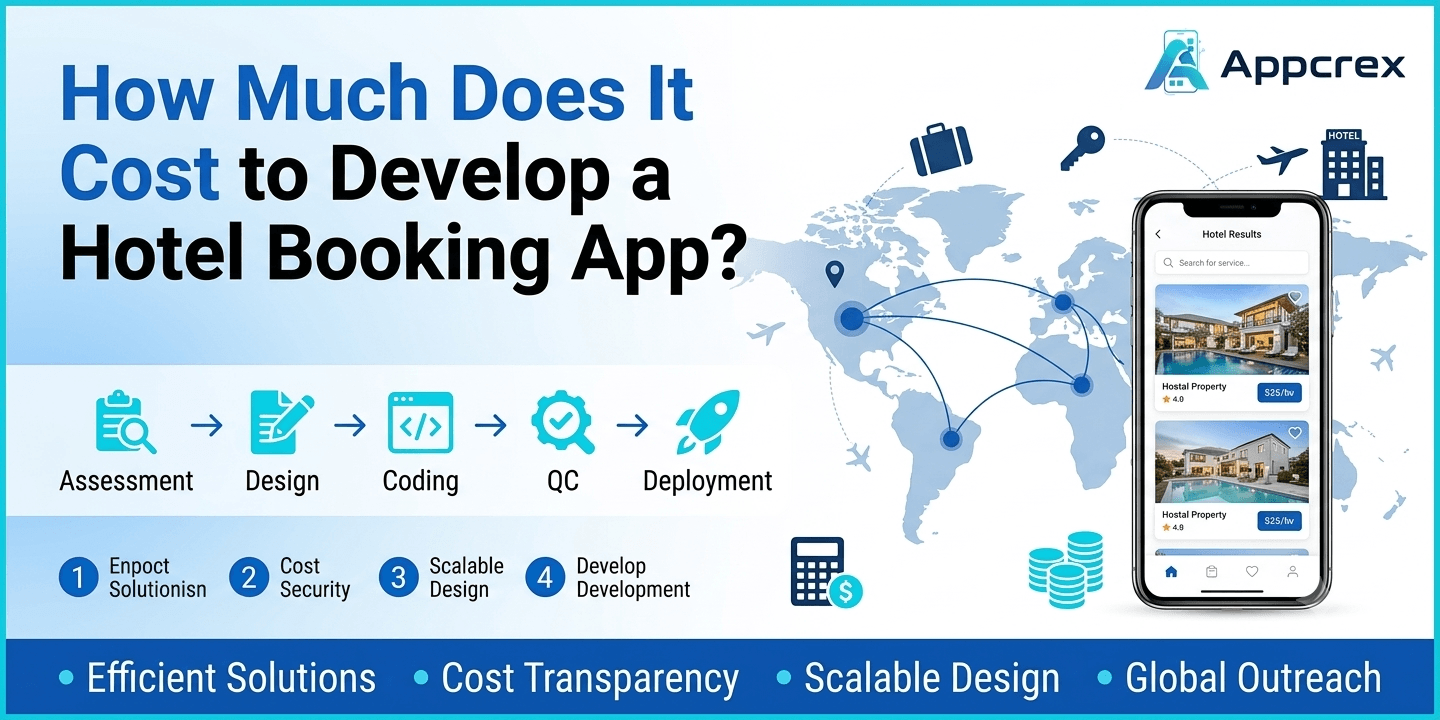
Hotel Booking App Development Process
The development process should start with the business model rather than immediately building screens.
Step 1: Business and Market Research
Define:
- Target customers
- Target geography
- Hotel categories
- Competitors
- Revenue model
- Booking workflow
- Required suppliers
Step 2: Feature and MVP Planning
Identify which features are essential for launch.
For an MVP, you may start with:
Search → Hotel Details → Room Selection → Booking → Payment → Confirmation
Advanced features can be added after validating demand.
Step 3: UI/UX Design
Design the complete customer journey from hotel discovery to successful booking.
The booking process should remain simple, with transparent pricing and clear cancellation policies.
Step 4: Backend Development
Develop:
- User management
- Hotel database
- Room inventory
- Availability
- Booking engine
- Payment processing
- Notifications
- Admin controls
Step 5: API and PMS Integration
Connect the platform with the required hotel inventory, PMS, channel manager, maps, payment and communication systems.
Also Read : What Is an MVP in App Development? A Complete Guide
Step 6: Mobile and Web Development
Depending on the business model, the product may include:
- iOS app
- Android app
- Customer web application
- Hotel partner portal
- Admin dashboard
Flutter or React Native can be considered when a business wants cross-platform mobile development.
Step 7: Testing
Testing should cover:
- Search
- Availability
- Room selection
- Booking
- Payment
- Cancellation
- Refunds
- Push Notifications
- API failures
- Security
- Performance
Step 8: Launch and Maintenance
After launch, the development team monitors application performance, booking failures, integrations, security and user behavior.
Regular maintenance is important because APIs, operating systems, payment services and third-party platforms change over time.
Technology Stack for a Hotel Booking App
A modern hotel booking platform can use:
| Technology Area | Recommended Options |
|---|---|
| Mobile | Flutter, React Native, Swift, Kotlin |
| Frontend | React, Next.js, Angular |
| Backend | Node.js, Python, Java, .NET |
| Database | PostgreSQL, MySQL, MongoDB |
| Cache/Search | Redis, Elasticsearch/OpenSearch |
| Cloud | AWS, Azure, Google Cloud |
| APIs | REST, GraphQL, Webhooks |
| AI | Python, ML, LLMs, AI agents |
| Infrastructure | Docker, Kubernetes, CI/CD |
The final technology stack should be selected according to expected booking volume, integrations, platforms and scalability requirements rather than simply choosing the most popular technology.
How Can a Hotel Booking App Make Money?
There are several ways to monetize a hotel booking platform.
Commission
Charge hotels a percentage of every completed booking.
Service Fee
Add a booking or convenience fee to customer transactions.
Featured Listings
Hotels can pay for higher visibility in search results.
Subscription
Offer premium membership to travelers or hotel partners.
Advertising
Hotels and hospitality businesses can promote their properties through sponsored placements.
B2B Revenue
Travel agencies and corporate customers can use the platform through specialized pricing or subscription plans.
Hidden Costs You Should Consider
The initial development budget is not the complete cost of operating a hotel booking platform.
Businesses should also consider:
- Cloud hosting
- API usage
- PMS fees
- Channel manager fees
- Payment processing
- SMS and email
- Maps
- Security monitoring
- App store fees
- Maintenance
- Bug fixes
- New feature development
- Third-party software licenses
Some 2026 estimates put ongoing operational and maintenance costs around $10,000–$30,000 annually for certain hotel-booking platforms, although actual expenses can vary substantially with booking volume and integrations.
How to Reduce Hotel Booking App Development Cost?
You don’t necessarily need to launch every feature in version one.
A practical approach is to:
Start with an MVP: Build search, hotel details, availability, booking and payment first.
Use cross-platform development: Flutter or React Native can reduce duplicate mobile development in suitable projects.
Prioritize integrations: Start with the most important hotel inventory or PMS integration.
Use scalable architecture: Build the backend so new properties and integrations can be added later.
Add AI in phases: Start with recommendations or chatbot support instead of building a complex AI agent from day one.
Test with a smaller market: Launch in one region or hotel category before expanding globally.
This approach can reduce initial investment while leaving room for future expansion.
FAQs
Q. How much does it cost to develop a hotel booking app?
A basic hotel booking MVP can cost around $20,000–$40,000, while a standard platform may cost $40,000–$80,000. Advanced OTA and enterprise platforms can reach $150,000–$400,000+ depending on integrations and complexity.
Q. How much does it cost to build an app like Booking.com for hotels?
A large hotel marketplace similar in functionality to an OTA can require $150,000–$400,000+. The final cost depends on hotel inventory, supplier integrations, partner dashboards, booking engine, payments, loyalty, AI and scalability.
Q. How long does it take to build a hotel booking app?
A focused MVP can take approximately 3–5 months, while a multi-property or enterprise platform can require 6–18 months depending on integrations and scope.
Q. Do I need PMS integration for a hotel booking app?
Not necessarily for a basic single-property MVP, but PMS integration becomes highly valuable when you need real-time room availability, rates and reservation synchronization.
Q. Can AI be added to a hotel booking app?
Yes. AI can support hotel recommendations, conversational search, customer service, personalized offers, dynamic pricing insights and intelligent travel assistance.
Q. Can I build a hotel booking app for Android and iOS?
Yes. You can develop separate native apps using Swift and Kotlin or use cross-platform technologies such as Flutter or React Native.
Conclusion
The cost to develop a hotel booking app depends on much more than the number of screens or the choice of mobile technology. The business model, hotel inventory, real-time availability, PMS and channel-manager integrations, payment system, partner dashboard, AI functionality and scalability all influence the final investment.
For a startup, a focused MVP in the $20,000–$40,000 range can be a practical starting point. Businesses planning a multi-hotel marketplace or OTA should prepare for a significantly larger investment because the platform needs a much more complex booking and supplier ecosystem.
The best strategy is to start with the features that directly support bookings, validate the business model, and then expand into loyalty, AI, personalization, automation and advanced hotel-management integrations.
Build Your Hotel Booking App with AppCrex
AppCrex can help you develop a custom hotel booking app, hotel chain application, multi-property booking platform or OTA-style marketplace with mobile, web, backend, payment and third-party integrations.
From hotel search and room booking to real-time availability, PMS integration, AI recommendations, partner dashboards and scalable cloud infrastructure, the platform can be designed around your business model.
Talk to AppCrex to plan your hotel booking app development project and turn your hospitality idea into a scalable digital platform.