📌 Key Takeaways
- LangGraph is ideal for complex, stateful and long-running AI workflows.
- CrewAI is designed around collaborative teams of specialized AI agents.
- Claude Agent SDK is best suited to Claude-centric autonomous agents and tool-driven workflows.
- LangGraph generally offers greater orchestration and model-level flexibility, while CrewAI emphasizes agent collaboration.
- The right framework depends on your business use case, workflow complexity, model strategy and scalability requirements.
Introduction
AI agents are moving beyond simple chatbots. Modern AI systems can plan tasks, use external tools, access data, make decisions, interact with APIs, and complete multi-step workflows with limited human intervention.
As agentic AI development grows, developers now have several frameworks and SDKs to choose from. Three names that frequently come up are LangGraph, CrewAI, and Claude Agent SDK.
Although all three can be used to build AI agents, they approach agent development differently.
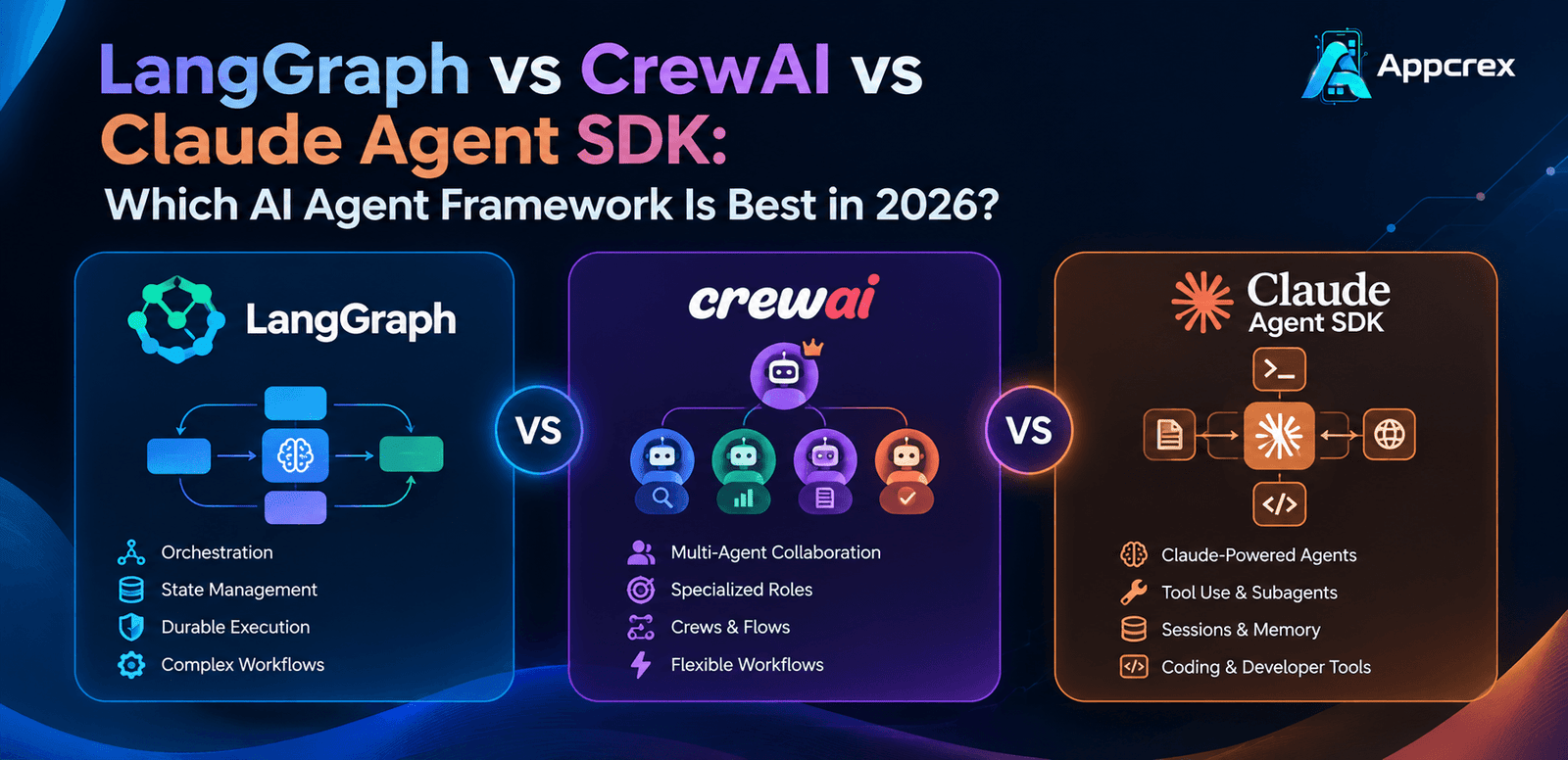
LangGraph focuses on low-level orchestration, state management, durable execution, and complex agent workflows. CrewAI emphasizes collaborative multi-agent systems where specialized agents work together as a team. Claude Agent SDK is designed around Claude-powered agents with tools, sessions, subagents, and coding-oriented capabilities.
So, which one should you choose?
This guide compares LangGraph vs CrewAI vs Claude Agent SDK across architecture, features, scalability, flexibility, use cases, development complexity, and business requirements.
Just Read : AI Agent Integration Services: Complete Guide to AI-Powered Business Integration
What Are LangGraph, CrewAI and Claude Agent SDK?
Before comparing them, it is important to understand what each technology is designed to solve.
What Is LangGraph?
LangGraph is an open-source agent orchestration framework and runtime from the LangChain ecosystem.
Rather than hiding the execution process behind a high-level abstraction, LangGraph gives developers control over the state, nodes, edges, execution paths, persistence, and agent behavior.
It is particularly useful for long-running and stateful AI agents where reliability and control are important. LangGraph provides capabilities such as durable execution, persistence, streaming, memory, and human-in-the-loop workflows.
For example, a business could use LangGraph to build an AI support agent that:
- Receives a customer request
- Identifies the issue
- Searches the knowledge base
- Checks customer information
- Decides whether escalation is necessary
- Requests human approval
- Updates the CRM
- Sends a final response
The developer can explicitly control how the agent moves through these steps.
What Is CrewAI?
CrewAI is a Python framework focused on creating collaborative teams of AI agents.
Instead of thinking about one agent performing every task, CrewAI allows developers to define multiple specialized agents with different roles, goals, tools, and responsibilities.
For example:
- Research Agent
- Data Analyst Agent
- Content Agent
- SEO Agent
- Reviewer Agent
These agents can collaborate to complete a larger objective.
CrewAI has two important concepts: Crews and Flows.
Crews are designed for autonomous collaboration between agents, while Flows provide more structured control over execution, state, events, conditional logic, and workflows.
This makes CrewAI particularly attractive for multi-agent automation and collaborative AI workflows.
What Is Claude Agent SDK?
Claude Agent SDK is Anthropic’s development approach for building agents powered by Claude.
The SDK provides mechanisms for agents to work with tools and interact with environments rather than simply generating text. Anthropic’s documentation also describes agents, tools, sessions, subagents, and dynamic workflows as important parts of its agent architecture.
The important distinction is that the Claude Agent SDK is closely tied to the Claude ecosystem.
A Claude agent can use tools, interact with files, execute commands, work with MCP servers, and perform multi-step tasks. Anthropic’s current tooling also supports built-in tools such as Bash, Read, Write, Edit, Glob, Grep, web search, and web fetch in its managed-agent environment.
This makes it especially interesting for coding agents, developer tools, research agents, and Claude-native autonomous workflows.
LangGraph vs CrewAI vs Claude Agent SDK: Quick Comparison
| Feature | LangGraph | CrewAI | Claude Agent SDK |
|---|---|---|---|
| Primary focus | Agent orchestration | Multi-agent collaboration | Claude-powered agents |
| Architecture | Graph/state-based | Crews + Flows | Agent + tools + sessions |
| Multi-agent support | Yes | Core strength | Yes, including subagents |
| Workflow control | Very high | High | High |
| Stateful workflows | Excellent | Supported | Session-based |
| Human-in-the-loop | Strong | Supported | Permission/confirmation mechanisms |
| Model flexibility | Very high | High | Claude-focused |
| Coding agents | Possible | Possible | Strong fit |
| Complex workflows | Excellent | Excellent | Excellent |
| Learning curve | Higher | Moderate | Moderate |
| Best for | Production orchestration | AI agent teams | Claude-native agents |
The biggest difference is not simply “which framework has more features.” The real question is where you want the intelligence and control to live.
LangGraph vs CrewAI vs Claude Agent SDK: Architecture
LangGraph Architecture
LangGraph represents workflows using states and execution nodes.
A simplified architecture can look like:
User → Router → Research → Tool → Decision → Human Review → Action → Response
Each component can update shared state.
This approach is useful when developers need precise control over execution.
LangGraph’s persistence layer can checkpoint graph state, enabling workflows to resume after interruptions or failures. It also supports human-in-the-loop patterns where execution can pause and later continue from saved state.
Best architectural advantage
Fine-grained orchestration and control.
CrewAI Architecture
CrewAI uses the concept of agents working together.
For example:
Manager Agent
↓
Research Agent → Analyst Agent → Writer Agent → Reviewer Agent
Each agent can have a specific role, goal, tools, and responsibilities.
CrewAI’s Flows can then control how these agents and tasks are connected.
This hybrid approach lets developers combine autonomous agent behavior with structured workflows.
Best architectural advantage
Natural multi-agent collaboration.
Claude Agent SDK Architecture
Claude Agent SDK follows a more agent-centric approach.
A Claude agent can reason about the task, decide which tools it needs, execute actions, inspect results, and continue working.
Anthropic’s tooling separates client-side tools from server-side tools. User-defined tools can be executed by the application, while Anthropic-provided server tools can execute on Anthropic infrastructure.
Claude agents can also use subagents for parallel or specialized work. Anthropic’s recent documentation describes single-agent, subagent, and dynamic-workflow approaches depending on who controls the next step of execution.
Best architectural advantage
Strong agent autonomy within the Claude ecosystem.
Also Read : Multi-Agent AI Development: Complete Guide to Architecture, Benefits, Cost & Use Cases
LangGraph vs CrewAI: Which Is Better for Multi-Agent Systems?
Both can build multi-agent systems, but their philosophies are different.
Choose LangGraph when:
- You need precise workflow control
- Agents have complex state
- You need durable execution
- Human approval is important
- Workflows must be highly auditable
- You need custom routing logic
- The workflow may run for a long time
LangGraph is particularly strong when the workflow itself is a critical part of the product.
Choose CrewAI when:
- Multiple agents need specialized roles
- You want a team-like agent architecture
- Agents need to collaborate
- You want to prototype multi-agent systems quickly
- Research, analysis, content, and decision-making agents need to work together
CrewAI’s own documentation positions Crews for autonomous collaboration and Flows for structured, deterministic execution.
Winner for multi-agent collaboration: CrewAI
Winner for orchestration control: LangGraph
LangGraph vs Claude Agent SDK
This comparison is particularly interesting because both can support sophisticated agent systems, but they sit at different abstraction levels.
LangGraph is designed to provide a general orchestration runtime.
Claude Agent SDK is more closely connected to Claude’s agent capabilities.
With LangGraph, developers can integrate different model providers and build custom orchestration logic.
With Claude Agent SDK, developers get a more Claude-centric experience, including Anthropic’s tools and agent capabilities.
Anthropic’s current managed-agent architecture also supports reusable agent configurations containing models, system prompts, tools, MCP servers, and skills.
Choose LangGraph if:
You want maximum control over the orchestration architecture and model layer.
Choose Claude Agent SDK if:
Your product is primarily built around Claude and you want to take advantage of Claude’s agent and tool ecosystem.
CrewAI vs Claude Agent SDK
CrewAI is generally more framework-oriented around agent teams.
Claude Agent SDK is more model/ecosystem-oriented.
For example, consider an AI research platform.
With CrewAI, you might create:
- Researcher Agent
- Fact Checker Agent
- Analyst Agent
- Writer Agent
With Claude Agent SDK, you might create a lead Claude agent capable of delegating work to subagents and using tools to perform research and analysis.
Neither approach is universally better.
The choice depends on whether you want your architecture to be centered around explicit agent roles or around Claude’s autonomous agent capabilities.
Human-in-the-Loop Comparison
Human oversight is becoming increasingly important for enterprise AI.
Imagine an AI agent wants to:
- Approve a refund
- Delete a database record
- Send an email
- Execute a financial transaction
- Modify production data
You may want a human to approve the action.
LangGraph
LangGraph has strong native support for interrupt-based human-in-the-loop workflows. Execution can pause, state can be persisted, and the workflow can resume after human approval or modification.
CrewAI
CrewAI supports human-in-the-loop triggers as part of its task and process capabilities, while Flows provide structured control over execution.
Claude Agent SDK
Anthropic’s agent ecosystem provides permission and confirmation mechanisms for tool execution. In its managed-agent architecture, permission policies can determine whether tools execute automatically or require approval.
Best choice for complex workflow-based HITL
LangGraph
Best choice for Claude-native tool approval
Claude Agent SDK
Which Is Easier to Learn?
Ease of development depends heavily on the developer’s background.
CrewAI
CrewAI can feel intuitive because its concepts resemble an organization:
Agent → Role → Task → Crew
This makes it approachable for developers who want to build multi-agent workflows without designing every low-level state transition.
LangGraph
LangGraph has a steeper learning curve because developers need to think about:
- State
- Nodes
- Edges
- Checkpoints
- Interrupts
- Execution paths
- Persistence
However, that additional complexity provides greater control.
Claude Agent SDK
Developers already familiar with Claude and tool calling may find Claude Agent SDK relatively natural. The complexity increases when building sophisticated workflows involving subagents, tools, permissions, sessions, and dynamic orchestration.
Which Framework Is More Flexible?
For model flexibility, LangGraph has a major advantage.
It is designed as an orchestration runtime rather than a single-model framework, so it can be used with different model providers and components.
CrewAI is also flexible and independent of LangChain, according to its documentation.
Claude Agent SDK is naturally more focused on the Claude ecosystem.
Therefore:
Model flexibility: LangGraph
Multi-agent flexibility: CrewAI
Claude-native capabilities: Claude Agent SDK
Which Is Best for Enterprise AI Agents?
Enterprise AI systems often require:
- Reliability
- Security
- Observability
- Human approval
- Persistent state
- Error recovery
- API integrations
- Auditability
- Scalability
LangGraph is particularly strong when the enterprise application requires explicit control over long-running workflows and state.
CrewAI is attractive for enterprise automation where several specialized AI agents need to collaborate.
Claude Agent SDK can be an excellent choice when an organization wants to build Claude-centric agents that interact with tools, files, coding environments, or MCP-based systems.
The correct choice ultimately depends on the architecture rather than simply choosing the framework with the most features.
LangGraph vs CrewAI vs Claude Agent SDK: Use Cases
Use LangGraph For
- Enterprise AI workflows
- Customer support agents
- Healthcare AI workflows
- Financial AI systems
- Approval-based automation
- Complex research agents
- Stateful conversational agents
- Long-running processes
- Multi-step business automation
Use CrewAI For
- Multi-agent research
- Content automation
- Marketing automation
- Business intelligence
- Competitive analysis
- Data analysis
- Autonomous AI teams
- Multi-agent decision systems
Use Claude Agent SDK For
- Coding agents
- Developer assistants
- AI research agents
- File-based automation
- Autonomous coding workflows
- Claude-powered enterprise assistants
- MCP-enabled agents
- Tool-using AI systems
Anthropic’s current agent tooling includes capabilities for filesystem interaction, command execution, web access, and other tools, making it particularly relevant for coding and computer-use-style workflows.
Performance and Scalability
Performance should not be judged only by how quickly an agent responds.
For production AI agents, developers should consider:
- Number of model calls
- Tool execution time
- State management
- Retry behavior
- Failure recovery
- Token usage
- Parallel execution
- Workflow complexity
- Infrastructure requirements
LangGraph is particularly suitable for long-running workflows because its persistence and checkpointing mechanisms can help recover and resume execution.
CrewAI can be effective when work can be divided among specialized agents and tasks.
Claude Agent SDK can be effective for autonomous Claude workflows where the agent itself determines which tools or subagents to use.
LangGraph vs CrewAI vs Claude Agent SDK: Pros and Cons
LangGraph
Pros
- Excellent workflow control
- Strong state management
- Durable execution
- Human-in-the-loop support
- Good for complex production systems
- High model flexibility
Cons
- Higher learning curve
- Requires more architectural planning
- Can require more development effort for simple agents
CrewAI
Pros
- Excellent multi-agent architecture
- Role-based agent design
- Easy-to-understand concepts
- Crews and Flows provide flexibility
- Good for collaborative AI workflows
Cons
- Multi-agent systems can become complex
- Autonomous collaboration can require careful testing
- Complex stateful workflows may require more architecture
Claude Agent SDK
Pros
- Strong Claude integration
- Powerful tool-use capabilities
- Good fit for coding agents
- Supports agent and subagent workflows
- MCP integration
- Strong ecosystem for Claude-based agents
Cons
- More dependent on the Claude ecosystem
- Less suitable when broad model-provider neutrality is a primary requirement
- Advanced agent workflows still require careful orchestration
Which One Should You Choose in 2026?
There is no single winner.
Instead, choose based on the problem you are solving.
| Requirement | Recommended Choice |
|---|---|
| Complex stateful workflow | LangGraph |
| Maximum orchestration control | LangGraph |
| Human approval workflows | LangGraph |
| Multi-agent team | CrewAI |
| Role-based agents | CrewAI |
| Autonomous AI collaboration | CrewAI |
| Claude-first development | Claude Agent SDK |
| Coding agent | Claude Agent SDK |
| Claude + MCP workflows | Claude Agent SDK |
| Multi-model architecture | LangGraph |
| Structured business workflow | LangGraph / CrewAI Flows |
| Autonomous research team | CrewAI / Claude Agent SDK |
LangGraph vs CrewAI vs Claude Agent SDK: Final Verdict
The best framework depends on the type of AI agent you want to build.
LangGraph is the strongest choice when your priority is control, state, reliability, persistence, and complex orchestration.
CrewAI is a strong option when your priority is multi-agent collaboration and role-based AI teams.
Claude Agent SDK is the natural choice when your priority is building powerful Claude-centric agents that can use tools, work with files, execute tasks, and coordinate subagents.
A simple way to remember the difference is:
LangGraph = Control
CrewAI = Collaboration
Claude Agent SDK = Claude-powered autonomy
For a production system, the decision should also consider your model strategy, existing tech stack, infrastructure, security requirements, development team, and expected workload.
FAQs
Q. Is LangGraph better than CrewAI?
Not universally. LangGraph is generally better when you need detailed control over state, execution, persistence and workflow orchestration. CrewAI is often more convenient when the primary requirement is collaborative multi-agent behavior.
Q. Is CrewAI better than LangGraph for multi-agent AI?
CrewAI has a strong focus on multi-agent collaboration and role-based teams, making it a natural choice for many multi-agent use cases. LangGraph can also build multi-agent systems but provides more low-level orchestration control.
Q. Is Claude Agent SDK a framework like LangGraph?
They overlap in agent-building capabilities but are positioned differently. LangGraph is a general orchestration runtime, while Claude Agent SDK is closely aligned with Anthropic’s Claude agent ecosystem.
Q. Can LangGraph work with Claude?
Yes. LangGraph can be used as an orchestration layer while integrating Claude as the underlying model.
Q. Can CrewAI use Claude?
Yes. CrewAI supports integrations with different LLM providers, so Claude can be used within CrewAI-based systems.
Q. Which is best for AI agent development?
There is no universal winner. Choose LangGraph for sophisticated orchestration, CrewAI for collaborative agent teams, and Claude Agent SDK for Claude-focused autonomous agents.
Q. Which framework should a startup choose?
For a startup building a straightforward multi-agent automation system, CrewAI can be a practical starting point. For a product requiring complex stateful workflows and long-term reliability, LangGraph may be a stronger foundation. If the product is specifically built around Claude and tool-driven autonomous work, Claude Agent SDK may be the better fit.
Conclusion
The AI agent ecosystem is moving toward more capable, autonomous and specialized systems. As a result, choosing the right agent framework has become an important architectural decision.
LangGraph, CrewAI and Claude Agent SDK are not simply three competing libraries. They represent different approaches to building agentic systems.
LangGraph gives developers granular control over orchestration and state. CrewAI makes it easier to design collaborative AI teams. Claude Agent SDK provides a Claude-focused environment for building agents that can use tools, work with external systems and coordinate complex tasks.
Before selecting a framework, evaluate the complexity of your workflow, model requirements, tool integrations, human approval needs, scalability goals and long-term maintenance requirements.
For businesses planning to build production-ready AI agents, choosing the framework should be based on the actual architecture and business objective, rather than popularity alone.
Build Custom AI Agents With AppCrex
If you are planning to build a custom AI agent, multi-agent platform, AI automation system or enterprise AI workflow, AppCrex can help you select the right architecture and technology stack based on your business requirements.
From AI agent development and LLM integration to custom automation, API integration and production deployment, the right architecture can turn an AI concept into a scalable business solution.