📌 Key Takeaways
- A Namshi-like MVP can start from around $40,000–$70,000.
- Search, product discovery, checkout, payments and delivery are core features.
- AI can improve recommendations, styling and personalized shopping.
- Marketplace, logistics and multi-country support increase development costs.
- Start with an MVP and add advanced fashion-commerce features as the business grows.
Introduction
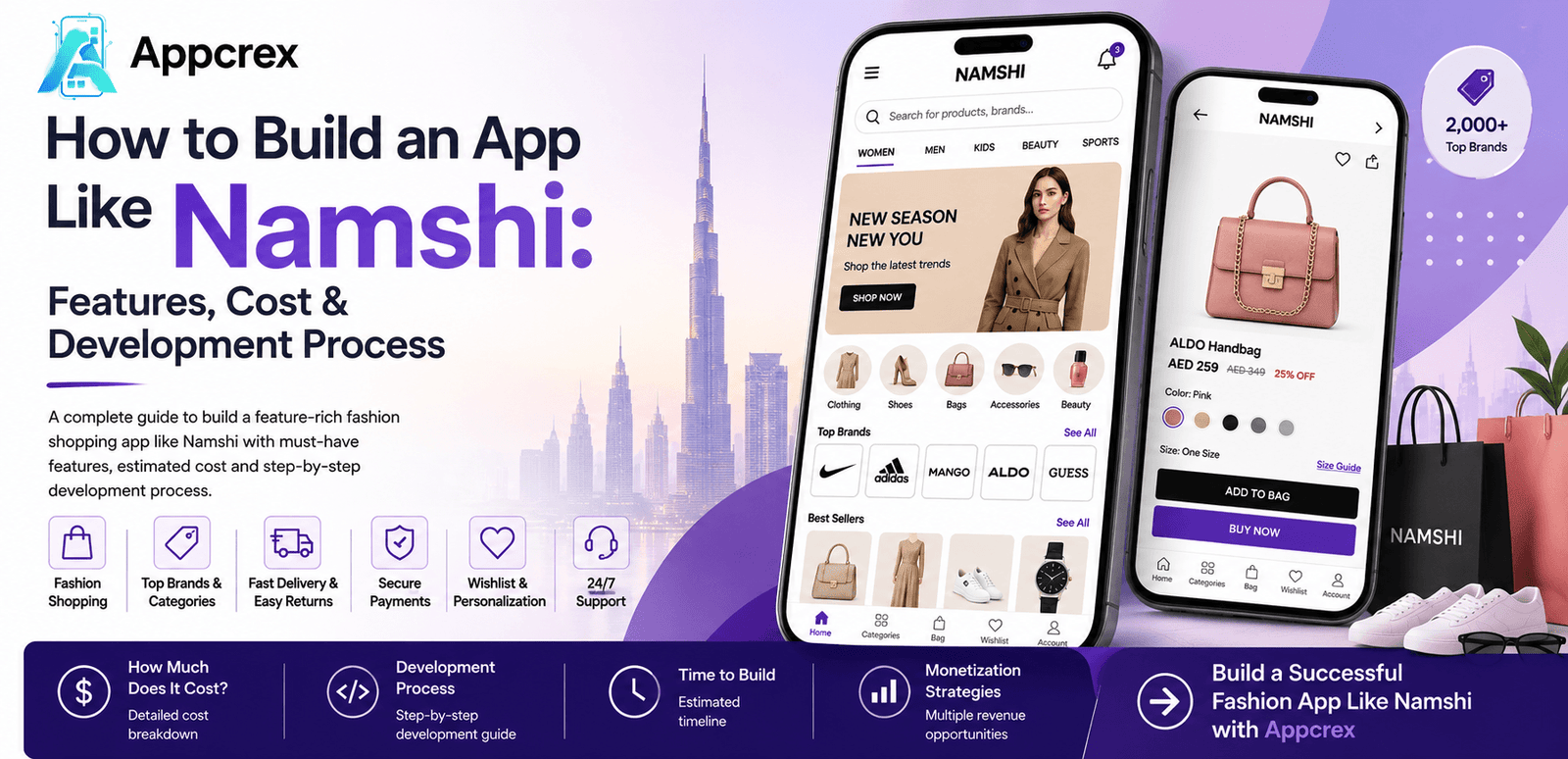
Namshi is a strong example of a fashion-focused eCommerce platform serving customers across the GCC. Its current platform features fashion, shoes, accessories, sports, beauty, kids, premium and sale categories, and promotes a catalog of more than 2,000 brands. It also supports features such as cash on delivery, fast delivery, returns and exchanges, and multiple payment options.
For entrepreneurs, this creates an opportunity to build a fashion shopping app like Namshi with a differentiated product, localized shopping experience, personalized recommendations, and a scalable eCommerce backend.
So, how much does it cost to build an app like Namshi?
A basic fashion eCommerce MVP can cost approximately $40,000–$70,000, while a more advanced platform can reach $120,000–$200,000+ depending on features, integrations, platforms, design, logistics, and backend complexity.
This guide covers the Namshi-like app development cost, features, business model, technology stack, development process, timeline, monetization strategies, and ways to reduce development costs.
Just Read :Hire Mobile App Developers in Dubai: A Complete Guide for Businesses in 2026
How Much Does It Cost to Build an App Like Namshi?
The development cost depends on the complexity of the shopping experience and the infrastructure behind it.
| App Type | Estimated Cost | Development Time |
|---|---|---|
| Basic Fashion eCommerce MVP | $40,000–$70,000 | 3–5 months |
| Standard Fashion Shopping App | $70,000–$120,000 | 5–8 months |
| Advanced App Like Namshi | $120,000–$200,000+ | 8–12 months |
| Enterprise Fashion Marketplace | $200,000+ | 12+ months |
These are approximate software-development estimates. Third-party APIs, payment gateway charges, cloud infrastructure, logistics integrations, licenses, security audits, and post-launch maintenance can add to the overall investment.
For a startup, it is usually better to launch with a focused MVP rather than trying to reproduce every feature of a mature fashion platform from day one.
What Makes Namshi Different?
Namshi is positioned around fashion and lifestyle shopping rather than being a general marketplace.
Its current catalog includes categories such as:
- Women’s fashion
- Men’s fashion
- Kids
- Shoes
- Bags
- Accessories
- Sports
- Beauty
- Premium products
- Sale and outlet products
The platform also promotes more than 2,000 brands and highlights authenticity, fast delivery, cash on delivery, and free returns/exchanges.
This is important when planning a Namshi-like app because the objective should not simply be to create another shopping application. Instead, the product should provide a specialized fashion discovery and purchasing experience.
Why Build a Fashion Shopping App Like Namshi?
The fashion eCommerce market offers several opportunities for startups and established retailers.
A new platform can target:
- Luxury fashion
- Affordable fashion
- Sportswear
- Beauty products
- Kids’ fashion
- Modest fashion
- Local brands
- Sustainable fashion
- Designer products
- Fashion accessories
You can also build a region-specific platform for markets such as:
- UAE
- Saudi Arabia
- Qatar
- Kuwait
- Bahrain
- Oman
Namshi currently operates across several GCC markets, including the UAE, Saudi Arabia, Qatar, Oman, Bahrain and Kuwait.
Also read : How Much Does It Cost to Build an AI-Powered App in Dubai? Complete Pricing Guide (2026)
Must-Have Features of an App Like Namshi
1. User Registration and Login
Customers should be able to create an account using:
- Mobile number
- OTP
- Social login
- Passwordless authentication
The onboarding process should be quick because unnecessary registration steps can increase abandonment.
Namshi currently uses email-based OTP verification as part of account creation.
2. Personalized Home Screen
The home screen should immediately show relevant products and promotions.
It can include:
- New arrivals
- Trending products
- Recommended products
- Best sellers
- Deals
- Seasonal collections
- Recently viewed products
- Personalized recommendations
Personalization can be powered by customer browsing and purchase behavior.
3. Product Categories
A fashion marketplace needs a strong category structure.
For example:
Women → Clothing → Dresses → Evening Dresses
or
Men → Shoes → Sneakers → Running Shoes
Categories should also support filters and sorting.
4. Advanced Product Search
Search is one of the most important features of a fashion shopping app.
Users should be able to search by:
- Product
- Brand
- Category
- Color
- Size
- Price
- Style
AI-powered search can later allow natural-language queries such as:
“Show me black sneakers under 500 AED.”
5. Product Filters
Advanced filters can include:
- Brand
- Price
- Size
- Color
- Category
- Material
- Rating
- Discount
- Availability
Good filtering significantly improves product discovery.
6. Product Details Page
Every product should have a detailed page containing:
- Product images
- Multiple angles
- Product name
- Brand
- Price
- Discount
- Available sizes
- Colors
- Description
- Material
- Size guide
- Reviews
- Delivery information
- Return information
A fashion product page should provide enough information for customers to make a purchase without needing to contact support.
7. Product Image Gallery
Fashion products require strong visual presentation.
The app can provide:
- Multiple images
- Zoom
- Full-screen view
- Video
- Model images
- Product close-ups
- 360-degree views
High-quality images can improve customer confidence and conversion rates.
8. Wishlist
Customers should be able to save products for later.
The wishlist can also become a personalization tool.
For example, the app can notify customers when:
- A saved product is discounted
- The product is almost out of stock
- A preferred size becomes available
- A similar product is launched
Namshi currently provides a wishlist that allows users to save products and track price changes.
9. Shopping Bag
The shopping bag should display:
- Selected products
- Size
- Color
- Quantity
- Price
- Discount
- Shipping charges
- Estimated delivery
- Total amount
Users should be able to easily modify products before checkout.
10. Secure Checkout
A smooth checkout process is critical for fashion eCommerce.
The checkout flow can include:
Address → Delivery → Coupon → Payment → Order Confirmation
Namshi’s current checkout flow includes address selection, delivery options, coupon handling, payment selection and order placement.
Also Read : How Much Does It Cost to Build a Shopping App in 2026? Complete Development Guide
11. Multiple Payment Methods
A Namshi-like platform can support:
- Credit cards
- Debit cards
- Digital wallets
- Apple Pay
- Buy Now, Pay Later
- Cash on delivery
- Local payment methods
Namshi currently lists payment options including Mastercard, Visa, Cash on Delivery, Tabby, Tamara and Apple Pay in the UAE experience.
The exact payment methods should be selected according to the target market.
12. Buy Now, Pay Later
BNPL can be particularly useful for fashion shopping because customers may want to spread the cost of higher-value purchases.
A platform can integrate eligible providers such as:
- Tabby
- Tamara
- Other regional BNPL providers
The availability of each service depends on the country and commercial agreement.
13. Coupon and Discount Management
Customers can enter promotional codes during checkout.
The system should support:
- Percentage discounts
- Fixed discounts
- Brand-specific offers
- Category-specific offers
- First-order promotions
- Seasonal campaigns
- Minimum order requirements
14. Real-Time Order Tracking
Customers should be able to see:
Order Confirmed → Processing → Packed → Shipped → Out for Delivery → Delivered
Namshi currently provides order tracking with delivery dates, tracking information and status updates.
15. Fast and Scheduled Delivery
A fashion shopping app can provide different delivery options.
For example:
- Standard delivery
- Next-day delivery
- Same-day delivery
- Scheduled delivery
- Pickup points
- Locker delivery
Namshi currently offers same-day and next-day delivery options in eligible locations for an additional fee.
16. Returns and Exchanges
Fashion eCommerce requires a strong returns system because customers may receive an item that doesn’t fit or match expectations.
The app should allow users to:
- Select an order
- Select a product
- Choose a return reason
- Select pickup
- Request an exchange
- Track the return
- Receive refund updates
Namshi currently supports return and exchange requests through its website and mobile app.
17. Refund Management
The system should support different refund methods.
Depending on the original payment method, refunds may go to:
- Bank account
- Wallet
- BNPL provider
Namshi’s current refund process varies by payment method, with card refunds, wallet refunds and refunds through Tabby/Tamara handled differently.
18. Reviews and Ratings
Customers should be able to review:
- Product quality
- Size
- Fit
- Material
- Overall experience
Verified reviews can increase customer trust.
19. Size Guide
Fashion customers often hesitate because they are unsure about sizing.
A size guide can provide:
- Clothing measurements
- Shoe sizes
- Brand-specific sizing
- International size conversion
An advanced app can also use AI-based fit recommendations.
20. Push Notifications
Notifications can inform users about:
- New arrivals
- Order updates
- Discounts
- Wishlist price drops
- Restocked products
- Abandoned carts
- Personalized recommendations
Notifications should be personalized instead of overwhelming customers.
21. Multi-Language Support
A GCC-focused fashion application can support:
- English
- Arabic
Additional languages can be added depending on the target audience.
A right-to-left Arabic interface should be designed properly rather than simply translating the text.
22. Multi-Currency Support
For international or GCC-focused platforms, the app can support multiple currencies.
Examples include:
- AED
- SAR
- QAR
- KWD
- BHD
- OMR
Currency and tax calculations should be handled centrally by the backend.
23. Store Locator
If the business operates physical stores, users can search for:
- Nearby stores
- Outlet locations
- Opening hours
- Directions
- Available services
This creates an omnichannel shopping experience.
24. Customer Support
The app can provide:
- FAQs
- Live chat
- AI chatbot
- Email support
- Phone support
- Order support
- Return support
AI can handle repetitive questions while complex cases can be transferred to human agents.
Advanced Features for a Namshi-Like App
Once the core shopping experience is stable, advanced capabilities can make the platform more competitive.
AI Fashion Recommendations
AI can recommend products based on:
- Browsing history
- Previous purchases
- Wishlist
- Preferred brands
- Colors
- Sizes
- Price range
Visual Search
Customers can upload a photo and find visually similar products.
For example:
Upload a sneaker image → Find similar sneakers available on the platform.
Virtual Try-On
AR technology can allow customers to visualize certain fashion products before purchasing.
AI Stylist
An AI stylist can answer:
“I need an outfit for a business dinner.”
It could recommend matching:
- Shirt
- Trousers
- Shoes
- Watch
- Accessories
Personalized Fashion Feed
Instead of showing the same home page to everyone, the app can generate a personalized fashion feed.
Admin Panel Features
The customer app is only one part of the platform.
A complete Namshi-like system also requires an admin dashboard.
Administrators should be able to manage:
- Products
- Brands
- Categories
- Inventory
- Orders
- Customers
- Payments
- Discounts
- Coupons
- Returns
- Refunds
- Delivery
- Reviews
- Notifications
- Analytics
Vendor Panel for a Fashion Marketplace
If you are building a marketplace rather than a single-brand store, vendors need their own dashboard.
Vendors can:
- Upload products
- Manage inventory
- Update prices
- Process orders
- View sales
- Manage returns
- View customer reviews
- Track payments
This significantly increases the development scope compared with a single-retailer app.
Technology Stack for a Namshi-Like App
Mobile App Development
You can use:
- Flutter
- React Native
- Kotlin
- Swift
Flutter and React Native can be suitable when launching Android and iOS applications with a shared codebase.
Frontend
Possible technologies include:
- React
- Next.js
- TypeScript
These are suitable for building responsive web shopping experiences and admin dashboards.
Backend
Possible backend technologies include:
- Node.js
- Java
- Python
- PHP/Laravel
The backend should be designed for product catalogs, inventory, orders, payments, users and real-time tracking.
Database
Possible technologies include:
- PostgreSQL
- MySQL
- MongoDB
- Redis
Redis can also be used for caching and improving performance.
Cloud Infrastructure
Potential providers include:
- AWS
- Google Cloud
- Microsoft Azure
Cloud infrastructure can support:
- Application servers
- Database
- Storage
- CDN
- Load balancing
- Monitoring
- Backups
Also Read : Marketplace App Development Company Dubai: Complete Guide to Features, Cost & Development Process
How Does a Namshi-Like App Work?
A simplified eCommerce architecture looks like:
Customer App → API Layer → Backend → Product Database → Inventory → Payment → Order Management → Delivery
For a purchase:
Browse Product → Select Size → Add to Bag → Checkout → Payment → Order Creation → Warehouse → Delivery → Tracking
For returns:
Order → Return Request → Pickup → Quality Check → Approval → Refund
This complete workflow must be designed carefully because fashion eCommerce involves more than just product listings and payments.
How to Build an App Like Namshi?
Step 1: Define Your Business Model
First decide whether you want to build:
- Single-brand fashion store
- Multi-vendor marketplace
- Fashion aggregator
- Luxury fashion marketplace
- Regional fashion platform
This decision affects the entire backend architecture.
Step 2: Research Your Target Market
Identify:
- Customer demographics
- Popular categories
- Local brands
- Competitors
- Payment preferences
- Delivery expectations
- Return behavior
For example, a UAE fashion marketplace may require a different payment and logistics strategy than one targeting India.
Step 3: Create the MVP
Start with:
- Registration
- Product catalog
- Search
- Filters
- Product details
- Wishlist
- Shopping bag
- Checkout
- Payment
- Order tracking
- Returns
- Admin panel
Step 4: Design UI/UX
Create interfaces for:
- Home
- Categories
- Search
- Product details
- Wishlist
- Bag
- Checkout
- Orders
- Profile
- Returns
The design should prioritize fashion discovery and quick checkout.
Step 5: Develop the Backend
Build:
- User management
- Product management
- Inventory
- Cart
- Orders
- Payments
- Coupons
- Delivery
- Returns
- Notifications
Step 6: Integrate Payments
Connect the required payment gateways and local payment options.
Step 7: Integrate Logistics
Connect the app with logistics partners for:
- Shipping
- Tracking
- Pickup
- Returns
- Delivery status
Step 8: Implement Security
Important security measures include:
- Secure authentication
- Encryption
- API security
- Payment security
- Access controls
- Fraud detection
- Secure data storage
Step 9: Test the Application
Testing should cover:
- Product browsing
- Search
- Checkout
- Payments
- Coupons
- Inventory
- Orders
- Tracking
- Returns
- Refunds
- Notifications
Performance testing is especially important before a major sale or promotional campaign.
Step 10: Launch and Scale
Launch the MVP, monitor customer behavior, collect feedback, and gradually introduce advanced features.
How Long Does It Take to Build an App Like Namshi?
| Development Scope | Estimated Timeline |
|---|---|
| Basic Fashion eCommerce MVP | 3–5 months |
| Standard Fashion App | 5–8 months |
| Advanced Namshi-Like Platform | 8–12 months |
| Large Fashion Marketplace | 12–18+ months |
A marketplace with multiple vendors, complex inventory, logistics, AI, AR, multi-country support, and multiple currencies will require additional development time.
Cost Breakdown
A rough budget could look like this:
| Development Component | Estimated Cost |
|---|---|
| UI/UX Design | $5,000–$12,000 |
| Android & iOS App | $20,000–$40,000 |
| Backend Development | $20,000–$40,000 |
| Product & Inventory System | $10,000–$20,000 |
| Payment Integration | $5,000–$12,000 |
| Logistics Integration | $7,000–$15,000 |
| Admin Panel | $8,000–$15,000 |
| Testing & Security | $8,000–$20,000 |
| DevOps & Deployment | $5,000–$12,000 |
The final investment depends on the number of platforms, features, integrations, and development team location.
Also Read : AI & ML Development Company: Complete Guide to Services, Cost & Development Process
What Factors Increase the Development Cost?
AI Features
AI recommendations, visual search, AI styling and personalization require additional development and infrastructure.
Multi-Vendor Architecture
A marketplace requires vendor onboarding, commissions, payouts, product approvals and vendor analytics.
Advanced Logistics
Real-time tracking, multiple carriers, warehouses and return pickups add complexity.
AR Virtual Try-On
AR-based shopping experiences can significantly increase development costs.
Multi-Country Support
Supporting multiple countries requires:
- Currency
- Taxes
- Payment methods
- Shipping rules
- Languages
- Return policies
Business Model of a Namshi-Like App
A fashion eCommerce platform can generate revenue through several channels.
Product Sales
The primary revenue stream can come from direct product sales.
Brand Commission
For a marketplace, the platform can charge vendors a percentage of every sale.
Featured Products
Brands can pay to display their products prominently.
Advertising
Fashion brands can purchase:
- Banner ads
- Sponsored products
- Campaign placements
- Category promotions
Membership
A premium membership can provide:
- Free shipping
- Exclusive discounts
- Early access
- Priority customer support
Private Label
A platform can eventually launch its own fashion brands or private-label products.
How to Make Your Fashion App Better Than a Namshi Clone?
Simply copying an established platform is unlikely to create a strong competitive advantage.
Instead, consider a unique positioning strategy.
AI-First Fashion Shopping
Make AI recommendations and styling the core experience.
Modest Fashion Marketplace
Focus on abayas, hijabs, modest clothing and related products.
Luxury Fashion
Target premium and designer brands.
Sustainable Fashion
Focus on environmentally responsible brands and products.
Local Fashion Brands
Create a marketplace for emerging regional designers.
Personalized Shopping
Build the entire home screen around individual customer preferences.
This creates a stronger reason for users to choose your app.
How to Reduce the Cost of Development?
Start with a carefully planned MVP.
Instead of launching:
Shopping + AI + AR + Marketplace + Social + Live Shopping
start with:
Catalog + Search + Product Details + Wishlist + Cart + Checkout + Payments + Orders
After acquiring customers, add:
AI Recommendations → Loyalty → Advanced Logistics → Visual Search → AR → Social Commerce
This approach can reduce initial development costs while allowing the product to evolve according to actual customer demand.
Why Choose AppCrex for Fashion eCommerce App Development?
AppCrex can help businesses build custom fashion eCommerce applications and marketplaces for regional and international markets.
Services can include:
- Fashion eCommerce App Development
- Shopping App Development
- Marketplace Development
- iOS App Development
- Android App Development
- Cross-Platform App Development
- AI Recommendation Development
- Payment Gateway Integration
- Logistics Integration
- Inventory Management
- Order Management
- Vendor Dashboard
- Admin Panel Development
- Push Notification Integration
- AR/Virtual Try-On Development
- Multilingual App Development
- Multi-Currency eCommerce
- Cloud Backend Development
- Maintenance & Support
Whether you want to launch a fashion marketplace, luxury shopping app, regional clothing platform, or AI-powered fashion commerce solution, AppCrex can help turn your concept into a scalable digital product.
Build Your Fashion Shopping App Like Namshi
The cost to build an app like Namshi can range from approximately $40,000 to $70,000 for an MVP and $120,000 to $200,000+ for an advanced platform.
The biggest cost drivers are not only the mobile application but also the backend systems behind inventory, payments, logistics, returns, refunds, personalization, and marketplace operations.
Namshi’s current shopping experience demonstrates how a fashion platform can combine a large brand catalog with features such as multiple categories, fast delivery, cash on delivery, returns and exchanges, and multiple payment methods.
For entrepreneurs, the best approach is to identify a specific market opportunity first and then build an MVP around it. Once the core shopping experience is working, advanced features such as AI fashion recommendations, visual search, virtual try-on, personalized feeds, multilingual support, loyalty programs, and social commerce can be added.
A successful fashion eCommerce app is ultimately not just about selling products. It is about creating a fast, personalized, visually engaging and trustworthy shopping experience.
Want to build a fashion eCommerce app like Namshi? Contact AppCrex to discuss your features, technology stack, development timeline and estimated budget.
FAQs
Q. How much does it cost to build an app like Namshi?
A basic fashion eCommerce MVP can cost around $40,000–$70,000, while an advanced platform can cost $120,000–$200,000+.
Q. How long does it take to build a Namshi-like app?
A basic version may take 3–5 months, while an advanced fashion marketplace can take 8–18 months or longer.
Q. What are the main features of a Namshi-like app?
Important features include product search, filters, product pages, wishlist, shopping bag, checkout, multiple payments, order tracking, delivery, returns, refunds, reviews and notifications.
Q. Can I build a fashion marketplace instead of a single-brand app?
Yes. A multi-vendor marketplace can allow multiple brands and sellers to list and sell their products. However, vendor management, commissions, payouts and inventory introduce additional development complexity.
Q. Can AI be added to a fashion shopping app?
Yes. AI can provide personalized product recommendations, fashion styling, visual search, size recommendations, customer support and personalized shopping feeds.
Q. Can I integrate AR virtual try-on?
Yes. AR can be integrated for selected product categories where virtual visualization provides genuine value.
Q. Can the app support Arabic and English?
Yes. A GCC-focused fashion app can support Arabic and English, including a properly designed right-to-left Arabic interface.
Q. Can the app support multiple currencies?
Yes. Multi-currency functionality can be implemented for businesses operating across different countries.
Q. Can AppCrex build a fashion shopping app like Namshi?
Yes. AppCrex can build custom fashion eCommerce apps and marketplaces with mobile apps, backend systems, payment integrations, logistics, AI features, admin dashboards and ongoing support.