📌 Key Takeaways
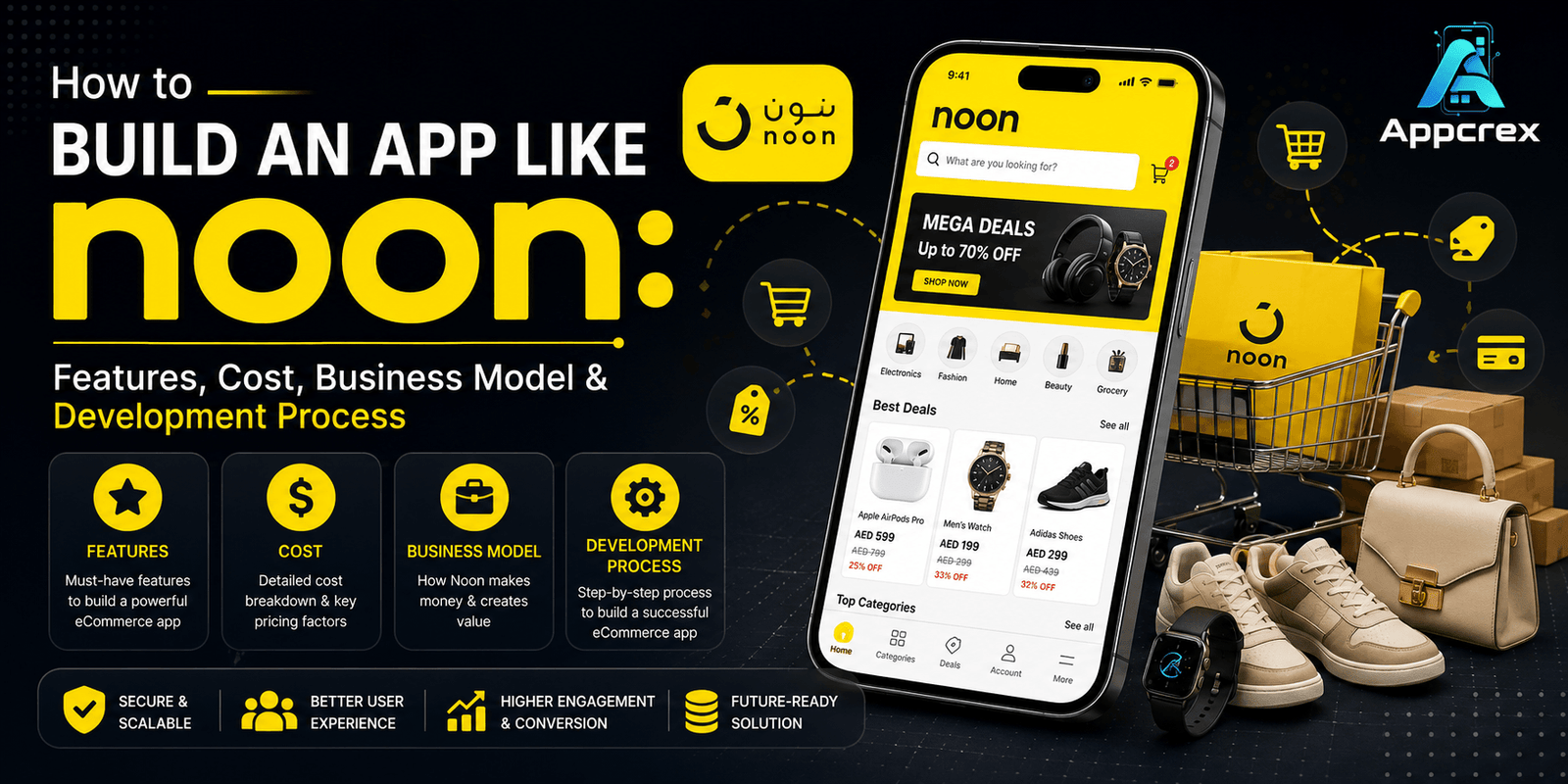
- A Noon-like eCommerce MVP can start at approximately $35,000–$60,000.
- Multi-vendor functionality makes the backend considerably more complex than a standard shopping app.
- Search, inventory, payments, APIs, and order management are core technical components.
- AI can improve product discovery, recommendations, search, demand forecasting, and fraud detection.
- Launching an MVP first is the most practical way to control development cost and validate the marketplace.
Introduction
The Middle East has become one of the most interesting markets for mobile-first commerce. Customers increasingly expect more than a traditional online store: they want a wide product catalog, fast delivery, flexible payments, personalized recommendations, easy returns, and a seamless mobile shopping experience.
A strong example is noon, a large regional online marketplace serving categories including electronics, fashion, beauty, home, groceries, and other everyday products. Its ecosystem also extends into food, fast grocery delivery, subscriptions, and on-demand delivery services.
For entrepreneurs, this creates an opportunity to build a multi-vendor eCommerce app like Noon with a localized marketplace model and additional services.
But a Noon-like platform is much more complex than a standard shopping app. It requires a customer-facing mobile experience, seller management, inventory synchronization, payment processing, logistics, order management, search infrastructure, notifications, analytics, and a scalable backend.
This guide explains how to build an app like Noon, including features, development cost, technology stack, business model, AI opportunities, technical architecture, development process, and ways to launch an MVP without spending the entire budget upfront.
Just Read : How Much Does It Cost to Build an AI-Powered App in Dubai? Complete Pricing Guide (2026)
How Much Does It Cost to Build an App Like Noon?
The cost depends primarily on the number of platforms, marketplace functionality, logistics requirements, integrations, and level of automation.
| Development Level | Estimated Cost | Approx. Timeline |
|---|---|---|
| Basic eCommerce MVP | $35,000–$60,000 | 4–6 months |
| Multi-Vendor Marketplace | $60,000–$110,000 | 6–9 months |
| Advanced Noon-Like Platform | $110,000–$200,000+ | 9–14 months |
| Large Multi-Service Ecosystem | $200,000–$350,000+ | 14–20+ months |
These are indicative development ranges rather than fixed quotations. Native iOS and Android development, advanced logistics, AI, real-time tracking, ERP integrations, and multiple payment providers can increase the overall budget.
What Makes a Noon-Like App Different From a Normal eCommerce App?
A traditional eCommerce application may have one business selling its own inventory.
A Noon-style platform can operate more like a digital marketplace, where multiple sellers can list products while the platform manages the customer experience, payments, discovery, and parts of fulfillment.
Third-party marketplace items, for example, can have seller-managed listings, stock, and pricing.
That creates several separate systems:
Customer App
↓
Marketplace & Search Engine
↓
Seller Platform
↓
Inventory & Order Management
↓
Payment & Fulfillment
↓
Delivery Network
The backend therefore becomes just as important as the mobile application.
Core Features of a Noon-Like Shopping App
1. Customer Registration
Users should be able to create accounts through:
- Mobile number
- OTP
- Apple
A secure authentication service should manage sessions, tokens, password recovery, and device verification.
For larger platforms, OAuth 2.0, JWT-based authentication, role-based authorization, and API security can be considered as part of the backend architecture.
Just Read : Digital Wallet App Development: Complete Guide to Features, Cost, Security & Trends (2026)
2. Personalized Home Screen
Instead of showing the same homepage to every user, the application can personalize content based on:
- Previous purchases
- Browsing history
- Favorite categories
- Location
- Price range
- Search behavior
- Seasonal interests
The homepage can include:
- Recommended products
- Flash deals
- Recently viewed products
- Popular categories
- Personalized offers
- New arrivals
This is where recommendation engines can provide a major advantage.
3. Product Search and Discovery
Search is one of the most important technical components of a marketplace containing thousands or millions of products.
Users should be able to search by:
- Product name
- Brand
- Category
- SKU
- Product type
- Seller
A scalable search architecture can use technologies such as Elasticsearch or OpenSearch for fast indexing and filtering.
Search results can be ranked using:
- Relevance
- Popularity
- Availability
- Price
- Ratings
- Seller quality
- Customer behavior
4. Advanced Filters
Users should be able to narrow products using:
- Price
- Brand
- Rating
- Category
- Color
- Size
- Availability
- Delivery time
- Seller
- Discount
For example, a customer searching for a laptop might filter by:
Brand → RAM → Storage → Screen Size → Price → Rating
The filtering system should be optimized so that users receive results quickly even when the product catalog becomes very large.
5. Product Detail Page
A detailed product page can include:
- Product images
- Videos
- Product description
- Specifications
- Price
- Discount
- Seller
- Ratings
- Reviews
- Availability
- Delivery estimate
- Return information
- Warranty
The platform should also show important delivery information before checkout. On Noon, available delivery options and estimated dates can vary by product, location, and fulfillment method.
6. Wishlist
Users can save products they are interested in.
A wishlist can support:
- Price-drop alerts
- Stock alerts
- Personalized recommendations
- Promotional notifications
It can also provide useful behavioral data for the recommendation engine.
7. Shopping Cart
The cart needs to support multiple products, potentially from different sellers.
It should calculate:
- Product price
- Quantity
- Discounts
- Taxes
- Shipping
- Delivery charges
- Coupons
- Final amount
The backend should always validate pricing and inventory before accepting an order.
8. Secure Checkout
A streamlined checkout can include:
- Delivery address
- Shipping option
- Payment method
- Coupon
- Order summary
- Final confirmation
A simple checkout experience is important because unnecessary steps can increase cart abandonment.
Noon’s own buying flow follows a similar progression from product selection to cart, delivery address, payment/order review, and order placement.
9. Multiple Payment Methods
A marketplace can support:
- Credit cards
- Debit cards
- Digital wallets
- Cash on delivery
- Buy Now, Pay Later
- Installment payments
The UAE market can support localized payment options, while international expansion may require additional gateways.
Payment information should be processed through secure payment providers rather than storing sensitive card data unnecessarily in the application backend.
10. Order Management
After checkout, an order may move through:
Order Placed → Confirmed → Processing → Packed → Shipped → Out for Delivery → Delivered
The order-management service should maintain the state of every order and synchronize updates between customers, sellers, warehouse systems, and delivery operations.
For multi-vendor orders, the system may also need to split a single customer cart into multiple fulfillment orders.
11. Real-Time Order Tracking
Customers want visibility after placing an order.
Tracking can show:
- Order status
- Estimated delivery
- Shipment progress
- Delivery partner
- Location where appropriate
- Notifications
Real-time updates can be implemented using WebSockets, event-driven architecture, push notifications, and location APIs.
12. Seller Registration
A multi-vendor marketplace needs a seller onboarding system.
Sellers can submit:
- Business information
- Contact details
- Trade license
- Identity documents
- Bank details
- Product categories
The exact requirements depend on the market and business model.
For example, Noon’s UAE seller onboarding includes business and identity documentation.
Also Read : How Much Does It Cost to Build a Shopping App in 2026? Complete Development Guide
13. Seller Dashboard
The seller portal is a major component of a Noon-like platform.
Sellers should be able to:
- Add products
- Edit listings
- Manage inventory
- Update pricing
- Process orders
- Track sales
- View settlements
- Manage returns
- Create promotions
A mature marketplace can also provide seller analytics and advertising tools.
Noon’s Seller Lab, for example, provides catalog, inventory, pricing, orders, sales, settlements, payouts, advertising, and insights functionality.
14. Product Catalog Management
A large marketplace needs structured catalog management.
The system should support:
- Categories
- Attributes
- SKUs
- Variants
- Images
- Product specifications
- Brand information
- Inventory
- Seller mapping
For large seller catalogs, bulk uploads and APIs can automate product synchronization.
Noon’s seller tools support single SKU uploads, bulk uploads, and API-based catalog workflows.
15. Inventory Management
Inventory needs to remain synchronized across the platform.
The system should track:
- Available quantity
- Reserved quantity
- Sold quantity
- Warehouse stock
- Seller stock
- Low-stock status
For large operations, inventory services can integrate with:
- ERP
- Warehouse Management System
- POS
- Seller APIs
This is where API integration services become particularly important.
16. Reviews and Ratings
Customers can review:
- Products
- Sellers
- Delivery experience
The platform should include moderation mechanisms to reduce:
- Spam
- Fake reviews
- Abusive content
- Duplicate submissions
Reviews can also become an important ranking signal for product discovery.
17. Offers, Coupons and Flash Sales
A marketplace can generate strong engagement through:
- Coupon codes
- Flash sales
- Seasonal offers
- Brand promotions
- Bundle discounts
- First-order discounts
A centralized promotion engine should validate eligibility before applying a discount.
18. Push Notifications
Notifications can cover:
- New deals
- Order confirmation
- Shipment updates
- Price drops
- Wishlist alerts
- Delivery updates
- Personalized recommendations
Users should have control over notification preferences to prevent excessive messaging.
Also Read : AI App Development Guide: Features, Cost & Process (2026)
AI Features for a Noon-Like App
AI is one of the biggest opportunities for differentiating a modern eCommerce marketplace.
AI Product Recommendations
An AI recommendation engine can analyze:
- Browsing behavior
- Purchases
- Search history
- Product interactions
- Customer preferences
It can then suggest products that are more relevant to each shopper.
AI Shopping Assistant
Instead of forcing users to search manually, an AI assistant could understand requests such as:
“Find me wireless headphones under AED 300 with good battery life.”
The system can interpret the request and return suitable products.
This can combine:
LLM → Search API → Product Catalog → Ranking Engine
rather than using an AI model alone.
AI Product Search
Natural-language search can understand:
- Intent
- Product attributes
- Budget
- Brand preference
- Use case
For example:
“I need a lightweight laptop for programming under AED 3,000.”
The search engine can convert that request into structured filters and ranking signals.
AI Personalized Offers
AI can predict which offers are most relevant to each customer based on shopping behavior.
Instead of sending the same promotion to everyone, the platform can personalize campaigns.
AI Demand Forecasting
Machine learning can estimate future product demand using:
- Historical sales
- Seasonal patterns
- Promotions
- Location
- Product category
- Customer behavior
This can help reduce stockouts and excess inventory.
AI Fraud Detection
AI can monitor unusual patterns involving:
- Payments
- Accounts
- Orders
- Returns
- Coupon usage
Suspicious activity can be sent for additional verification.
Also Read : AI Sales Agent Development Company in UAE: Complete Guide to Features, Cost, Benefits & Business Use Cases
Technical Architecture for a Noon-Like App
A large marketplace should be designed for scalability from the beginning.
Mobile Layer
- iOS
- Android
- Flutter or React Native
API Layer
- REST APIs
- GraphQL where appropriate
- API gateway
- Authentication
- Rate limiting
Application Layer
Potential services include:
- User service
- Product service
- Search service
- Cart service
- Order service
- Payment service
- Seller service
- Inventory service
- Delivery service
- Notification service
- Recommendation service
Data Layer
Possible technologies:
- PostgreSQL
- MySQL
- MongoDB
- Redis
- Elasticsearch/OpenSearch
Infrastructure
A cloud platform such as AWS, Azure, or Google Cloud can provide:
- Compute
- Databases
- Object storage
- CDN
- Load balancing
- Monitoring
- Auto-scaling
For a large marketplace, microservices architecture can be considered when independent scaling and service isolation justify the additional operational complexity.
Technology Stack for a Noon-Like App
| Technology Area | Possible Technologies |
|---|---|
| Mobile App | Flutter, React Native, Swift, Kotlin |
| Backend | Node.js, Python, Java, Go |
| Database | PostgreSQL, MySQL, MongoDB |
| Cache | Redis |
| Search | Elasticsearch, OpenSearch |
| APIs | REST, GraphQL |
| Real-Time | WebSockets |
| Cloud | AWS, Azure, Google Cloud |
| Storage | Amazon S3 / Cloud Storage |
| AI/ML | Python, ML frameworks, AI APIs |
| Notifications | Firebase Cloud Messaging, APNs |
| Analytics | Firebase, cloud analytics platforms |
| Payments | Regional/global payment gateways |
The final stack should be selected according to product scale, expected traffic, development budget, team expertise, and integration requirements.
How Does a Noon-Like Marketplace Work?
The technical workflow can be divided into several stages.
Product Discovery
Customer → Search → Search Engine → Product Catalog → Ranked Results
Checkout
Product → Cart → Pricing Engine → Payment Gateway → Order Service
Fulfillment
Order → Seller/Warehouse → Inventory → Packing → Shipment
Delivery
Shipment → Logistics System → Delivery Partner → Customer
Post-Purchase
Delivery → Review → Return/Refund → Customer Support
A well-designed backend keeps these processes synchronized.
Development Process for a Noon-Like App
Step 1: Define the Marketplace Model
Before development, decide:
- Who sells?
- Who owns inventory?
- Who handles fulfillment?
- Who handles delivery?
- How does the platform earn revenue?
This determines much of the technical architecture.
Step 2: Select the MVP
Don’t attempt to replicate every Noon service from day one.
A practical MVP could include:
- Customer app
- Product catalog
- Search
- Filters
- Cart
- Checkout
- Payments
- Seller dashboard
- Inventory
- Order management
- Admin panel
Step 3: Design the User Experience
Create separate experiences for:
- Customers
- Sellers
- Administrators
The customer journey should remain simple:
Discover → Compare → Buy → Track → Receive
Step 4: Build the Backend
Develop the APIs and services required for:
- Authentication
- Product catalog
- Search
- Cart
- Orders
- Payments
- Seller management
- Inventory
- Notifications
The backend should be designed for future integrations.
Step 5: Integrate Payments and Logistics
Depending on the market, integrate:
- Payment gateways
- Maps
- Shipping providers
- SMS
- Push notifications
- ERP systems
- Warehouse systems
Step 6: Implement Search
Search should be treated as a core product capability rather than a simple database query.
For large catalogs, use:
- Search indexing
- Filters
- Ranking
- Autocomplete
- Synonym handling
- Typo tolerance
Step 7: Add AI
After the basic marketplace works reliably, AI can be added for:
- Recommendations
- Natural-language search
- Shopping assistant
- Demand forecasting
- Fraud detection
This phased approach reduces initial complexity.
Step 8: Testing
Test the entire marketplace ecosystem:
- Registration
- Product search
- Cart
- Checkout
- Payment
- Inventory
- Seller workflows
- Order processing
- Delivery
- Returns
- Notifications
Also perform:
- API testing
- Load testing
- Security testing
- Performance testing
- Device testing
Development Cost Breakdown
| Component | Estimated Cost |
|---|---|
| UI/UX Design | $7,000–$15,000 |
| Customer Mobile App | $20,000–$40,000 |
| Seller Dashboard | $15,000–$30,000 |
| Backend & APIs | $25,000–$50,000 |
| Search & Recommendation | $8,000–$20,000 |
| Payment Integration | $5,000–$12,000 |
| Inventory & Order Management | $15,000–$30,000 |
| Admin Dashboard | $10,000–$20,000 |
| AI Features | $10,000–$30,000 |
| Testing & Security | $10,000–$20,000 |
The final price will depend on the number of platforms, integrations, product complexity, and development team structure.
How Long Does It Take to Build an App Like Noon?
A focused eCommerce MVP can take approximately 4–6 months.
A multi-vendor marketplace generally requires 6–9 months, while a highly scalable platform with advanced logistics, AI, multiple services, and complex seller infrastructure may take 9–14 months or longer.
| Stage | Estimated Time |
|---|---|
| Research & Planning | 2–4 weeks |
| UI/UX | 4–6 weeks |
| Backend & API | 8–14 weeks |
| Mobile Development | 10–18 weeks |
| Seller System | 5–10 weeks |
| Integrations | 3–6 weeks |
| QA & Security | 4–8 weeks |
| Launch | 1–2 weeks |
Several stages can run in parallel, so the total project timeline will not necessarily equal the sum of every stage.
Business Model of a Noon-Like App
A marketplace can generate revenue through several channels.
Seller Commission
Charge sellers a percentage of successful transactions.
Seller Subscription
Offer premium plans for:
- Advanced analytics
- More visibility
- Advertising tools
- Seller management features
Featured Listings
Sellers and brands can pay to promote products.
Advertising
Brands can purchase:
- Sponsored products
- Banner placements
- Search promotions
- Campaigns
Delivery Fees
Customers can pay delivery charges depending on location, order value, speed, and fulfillment method.
Membership
A subscription program can offer benefits such as discounted or free delivery and exclusive offers.
Noon’s current UAE membership program illustrates how subscription can extend across multiple services and provide delivery and promotional benefits.
How to Make a Noon-Like App Different?
Simply copying an established marketplace is unlikely to create a strong competitive advantage.
Instead, focus on a specific market opportunity.
AI-First Shopping
Build the platform around an AI shopping assistant and personalized discovery.
Local Marketplace
Help local sellers reach customers while providing better catalog and logistics tools.
Premium Commerce
Focus on:
- Authentic products
- Premium brands
- Faster delivery
- Better customer support
Hyperlocal Commerce
Build a platform focused on same-day or ultra-fast delivery in selected cities.
Vertical Marketplace
Instead of selling everything, specialize in:
- Fashion
- Electronics
- Beauty
- Home
- Grocery
- Baby products
A focused marketplace can be easier to launch and position than a general-purpose platform.
How to Reduce the Cost of Building a Noon-Like App?
The biggest mistake is trying to build the entire ecosystem at once.
Phase 1 — Marketplace MVP
Launch:
- Customer app
- Product catalog
- Search
- Cart
- Checkout
- Payment
- Seller portal
- Admin dashboard
Phase 2 — Marketplace Growth
Add:
- Reviews
- Coupons
- Seller analytics
- Advertising
- Loyalty
- Advanced delivery
Phase 3 — Intelligent Commerce
Add:
- AI recommendations
- AI shopping assistant
- Natural-language search
- Demand forecasting
- Fraud detection
- Personalized offers
This approach allows you to test the business model before investing in advanced infrastructure.
Why Choose AppCrex for eCommerce App Development?
AppCrex can help businesses build customized eCommerce and marketplace platforms for Dubai, UAE, and international markets.
Services can include:
- eCommerce App Development
- Multi-Vendor Marketplace Development
- Shopping App Development
- Seller Portal Development
- Custom Mobile App Development
- iOS App Development
- Android App Development
- Flutter App Development
- React Native App Development
- AI App Development
- AI Integration Services
- Payment Gateway Integration
- API Integration
- Real-Time Tracking
- Cloud Backend Development
- Custom Software Development
- Admin Dashboard Development
Businesses can also hire mobile app developers for dedicated development teams covering frontend, backend, API development, cloud infrastructure, AI integration, and ongoing maintenance.
Build an eCommerce Marketplace Like Noon With AppCrex
The cost to build an app like Noon can start at around $35,000–$60,000 for a focused MVP and exceed $200,000 for an advanced marketplace ecosystem.
The biggest cost drivers are not just mobile app screens. They include marketplace architecture, seller management, search infrastructure, inventory synchronization, payment processing, logistics, APIs, cloud infrastructure, and advanced automation.
The strongest approach is to launch with a focused marketplace, validate customer and seller demand, and then expand into AI-powered recommendations, faster fulfillment, advanced analytics, subscriptions, and additional services.
A Noon-like platform can become much more than an online store when its commerce, marketplace, logistics, payments, and AI systems are designed to work together.
Planning to build an eCommerce marketplace like Noon? AppCrex can help turn your idea into a scalable mobile commerce platform with the right features, technology architecture, development roadmap, and budget.
FAQs
Q. How much does it cost to build an app like Noon?
A focused MVP can cost approximately $35,000–$60,000, while an advanced multi-vendor marketplace can cost $110,000–$200,000+.
Q. How long does it take to develop a Noon-like app?
A basic MVP can take around 4–6 months, while a complex marketplace may require 9–14 months or longer.
Q. What are the main features of a Noon-like app?
Product search, filters, product pages, wishlist, cart, checkout, payments, seller management, inventory, order tracking, reviews, notifications, and an admin dashboard are core features.
Q. Can I build a multi-vendor marketplace like Noon?
Yes. A multi-vendor architecture can allow independent sellers to manage products, pricing, inventory, and orders through a seller portal.
Q. Can AI be integrated into an eCommerce marketplace?
Yes. AI can support product recommendations, natural-language search, AI shopping assistants, personalized offers, demand forecasting, and fraud detection.
Q. What technology is used to build a Noon-like app?
Possible technologies include Flutter or React Native for mobile development, Node.js/Python/Java for backend services, PostgreSQL or MongoDB for data, Redis for caching, Elasticsearch/OpenSearch for search, WebSockets for real-time communication, and AWS, Azure, or Google Cloud for infrastructure.
Q. How does a Noon-like marketplace make money?
Common revenue streams include seller commissions, subscriptions, sponsored listings, advertising, delivery fees, and premium memberships.
Q. Can the app support sellers and brands?
Yes. A dedicated seller platform can provide catalog management, inventory, pricing, orders, analytics, settlements, and advertising capabilities.
Q. Can I hire mobile app developers to build a Noon-like app?
Yes. You can hire mobile app developers with experience in eCommerce, marketplace architecture, payment gateways, APIs, cloud infrastructure, logistics, and AI.
Q. Can AppCrex develop a Noon-like marketplace?
Yes. AppCrex can develop the customer application, seller platform, backend APIs, admin dashboard, payment integration, search, AI functionality, and other components required for a scalable marketplace.