📌 Key Takeaways
- A Vaarta-like messaging MVP can start from around $40,000–$70,000.
- Real-time messaging, security, privacy, groups, and media sharing are the core features.
- Indian-language support can be a strong differentiator for a local messaging platform.
- AI can add translation, smart search, summaries, and spam-detection capabilities.
- Start with an MVP and expand into calls, business messaging, enterprise tools, and AI features as the platform grows.
Introduction
Messaging has become one of the most important forms of digital communication. People use messaging platforms every day to communicate with family, friends, communities, customers, and business teams.
While global platforms dominate the messaging market, there is growing interest in building Indian messaging apps that focus on privacy, local requirements, secure communication, and a user experience designed for Indian audiences.
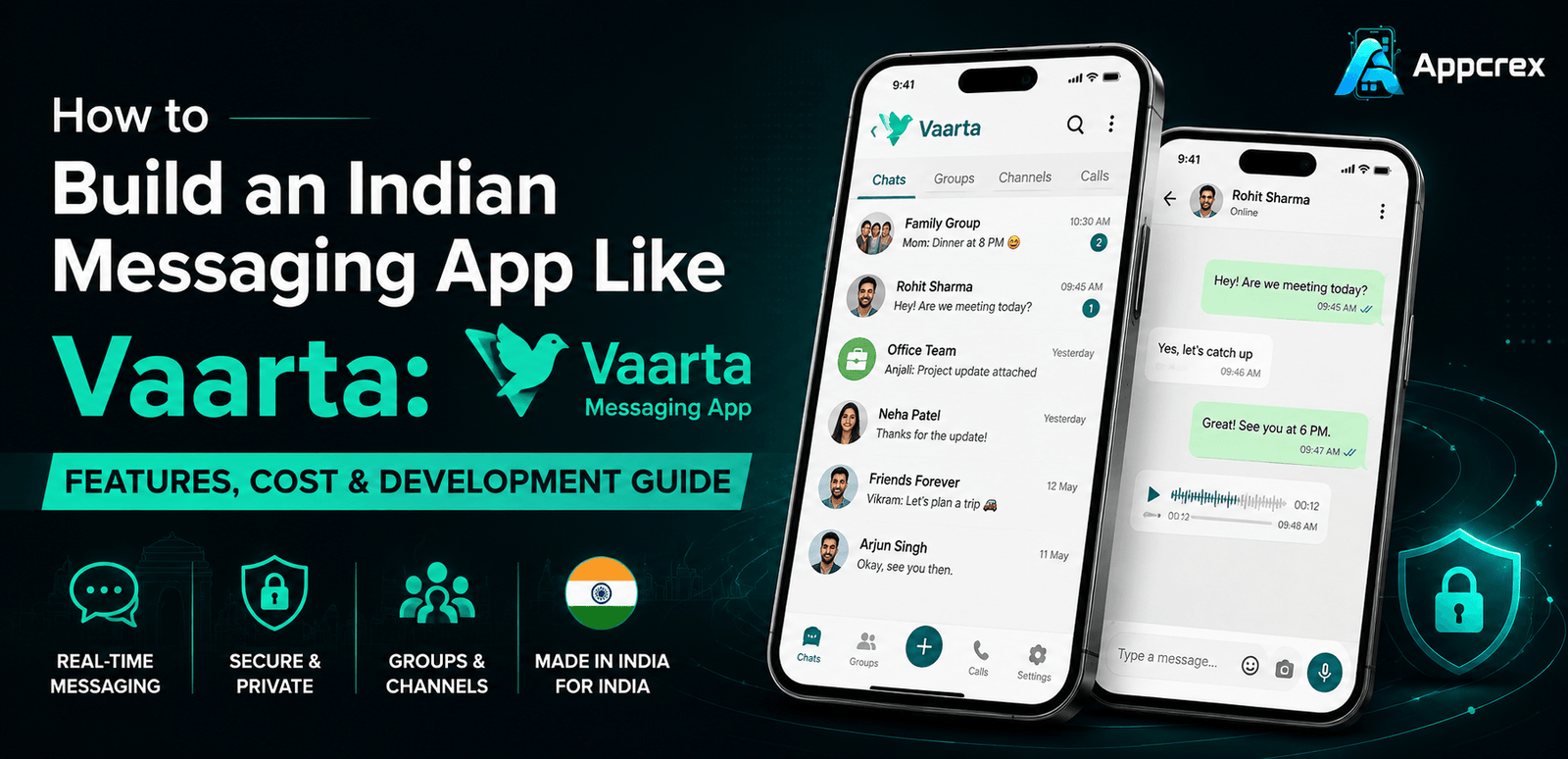
Vaarta Messaging App is one such example. It positions itself as an India-focused messaging platform with real-time chats, groups, privacy controls, end-to-end encryption, web and desktop access, and other communication features. Vaarta’s official feature pages highlight messaging, groups, favorites, privacy controls, encryption, and multi-device access.
This creates an interesting opportunity for entrepreneurs looking to build their own messaging app like Vaarta or develop a differentiated Indian alternative to existing chat platforms.
So, how much does it cost to build a messaging app like Vaarta? What features should it have? Which technology stack should you choose? And how can you monetize the platform?
This guide covers the complete process of Indian messaging app development, including features, cost, technology, security, business model, development timeline, and future opportunities.
How Much Does It Cost to Build an App Like Vaarta?
The cost depends on the number of features, platforms, security requirements, backend architecture, and real-time communication capabilities.
| App Type | Estimated Development Cost |
|---|---|
| Basic Messaging MVP | $40,000–$70,000 |
| Standard Messaging App | $70,000–$120,000 |
| Advanced Messaging Platform | $120,000–$200,000+ |
| Enterprise-Grade Messaging Ecosystem | $200,000–$300,000+ |
These are broad software-development estimates. Third-party services, cloud infrastructure, communication APIs, security audits, storage, CDN usage, and ongoing maintenance can increase the total operating cost.
For a startup, the most practical approach is usually to launch an MVP with real-time messaging, groups, media sharing, notifications, privacy controls, and secure authentication, and then introduce advanced capabilities after gaining users.
What Is an Indian Messaging App Like Vaarta?
An Indian messaging application like Vaarta can provide a private digital communication environment where users can:
- Send instant messages
- Create groups
- Share photos and videos
- Send documents
- Share locations
- Send voice notes
- Make voice or video calls
- Search conversations
- Manage privacy settings
- Protect chats
- Use the platform across devices
Vaarta’s official website describes features including real-time messaging, groups, media and document sharing, location sharing, voice notes, privacy controls, favorites, web/desktop access, and end-to-end encryption.
The goal of a new app should not simply be to copy another messenger. Instead, businesses can use the basic concept and create a product with a unique value proposition for Indian users.
Just Read : Mobile App Development in India: Cost, Technologies, Process & Business Opportunities
Why Build an Indian Messaging App?
India has a huge smartphone and internet user base, creating opportunities for communication products targeted at specific communities and use cases.
Instead of competing only as another general-purpose messenger, a startup can focus on a particular segment.
For example:
- Indian-language messaging
- Business communication
- Private messaging
- Community communication
- Education
- Family communication
- Local communities
- Enterprise collaboration
- Secure document sharing
- Customer communication
This approach can make it easier to differentiate the product.
Key Features of a Messaging App Like Vaarta
1. Mobile Number Registration
The onboarding process can start with a mobile number.
A typical flow is:
Enter Number → OTP Verification → Create Profile → Start Messaging
OTP-based authentication is familiar to Indian users and can simplify account creation.
Vaarta’s help center describes mobile-number registration followed by OTP verification and profile setup.
2. User Profile
Users should have a dedicated profile containing:
- Name
- Profile photo
- Phone number
- About/bio
- Privacy settings
- Status
- Account settings
Users should have control over which profile details are visible to other people.
3. Real-Time Messaging
Real-time messaging is the foundation of the application.
Users should be able to send:
- Text
- Emojis
- Images
- Videos
- Documents
- Locations
- Voice messages
The message should appear quickly without requiring the user to refresh the screen.
4. One-to-One Chat
The basic private-chat experience should support:
- Text messages
- Media
- Documents
- Voice notes
- Message timestamps
- Delivery status
- Read status
- Message deletion
A clean chat interface is essential because users spend most of their time inside conversations.
5. Group Chat
Users can create groups for:
- Family
- Friends
- Work
- Communities
- Education
- Local organizations
Group features can include:
- Group name
- Group image
- Description
- Members
- Admin controls
- Group permissions
- Media sharing
- Notifications
Vaarta currently highlights groups as one of its core messaging features.
6. Voice Messages
Voice notes provide a convenient way to communicate when typing is inconvenient.
The feature can support:
- Record
- Pause
- Send
- Playback
- Delete
The backend should optimize audio storage and delivery to control bandwidth and cloud-storage costs.
7. Photo & Video Sharing
Users should be able to share images and videos directly from the chat.
The system can include:
- Image compression
- Video compression
- Preview
- Download
- Forward
- Delete
A CDN can improve media delivery for users across different regions.
8. Document Sharing
A modern messaging app can allow users to send:
- PDFs
- Word documents
- Spreadsheets
- Presentations
- ZIP files
- Other supported formats
This feature can make the platform useful for business and professional communication.
Just Read : End-to-End App Development Company: The Complete Guide to Building Successful Mobile Apps
9. Location Sharing
Users can share their current or selected location with contacts.
This can be useful for:
- Meeting friends
- Delivery
- Family
- Business teams
- Field employees
Location sharing should be designed with clear privacy controls.
10. Voice & Video Calling
A more advanced messaging app can support:
- One-to-one voice calls
- One-to-one video calls
- Group calls
Real-time calling generally requires additional infrastructure such as WebRTC or a suitable communication service.
11. End-to-End Encryption
Privacy can be one of the strongest differentiators for an Indian messaging platform.
End-to-end encryption is designed so that messages are encrypted between communicating endpoints rather than being readable by the service provider in ordinary operation.
Vaarta explicitly highlights end-to-end encryption for messages and calls.
A new messaging platform should use a well-established cryptographic design rather than attempting to create its own encryption algorithm.
12. Privacy Controls
Users should be able to control information such as:
- Profile visibility
- Online status
- Last seen
- Read receipts
- Contact permissions
- Blocking
- Group invitations
Privacy settings should be easy to understand rather than hidden inside complicated menus.
Vaarta currently highlights privacy controls that let users choose who can see certain information and when they are online.
13. App Lock
An additional PIN or biometric lock can protect conversations if someone gets physical access to the device.
Possible options include:
- PIN
- Fingerprint
- Face authentication
- Device authentication
Vaarta’s help center describes an App Lock feature protected by a PIN.
14. Message Deletion
Users may need options such as:
- Delete for me
- Delete for everyone
- Delete after a selected period
Vaarta’s help documentation describes both deletion-for-self and deletion-for-everyone options.
15. Message Search
As users accumulate hundreds or thousands of conversations, search becomes essential.
Users should be able to search:
- Messages
- People
- Groups
- Shared content
Vaarta describes an in-app search experience for finding people, messages, groups, and shared content.
16. Favorites
Users can mark important conversations for quick access.
For example:
- Family
- Important clients
- Work groups
- Close friends
Favorites can improve navigation for users with large chat lists.
Vaarta lists Favorites among its core features.
17. Multi-Device Support
Users increasingly expect their conversations to be available across devices.
A messaging platform can support:
- Android
- iPhone
- Web
- Desktop
Vaarta currently offers web and desktop access with linked-device functionality.
18. Push Notifications
Notifications can alert users about:
- New messages
- Group activity
- Calls
- Contact requests
- Security events
Users should also have controls to mute individual conversations or groups.
19. Contact Synchronization
With appropriate permissions, the application can help users identify contacts already using the platform.
The system should minimize unnecessary access to contact information and clearly communicate why the permission is needed.
20. Blocking & Reporting
Users should be able to:
- Block users
- Report spam
- Report abuse
- Mute conversations
- Restrict unwanted contacts
This is especially important as the user base grows.
21. Chat Backup & Data Management
Depending on the product’s privacy architecture, you may provide:
- Cloud backup
- Device backup
- Encrypted backup
- Media backup
- Chat restoration
However, backup design must be carefully aligned with the app’s encryption and privacy model.
Vaarta’s website currently describes data-retention controls and also discusses backup/recovery functionality, so a new product should define its own approach clearly rather than assuming one model fits every privacy strategy.
Also Read : AI Chatbot Development Company: Complete Guide to Features, Benefits, Cost & Trends (2026)
22. Data Retention Controls
A privacy-focused messaging app can allow users to select how long messages remain available.
For example:
1 day → 7 days → 30 days → 90 days → 365 days
Automatic deletion can reduce the amount of long-term conversation data retained by the platform.
Vaarta currently promotes configurable data-retention controls with automatic deletion of older messages.
23. Broadcast Messaging
Businesses and communities may need broadcast functionality.
Possible use cases include:
- Customer announcements
- Community updates
- School notifications
- Business communication
- Event updates
This can also create a potential monetization opportunity.
24. Admin Dashboard
A messaging platform needs a secure backend administration panel.
Administrators can manage:
- Users
- Reports
- Blocked accounts
- Groups
- Abuse complaints
- Notifications
- Subscription plans
- Analytics
- System settings
Sensitive user information should only be accessible to authorized staff.
25. Moderation System
A large communication platform needs tools to detect and manage abuse.
Possible systems include:
- Spam detection
- User reports
- Automated abuse signals
- Account restrictions
- Content moderation
- Rate limiting
AI can potentially assist moderation, but human review and clear policies remain important for difficult cases.
Technology Stack for an Indian Messaging App
Mobile App Development
You can choose from:
- Flutter
- React Native
- Kotlin
- Swift
Flutter or React Native can be suitable when the goal is to launch Android and iOS applications efficiently from a shared codebase.
For highly specialized real-time communication or device-level functionality, native components may still be required.
Web Application
Possible technologies include:
- React
- Next.js
- TypeScript
The web version can allow users to access chats from computers.
Backend Development
Possible backend technologies include:
- Node.js
- Go
- Java
- Python
Real-time communication requires a backend architecture designed for persistent connections, message delivery, presence, notifications, and high concurrency.
Real-Time Communication
Technologies such as:
- WebSockets
- WebRTC
- Redis
- Message queues
can be used depending on the feature.
WebSockets can support real-time text messaging, while WebRTC can support real-time audio and video communication.
Database
Potential technologies include:
- PostgreSQL
- MySQL
- MongoDB
- Redis
A messaging platform may use more than one database depending on the workload.
For example, Redis can help with:
- Presence
- Caching
- Session information
- Real-time events
Cloud Infrastructure
Potential cloud infrastructure can include:
- AWS
- Google Cloud
- Microsoft Azure
Cloud infrastructure can support:
- Application servers
- Databases
- Object storage
- CDN
- Load balancing
- Monitoring
- Backups
- Disaster recovery
Media Storage & CDN
Messaging apps can generate enormous amounts of image, video, audio, and document traffic.
A CDN can help deliver media faster to users in different geographic regions.
Media processing can also include:
- Compression
- Thumbnail generation
- Video transcoding
- File validation
- Virus scanning
How Does a Messaging App Like Vaarta Work?
A simplified architecture looks like:
User A → Mobile App → Real-Time Server → Message Service → User B
For media:
User → Upload Service → Secure Storage → CDN → Recipient
For notifications:
Message Event → Notification Service → Push Provider → Recipient Device
For calls:
User A ↔ Signaling Server ↔ WebRTC ↔ User B
This architecture needs to remain scalable as the number of concurrent users increases.
Also Read : Mobile App Development Consulting Company: Turn Your App Idea into a Successful Mobile App
Development Process
Step 1: Define Your Target Audience
Before writing code, determine who the application is for.
You could target:
- Indian consumers
- Families
- Businesses
- Students
- Communities
- Professionals
- Enterprises
A clear audience helps determine which features should be included in the MVP.
Step 2: Define Your Unique Value Proposition
Don’t simply build another generic chat app.
Your differentiation could focus on:
- Privacy
- Indian languages
- Business communication
- Local communities
- Secure document sharing
- Enterprise messaging
- Low-bandwidth communication
Step 3: Plan the MVP
A strong first version can include:
- OTP registration
- User profiles
- One-to-one messaging
- Groups
- Image/video sharing
- Documents
- Voice notes
- Push notifications
- Blocking/reporting
- Basic privacy controls
- Admin dashboard
Step 4: Design UI/UX
Important screens include:
- Login
- Home
- Chat list
- Private chat
- Groups
- Calls
- Contacts
- Profile
- Privacy
- Settings
The interface should be simple enough for first-time users.
Step 5: Build the Backend
Develop:
- Authentication
- User management
- Chat services
- Real-time messaging
- Media services
- Notifications
- Group management
- Privacy services
Step 6: Implement Security
Security should be built into the architecture rather than added after development.
Consider:
- Encryption
- Secure authentication
- Access control
- Device management
- Rate limiting
- Abuse prevention
- Secure media storage
- Audit logging
Step 7: Add Real-Time Communication
Implement real-time message delivery, typing indicators, presence, delivery status, and notifications.
Step 8: Test the Platform
Testing should cover:
- Message delivery
- Offline/online transitions
- Media uploads
- Notifications
- Group chats
- Multiple devices
- Encryption
- Calls
- Security
- Performance
Step 9: Load Testing
Messaging platforms can experience sudden traffic spikes.
Test scenarios should include:
- Thousands of simultaneous connections
- Large group conversations
- High media uploads
- Large notification volumes
- Reconnection after network loss
Step 10: Launch and Scale
After launch, monitor:
- Message delivery latency
- Server performance
- Crash rates
- Storage usage
- API performance
- User retention
- Abuse reports
The infrastructure can then be scaled based on actual usage.
Also Read : FinTech API Integration Services: Complete Guide to Banking APIs, Payments & Security
How Long Does It Take to Build an App Like Vaarta?
| Project Type | Estimated Timeline |
|---|---|
| Basic Messaging MVP | 4–6 months |
| Standard Messaging App | 6–9 months |
| Advanced Messaging Platform | 9–12 months |
| Large Multi-Platform Ecosystem | 12–18+ months |
Voice/video calling, advanced encryption, multi-device synchronization, large groups, AI features, and enterprise capabilities can increase the timeline.
Cost Breakdown
A typical project budget may look like this:
| Development Component | Estimated Cost |
|---|---|
| UI/UX Design | $5,000–$12,000 |
| Android & iOS App | $20,000–$45,000 |
| Backend & APIs | $20,000–$45,000 |
| Real-Time Chat | $10,000–$25,000 |
| Media & File Sharing | $7,000–$15,000 |
| Voice/Video Calling | $10,000–$30,000 |
| Admin Dashboard | $7,000–$15,000 |
| Security & Testing | $10,000–$25,000 |
| DevOps & Deployment | $5,000–$15,000 |
The final budget depends on the features selected for the first release.
What Increases the Cost of Messaging App Development?
End-to-End Encryption
Advanced encryption architecture requires careful engineering and security testing.
Voice & Video Calls
Real-time communication introduces additional infrastructure and performance requirements.
Multi-Device Synchronization
Keeping messages synchronized across mobile, web, and desktop devices adds backend complexity.
Large Groups
Supporting very large groups requires optimized message distribution and notification architecture.
Media Storage
Photos, videos, documents, and voice messages increase cloud storage and bandwidth requirements.
AI Features
AI moderation, smart search, translation, and conversational assistants add additional infrastructure and model costs.
AI Features for an Indian Messaging App
AI can help differentiate a new messaging platform.
AI Translation
Users could communicate across Indian languages with automatic translation.
For example:
Hindi → Tamil → Bengali → English
This could be particularly useful for a multilingual Indian audience.
Also Read : AI App Development in the UK: Use Cases, Cost, Features & Development Guide
AI Message Assistance
AI can help users:
- Rewrite messages
- Translate messages
- Summarize long conversations
- Generate replies
Smart Search
Users could ask:
“Show me the document Rahul sent last month.”
The system could use natural-language search to locate relevant content.
Spam Detection
AI models can identify suspicious messaging patterns and potential spam.
Conversation Summaries
AI can summarize long group conversations for users who missed earlier messages.
These features should be implemented with strong privacy protections, especially when messages are encrypted.
Business Model of an Indian Messaging App
A messaging application can use several monetization strategies.
Freemium Model
Basic messaging remains free while premium features are paid.
Premium features could include:
- Larger file limits
- Advanced privacy controls
- Premium themes
- Extra storage
- Business tools
Business Messaging
Businesses can pay for:
- Verified business profiles
- Customer communication
- Broadcasts
- Automated replies
- Business analytics
Subscription Plans
Possible plans include:
Free → Personal → Business → Enterprise
Each tier can provide different functionality.
Enterprise Messaging
Organizations can use a private communication platform for:
- Employees
- Departments
- Internal groups
- Document sharing
- Team communication
Enterprise contracts can provide a stronger revenue opportunity than consumer advertising.
How to Make a Messaging App Different From WhatsApp?
Instead of directly competing feature-for-feature, focus on a specific advantage.
For example:
Privacy-First Messenger
Focus heavily on encryption and privacy controls.
Indian-Language Messenger
Provide strong support for multiple Indian languages.
Business Messenger
Combine chat, file sharing, task management, and business communication.
Community Messenger
Build tools specifically for local groups, organizations, and communities.
Secure Document Messenger
Combine messaging with encrypted document storage and sharing.
This type of positioning can make a new platform easier to market.
How to Reduce Development Cost?
Start With an MVP
Don’t build every feature at launch.
Start with:
- Registration
- One-to-one chat
- Groups
- Media
- Notifications
- Privacy
- Admin
Use Cross-Platform Development
Flutter or React Native can reduce duplicated mobile development.
Use Proven Communication Infrastructure
For an MVP, existing communication infrastructure can help reduce development time where it meets your security and scalability requirements.
Launch in One Market
Focus on India first rather than building global infrastructure immediately.
Add AI Later
AI translation, summaries, smart search, and assistants can be introduced after the core messaging experience is stable.
Why Choose AppCrex for Messaging App Development?
AppCrex can help businesses build custom messaging and communication platforms for consumer, community, and enterprise use cases.
Our services can include:
- Messaging App Development
- Chat App Development
- Real-Time Chat Development
- Social Networking App Development
- Secure Messaging App Development
- Voice & Video Calling
- Group Chat Development
- Media Sharing
- Push Notification Integration
- AI Chat Integration
- Multilingual Messaging
- Admin Dashboard Development
- Cloud Backend Development
- API Development
- iOS & Android Development
- Web Messaging Platform
- Security Testing
- Maintenance & Support
The product can be designed around your target users, privacy requirements, business model, and scalability goals.
Build an Indian Messaging App Like Vaarta With AppCrex
Building an Indian messaging app like Vaarta is an opportunity to create a communication platform that goes beyond basic text messaging.
The cost to build an app like Vaarta can range from approximately $40,000 for a focused MVP to $200,000+ for an advanced messaging platform, while a large multi-platform ecosystem can require $300,000 or more.
The most important components are real-time messaging, secure authentication, media sharing, groups, privacy controls, notifications, scalable backend infrastructure, and strong security architecture.
For startups, the best approach is to start with a focused MVP and build a clear differentiator around privacy, Indian languages, communities, business communication, or secure collaboration.
Once the platform has established a user base, you can expand into voice/video calling, AI translation, smart search, enterprise messaging, business profiles, advanced privacy features, and other premium capabilities.
Have an idea for an Indian messaging app? Contact AppCrex to discuss your app concept, features, technology stack, development timeline, and estimated budget.
FAQs
Q. How much does it cost to build an app like Vaarta?
A basic messaging MVP can cost approximately $40,000–$70,000, while an advanced messaging platform can cost $120,000–$200,000+ depending on features and infrastructure.
Q. How long does it take to build a messaging app like Vaarta?
A basic MVP may take around 4–6 months, while an advanced multi-platform messaging application can require 9–18 months or more.
Q. What are the main features of an Indian messaging app?
Core features can include OTP registration, profiles, real-time messaging, group chats, media sharing, documents, voice notes, calls, notifications, privacy controls, message deletion, blocking, reporting, and multi-device support.
Q. Can I build a messaging app with end-to-end encryption?
Yes. End-to-end encryption can be incorporated into the architecture using established cryptographic protocols and carefully designed key management. Security should be reviewed and tested by qualified professionals.
Q. Can an Indian messaging app support multiple languages?
Yes. Multilingual interfaces, translation features, and regional-language messaging can be incorporated depending on the target audience.
Q. Can AI be added to a messaging application?
Yes. AI can support translation, smart search, conversation summaries, suggested replies, spam detection, and other productivity features.
Q. Can I build a messaging app for businesses?
Yes. A business-focused messenger can include team chats, file sharing, employee groups, business profiles, broadcasts, admin controls, and enterprise security.
Q. Can AppCrex develop an app like Vaarta?
Yes. AppCrex can develop custom messaging, chat, social communication, and secure collaboration platforms based on your business requirements.