📌 Key Takeaways
- An AI app like Krutrim can cost from $40,000 for an MVP to $300,000+ for an advanced platform.
- You don’t necessarily need to train a proprietary AI model to launch an AI product.
- Multilingual support, voice AI, RAG, personalization, and AI search can create significant product value.
- AI infrastructure and model usage create ongoing costs after development.
- Starting with a focused AI MVP is often more practical than attempting to build a complete AI ecosystem from day one.
Introduction
Artificial intelligence is moving rapidly from experimental technology to everyday digital products. Businesses are now using AI assistants, conversational interfaces, content generation, voice interaction, search, automation, and multilingual AI to create new customer experiences.
India presents a particularly interesting opportunity because millions of users interact with digital services in languages beyond English. This has created demand for AI products that understand Indian languages, local context, voice interaction, and India-specific use cases.
Krutrim is an example of this broader Indian AI ecosystem. For businesses and entrepreneurs, its approach offers an interesting reference point for building an AI assistant or multilingual AI platform designed for Indian users.
However, building an AI app like Krutrim does not mean copying an existing product. A new platform can focus on a specific audience, industry, language, or business problem while using modern AI models and infrastructure.
The cost to build an AI app like Krutrim can range from approximately $40,000 to $300,000+, depending on whether you are integrating existing AI models or building and training your own models.
A focused AI MVP may cost around $40,000–$80,000, while an advanced AI assistant with voice, multilingual capabilities, custom knowledge, enterprise integrations, and sophisticated infrastructure can cost $100,000–$200,000+. Building and operating a proprietary large-scale foundation model can require substantially greater investment.
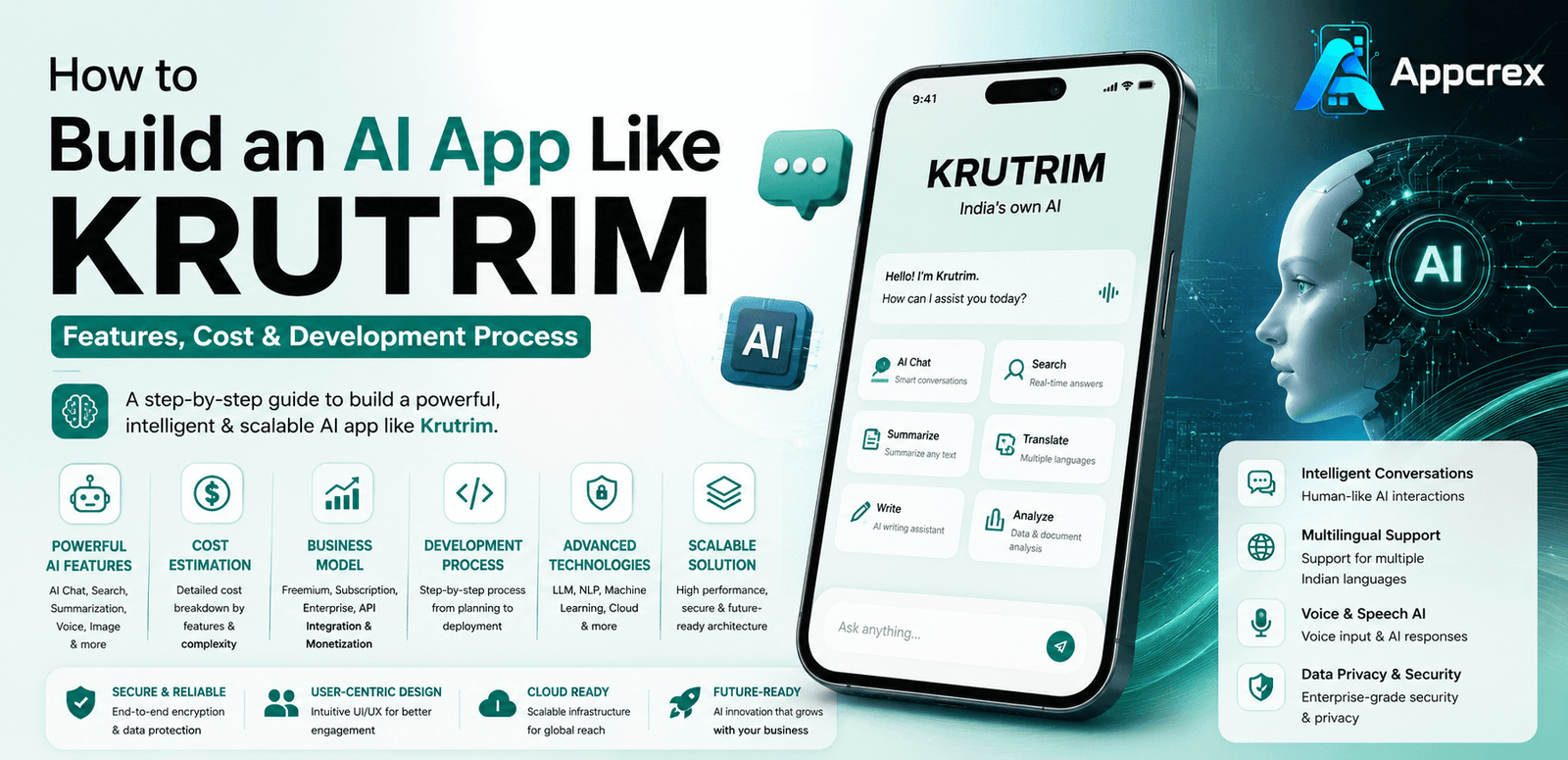
This guide explains how to build an AI app like Krutrim, including features, technology stack, development process, cost, monetization, AI model choices, infrastructure, and scaling considerations.
What Is an AI App Like Krutrim?
An AI app like Krutrim can be understood as a conversational AI platform that allows users to interact with artificial intelligence through natural language.
Depending on the product strategy, such an application could provide:
- AI conversations
- Multilingual assistance
- Text generation
- Question answering
- Summarization
- Translation
- Voice interaction
- Content assistance
- Knowledge search
- Business automation
- Personalized assistance
The important point is that you do not need to build a general-purpose AI platform from day one.
A startup could begin with a specific use case such as:
- Indian-language AI assistant
- AI customer-support platform
- AI education assistant
- AI business copilot
- AI healthcare information assistant
- AI writing platform
- AI voice assistant
The initial product can then expand as user demand and available resources increase.
How Much Does It Cost to Build an AI App Like Krutrim?
The development cost depends heavily on the AI architecture.
| AI App Type | Estimated Cost |
|---|---|
| Basic AI MVP | $40,000–$80,000 |
| Multilingual AI Assistant | $60,000–$120,000 |
| Advanced AI Chat Platform | $100,000–$200,000+ |
| Enterprise AI Platform | $150,000–$300,000+ |
| Custom AI Model/LLM Platform | $300,000–$1M+ |
These are broad planning estimates.
The cost of a proprietary foundation model can be dramatically higher because model training requires large datasets, specialized AI engineers, GPU infrastructure, evaluation systems, safety testing, and ongoing inference infrastructure.
For many businesses, integrating an existing foundation model or using an open-source model is a much more practical starting point.
What Makes an AI App Expensive?
Unlike a standard mobile application, AI products have two major cost components:
Product Development
This includes:
- UI/UX
- Mobile development
- Backend
- APIs
- Authentication
- Database
- Admin dashboard
AI Infrastructure
This can include:
- AI model access
- GPU infrastructure
- Model hosting
- Fine-tuning
- Embeddings
- Vector databases
- Data processing
- Evaluation
- Monitoring
- Inference
The second category can become a significant ongoing operating expense as the number of users increases.
Also Read : AI Agent Development Company: Complete Guide to Features, Benefits, Cost & Development Process (2026)
Key Features of an AI App Like Krutrim
1. AI Chat Interface
The central feature is a conversational interface where users can ask questions and receive AI-generated responses.
A modern chat interface can support:
- Text prompts
- Long conversations
- Conversation history
- New conversations
- Message editing
- Copy/share
- Regeneration
- Feedback
The interface should be simple enough for users who have never interacted with an AI assistant.
2. Multilingual AI
For an India-focused AI platform, multilingual support can be a major differentiator.
The application could support languages such as:
- Hindi
- English
- Bengali
- Marathi
- Tamil
- Telugu
- Kannada
- Gujarati
- Malayalam
- Punjabi
The exact languages should depend on the model’s capabilities and the product’s target audience.
Multilingual AI can be useful for:
- Translation
- Content creation
- Customer support
- Education
- Search
- Local-language assistance
3. Voice AI
Voice interaction can make AI accessible to users who prefer speaking rather than typing.
A voice-enabled AI application may include:
Speech → Speech-to-Text → AI Model → Response Generation → Text-to-Speech
Users could ask questions in their preferred language and receive a spoken response.
This requires additional technologies for:
- Speech recognition
- Language detection
- AI inference
- Text-to-speech
- Audio streaming
Voice functionality therefore increases development complexity.
Also Read : Voice AI Integration: Complete Guide to Benefits, Use Cases, Cost & Implementation (2026)
4. AI Search
An AI-powered search system can provide direct answers rather than simply returning a list of links.
It can combine:
- User query
- Search engine
- AI model
- Relevant sources
- Contextual response
For business applications, AI search can also operate over private company information.
5. Conversation History
Users may want to revisit previous conversations.
The system can provide:
- Chat history
- Search conversations
- Rename chats
- Delete chats
- Organize conversations
This requires reliable storage and privacy controls.
6. Personalized AI
AI applications can become more useful when they understand relevant user preferences and context.
Personalization can include:
- Preferred language
- Writing style
- Frequently used tasks
- Saved instructions
- Conversation context
However, personalization should be implemented with appropriate privacy controls and transparent data practices.
7. File Upload & AI Analysis
A more advanced AI app can allow users to upload documents and ask questions about them.
Supported content could include:
- PDFs
- Documents
- Text files
- Images
- Spreadsheets
A typical architecture may use:
Upload → Text Extraction → Chunking → Embeddings → Vector Database → Retrieval → AI Response
This is commonly referred to as Retrieval-Augmented Generation (RAG).
8. AI Content Generation
Users can use an AI platform to generate:
- Articles
- Emails
- Product descriptions
- Social media content
- Summaries
- Reports
- Ideas
- Business documents
Businesses can customize these features according to their target audience.
9. AI Translation
An India-focused AI assistant can provide translation between English and supported Indian languages.
Translation can be useful for:
- Business communication
- Education
- Customer support
- Content creation
- Travel
- Government and public services
10. AI Image Understanding
A multimodal AI platform can allow users to upload images and ask questions about them.
Possible use cases include:
- Document understanding
- Image descriptions
- Visual search
- Product analysis
- Educational images
More advanced capabilities require multimodal AI models.
11. AI Safety & Moderation
AI systems should include safeguards against:
- Harmful content
- Prompt injection
- Abuse
- Data leakage
- Inappropriate outputs
- Automated attacks
Safety mechanisms can operate at multiple levels:
Input → Safety Filter → AI Model → Output Validation → User
For enterprise applications, additional logging and monitoring may be necessary.
12. User Authentication
Users can register through:
- Phone number
- OTP
- Social login
Businesses can also introduce subscription-based accounts with different usage limits.
13. AI Usage Limits
Because AI inference can create ongoing costs, businesses may establish limits based on:
- Number of messages
- Token usage
- Model selection
- File processing
- Voice usage
For example, a free plan could offer limited access while premium users receive higher usage limits.
14. AI Model Selection
The AI model is one of the most important technical decisions.
There are generally three approaches.
Use Third-Party AI APIs
This is usually the fastest approach.
Advantages:
- Faster launch
- Lower initial infrastructure investment
- No need to train a foundation model
Use Open-Source Models
Businesses can deploy or customize suitable open-source models.
Advantages can include:
- More control
- Customization
- Potentially greater data control
- Ability to optimize infrastructure
But hosting and maintaining the model becomes the company’s responsibility.
Train a Proprietary Model
This provides the greatest control but requires substantial investment.
It can involve:
- Large datasets
- Data cleaning
- Model architecture
- Training
- Fine-tuning
- Evaluation
- GPU infrastructure
- Safety testing
For most startups, training a foundation model from scratch is not the right first step.
Technology Stack for an AI App Like Krutrim
The technology stack depends on the product architecture.
Mobile App
Possible technologies:
- Flutter
- React Native
- Swift
- Kotlin
Flutter or React Native can be considered when the business wants both iOS and Android applications.
Frontend
Possible technologies include:
- React
- Next.js
- TypeScript
Backend
Common choices include:
- Python
- Node.js
- Java
- Go
Python is particularly useful for AI and machine-learning workflows.
Databases
Depending on requirements:
- PostgreSQL
- MySQL
- MongoDB
- Redis
AI Infrastructure
AI systems may use:
- LLM APIs
- Open-source models
- GPU servers
- Model-serving frameworks
- Vector databases
- Embedding models
Cloud Infrastructure
Potential providers include:
- AWS
- Google Cloud
- Microsoft Azure
RAG for AI Apps
Retrieval-Augmented Generation can be useful when an AI application needs to answer questions using a controlled knowledge base.
For example, a business could create an AI assistant trained on its:
- Product documentation
- Policies
- Internal knowledge
- FAQs
- Support material
The architecture can work like this:
User Question → Query Processing → Vector Search → Relevant Information → AI Model → Response
This can reduce the need to retrain the underlying model whenever the knowledge base changes.
Fine-Tuning vs RAG
These technologies serve different purposes.
RAG
Useful when the AI needs access to frequently changing information.
Fine-Tuning
Useful when you want to influence how a model performs certain tasks or follows particular patterns.
A project may use one or both approaches depending on the requirements.
AI App Development Process
Building an AI platform requires a different development process from a conventional mobile application.
Step 1: Define the AI Use Case
Start by answering:
- Who will use the application?
- What problem does AI solve?
- Which languages are required?
- Is voice needed?
- Does the AI need private knowledge?
- Is the product consumer or enterprise-focused?
Also Read : AI App Development in the UK: Use Cases, Cost, Features & Development Guide
Step 2: Select the AI Architecture
Determine whether the project will use:
- Third-party AI APIs
- Open-source models
- Fine-tuned models
- RAG
- Custom models
Step 3: Build the Product Prototype
Design:
- Chat interface
- Prompt experience
- Conversation history
- User dashboard
- Subscription interface
Step 4: Develop Backend
The backend handles:
- Authentication
- AI requests
- User management
- Usage tracking
- Subscription
- Conversation history
- APIs
Step 5: Integrate AI
Connect the selected AI model with the backend.
Additional components may include:
- Prompt management
- Context management
- Retrieval
- Embeddings
- Vector database
- Moderation
Step 6: Add Multilingual & Voice Capabilities
If required, integrate:
- Speech-to-text
- Text-to-speech
- Translation
- Language detection
Step 7: Testing & Evaluation
AI testing is different from conventional software testing.
The team should evaluate:
- Accuracy
- Hallucinations
- Response quality
- Language performance
- Latency
- Safety
- Prompt injection
- Cost per request
AI Model Evaluation
An AI app should not be evaluated only by whether it produces an answer.
Testing can measure:
Accuracy
Does the response answer the question correctly?
Relevance
Does it stay focused on the user’s request?
Hallucination Rate
Does it invent unsupported information?
Language Quality
Does it understand and generate the target languages naturally?
Latency
How long does the user wait for a response?
Cost
How much does each request cost the business?
These metrics become particularly important at scale.
How Long Does It Take to Build an AI App Like Krutrim?
The timeline depends on the level of customization.
| Project | Approximate Timeline |
|---|---|
| Basic AI MVP | 3–5 months |
| Multilingual AI Assistant | 5–7 months |
| Advanced AI Platform | 7–12+ months |
| Custom Model Platform | 12+ months |
If the project requires proprietary model training, the timeline can increase substantially.
Cost Breakdown
A typical AI application budget can be divided into several components.
| Component | Estimated Cost |
|---|---|
| UI/UX Design | $5,000–$15,000 |
| Mobile App | $15,000–$40,000 |
| Backend | $15,000–$40,000 |
| AI Integration | $15,000–$50,000 |
| RAG/Vector Search | $10,000–$30,000 |
| Voice AI | $10,000–$30,000 |
| Admin Dashboard | $8,000–$20,000 |
| Testing | $5,000–$15,000 |
| Cloud/DevOps Setup | $5,000–$20,000 |
Not every project requires all of these components.
Ongoing Costs of Running an AI App
Development isn’t the only expense.
After launch, businesses may have recurring costs for:
- AI API usage
- GPU infrastructure
- Cloud hosting
- Databases
- Storage
- Bandwidth
- Monitoring
- Security
- Maintenance
- Model evaluation
AI products can therefore have a very different cost structure from conventional mobile applications.
A company should estimate cost per user and cost per AI interaction before introducing a free unlimited plan.
Business Model for an AI App
There are several possible monetization strategies.
Freemium
Offer basic AI functionality for free and charge for higher limits.
Subscription
Monthly or annual plans can provide:
- Higher usage
- Advanced models
- Voice
- File analysis
- Premium features
Enterprise Plans
Businesses can pay for:
- Private AI assistants
- Team accounts
- Higher usage
- API access
- Custom integrations
API Monetization
An AI company can provide APIs that allow other developers to integrate its models into their own products.
How to Make Money From an AI App Like Krutrim?
A diversified model could combine:
Free Users → Premium Users → Business Users → Enterprise → API Customers
This allows the business to generate revenue from multiple customer segments.
Challenges of Building an AI App Like Krutrim
Building an AI assistant is not simply a matter of connecting a chatbot API.
AI Accuracy
Users expect reliable answers.
Infrastructure Cost
AI inference can become expensive as usage grows.
Latency
Slow responses can negatively affect user experience.
Multilingual Performance
Supporting multiple languages requires careful model evaluation.
Data Privacy
AI applications may process highly sensitive user information.
Competition
The AI market contains many established and rapidly evolving products.
Model Dependency
Using third-party models creates dependency on external providers.
How to Reduce AI App Development Cost?
Start With an MVP
Don’t attempt to build a complete AI ecosystem immediately.
Use Existing Models
Third-party APIs or suitable open-source models can significantly reduce initial investment.
Focus on One Use Case
Instead of building a general AI assistant, target one specific problem.
Use RAG Where Appropriate
RAG can provide domain-specific knowledge without requiring a complete model-training pipeline.
Add Voice Later
Voice is valuable but increases technical complexity.
Monitor AI Costs
Track token usage and infrastructure expenses from the beginning.
Also Read : What Is an MVP in App Development? A Complete Guide
How AppCrex Can Help Build an AI App?
AppCrex provides AI app development services for startups, businesses, and enterprises looking to introduce artificial intelligence into mobile and web products.
Our services can include:
- AI App Development
- AI Chatbot Development
- Generative AI Integration
- AI Agent Development
- LLM Integration
- RAG Development
- AI API Integration
- Voice AI Integration
- Multilingual AI Solutions
- Mobile App Development
- Backend Development
- Cloud Infrastructure
- UI/UX Design
- API Development
- AI Testing & Optimization
- Maintenance & Support
We can help businesses determine whether they need an existing AI model, RAG architecture, fine-tuning, or a more customized AI solution.
Build Your AI App Like Krutrim With AppCrex
Building an AI application inspired by Krutrim is an opportunity to create a product specifically designed around the needs of Indian users and businesses.
You don’t need to begin by creating a massive foundation model.
A more practical approach for many startups is to start with a focused AI product, integrate an appropriate model, build a strong user experience, support the required Indian languages, and gradually introduce advanced capabilities.
The development cost can start around $40,000–$80,000 for an AI MVP, while an advanced AI platform can require $100,000–$300,000+. A proprietary foundation model can require significantly more investment.
The most important factors are the AI architecture, number of features, model strategy, infrastructure, multilingual support, voice capabilities, security, and expected user scale.
Have an AI app idea? Contact AppCrex to discuss your AI product, technology requirements, development roadmap, and estimated budget.
FAQs
Q. How much does it cost to build an AI app like Krutrim?
A focused AI MVP can cost around $40,000–$80,000, while an advanced AI platform can cost $100,000–$300,000+. Building a proprietary foundation model requires substantially more investment.
Q. How long does it take to develop an AI app?
A basic AI application may take 3–5 months, while an advanced multilingual or enterprise platform can require 7–12+ months.
Q. Do I need to train my own AI model?
Not necessarily. Many startups can begin by integrating existing AI models or suitable open-source models and then customize the experience using RAG, fine-tuning, or other techniques.
Q. Can an AI app support Indian languages?
Yes. An AI platform can be designed to support multiple Indian languages, provided the selected AI and speech models perform adequately for the languages being targeted.
Q. Can I add voice to an AI app?
Yes. Voice functionality can combine speech recognition, AI processing, and text-to-speech technologies.
Q. What is RAG in AI app development?
RAG stands for Retrieval-Augmented Generation. It allows an AI system to retrieve relevant information from a knowledge base before generating an answer.
Q. Can AppCrex develop a multilingual AI assistant?
Yes. AppCrex can develop AI assistants with multilingual functionality, AI integrations, voice capabilities, RAG, and custom backend systems according to project requirements.
Q. Is Flutter suitable for an AI mobile application?
Flutter can be suitable when a business wants to build iOS and Android applications from a shared codebase. The final technology choice depends on the product’s requirements.