📌 Key Takeaways
- Oxford has a strong Digital Health + AI ecosystem backed by research and HealthTech innovation.
- Remote monitoring, AI, wearables and clinical research apps offer strong development opportunities.
- Healthcare security and compliance should be considered from the beginning.
- AI can support healthcare workflows, but sensitive applications require validation and appropriate human oversight.
- MVP-first development can help HealthTech businesses validate their idea before scaling.
Introduction
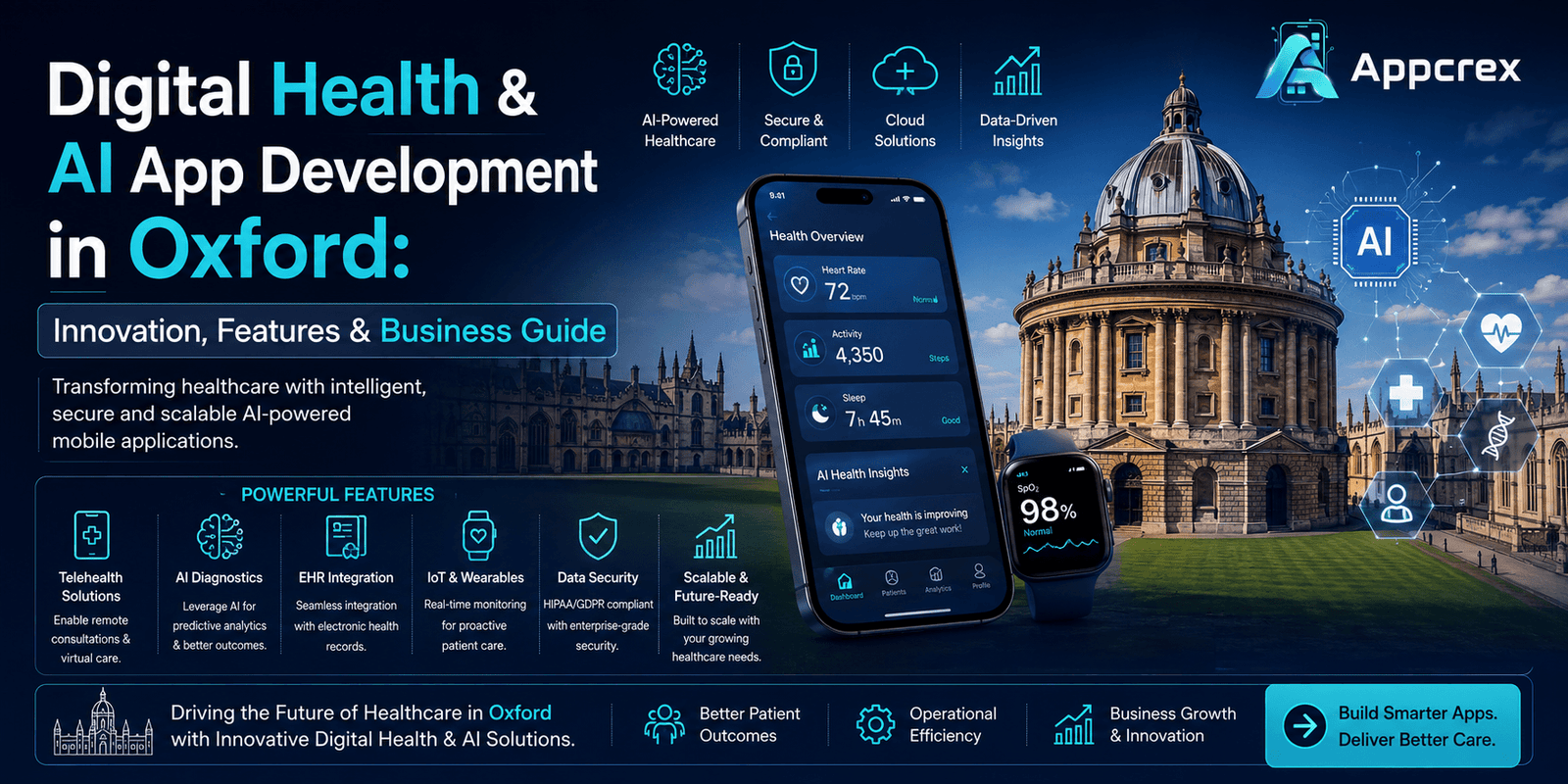
Oxford is increasingly becoming an important environment for digital health, artificial intelligence, biomedical research, and health technology innovation. The city benefits from the research capabilities of the University of Oxford, specialist digital-health programmes, health-focused spinouts, and a growing ecosystem connecting science with commercial technology.
The Oxford Institute of Digital Health focuses on areas such as digital transformation of care, mobile health, wearables, remote monitoring, diagnostics, data science, and AI-driven risk prediction.
This makes Oxford an interesting market for businesses developing AI healthcare apps, remote patient monitoring platforms, clinical research software, digital therapeutics, health-data solutions, and connected healthcare products.
In this guide, we explore the opportunities, features, technologies, development process, costs, security considerations, and business potential of digital health and AI app development in Oxford.
Why Oxford Is a Strong Market for Digital Health Apps
Oxford’s advantage is its combination of research, healthcare, AI, life sciences, and entrepreneurship.
The Oxford Institute of Digital Health specifically highlights mobile health, wearables, remote consultations, monitoring, diagnostics, and personalised medicine as areas where digital technology can improve healthcare delivery.
Oxford also has a strong commercialisation ecosystem. Oxford Science Enterprises’ HealthTech portfolio includes areas such as digital health platforms, connected technologies, diagnostics, devices, AI, data science, and healthcare research.
This creates opportunities for technology businesses to develop solutions around real healthcare and research requirements rather than building generic health apps.
Digital Health Opportunities in Oxford
The most promising opportunities are not limited to appointment-booking applications.
1. Remote Patient Monitoring
Apps can collect information from patients and connected devices and present relevant data to healthcare professionals.
Potential capabilities include:
- Vital-sign monitoring
- Medication reminders
- Patient dashboards
- Health alerts
- Wearable integration
- Long-term condition tracking
2. AI-Powered Risk Prediction
AI and machine learning can help analyse healthcare data and identify patterns that may support earlier intervention.
Oxford’s digital-health research includes the use of AI and machine learning with electronic health records to develop prediction tools for precision medicine.
Commercial products should, however, distinguish between clinical decision support and claims that require formal medical-device or regulatory approval.
3. Digital Clinical Research Platforms
Oxford’s research environment creates opportunities for platforms supporting:
- Clinical studies
- Participant recruitment
- Research data collection
- Digital questionnaires
- Remote monitoring
- Trial management
- Research dashboards
A well-designed platform can reduce manual processes while making research participation easier.
4. AI Diagnostic Support
AI can potentially support healthcare professionals by analysing relevant information and identifying patterns.
Oxford’s AI for Digital Health research includes work on cancer and cardiovascular risk prediction, among other areas.
For commercial applications, the development approach should include appropriate clinical validation, governance, explainability, and regulatory planning.
5. Wearable & Connected Health Apps
Wearables can provide continuous or periodic data that applications can transform into useful insights.
Examples include:
- Heart-rate information
- Activity data
- Sleep information
- Glucose-related data
- Blood oxygen readings
- Fitness metrics
The value is not simply collecting data; it is presenting meaningful information to users or authorised professionals.
Also Read : Wearable App Development Company: Complete Guide to Features, Cost & Development Process
What Can an AI Healthcare App Do?
An AI-enabled healthcare application can combine conventional mobile features with intelligent services.
For example:
User Data → Secure Backend → AI/Data Processing → Personalised Insight → User or Clinician
Depending on the product, AI can support:
- Natural-language interaction
- Patient education
- Personalised recommendations
- Risk assessment
- Document summarisation
- Medical information search
- Data classification
- Pattern detection
- Clinical workflow support
AI should be positioned as an appropriate support layer rather than replacing qualified healthcare professionals where clinical judgement is required.
Also Read : Healthcare CRM Software Development: Complete Guide to Features, Benefits, Cost & AI Integration (2026)
Generative AI in Digital Health Applications
Generative AI is creating new possibilities for healthcare interfaces.
A patient could interact with a conversational assistant rather than navigating through multiple menus.
For example:
“Show me my upcoming appointments.”
Or:
“Summarise the information from my recent health reports.”
A healthcare organisation could also use AI internally to summarise authorised documents, organise information, or support administrative workflows.
However, healthcare AI requires stronger safeguards around:
- Patient privacy
- Data access
- Accuracy
- Hallucination risk
- Human oversight
- Auditability
- Security
AI Agent Development for Healthcare
AI agents can go beyond answering questions by interacting with approved software systems.
A healthcare workflow might look like:
User Request → AI Agent → Permission Check → Healthcare System → Action → Confirmation
For example, an agent could potentially assist with administrative tasks such as retrieving authorised information or preparing a summary.
For sensitive healthcare environments, agents should operate within clearly defined permissions and should not be allowed unrestricted access to patient systems.
Also Read : AI Agent Development Company: Complete Guide to Features, Benefits, Cost & Development Process (2026)
Essential Features of a Digital Health App
A healthcare application should be designed around its specific users.
Patient Features
- Registration
- Profile management
- Health information
- Appointment booking
- Medication reminders
- Secure messaging
- Notifications
- Document access
Doctor or Clinician Features
- Patient dashboard
- Appointment management
- Health records
- Reports
- Monitoring information
- Communication
- Alerts
Admin Features
- User management
- Provider management
- Analytics
- Content management
- Permissions
- Audit logs
AI Features Worth Considering
Not every health app needs AI.
Where there is a genuine use case, developers can consider:
AI Health Assistant
Provides conversational support based on approved information.
Smart Search
Allows users to find information using natural language.
Personalised Insights
Identifies patterns from authorised user data.
Predictive Analytics
Supports risk analysis where the underlying model has been appropriately validated.
Document Intelligence
Extracts and summarises information from suitable documents.
AI-Powered Clinical Support
Can assist professionals with specific workflows when appropriately validated and regulated.
Technology Stack for Digital Health Apps
A digital health platform may include several technical layers.
Mobile Development
- Flutter
- React Native
- Swift
- Kotlin
Backend
- Node.js
- Python
- Java
- .NET
Database
- PostgreSQL
- MySQL
- MongoDB
Cloud
- AWS
- Microsoft Azure
- Google Cloud
AI & Data
- Python
- Machine learning frameworks
- Generative AI APIs
- NLP
- Data analytics
The final stack should be selected according to the application’s security, scalability, integration, and regulatory requirements.
Healthcare API & System Integration
A digital health application may need to connect with other systems.
Potential integrations include:
- Electronic health records
- Hospital systems
- Appointment systems
- Wearables
- Laboratory systems
- Payment platforms
- Identity services
- Communication platforms
Interoperability should be considered during architecture rather than added at the end of development.
Data Security & Compliance
Healthcare applications deal with highly sensitive information, making security a core part of development.
A secure architecture can include:
- Encryption
- Secure authentication
- Role-based access
- Multi-factor authentication
- API security
- Audit logging
- Secure cloud infrastructure
- Data minimisation
- Backup and recovery
- Security testing
For UK-focused products, UK GDPR and the Data Protection Act 2018 should be considered where applicable.
If a product qualifies as a medical device or software as a medical device, additional regulatory requirements may apply.
Therefore, compliance should be assessed according to the actual functionality and intended use of the product.
How Much Does It Cost to Develop a Digital Health App in Oxford?
There is no universal development price because healthcare applications can range from simple patient portals to sophisticated AI platforms.
As an indicative planning framework:
| App Complexity | Approx. Development Cost |
|---|---|
| Basic Digital Health App | £15,000–£25,000 |
| Medium Health App | £25,000–£45,000 |
| Advanced Healthcare Platform | £45,000–£75,000+ |
| AI-Powered Health App | £60,000–£120,000+ |
| Enterprise Health Platform | £80,000–£150,000+ |
These figures are planning estimates, not fixed Oxford market quotations.
The actual budget depends on:
- Number of platforms
- UI/UX complexity
- Backend architecture
- Healthcare integrations
- AI functionality
- Data requirements
- Security
- Compliance
- Testing
- Cloud infrastructure
- Third-party services
What Makes a Healthcare App More Expensive?
AI Development
A basic AI API integration is different from building and validating a specialised AI model.
Healthcare Integrations
Connecting with existing clinical systems can require considerable technical and interoperability work.
Security
Sensitive information requires stronger security architecture and testing.
Multiple User Roles
Patient, doctor, researcher, administrator, and other roles create additional workflows.
Real-Time Monitoring
Continuous monitoring and alerting require additional infrastructure.
Development Timeline
The development timeline depends on product complexity.
| Project Type | Approx. Timeline |
|---|---|
| Basic App | 2–4 months |
| Medium App | 3–6 months |
| Advanced Health Platform | 5–8 months |
| AI-Powered App | 6–10 months |
| Enterprise Platform | 8–14+ months |
Discovery, regulatory planning, integrations, testing, and clinical validation can extend the timeline.
A Better Development Approach for HealthTech Startups
Instead of building every feature immediately, businesses can follow an MVP approach.
Stage 1 — Define the Problem
Identify the specific healthcare or operational problem.
Stage 2 — Validate the Use Case
Understand users, workflows, regulations, and technical constraints.
Stage 3 — Build the MVP
Develop the minimum set of features required to test the concept.
Stage 4 — Test With Real Users
Collect feedback and identify usability or workflow problems.
Stage 5 — Add AI & Automation
Introduce intelligent features where they provide measurable value.
Stage 6 — Scale
Expand integrations, users, infrastructure, and capabilities.
This approach can help avoid spending heavily on features that users may not actually need.
Oxford’s AI & HealthTech Ecosystem
Oxford’s ecosystem is particularly interesting because digital health sits at the intersection of medicine, data science, AI, engineering, and life sciences.
The University of Oxford’s AI for Digital Health work includes areas such as cancer, cardiovascular disease, AI evaluation, and clinical applications.
Oxford Science Enterprises also highlights HealthTech opportunities across care delivery, diagnostics and devices, and data and discovery, with its portfolio including AI-powered diagnostics, digital surgery, connected technologies, and other healthcare innovations.
This makes Oxford particularly relevant for businesses working on technology that connects research with practical healthcare applications.
Who Can Benefit From Digital Health App Development in Oxford?
HealthTech Startups
Build and validate new digital healthcare products.
Research Organisations
Create platforms for data collection, studies, and participant engagement.
Healthcare Providers
Improve patient communication and digital workflows.
Life Sciences Companies
Develop digital tools supporting research and patient services.
Medical Technology Businesses
Connect devices with software platforms and dashboards.
Wellness Companies
Build consumer-focused health and wellbeing products where medical-device regulation does not apply.
How to Choose a Digital Health App Development Company?
Don’t evaluate a development company solely by its portfolio of ordinary mobile applications.
Look for experience in:
- Healthcare software
- Secure application architecture
- AI integration
- Data engineering
- API development
- Cloud infrastructure
- Mobile development
- Testing
- Compliance-aware development
Also ask how the team handles patient data, access controls, audit logs, third-party integrations, AI risks, and post-launch maintenance.
Why AppCrex for Digital Health & AI App Development?
AppCrex can help businesses build digital products across mobile, cloud, AI, and custom software development.
Our capabilities include:
- Healthcare app development
- AI app development
- Generative AI integration
- AI agent development
- Flutter development
- React Native development
- iOS development
- Android development
- Backend development
- API integration
- Cloud solutions
- UI/UX design
- QA testing
- Maintenance and support
For Oxford-focused businesses, the development strategy can be structured around the specific needs of HealthTech, research, digital care, AI, wearables, or healthcare data.
FAQs
Q. Why is Oxford suitable for digital health app development?
Oxford has a strong combination of medical research, digital-health research, AI, data science, life sciences, and HealthTech commercialisation.
Q. How much does a digital health app cost?
A basic product may start around £15,000–£25,000, while advanced AI and enterprise healthcare platforms can exceed £100,000 depending on scope.
Q. Can AI be integrated into a healthcare app?
Yes. AI can support appropriate use cases such as conversational interfaces, data analysis, prediction, document processing, and workflow assistance.
Q. What technologies are used to build healthcare apps?
Common technologies include Flutter, React Native, Swift, Kotlin, Node.js, Python, PostgreSQL, cloud platforms, APIs, and AI technologies.
Q. How long does it take to build a healthcare app?
A basic app may take 2–4 months, while advanced AI or enterprise healthcare platforms can require 6–14+ months.
Q. Do healthcare apps require special compliance?
Potentially, yes. Requirements depend on the type of data handled, intended users, functionality, and whether the software falls within medical-device regulations.
Q. Can a healthcare app connect with wearables?
Yes. Apps can integrate with compatible wearable platforms and connected devices to collect and present authorised health or activity information.
Final Thoughts
Oxford offers a distinctive environment for digital health innovation because healthcare research, AI, data science, life sciences, and technology development increasingly intersect within the ecosystem.
For businesses, this creates opportunities beyond traditional appointment-booking or wellness apps. Products can focus on remote monitoring, clinical research, AI-assisted workflows, health analytics, digital interventions, diagnostics support, wearables, and personalised care.
The key is to begin with a clearly defined healthcare problem and then select the appropriate technology, security architecture, AI capabilities, and compliance strategy.
Digital health products should be built around trust, privacy, interoperability, usability, clinical relevance, and measurable outcomes rather than technology alone. Oxford’s own digital-health research emphasises that digital solutions should be ethical, safe, secure, reliable, equitable, sustainable, and interoperable.
Build Your Digital Health App With AppCrex
Have an idea for a digital health, AI healthcare, wearable, remote monitoring, or HealthTech platform in Oxford?
AppCrex can help transform the concept into a secure and scalable digital product—from UI/UX and mobile development to backend engineering, AI integration, APIs, cloud infrastructure, testing, deployment, and ongoing support.
Turn your HealthTech idea into a practical digital solution with AppCrex.