📌 Key Takeaways
- App costs depend on complexity, features, platforms, and integrations.
- MVP development helps startups control initial investment.
- AI and Generative AI can add automation, personalization, and intelligent workflows.
- Flutter and React Native can simplify multi-platform development.
- Security, scalability, and Arabic/English support should be planned from the start.
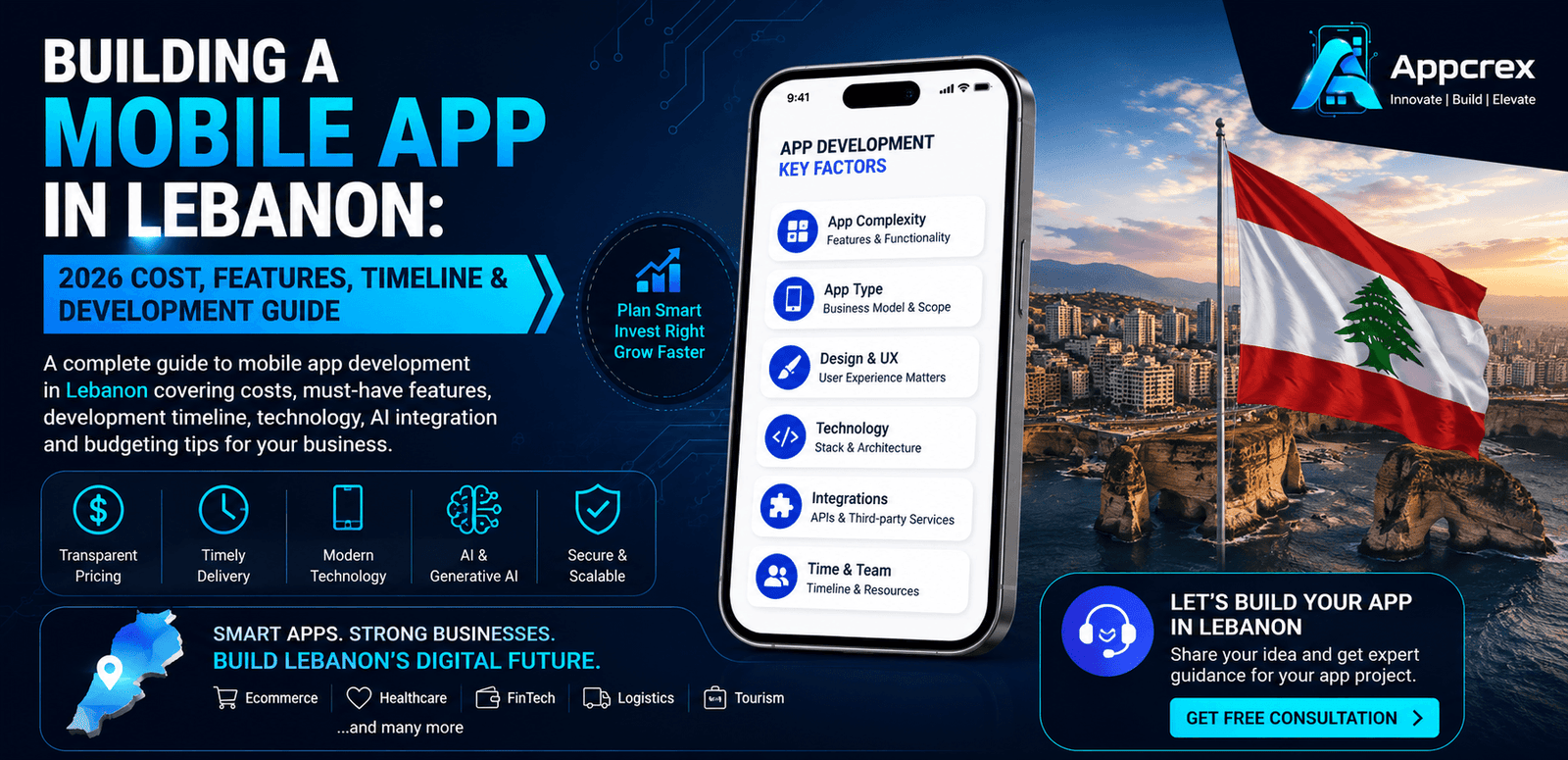
Lebanon’s digital market is creating opportunities for businesses that want to move customer services, sales, bookings, payments, and internal operations to mobile platforms. From Beirut and Tripoli to other growing business centers, companies across eCommerce, healthcare, fintech, tourism, food delivery, logistics, education, and professional services are exploring custom mobile solutions.
But one question usually comes first:
How much does it cost to build a mobile app in Lebanon?
The answer depends on what you want the app to do. A simple business app may require a relatively modest investment, while a marketplace, fintech platform, healthcare solution, or AI-powered application can require significantly more engineering.
For planning purposes, mobile app development in Lebanon can range from around $15,000 to $120,000+, depending on functionality, platforms, UI/UX, backend architecture, integrations, security, AI capabilities, and development methodology.
This guide looks beyond a simple price range. It explains what affects the budget, how different app types compare, what features increase costs, how AI and Generative AI change development, how long projects take, and how businesses can plan their investment more effectively.
First, What Determines the Price?
There isn’t a universal “Lebanon app development price.”
Think of app development as building a digital business rather than simply designing a collection of screens.
A typical project may contain:
Mobile interface
The customer-facing Android and/or iOS experience.
Backend infrastructure
Servers, databases, APIs, authentication, business logic, and data management.
Admin system
A dashboard for managing users, products, orders, content, payments, or reports.
Third-party services
Payment gateways, maps, SMS, email, analytics, cloud services, and other APIs.
Advanced intelligence
AI assistants, recommendation engines, predictive analytics, machine learning, Generative AI, or AI agents.
The more of these components your product requires, the more development effort is involved.
A Realistic Budget Breakdown for Lebanese Businesses
Instead of assigning one price to every project, businesses can think about their application in development tiers.
| Type of Product | Approx. Development Cost | Typical Timeline |
|---|---|---|
| Basic Business App | $15,000–$25,000 | 2–3 months |
| Standard Customer App | $25,000–$45,000 | 3–5 months |
| Advanced Mobile Platform | $45,000–$80,000 | 5–8 months |
| Marketplace / Multi-Service App | $60,000–$100,000+ | 6–10 months |
| Enterprise / AI-Powered Product | $80,000–$120,000+ | 8–12+ months |
These figures are planning estimates rather than fixed quotations. The actual cost should be calculated after requirements, user roles, integrations, design expectations, and technical architecture are defined.
What Can a $20K App Look Like?
A smaller budget doesn’t necessarily mean a poor product.
For example, a startup could build an MVP containing:
- User registration
- Login
- User profile
- Product or service listings
- Search
- Basic booking/order functionality
- Push notifications
- Simple admin panel
The product can then be launched and tested with real users.
Features such as AI recommendations, subscriptions, loyalty programs, advanced analytics, multilingual content, or automation can be introduced in later versions.
This is often more practical than spending heavily on features that haven’t yet been validated.
Industry-Wise App Development Costs in Lebanon
The industry has a major impact on development complexity.
1. eCommerce App Development
Retailers can use mobile commerce applications to allow customers to browse products, place orders, make payments, and track deliveries.
A typical eCommerce app may include:
- Product catalog
- Categories
- Search
- Filters
- Product details
- Cart
- Checkout
- Payments
- Order tracking
- Wishlist
- Reviews
- Coupons
- Loyalty rewards
Estimated development investment: $25,000–$70,000+
A multi-vendor marketplace can cost more because sellers require individual dashboards, product management, order management, commissions, and potentially vendor payouts.
2. FinTech App Development
Financial applications usually require more sophisticated architecture than a standard business app.
Potential functionality includes:
- Account management
- Digital wallets
- Payments
- Transaction history
- KYC workflows
- Authentication
- Notifications
- Financial dashboards
- Transaction monitoring
- Banking/API integrations
Estimated investment: $45,000–$120,000+
Security becomes particularly important when the application handles financial information.
3. Healthcare App Development
Healthcare businesses can build applications for appointments, telemedicine, patient engagement, medical services, and healthcare administration.
Common features include:
- Doctor profiles
- Search
- Appointment booking
- Patient profiles
- Video consultations
- Digital prescriptions
- Reminders
- Payments
- Notifications
- Admin dashboards
Estimated investment: $35,000–$100,000+
Healthcare products should incorporate appropriate privacy, authentication, authorization, security, and regulatory considerations from the beginning.
4. Food Delivery App Development
A food delivery platform isn’t normally just one application.
A complete ecosystem may contain:
Customer App + Restaurant Dashboard + Delivery App + Admin Panel
Features can include:
- Restaurant discovery
- Menus
- Search
- Cart
- Checkout
- Payment
- Driver assignment
- GPS tracking
- Order status
- Reviews
- Offers
- Push notifications
Estimated investment: $35,000–$90,000+
Real-time location, multiple user roles, delivery optimization, and order synchronization can increase the development scope.
5. Logistics and Fleet Applications
Logistics businesses can use mobile platforms to manage drivers, vehicles, shipments, routes, and deliveries.
Useful functionality includes:
- Driver profiles
- Vehicle management
- GPS tracking
- Route planning
- Shipment management
- Delivery status
- Digital proof of delivery
- Notifications
- Analytics
- Admin dashboard
Estimated investment: $40,000–$100,000+
If the platform also incorporates predictive analytics, IoT devices, or intelligent route optimization, the technical requirements become more advanced.
6. Tourism and Travel Apps
Travel applications can combine discovery, bookings, recommendations, maps, and personalized experiences.
A tourism platform could include:
- Destination discovery
- Hotel listings
- Booking
- Attractions
- Maps
- Travel guides
- Reviews
- Itinerary planning
- Recommendations
- Promotions
Estimated investment: $25,000–$75,000+
Generative AI can take this further by creating personalized travel plans based on budget, interests, duration, and location.
AI Is Becoming a Core Part of Modern Mobile Apps
AI doesn’t necessarily mean building a completely separate AI product.
Businesses can integrate intelligence into an existing mobile experience.
For example:
AI Recommendation Systems
Suggest relevant products, services, properties, content, or destinations based on user behavior.
Predictive Analytics
Analyze historical data to identify trends and forecast potential outcomes.
AI Customer Support
Handle common customer queries and escalate complicated issues to human agents.
Computer Vision
Process images for verification, classification, recognition, inspection, or document-related workflows.
Voice AI
Allow users to interact with the application through natural language.
Machine Learning
Detect patterns in customer behavior, transactions, operational data, or other business information.
The important question is not “Can we add AI?”
It is:
“Which business problem can AI solve better than a traditional workflow?”
Generative AI Can Change the User Experience
Generative AI adds another layer to mobile application development.
Instead of users navigating through predefined menus for every task, they can communicate naturally with the product.
For example:
“Find me three hotels near Beirut suitable for a family trip within my budget.”
An AI-powered travel platform could understand the request, search connected data, apply filters, and present suitable results.
Generative AI can support:
- AI chat assistants
- Intelligent search
- Document summarization
- Personalized recommendations
- Content generation
- Knowledge assistants
- Voice interactions
- AI customer service
- AI agents
- Automated workflows
What Does Generative AI Integration Add to Development?
A basic AI API integration may be relatively straightforward.
A more advanced system can require:
- Large Language Model integration
- RAG architecture
- Vector databases
- Knowledge bases
- Prompt engineering
- AI orchestration
- API integrations
- User context management
- Security controls
- Monitoring
- Usage management
An AI agent can be even more sophisticated because it may interact with external systems and perform actions instead of simply generating text.
For example:
User request → AI understands intent → AI checks data → API executes action → AI confirms result
That requires significantly more backend engineering.
Arabic, English and Localization
For businesses targeting Lebanon and the wider Middle East, language support should be considered during product design.
Depending on the audience, an app may require:
- Arabic
- English
- RTL support
- Localized content
- Multilingual notifications
- Localized forms
- Flexible layouts
Arabic support isn’t simply about translating text.
The interface itself needs to accommodate right-to-left presentation across menus, forms, buttons, navigation, search, and other components.
Planning localization during UI/UX design is generally easier than retrofitting it after development.
Native or Cross-Platform: Which Should You Choose?
Technology selection can influence both budget and development speed.
Native Development
For dedicated platforms:
Android → Kotlin
iOS → Swift
Native development can be suitable when the application requires high performance, advanced platform capabilities, or deep device integration.
Cross-Platform Development
Popular frameworks include:
- Flutter
- React Native
A shared codebase can make it easier to launch Android and iOS versions while reducing duplicated development effort.
For many startups and SMEs, cross-platform development can be an efficient option.
However, the cheapest technology isn’t automatically the best technology. The decision should be based on the product’s long-term requirements.
How Long Does It Take to Build an App in Lebanon?
Development timelines vary according to scope.
Simple App
2–3 months
MVP
2–4 months
Standard Business App
3–6 months
Advanced Application
5–8 months
Enterprise / AI Product
8–12+ months
A typical development journey includes:
Discovery → UX/UI → Development → Integration → Testing → Deployment → Optimization
Changing requirements during development can increase both cost and timeline.
Don’t Forget the Cost After Launch
The initial development budget is only part of the total product investment.
Maintenance
You may need ongoing:
- Bug fixes
- Security updates
- OS compatibility updates
- Performance optimization
Cloud Infrastructure
Hosting expenses can grow as traffic, users, storage, and data processing increase.
Third-Party APIs
Recurring costs may come from:
- Maps
- SMS
- Payments
- Analytics
- AI services
AI Usage
Generative AI and other AI services can introduce usage-based recurring expenses.
Marketing
A technically excellent app still needs users. Businesses may invest in:
- App Store Optimization
- SEO
- Paid advertising
- Social media
- Partnerships
- Content marketing
A Smarter Way to Control Your App Budget
Instead of cutting development quality, control the scope.
Start With the Core Problem
Identify exactly what the app needs to solve.
Separate Must-Have and Nice-to-Have Features
Not every feature needs to be included in version one.
Build an MVP
Launch the essential product and validate the market.
Add AI Where It Creates Value
Don’t integrate AI simply because it is trending.
Plan Integrations Before Coding
Payments, maps, CRMs, ERPs, AI APIs, and other third-party services should be considered during architecture planning.
Design Before Development
A clickable prototype can expose usability problems before expensive development begins.
Think About Scalability
A scalable architecture reduces the likelihood of expensive redevelopment later.
What Should You Ask an App Development Company?
When comparing development partners in Lebanon, don’t compare quotations based only on the final number.
Ask:
What exactly is included?
Does the quotation include UI/UX?
Are backend and admin panels included?
How many platforms are supported?
Which integrations are included?
How is testing handled?
What happens after launch?
Are maintenance and support available?
Can the team handle AI and Generative AI if required?
A professional mobile app development company in Lebanon should be able to explain how its estimate was calculated.
App Development Roadmap for Different Business Models
A startup doesn’t need the same development process as an enterprise.
For a Startup
Idea → Market Validation → MVP → Launch → Feedback → Scale
For an eCommerce Business
Business Analysis → UX → Catalog → Payments → Orders → Launch → Personalization
For a FinTech Product
Requirements → Security Architecture → APIs → Core Financial Features → Testing → Deployment
For an AI Startup
AI Use Case → Data Strategy → Prototype → AI Integration → Mobile Experience → Production
For an Enterprise
Discovery → Architecture → Integrations → Development → Security → Testing → Deployment → Optimization
This flexible approach allows the investment to match the actual business objective.
Why Choose AppCrex?
AppCrex helps businesses turn digital product ideas into scalable mobile solutions.
Our capabilities cover:
- Custom mobile app development
- Android app development
- iOS app development
- Flutter development
- React Native development
- AI app development
- Generative AI integration
- Machine learning solutions
- AI agent integration
- FinTech app development
- eCommerce app development
- Healthcare app development
- Logistics app development
- On-demand app development
- API integration
- Cloud solutions
- UI/UX design
- App maintenance
Whether you’re starting with an MVP or planning a complex enterprise platform, AppCrex can help structure the product around your business model, target audience, technical requirements, budget, and long-term growth plans.
FAQs
Q. How much does it cost to develop a mobile app in Lebanon?
A mobile app can cost approximately $15,000 to $120,000+, depending on complexity, features, platforms, integrations, technology, and development requirements.
Q. What is the cost of a basic app?
A basic business application may start around $15,000–$25,000.
Q. How much does an advanced mobile app cost?
Advanced applications may fall in the $45,000–$80,000+ range, while enterprise or AI-heavy platforms can exceed $120,000.
Q. Is an MVP cheaper?
Yes. An MVP focuses on essential functionality and can help businesses validate an idea before investing in advanced features.
Q. Can AI be added to an existing app?
Yes. Existing applications can be enhanced with AI chat, recommendations, predictive analytics, Generative AI, voice AI, machine learning, and AI agents.
Q. Which is better: Flutter or native development?
It depends on the project. Flutter can be efficient for multi-platform development, while native development may be preferable when advanced platform-specific functionality is required.
Q. How long does mobile app development take?
A simple app may take 2–3 months, while advanced or enterprise applications can require 5–12+ month.
Conclusion
The cost of mobile app development in Lebanon isn’t determined by a single formula.
A basic application may require a relatively modest investment, while a marketplace, financial platform, healthcare solution, logistics system, or AI-powered product can require significantly more engineering.
The most effective strategy is to define the business objective first and then decide which features are genuinely necessary.
For startups, an MVP can provide a controlled entry into the market. Established businesses may benefit from deeper integrations, automation, analytics, personalization, and AI.
Most importantly, modern app development is moving beyond traditional mobile interfaces. AI, Generative AI, machine learning, predictive analytics, voice AI, and AI agents can now become part of the product itself when they solve a meaningful business or customer problem.
Build Your Mobile App With AppCrex
Planning to build a mobile app for Lebanon or the wider Middle East?
AppCrex can support the complete journey—from product strategy and UI/UX design to mobile development, backend engineering, API integrations, AI implementation, testing, deployment, and ongoing maintenance.
Whether your idea is a marketplace, FinTech app, eCommerce platform, healthcare solution, logistics product, tourism app, or AI-powered mobile experience, the development approach can be tailored to your goals.
Turn your app idea into a scalable digital product with AppCrex.