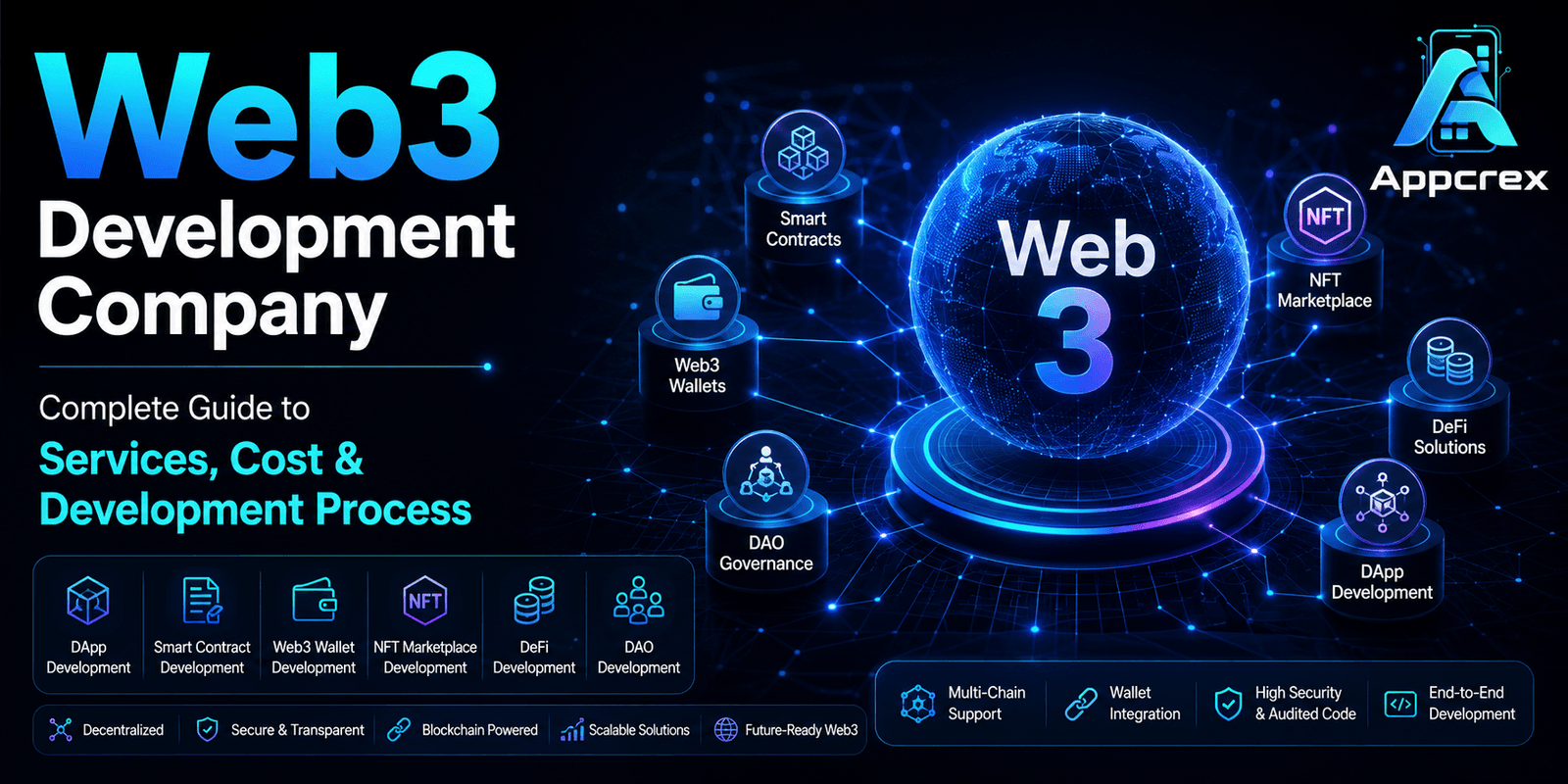
Web3 is changing how businesses build digital products by introducing decentralized networks, blockchain-based ownership, smart contracts, digital assets, and user-controlled identities. From decentralized applications and DeFi platforms to NFT marketplaces, blockchain games, DAOs, and Web3 wallets, businesses across multiple industries are exploring decentralized technologies.
As demand for decentralized solutions grows, choosing the right Web3 development company becomes important for businesses looking to build secure, scalable, and user-friendly Web3 products.
Web3 development requires expertise across blockchain networks, smart contracts, decentralized applications, wallets, tokens, APIs, security, and frontend development. A professional development team can help transform a Web3 idea into a production-ready solution.
What Is Web3 Development?
Web3 development is the process of creating decentralized applications, platforms, protocols, and digital ecosystems using blockchain and decentralized technologies.
Unlike conventional applications that generally depend on centralized servers and databases, Web3 applications can use blockchain networks and smart contracts for parts of their functionality.
A Web3 product may include:
- Blockchain integration
- Smart contracts
- Cryptocurrency wallets
- Tokens
- NFTs
- Decentralized applications
- DeFi functionality
- DAO governance
- Digital identity
- Decentralized storage
- Web3 APIs
The exact architecture depends on the project’s business model and technical requirements.
What Is a Web3 Development Company?
A Web3 development company specializes in designing and developing blockchain-based products and decentralized applications.
A professional Web3 development team can help businesses with everything from initial strategy and blockchain selection to smart contract development, frontend integration, testing, deployment, and maintenance.
A Web3 development team may include:
- Blockchain developers
- Smart contract developers
- Web3 developers
- Frontend developers
- UI/UX designers
- QA engineers
- Security specialists
- Project managers
This combination of skills helps businesses develop complete Web3 ecosystems rather than isolated blockchain components.
Web3 Development Services
A full-service Web3 development company can provide several types of development solutions.
1. Custom Web3 Development
Custom Web3 development involves creating a decentralized solution according to specific business requirements.
It can include:
- Web3 architecture
- Blockchain integration
- Smart contracts
- Wallet connectivity
- Token integration
- DApp development
- APIs
- Admin dashboard
- Analytics
- Security testing
Custom development is suitable for businesses that require functionality beyond existing Web3 products.
2. Web3 DApp Development
Decentralized applications, or DApps, use blockchain networks and smart contracts for selected application functionality.
Web3 DApps can be developed for:
- Finance
- Gaming
- Marketplaces
- Social platforms
- Healthcare
- Supply chain
- Real estate
- Entertainment
- Payments
A DApp typically combines a user-friendly frontend with blockchain-based functionality.
3. Smart Contract Development
Smart contracts automate predefined rules and transactions on blockchain networks.
They can be used for:
- Token transfers
- Payments
- Staking
- NFT transactions
- Governance
- DeFi protocols
- Marketplace transactions
- Access management
Smart contracts should undergo extensive testing and, where appropriate, independent security auditing before handling real assets.
Just Read : Smart Contract Development Company: Complete Guide to Services, Cost & Development Process
4. Web3 Wallet Development
Wallets provide users with a way to manage digital assets and interact with Web3 applications.
A Web3 wallet solution can support:
- Cryptocurrency management
- Token transactions
- NFT management
- DApp connectivity
- Transaction signing
- Network switching
- Portfolio tracking
Businesses can develop custom wallets or integrate existing wallet connectivity into their Web3 applications.
5. Web3 Wallet Integration
Wallet integration allows users to connect their existing wallets with a DApp or Web3 platform.
It can enable users to:
- Connect wallets
- Sign transactions
- Approve smart contracts
- Transfer assets
- Access decentralized services
Wallet integration is especially important for DeFi platforms, NFT marketplaces, blockchain games, and other DApps.
6. Web3 Token Development
Tokens can provide utility, governance, rewards, access, or other functionality within a Web3 ecosystem.
A token development project can involve:
- Token architecture
- Smart contract development
- Supply configuration
- Minting and burning mechanisms
- Transfer functionality
- Governance features
- Wallet integration
Token design should be aligned with the overall business model and applicable regulatory requirements.
7. NFT Development
Web3 businesses can use NFTs to represent unique digital assets.
NFT development services can include:
- NFT smart contracts
- NFT minting
- NFT marketplaces
- Collection management
- Metadata integration
- Wallet integration
- NFT trading functionality
NFTs can be used in gaming, digital art, entertainment, memberships, collectibles, and other applications.
Just Read : How Can You Hire the Best NFT Marketplace Development Company?
8. DeFi Development
Web3 development companies can also build decentralized finance solutions.
Examples include:
- Decentralized exchanges
- Lending platforms
- Borrowing platforms
- Staking platforms
- Liquidity pools
- Yield-related protocols
- DeFi dashboards
These solutions generally require extensive smart contract development and security testing.
9. DAO Development
Decentralized Autonomous Organizations can provide blockchain-based governance mechanisms.
A DAO solution can include:
- Governance tokens
- Proposal creation
- Voting
- Delegation
- Treasury management
- Proposal execution
- Community governance
Key Features of a Web3 Application
The features of a Web3 application depend on its purpose, but common functionality includes the following.
Blockchain Integration
The application connects with one or more blockchain networks to read data and submit transactions.
Wallet Connectivity
Users can connect compatible wallets to authenticate, manage assets, and sign transactions.
Smart Contract Interaction
The frontend can communicate with deployed smart contracts to execute supported blockchain functions.
Token Support
Applications can support native assets, tokens, stablecoins, NFTs, or other digital assets.
Transaction Management
Users can review transaction details, network fees, confirmation status, and blockchain transaction records.
User Dashboard
A dashboard can display:
- Wallet balance
- Token holdings
- NFTs
- Transactions
- Staking positions
- Rewards
- Activity history
Notifications
Notifications can inform users about transactions, blockchain events, account activity, and other important actions.
Analytics
Web3 analytics can help businesses understand:
- Wallet activity
- Transactions
- Token activity
- User engagement
- Protocol usage
- Asset movements
How to Build a Web3 Application?
Building a Web3 application requires a combination of blockchain development, smart contracts, frontend engineering, wallet integration, and security.
Step 1: Define the Business Concept
Start by identifying:
- Target users
- Business problem
- Web3 functionality
- Revenue model
- Digital assets involved
- Decentralization requirements
Not every application needs to put every component on-chain. A well-designed architecture determines which functions should use blockchain and which can remain off-chain.
Step 2: Choose the Blockchain
The blockchain should be selected according to:
- Transaction costs
- Performance
- Security
- Ecosystem
- Developer tooling
- Wallet support
- Smart contract capabilities
- User adoption
Ethereum and several other blockchain ecosystems can be considered depending on the project’s requirements.
Step 3: Design the Web3 Architecture
Developers determine how the frontend, smart contracts, blockchain, wallets, APIs, indexing systems, and off-chain services will communicate.
A simplified architecture may look like:
User → Web3 Frontend → Wallet → Smart Contract → Blockchain
Additional infrastructure can be added for analytics, indexing, storage, authentication, and application-specific services.
Step 4: Develop Smart Contracts
Smart contracts are developed according to the application’s business logic.
Contracts may manage:
- Tokens
- Payments
- Ownership
- Staking
- Governance
- NFT transactions
- Marketplace operations
- DeFi functionality
Step 5: Build the Frontend
The frontend provides users with an interface for interacting with the Web3 product.
Typical screens may include:
- Home
- Dashboard
- Wallet
- Assets
- Transactions
- Marketplace
- Staking
- Governance
- Profile
- Settings
The interface should clearly explain blockchain transactions because users may need to approve actions through their wallets.
Step 6: Integrate Wallets
Wallet integration allows users to connect their wallets and authorize blockchain transactions.
Developers implement appropriate connection, signing, network-switching, and error-handling flows.
Step 7: Integrate APIs and Blockchain Infrastructure
Web3 applications may need blockchain nodes, APIs, indexing services, decentralized storage, or other infrastructure.
These services can help retrieve blockchain data and improve application performance.
Step 8: Test the Application
Testing should cover both traditional application functionality and blockchain interactions.
Testing can include:
- Functional testing
- Smart contract testing
- Integration testing
- Wallet testing
- Security testing
- Performance testing
- Cross-device testing
- User acceptance testing
Step 9: Conduct Security Audits
Security is particularly important for Web3 applications that handle tokens, NFTs, financial transactions, or user-controlled assets.
Security reviews may examine:
- Smart contract logic
- Access controls
- Transaction validation
- Reentrancy risks
- Oracle dependencies
- Upgrade mechanisms
- Wallet interactions
Step 10: Deploy and Maintain
After successful testing and security validation, the Web3 application can be deployed.
Post-launch maintenance can include:
- Blockchain upgrades
- Smart contract monitoring
- Bug fixes
- Performance optimization
- New wallet integration
- New token support
- Security improvements
- Feature updates
Also Read : Digital Wallet App Development: Complete Guide to Features, Cost, Security & Trends (2026)
Web3 Technology Stack
The technology stack depends on the application’s architecture and selected blockchain.
Blockchain
Potential networks include:
- Ethereum
- BNB Chain
- Polygon
- Avalanche
- Solana
- Other compatible blockchain ecosystems
Smart Contracts
For EVM-based applications, Solidity is widely used.
Development tools can include:
- Hardhat
- Foundry
- Remix
- OpenZeppelin libraries
Frontend
Common frontend technologies include:
- React
- Next.js
- JavaScript
- TypeScript
Web3 Integration
Web3 libraries and blockchain infrastructure can be used to connect the frontend with wallets and blockchain networks.
Storage
Depending on the application, decentralized or traditional storage systems can be used for assets, metadata, and application data.
Web3 Use Cases
Web3 technology can be applied across multiple industries.
Finance
Web3 can support:
- DeFi
- Digital payments
- Tokenized assets
- Decentralized trading
- Lending
Gaming
Blockchain gaming can introduce:
- Digital asset ownership
- NFTs
- Token economies
- Player marketplaces
- Blockchain-based rewards
E-Commerce
Businesses can explore:
- Cryptocurrency payments
- Token-based loyalty
- NFT memberships
- Digital ownership
Real Estate
Blockchain-based platforms can explore:
- Asset tokenization
- Digital ownership records
- Investment platforms
- Transaction automation
Entertainment
Web3 can support:
- Digital collectibles
- Fan memberships
- Creator economies
- NFT-based experiences
Supply Chain
Blockchain can provide tamper-resistant records for selected supply-chain processes and product information.
Web2 vs Web3: What’s the Difference?
| Factor | Web2 | Web3 |
|---|---|---|
| Infrastructure | Primarily centralized | Can use decentralized networks |
| Data Control | Usually platform-controlled | Can provide greater user ownership/control in selected models |
| Identity | Platform accounts | Can use blockchain wallets and decentralized identity approaches |
| Transactions | Centralized systems | Blockchain-based transactions |
| Ownership | Platform-defined | Can use tokens and NFTs |
| Applications | Centralized apps | DApps and hybrid applications |
| Governance | Usually centralized | Can incorporate decentralized governance |
Web3 does not necessarily mean that every component of an application must be decentralized. Many practical products use a hybrid architecture that combines centralized and decentralized technologies.
Benefits of Web3 Development
Decentralization
Web3 applications can reduce dependence on a single centralized authority for selected functions.
Digital Ownership
Blockchain technology can provide verifiable ownership records for tokens and digital assets.
Transparency
Transactions recorded on public blockchains can be independently verified.
Programmability
Smart contracts allow developers to automate predefined rules and processes.
Global Accessibility
Blockchain-based applications can potentially serve users across multiple markets, subject to applicable laws and restrictions.
Interoperability
Web3 applications can interact with wallets, tokens, smart contracts, and other blockchain-based protocols.
How Much Does Web3 Development Cost?
The cost of Web3 development varies depending on application complexity, blockchain selection, smart contract requirements, integrations, and security needs.
A broad estimate can be:
| Web3 Project Type | Estimated Development Cost |
|---|---|
| Basic Web3 DApp | $15,000 – $30,000 |
| Custom Web3 Application | $25,000 – $50,000 |
| NFT Marketplace | $30,000 – $70,000+ |
| Web3 Wallet | $30,000 – $70,000+ |
| DeFi Platform | $40,000 – $100,000+ |
| Advanced Web3 Ecosystem | $60,000 – $150,000+ |
These figures are indicative. Actual pricing depends on project requirements.
Factors Affecting Web3 Development Cost
The final budget can be influenced by:
- Blockchain network
- Number of smart contracts
- DApp complexity
- Wallet integrations
- Token functionality
- NFT functionality
- DeFi functionality
- UI/UX requirements
- Backend infrastructure
- APIs
- Decentralized storage
- Security audits
- Testing
- Admin dashboard
- Third-party integrations
- Post-launch maintenance
Security Considerations for Web3 Development
Security should be considered from the beginning of a Web3 project.
Smart Contract Security
Smart contracts should be carefully designed, tested, reviewed, and audited when appropriate.
Wallet Security
Applications should avoid unnecessary exposure of sensitive wallet information and provide clear transaction-signing experiences.
Access Control
Administrative functionality should use strong authorization mechanisms.
Oracle Security
Applications that depend on external data should carefully evaluate oracle reliability and manipulation risks.
Frontend Security
Web3 applications should also protect users against malicious links, unauthorized transactions, compromised dependencies, and other frontend risks.
Continuous Monitoring
Security monitoring should continue after deployment because blockchain ecosystems and attack techniques evolve.
How to Choose a Web3 Development Company?
Choosing the right development partner can significantly affect the quality and security of a Web3 project.
Consider the following factors:
Blockchain Expertise
Check whether the team has experience with your preferred blockchain ecosystem.
Smart Contract Experience
Review the company’s experience building and testing smart contracts.
Web3 Portfolio
Look for relevant projects involving:
- DApps
- DeFi
- NFTs
- Wallets
- DAOs
- Tokens
- Blockchain marketplaces
Security Practices
Ask about:
- Code reviews
- Automated testing
- Smart contract audits
- Security testing
- Monitoring
Full-Cycle Development
A reliable partner should be able to handle:
Strategy → Architecture → UI/UX → Development → Integration → Testing → Security → Deployment → Maintenance
Why Choose AppCrex for Web3 Development?
AppCrex provides customized blockchain and Web3 development solutions for startups and businesses looking to build decentralized digital products.
Our Web3 development services can include:
- Custom Web3 development
- DApp development
- Smart contract development
- Web3 wallet development
- Crypto wallet integration
- DeFi development
- NFT development
- NFT marketplace development
- Token development
- DAO development
- Blockchain integration
- Web3 API integration
- Testing and deployment
- Post-launch maintenance
AppCrex can help businesses move from Web3 strategy and architecture to development, testing, deployment, and ongoing technical support.
FAQs
Q. What is a Web3 development company?
A Web3 development company builds decentralized applications, blockchain-based platforms, smart contracts, wallets, tokens, NFT solutions, DeFi products, DAOs, and other Web3 solutions.
Q. How much does Web3 development cost?
Web3 development can range from around $15,000 to $150,000+, depending on the project’s complexity, blockchain, smart contracts, integrations, security requirements, and features.
Q. How long does it take to build a Web3 application?
A basic Web3 DApp may take several weeks to a few months, while complex DeFi, NFT, or multi-component Web3 ecosystems can require several months or longer.
Q. Which blockchain is best for Web3 development?
There is no universal best blockchain. Ethereum and other blockchain ecosystems can be evaluated based on transaction costs, scalability, security, ecosystem maturity, wallet support, and project requirements.
Q. What is the difference between Web3 and blockchain?
Blockchain is an underlying technology used by many Web3 applications. Web3 is a broader concept involving decentralized applications, digital ownership, blockchain-based identity, tokens, wallets, and decentralized infrastructure.
Q. Can Web3 applications use traditional databases?
Yes. Many Web3 applications use a hybrid architecture where blockchain handles specific functions while traditional databases and backend systems manage other application requirements.
Q. Is Web3 development secure?
Security depends on smart contract design, wallet integration, application architecture, testing, auditing, infrastructure, and ongoing monitoring. Professional security practices are essential for applications handling digital assets.
Q. Can AppCrex develop a custom Web3 application?
Yes. AppCrex can develop custom Web3 applications, DApps, wallets, DeFi platforms, NFT marketplaces, token ecosystems, DAOs, and other blockchain-based solutions.
Conclusion
Web3 is creating new possibilities for businesses to build decentralized applications, digital asset ecosystems, user-controlled experiences, and blockchain-powered financial and commercial platforms.
However, successful Web3 development requires expertise across blockchain technology, smart contracts, wallets, DApps, tokens, security, frontend development, and decentralized infrastructure.
Whether you want to build a Web3 DApp, DeFi platform, NFT marketplace, Web3 wallet, DAO, token ecosystem, or custom decentralized application, working with an experienced Web3 development company can help reduce technical complexity and accelerate development.
Build Your Web3 Solution with AppCrex
Have a Web3 idea you want to turn into a working product?
AppCrex can help you design, develop, integrate, test, and deploy a customized Web3 solution based on your business requirements.
From DApp and smart contract development to Web3 wallets, DeFi, NFTs, tokens, and blockchain integration, our team can help you build a scalable Web3 product.
Contact AppCrex today to discuss your Web3 development project.