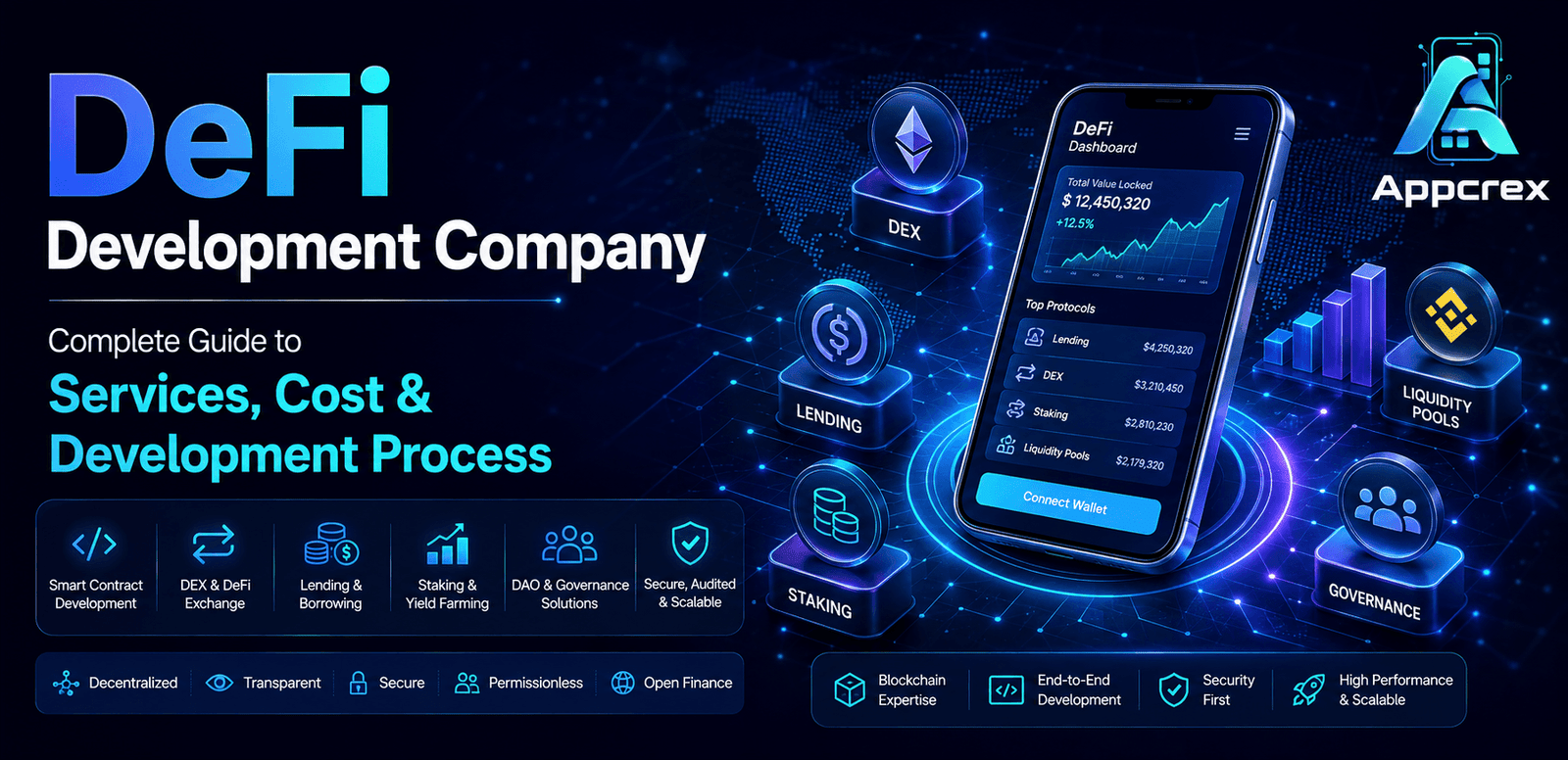
Decentralized Finance (DeFi) is transforming the way financial services are designed, delivered, and accessed. By using blockchain networks and smart contracts, DeFi platforms can provide financial functions such as lending, borrowing, token swapping, staking, liquidity management, and decentralized trading without relying entirely on traditional intermediaries.
As businesses and startups explore blockchain-based financial products, the demand for a reliable DeFi development company is increasing. Building a DeFi platform, however, requires more than smart contract programming. It involves blockchain architecture, token economics, security, wallet integration, frontend development, liquidity mechanisms, testing, and continuous monitoring.
This guide explains DeFi development services, key features, use cases, development process, technology stack, benefits, and DeFi development cost to help businesses understand what it takes to build a successful decentralized finance platform.
What Is DeFi?
DeFi, or decentralized finance, refers to blockchain-based financial services that operate through decentralized protocols and smart contracts.
Traditional financial platforms generally depend on banks, brokers, payment providers, or other centralized institutions. DeFi applications can automate many financial operations through smart contracts deployed on blockchain networks.
Users can interact with DeFi platforms through compatible wallets and blockchain transactions.
Common DeFi services include:
- Decentralized exchanges
- Crypto lending and borrowing
- Staking
- Liquidity pools
- Yield farming
- Token swaps
- Asset management
- Decentralized derivatives
- DAO-based governance
The objective is to create financial infrastructure that is programmable, transparent, and accessible through blockchain technology.
Just Read : Blockchain Development Company: Complete Guide to Services, Cost & Development Process
What Is DeFi Development?
DeFi development involves designing and building decentralized financial applications and protocols using blockchain networks, smart contracts, Web3 technologies, and digital assets.
A professional DeFi development company can build everything from a simple token-swapping platform to a sophisticated decentralized financial ecosystem.
A typical DeFi project may include:
- Smart contracts
- Web3 frontend
- Crypto wallet integration
- Liquidity pools
- Token system
- Staking mechanism
- Governance
- Oracle integration
- Analytics dashboard
- Admin functionality
- Security monitoring
The exact architecture depends on the project’s financial model and supported blockchain network.
DeFi Development Services
A full-service DeFi development company can provide different solutions based on the business model.
1. DeFi Platform Development
Custom DeFi platforms are designed according to specific financial requirements.
A platform may support:
- Token swaps
- Lending
- Borrowing
- Staking
- Liquidity provision
- Yield generation
- Portfolio management
- Governance
The development team can design the user interface, smart contracts, backend infrastructure, wallet connectivity, and analytics components.
2. DeFi Exchange Development
Decentralized exchanges allow users to trade digital assets directly through blockchain-based protocols.
A DEX can include:
- Token swapping
- Liquidity pools
- Trading interface
- Slippage controls
- Price charts
- Transaction history
- Wallet connection
- Liquidity provider functionality
The underlying smart contracts manage transactions and liquidity according to the protocol’s rules.
3. DeFi Lending and Borrowing Development
DeFi lending platforms connect liquidity providers with borrowers through smart contracts.
Users can potentially:
- Deposit digital assets
- Earn protocol-defined returns
- Borrow supported assets
- Provide collateral
- Monitor positions
- Repay loans
A lending platform requires careful design of collateral rules, liquidation mechanisms, interest calculations, and risk controls.
4. DeFi Staking Platform Development
Staking platforms allow users to lock or delegate supported assets according to predefined protocol rules.
Features can include:
- Token staking
- Reward calculation
- Locking periods
- Flexible staking
- Reward claiming
- APY display
- Staking history
- Wallet integration
The reward mechanism should be designed carefully to align with the project’s token economics.
5. Liquidity Pool Development
Liquidity pools are a core component of many DeFi protocols.
Users can deposit supported assets into a pool and receive liquidity-related benefits according to the protocol.
A liquidity management solution can include:
- Pool creation
- Asset deposits
- Liquidity withdrawal
- Pool statistics
- Reward calculation
- Liquidity provider tracking
- Fee management
6. Yield Farming Development
Yield farming platforms allow users to allocate digital assets to eligible liquidity or protocol strategies.
A yield farming platform may include:
- Multiple farming pools
- Reward distribution
- Locking periods
- APY/APR display
- Deposit and withdrawal functionality
- Reward tracking
- Smart contract automation
Because yield mechanisms can involve significant financial risk, security testing and transparent protocol logic are particularly important.
7. DeFi Token Development
Tokens can be an important component of a DeFi ecosystem.
A custom token can support:
- Utility
- Governance
- Rewards
- Liquidity incentives
- Access mechanisms
- Protocol participation
Token functionality may include transfers, supply management, minting, burning, and governance-related features depending on the project’s design.
8. DeFi DAO Development
A DAO can provide decentralized governance for a DeFi ecosystem.
DAO functionality may include:
- Proposal creation
- Voting
- Governance tokens
- Treasury management
- Delegation
- Proposal execution
- Community participation
This allows eligible users to participate in selected protocol decisions through blockchain-based governance mechanisms.
Also Read : Cloud Application Development Company: Complete Guide to Services, Cost & Development Process
Key Features of a DeFi Platform
A modern DeFi platform may include the following features.
Crypto Wallet Integration
Users can connect supported wallets to interact with blockchain contracts and manage transactions.
Token Swapping
Users can exchange one supported digital asset for another according to the protocol’s available liquidity and pricing mechanism.
Liquidity Pools
Liquidity providers can deposit assets into supported pools.
Staking
Users can stake eligible tokens according to the platform’s rules.
Lending and Borrowing
Users can supply assets or borrow against eligible collateral.
Portfolio Dashboard
A dashboard can display:
- Token balances
- Staked assets
- Liquidity positions
- Rewards
- Transaction history
Governance
Token holders can participate in protocol governance where applicable.
Notifications
Users can receive updates about transactions, rewards, staking events, and other platform activities.
Analytics
Analytics dashboards can display protocol activity, liquidity, transaction volumes, and other relevant metrics.
How to Build a DeFi Platform?
Building a DeFi platform requires a combination of blockchain technology, smart contracts, Web3 development, security, and financial logic. The development process should begin with a clear understanding of the platform’s purpose, target users, supported assets, and revenue model.
Here is a typical process for building a DeFi platform:
1. Define the DeFi Business Model
First, determine what type of DeFi platform you want to build.
For example:
- Decentralized exchange
- Lending and borrowing platform
- Staking platform
- Yield farming platform
- Liquidity pool platform
- DeFi asset management platform
- DAO-based financial platform
The business model determines the smart contract architecture, features, blockchain network, and required integrations.
2. Select the Blockchain
Choose a blockchain based on:
- Transaction speed
- Gas fees
- Scalability
- Security
- Existing DeFi ecosystem
- Liquidity
- Wallet compatibility
- Developer tools
Ethereum is widely used for DeFi, while other networks such as BNB Chain, Polygon, Avalanche, and Solana can also be considered depending on the project’s requirements.
3. Design Smart Contracts
Smart contracts form the core of a DeFi platform.
Depending on the project, contracts may manage:
- Token swaps
- Deposits and withdrawals
- Staking
- Lending and borrowing
- Interest calculations
- Rewards
- Liquidity pools
- Governance
- Liquidations
The contract architecture should be designed carefully before development begins.
Also Read : AI & ML Development Company: Complete Guide to Services, Cost & Development Process
4. Develop the DeFi Platform
Developers build the smart contracts, frontend interface, wallet integration, backend services, APIs, dashboards, and other required components.
The platform should provide a simple interface while clearly displaying transaction information, fees, balances, and blockchain confirmations.
5. Integrate Wallets and Blockchain Infrastructure
Users need compatible wallets to interact with the protocol.
The platform can integrate wallet connectivity and blockchain infrastructure required for reading blockchain data, submitting transactions, tracking activity, and displaying user balances.
6. Test and Audit the Platform
Testing should cover both the application and smart contracts.
Security checks may focus on:
- Smart contract vulnerabilities
- Access control
- Reentrancy
- Oracle manipulation
- Token interactions
- Transaction failures
- Economic attack scenarios
A professional security audit is strongly recommended before a DeFi platform handles real user assets.
7. Deploy and Monitor
After successful testing and auditing, the platform can be deployed on the selected blockchain network.
Post-launch monitoring can help identify unusual activity, performance issues, integration problems, and potential security concerns.
How Does DeFi Development Work?
Building a DeFi platform requires a structured development process.
Step 1: Business and DeFi Strategy
The first stage is understanding the project’s objective.
The development team identifies:
- Target users
- Financial model
- Supported assets
- Revenue model
- Blockchain requirements
- Liquidity strategy
- Governance requirements
This stage helps determine the appropriate DeFi architecture.
Step 2: Blockchain Selection
The appropriate blockchain is selected according to the platform’s requirements.
Factors include:
- Transaction costs
- Network performance
- Security
- Ecosystem maturity
- Developer tooling
- Wallet compatibility
- Liquidity availability
Ethereum, BNB Chain, Polygon, Avalanche, Solana, and other blockchain ecosystems can be considered depending on the project.
Step 3: DeFi Architecture Design
Developers define how the different components will communicate.
The architecture may include:
User Interface → Web3 Wallet → Smart Contracts → Blockchain
Additional components such as oracles, analytics systems, APIs, and indexing infrastructure can be included where required.
Step 4: Smart Contract Development
Smart contracts implement the core financial logic.
Depending on the platform, contracts may manage:
- Deposits
- Withdrawals
- Token swaps
- Staking
- Rewards
- Lending
- Borrowing
- Liquidation
- Governance
Since smart contracts may interact directly with user assets, secure development practices are essential.
Step 5: Frontend Development
The frontend provides users with an interface for interacting with the DeFi protocol.
Common screens can include:
- Dashboard
- Swap
- Liquidity
- Staking
- Lending
- Borrowing
- Portfolio
- Governance
- Transaction history
The interface should clearly communicate transaction details, fees, network status, and confirmation requirements.
Step 6: Wallet Integration
Wallet connectivity allows users to authorize blockchain transactions.
The platform may support wallets compatible with its chosen blockchain ecosystem.
Wallet integration should include appropriate transaction confirmation and error-handling flows.
Step 7: Testing
Testing is one of the most important stages of DeFi development.
It may include:
- Unit testing
- Integration testing
- Smart contract testing
- Functional testing
- Security testing
- Performance testing
- User acceptance testing
Developers should also test unusual transaction conditions and edge cases.
Step 8: Smart Contract Audit
A security audit can help identify vulnerabilities before the platform handles real assets.
An audit may examine:
- Access controls
- Business logic
- Reentrancy risks
- Arithmetic issues
- Oracle-related risks
- Permission mechanisms
- Token interactions
- Upgrade mechanisms
For a financial protocol, independent security review should be treated as a major part of the launch process rather than an optional afterthought.
Step 9: Testnet Deployment
The protocol can first be deployed on a suitable test network.
This allows developers to evaluate real blockchain interactions before moving to production.
Step 10: Mainnet Launch and Monitoring
After testing and security validation, the protocol can be deployed to the selected mainnet.
Post-launch activities may include:
- Transaction monitoring
- Smart contract monitoring
- Performance optimization
- Security monitoring
- Bug fixes
- Protocol improvements
- Infrastructure maintenance
Also Read : Offshore Software Development Services: Everything Businesses Need to Know Before Hiring a Development Team
DeFi Development Technology Stack
The technology stack depends on the selected blockchain and application architecture.
Blockchain
Possible blockchain ecosystems include:
- Ethereum
- BNB Chain
- Polygon
- Avalanche
- Solana
- Other EVM-compatible networks
Smart Contract Development
For EVM-based projects, Solidity is widely used.
Development environments and tools may include:
- Hardhat
- Foundry
- Remix
- OpenZeppelin libraries
Frontend
A DeFi interface can be built using:
- React
- Next.js
- JavaScript
- TypeScript
Blockchain Integration
Depending on requirements, developers may use Web3 libraries and blockchain infrastructure providers to communicate with networks.
Wallets
Wallet connectivity can be implemented through compatible wallet providers and standards.
Database and Indexing
Off-chain databases or blockchain indexing infrastructure may be used for analytics, historical transactions, user dashboards, and other application requirements.
DeFi Use Cases
DeFi technology can be applied to several financial use cases.
Decentralized Trading
Users can trade supported digital assets without relying entirely on centralized exchanges.
Lending
Users can supply assets and participate in decentralized lending protocols.
Borrowing
Eligible users can borrow assets against collateral according to protocol rules.
Asset Management
DeFi applications can provide tools for monitoring and managing digital asset positions.
Payments
Blockchain-based financial applications can support programmable payment flows.
Tokenization
Real-world or digital assets can potentially be represented through blockchain-based tokens, subject to the relevant legal and regulatory framework.
Decentralized Governance
DAOs can provide governance mechanisms for community-driven financial protocols.
DeFi vs Traditional Finance: What’s the Difference?
DeFi and traditional finance provide many similar financial functions, but they operate using different infrastructure and models.
| Factor | DeFi | Traditional Finance |
|---|---|---|
| Infrastructure | Blockchain networks | Centralized financial infrastructure |
| Intermediaries | Reduced or protocol-based | Banks, brokers, payment providers |
| Execution | Smart contracts | Institutions and manual/automated systems |
| Transparency | Blockchain transactions can be publicly verifiable | Depends on institution |
| Accessibility | Potentially global, subject to applicable restrictions | Often dependent on geography and eligibility |
| Availability | Blockchain protocols can operate continuously | Often follows institutional operating systems/hours |
| Governance | Can use decentralized governance | Usually centralized management |
| Programmability | Highly programmable through smart contracts | More dependent on conventional software systems |
DeFi does not simply replace traditional finance. Instead, it introduces a different model for delivering financial services through blockchain-based infrastructure.
Factors Affecting DeFi Development Cost
The cost of developing a DeFi platform varies significantly from one project to another. Several factors influence the overall development budget.
Platform Complexity
A basic staking platform will generally require less development effort than a complete DeFi ecosystem containing DEX, lending, liquidity, governance, and token functionality.
Smart Contract Complexity
The number and complexity of smart contracts directly affect development, testing, auditing, and maintenance requirements.
Blockchain Network
Different blockchain networks have different development environments, infrastructure requirements, tooling, and integration considerations.
Wallet Integration
Supporting multiple wallets can increase development and testing requirements.
Oracle Integration
DeFi applications that depend on external price or market data may require secure oracle infrastructure.
Security Audit
Security audits can add to the project cost but are particularly important for protocols that handle valuable digital assets.
UI/UX Design
A sophisticated DeFi dashboard with trading charts, portfolio tracking, liquidity management, staking, and analytics requires more design and frontend development effort.
Admin and Analytics
Custom dashboards for protocol management, transaction monitoring, analytics, user activity, and reporting can also increase development costs.
Post-Launch Maintenance
Ongoing monitoring, security updates, infrastructure maintenance, and blockchain ecosystem changes should also be considered when calculating the total cost of ownership.
Benefits of DeFi Development
Reduced Dependence on Intermediaries
Smart contracts can automate many financial operations that traditionally require intermediaries.
Global Accessibility
Blockchain-based services can potentially be accessed by users across different markets, subject to applicable laws and restrictions.
Transparency
Blockchain transactions and contract activity can provide publicly verifiable records on supported networks.
Automation
Smart contracts can automatically execute predefined financial rules.
Programmable Finance
Developers can create financial products that interact with other blockchain protocols.
24/7 Availability
Blockchain networks generally operate continuously, allowing decentralized protocols to function outside traditional banking hours.
Also Read : AI Software Development Company: Custom AI Solutions, Cost & Development Process
How Much Does It Cost to Develop a DeFi Platform?
The cost to develop a DeFi platform depends on its complexity, number of smart contracts, blockchain network, security requirements, integrations, and features.
A broad estimate can look like this:
| DeFi Project Type | Estimated Development Cost |
|---|---|
| Basic DeFi Platform | $15,000 – $30,000 |
| DeFi Staking Platform | $15,000 – $35,000 |
| DeFi Lending Platform | $25,000 – $60,000+ |
| Decentralized Exchange | $30,000 – $80,000+ |
| Yield Farming Platform | $25,000 – $60,000+ |
| Complex DeFi Ecosystem | $50,000 – $150,000+ |
These figures are indicative rather than fixed quotes.
How Can a DeFi Development Company Help Your Business?
Developing a DeFi platform internally can require significant blockchain expertise and specialized infrastructure. Working with an experienced DeFi development company can provide access to a complete technical team.
A professional development partner can help with:
- DeFi business and technical strategy
- Blockchain selection
- Smart contract architecture
- DeFi protocol development
- Token development
- Wallet integration
- Oracle integration
- DApp development
- Security testing
- Smart contract audits
- Testnet deployment
- Mainnet deployment
- Post-launch monitoring
This allows businesses to focus on their product and market strategy while the development team manages the technical implementation.
Factors Affecting DeFi Development Cost
The final cost can depend on:
- Number of smart contracts
- Blockchain selection
- DeFi features
- Token development
- Wallet integrations
- Oracle integration
- Liquidity mechanisms
- Governance functionality
- UI/UX complexity
- Security audits
- Testing requirements
- Admin dashboard
- Third-party integrations
- Development team location
- Maintenance and monitoring
A simple staking platform and a multi-protocol DeFi ecosystem require completely different levels of development and security effort.
Security Considerations for DeFi Development
Security should be a primary consideration when building a DeFi platform because smart contracts can interact directly with digital assets.
Important areas include:
Secure Smart Contract Architecture
Contracts should be designed with appropriate permission and transaction controls.
Code Reviews
Multiple levels of code review can help identify implementation issues.
Automated Testing
Automated tests should cover core functions and potential edge cases.
Security Audits
Independent audits can provide an additional layer of security review.
Oracle Security
Protocols relying on external price data need appropriate oracle design and manipulation-risk controls.
Access Control
Administrative and privileged functions should use carefully designed authorization mechanisms.
Monitoring
After deployment, contract and protocol activity should be monitored for unusual behavior.
How to Choose a DeFi Development Company?
Before hiring a DeFi development company, evaluate its technical capabilities and development approach.
Check Blockchain Experience
Make sure the team has experience with the blockchain ecosystem you intend to use.
Review DeFi Projects
Look for relevant experience in:
- DEX development
- Lending
- Staking
- Yield farming
- Token development
- DAO development
Evaluate Security Practices
Ask about smart contract testing, code reviews, audits, and post-launch monitoring.
Assess the Development Team
A complete DeFi team may include:
- Blockchain developers
- Smart contract developers
- Web3 developers
- UI/UX designers
- QA engineers
- Security specialists
- Project managers
Consider Long-Term Support
DeFi protocols may require continuous monitoring and technical maintenance after launch.
Best Practices for DeFi Platform Development
A successful DeFi platform requires a strong focus on security, usability, and transparency.
Prioritize Security
Security should be considered from the architecture stage rather than only before launch.
Keep Smart Contracts Simple
Unnecessary complexity can increase the possibility of implementation errors and security issues.
Conduct Multiple Testing Rounds
Test contracts under normal conditions as well as unexpected and edge-case scenarios.
Use Reliable Oracles
If the platform depends on external price information, carefully evaluate the oracle mechanism and its potential manipulation risks.
Provide Transparent Information
Users should be able to understand fees, transaction requirements, rewards, risks, and protocol rules before interacting with the platform.
Plan for Scalability
The architecture should account for increasing users, transactions, liquidity, and blockchain activity.
Monitor After Launch
Security and performance monitoring should continue after deployment because blockchain protocols remain exposed to evolving technical and economic risks.
Why Choose AppCrex for DeFi Development?
AppCrex helps businesses develop customized blockchain and DeFi solutions based on their specific product and financial requirements.
Our DeFi development capabilities can include:
- Custom DeFi platform development
- DEX development
- DeFi lending and borrowing
- Staking platform development
- Liquidity pool development
- Yield farming solutions
- DeFi token development
- DAO development
- Smart contract development
- Wallet integration
- DApp development
- Blockchain integration
- Testing and deployment
- Post-launch maintenance
From an initial DeFi concept to a production-ready platform, AppCrex can help businesses plan the architecture, develop the required components, integrate blockchain infrastructure, and prepare the platform for launch.
FAQs
Q. What is a DeFi development company?
A DeFi development company specializes in building decentralized financial platforms using blockchain networks, smart contracts, Web3 technologies, digital assets, and decentralized protocols.
Q. How much does it cost to develop a DeFi platform?
DeFi development can range from approximately $15,000 for a relatively basic platform to $150,000 or more for a complex DeFi ecosystem. The actual cost depends on features, blockchain, smart contract complexity, security requirements, and integrations.
Q. How long does it take to build a DeFi platform?
A basic DeFi product may take several weeks to a few months, while complex protocols can require several months or longer. Security testing and auditing can also affect the timeline.
Q. Which blockchain is best for DeFi development?
There is no single best blockchain for every DeFi project. Ethereum, BNB Chain, Polygon, Avalanche, Solana, and other networks can be considered based on transaction costs, scalability, ecosystem, security, liquidity, and technical requirements.
Q. What features should a DeFi platform have?
Depending on the business model, a DeFi platform can include wallet integration, token swaps, liquidity pools, staking, lending, borrowing, governance, portfolio tracking, analytics, and transaction history.
Q. Is DeFi development secure?
DeFi security depends heavily on smart contract architecture, coding practices, testing, auditing, oracle design, access controls, and monitoring. A professional development and security process can help reduce vulnerabilities.
Q. Can AppCrex develop a custom DeFi platform?
Yes. AppCrex can develop customized DeFi solutions including DEXs, staking platforms, lending and borrowing systems, liquidity solutions, token ecosystems, DAOs, and other blockchain-based financial platforms.
Conclusion
DeFi is creating new possibilities for programmable and decentralized financial services. From decentralized exchanges and lending platforms to staking, liquidity pools, token ecosystems, and DAOs, blockchain technology enables businesses to create financial products with automated and transparent processes.
However, building a successful DeFi platform requires expertise across smart contracts, blockchain architecture, Web3 development, security, token economics, wallet integration, testing, and deployment.
Choosing an experienced DeFi development company can help businesses move from an initial idea to a secure, scalable, and user-friendly decentralized finance platform.
Build Your DeFi Platform with AppCrex
Have an idea for a DeFi platform, DEX, staking solution, lending protocol, or blockchain-based financial product?
AppCrex can help you design, develop, test, integrate, and deploy a custom DeFi solution tailored to your business goals.
Contact AppCrex today to discuss your DeFi development project.