📌 Key Takeaways
- Select the Right Wearable Platform: Support popular ecosystems such as Apple Watch, Wear OS, Fitbit, and Garmin based on your audience.
- Prioritize User Experience: Design lightweight, intuitive apps optimized for smaller screens and quick interactions.
- Core fintech features include digital wallets, instant payments, multi-currency support, analytics, and fraud detection.
- Plan Development Costs Carefully: Budget for device compatibility, integrations, security, AI features, and ongoing maintenance.
- Partner with an Experienced Team: Working with a trusted wearable app development company ensures a scalable, secure, and future-ready solution.
Introduction
Wearable technology has transformed the way people monitor their health, fitness, productivity, and daily activities. From smartwatches and fitness trackers to smart glasses and medical wearables, connected devices are becoming an essential part of modern life. As consumers and businesses increasingly rely on real-time data, the demand for innovative wearable applications continues to grow across industries.
Modern wearable apps do much more than count steps or display notifications. They track heart rate, sleep patterns, blood oxygen levels, physical activity, GPS location, and even support remote patient monitoring. Powered by Artificial Intelligence (AI), IoT, cloud computing, and Bluetooth Low Energy (BLE), wearable applications deliver personalized insights that help users make better health and lifestyle decisions.
Whether you’re a healthcare provider, fitness startup, sports organization, logistics company, or enterprise looking to build a wearable solution, partnering with an experienced Wearable App Development Company ensures your application is secure, scalable, and optimized for today’s leading wearable devices.
At AppCrex, we develop custom wearable applications for Apple Watch, Wear OS, Fitbit, Garmin, Samsung Galaxy Watch, Huawei Watch, and other connected devices. Our solutions combine AI, real-time health monitoring, IoT integration, cloud connectivity, and intuitive user experiences to help businesses stay ahead in the rapidly growing wearable technology market.
What is Wearable App Development?
Wearable app development is the process of designing, developing, and deploying software applications for wearable devices such as smartwatches, fitness trackers, smart glasses, healthcare wearables, and other connected devices.
Unlike traditional mobile applications, wearable apps are designed for smaller screens, quick interactions, and real-time access to information. They typically integrate with smartphones, cloud platforms, IoT devices, and health monitoring systems to deliver personalized experiences.
Wearable applications can perform tasks such as:
- Health Monitoring
- Fitness Tracking
- Heart Rate Monitoring
- Sleep Tracking
- Blood Oxygen (SpO₂) Monitoring
- GPS Navigation
- Step Counting
- Workout Tracking
- Contactless Payments
- Smart Notifications
- Voice Commands
- Emergency Alerts
With the advancement of AI and sensor technology, wearable apps are becoming more intelligent, helping users monitor their health, improve fitness, enhance productivity, and stay connected wherever they go.
Why Invest in Wearable App Development?
The wearable technology market is expanding rapidly as consumers and businesses adopt connected devices for healthcare, fitness, sports, and enterprise applications. Investing in wearable app development enables organizations to deliver innovative digital experiences while unlocking new business opportunities.
Growing Wearable Technology Market
The popularity of smartwatches, fitness trackers, and connected medical devices continues to increase worldwide. Consumers expect real-time health insights, seamless connectivity, and personalized experiences, making wearable applications a strategic investment for businesses.
Rising Demand for Digital Healthcare
Healthcare providers are increasingly using wearable devices to support:
- Remote Patient Monitoring
- Chronic Disease Management
- Heart Rate Monitoring
- Blood Oxygen Tracking
- Medication Reminders
- Telehealth Services
Wearable applications improve patient engagement while enabling healthcare professionals to monitor health data remotely.
Increased Focus on Fitness & Wellness
Fitness enthusiasts rely on wearable devices to monitor:
- Daily Steps
- Calories Burned
- Workout Performance
- Sleep Quality
- Heart Rate
- Activity Levels
Wearable apps encourage healthier lifestyles through real-time insights and personalized recommendations.
Enterprise & Industrial Adoption
Beyond healthcare and fitness, wearable applications are transforming industries such as:
- Manufacturing
- Logistics
- Retail
- Construction
- Field Services
Businesses use wearable technology to improve worker safety, productivity, communication, and operational efficiency.
AI-Powered Personalization
Artificial Intelligence enhances wearable apps by providing:
- Personalized Fitness Coaching
- Predictive Health Insights
- Smart Notifications
- Activity Recommendations
- Automated Health Alerts
AI-driven experiences increase user engagement and deliver greater value.
Competitive Business Advantage
Launching a custom wearable app enables businesses to:
- Improve Customer Engagement
- Offer Premium Digital Services
- Increase Brand Loyalty
- Generate Recurring Revenue
- Differentiate from Competitors
A well-designed wearable solution creates long-term value for both businesses and users.
Also Read : Fitness App Development Company: Complete Guide to Features, Cost & Development Process
Types of Wearable Apps
Wearable applications serve various industries and use cases. Choosing the right type depends on your business goals and target audience.
Fitness Tracking Apps
Fitness tracking apps help users monitor physical activities and achieve wellness goals.
Features
- Step Counting
- Workout Tracking
- Calories Burned
- Distance Monitoring
- Activity Goals
- Fitness Reports
Best For
- Fitness Startups
- Gyms
- Wellness Brands
- Sports Organizations
Healthcare Wearable Apps
Healthcare wearable apps enable continuous health monitoring and remote patient care.
Features
- Heart Rate Monitoring
- Blood Pressure Tracking
- Blood Oxygen Monitoring
- Medication Reminders
- Health Reports
- Emergency Alerts
Best For
- Hospitals
- Clinics
- Telemedicine Providers
- Healthcare Startups
Smartwatch Apps
Smartwatch apps provide quick access to important information and notifications directly from wearable devices.
Features
- Notifications
- Voice Commands
- Calendar
- Weather Updates
- Contactless Payments
- Music Controls
Best For
- Consumer Applications
- Business Productivity
- Lifestyle Apps
Sports Performance Apps
Designed for athletes and sports teams, these applications help improve performance and monitor training progress.
Features
- GPS Tracking
- Speed & Distance Monitoring
- Performance Analytics
- Recovery Tracking
- Heart Rate Zones
- Training Reports
Best For
- Sports Clubs
- Professional Athletes
- Coaches
- Running & Cycling Communities
Enterprise Wearable Apps
Enterprise wearable solutions improve workplace productivity and safety.
Features
- Employee Tracking
- Task Management
- Safety Alerts
- Location Monitoring
- Asset Tracking
- Workforce Communication
Best For
- Manufacturing
- Logistics
- Construction
- Warehousing
Smart Glasses Applications
Applications built for smart glasses provide hands-free access to information using augmented reality (AR) and voice controls.
Features
- Remote Assistance
- AR Instructions
- Live Video Streaming
- Navigation
- Field Service Support
Best For
- Healthcare
- Manufacturing
- Maintenance Services
- Field Operations
Also Read : Healthcare CRM Software Development: Complete Guide to Features, Benefits, Cost & AI Integration (2026)
How to Build a Wearable App?
Building a successful wearable app requires careful planning, the right technology stack, and a deep understanding of user needs. Unlike traditional mobile applications, wearable apps must be lightweight, responsive, battery-efficient, and capable of processing real-time sensor data.
Whether you’re building a healthcare wearable, fitness tracker, smartwatch app, or enterprise wearable solution, following a structured development process improves the chances of success.
Step 1: Define Your Business Goals
Start by identifying the purpose of your wearable application.
Ask yourself:
- Who is your target audience?
- Which wearable devices will you support?
- What problem will your app solve?
- Will the app integrate with smartphones?
- Will AI or IoT be included?
A clear product vision helps prioritize features and reduces development risks.
Step 2: Choose the Right Wearable Platform
Selecting the right platform depends on your business requirements and audience.
Popular wearable platforms include:
- Apple Watch (watchOS)
- Wear OS by Google
- Fitbit
- Garmin
- Samsung Galaxy Watch
- Huawei Watch
Supporting multiple platforms increases your app’s market reach.
Step 3: Research Your Users
Understanding user expectations helps build a better product.
Research should include:
- Competitor Analysis
- User Behavior
- Industry Trends
- Device Usage
- Pain Points
Studying successful wearable applications provides valuable insights into market expectations.
Step 4: Design an Optimized UI/UX
Wearable devices have limited screen space, making simplicity essential.
Focus on:
- Minimal Navigation
- Large Touch Targets
- Easy-to-Read Fonts
- Voice Interaction
- Quick Actions
- Simple User Flows
A clean interface ensures a smooth user experience.
Step 5: Develop an MVP
Launch with a Minimum Viable Product (MVP) that includes core functionality.
Typical MVP features include:
- User Registration
- Device Pairing
- Activity Tracking
- Notifications
- Dashboard
- Health Monitoring
- Basic Reports
An MVP allows businesses to validate the product and gather user feedback before investing in advanced functionality.
Step 6: Add Advanced Features
After validating the MVP, expand the app with premium capabilities.
Examples include:
- AI Health Monitoring
- AI Fitness Coaching
- Predictive Analytics
- Voice Commands
- GPS Tracking
- Wearable-to-Wearable Sync
- Cloud Synchronization
- Emergency Alerts
These features enhance user engagement and create competitive differentiation.
Step 7: Test Across Multiple Devices
Wearable applications should be tested on different devices and operating systems.
Testing includes:
- Functional Testing
- Performance Testing
- Battery Consumption Testing
- Bluetooth Connectivity Testing
- Compatibility Testing
- Security Testing
- User Acceptance Testing
Comprehensive testing ensures consistent performance across supported devices.
Step 8: Launch & Maintain
Deploy the application on supported platforms and continue improving it after launch.
Post-launch activities include:
- Performance Monitoring
- Bug Fixes
- Feature Updates
- Device Compatibility Updates
- Security Improvements
Continuous maintenance ensures long-term success.
Also Read : Gym Management App Development Company: Complete Guide to Features, Cost & Development Process
Must-Have Wearable App Features
A modern wearable application should provide an intuitive experience while delivering real-time insights and seamless connectivity.
User Features
The user module focuses on health monitoring, activity tracking, and personalized experiences.
User Registration & Profile
Allow users to register through:
- Phone Number
- Google Login
- Apple ID
Profiles can include:
- Age
- Height
- Weight
- Health Goals
- Medical Information (Optional)
- Connected Devices
Device Pairing
Users should be able to connect wearable devices quickly using Bluetooth.
Supported devices may include:
- Apple Watch
- Wear OS Watches
- Fitbit
- Garmin
- Samsung Galaxy Watch
Fast and secure pairing improves the onboarding experience.
Activity Tracking
Track daily activities such as:
- Steps
- Distance
- Calories Burned
- Active Minutes
- Floors Climbed
Real-time activity tracking helps users stay motivated.
Health Monitoring
Provide real-time monitoring for:
- Heart Rate
- Blood Oxygen (SpO₂)
- Sleep Quality
- Stress Levels
- Body Temperature (supported devices)
- Blood Pressure (supported devices)
These insights help users monitor their overall well-being.
Workout Tracking
Support multiple workout modes, including:
- Running
- Walking
- Cycling
- Strength Training
- Yoga
- Swimming
- HIIT
- Hiking
Users can view workout summaries and performance metrics after each session.
GPS & Location Tracking
Enable GPS-based tracking for outdoor activities.
Features include:
- Route Mapping
- Distance Calculation
- Speed Monitoring
- Pace Tracking
- Location History
This is especially useful for runners, cyclists, and hikers.
Smart Notifications
Allow users to receive important updates directly on their wearable devices.
Examples include:
- Incoming Calls
- Messages
- Calendar Events
- Medication Reminders
- Workout Reminders
- Hydration Alerts
Timely notifications improve user engagement.
Goal Setting
Users should be able to define personal fitness goals such as:
- Daily Steps
- Weight Loss
- Running Distance
- Calories Burned
- Workout Duration
Progress tracking keeps users motivated and accountable.
Progress Dashboard
Display visual reports for:
- Weekly Progress
- Monthly Trends
- Health Statistics
- Workout History
- Goal Achievement
Charts and analytics make it easier to understand long-term performance.
Also Read : Healthcare App Development Guide: Features, Cost & Process (2026)
Admin Dashboard Features
A centralized admin dashboard enables businesses to manage users, devices, analytics, and platform performance efficiently.
User Management
Admins can:
- View User Profiles
- Manage Accounts
- Suspend Users
- Reset Passwords
- Monitor Activity
Device Management
Manage connected wearable devices.
Features include:
- Device Registration
- Pairing Status
- Firmware Compatibility
- Device Analytics
Content Management
Update app content without requiring code changes.
Manage:
- Notifications
- Health Tips
- Workout Plans
- Promotional Content
- Help Articles
Analytics & Reports
Generate insights such as:
- Active Users
- Device Usage
- Workout Trends
- Health Trends
- Revenue Reports
- Subscription Analytics
These reports help optimize business performance.
Subscription Management
Manage:
- Free Plans
- Premium Memberships
- Billing
- Coupons
- Renewals
- Payment History
Wearable Devices We Develop Apps For
At AppCrex, we develop wearable applications for leading smartwatch and wearable ecosystems.
Apple Watch (watchOS)
Ideal for:
- Healthcare Apps
- Fitness Tracking
- Productivity Apps
- Lifestyle Applications
Wear OS by Google
Develop feature-rich wearable applications for Android-based smartwatches.
Samsung Galaxy Watch
Create custom wearable apps optimized for Samsung’s smartwatch ecosystem.
Fitbit
Develop fitness-focused applications with health monitoring and activity tracking capabilities.
Garmin
Build applications for sports enthusiasts, athletes, runners, and cyclists with advanced GPS and performance tracking.
Huawei Watch
Deliver wearable experiences for Huawei’s smartwatch ecosystem with health monitoring and fitness features.
AI Features in Wearable Apps
Artificial Intelligence enhances wearable applications by delivering personalized, data-driven experiences.
1. AI Health Monitoring
Analyze sensor data to detect health trends and provide personalized wellness insights.
2. AI Fitness Coach
Recommend customized workout plans based on user activity, goals, and performance.
3. AI Predictive Analytics
Identify behavioral patterns and predict potential health risks or changes in activity levels.
4. AI Smart Notifications
Send context-aware reminders for medication, hydration, workouts, or recovery based on user behavior.
5. AI Voice Assistant
Enable hands-free interaction using voice commands for workouts, navigation, reminders, and health tracking.
6. AI Chatbot
Provide instant assistance for health queries, fitness guidance, and app support through an intelligent chatbot.
Also Read : AI App Development Guide: Features, Cost & Process (2026)
Industries That Benefit from Wearable App Development
Wearable applications are no longer limited to fitness tracking. Today, businesses across healthcare, sports, manufacturing, logistics, retail, and enterprise sectors are leveraging wearable technology to improve user experiences, streamline operations, and enhance productivity.
Below are some of the key industries benefiting from wearable app development.
Healthcare
Healthcare is one of the fastest-growing sectors adopting wearable technology. Wearable apps enable continuous patient monitoring, helping healthcare providers deliver proactive and personalized care.
Use Cases
- Remote Patient Monitoring
- Heart Rate Tracking
- Blood Oxygen Monitoring (SpO₂)
- Blood Pressure Monitoring
- Medication Reminders
- Telemedicine Integration
- Elderly Care
- Chronic Disease Management
Fitness & Wellness
Fitness businesses use wearable applications to provide real-time workout tracking, personalized coaching, and wellness insights.
Use Cases
- Activity Tracking
- Workout Monitoring
- Sleep Analysis
- Nutrition Tracking
- Calorie Monitoring
- AI Fitness Coach
- Personal Training
- Goal Tracking
Sports & Athletics
Professional athletes and sports organizations rely on wearable apps to monitor performance and optimize training.
Use Cases
- GPS Tracking
- Speed Analysis
- Performance Monitoring
- Recovery Tracking
- Injury Prevention
- Training Analytics
- Team Performance Reports
Logistics & Transportation
Wearable devices improve workforce productivity and employee safety in logistics operations.
Use Cases
- Driver Tracking
- Workforce Communication
- Route Monitoring
- Hands-Free Navigation
- Safety Alerts
- Asset Tracking
Manufacturing & Construction
Industrial wearable solutions enhance workplace safety while improving operational efficiency.
Use Cases
- Worker Safety Monitoring
- Hazard Alerts
- Smart Helmets
- Equipment Monitoring
- AR-Based Instructions
- Field Service Assistance
Retail & E-commerce
Retail businesses use wearable apps to improve customer experiences and streamline employee workflows.
Use Cases
- Inventory Management
- Employee Communication
- Barcode Scanning
- Contactless Payments
- Customer Assistance
Enterprise & Corporate
Organizations use wearable technology to improve employee wellness, productivity, and workplace collaboration.
Use Cases
- Employee Wellness Programs
- Attendance Tracking
- Smart Notifications
- Task Management
- Corporate Health Initiatives
How Much Does It Cost to Develop a Wearable App?
One of the most common questions businesses ask is, “How much does it cost to develop a wearable app?”
The development cost depends on factors such as supported devices, application complexity, AI capabilities, Bluetooth connectivity, cloud infrastructure, third-party integrations, security requirements, and platform compatibility.
Estimated Wearable App Development Cost
| App Type | Estimated Cost (USD) | Timeline |
|---|---|---|
| Basic Wearable App | $20,000–$40,000 | 3–4 Months |
| Standard Wearable App | $40,000–$80,000 | 4–6 Months |
| Advanced Wearable App | $80,000–$150,000 | 6–9 Months |
| Enterprise AI Wearable Platform | $150,000–$300,000+ | 9–12+ Months |
Note: These are estimated costs. The final development budget depends on project scope, supported wearable platforms, AI features, integrations, and customization requirements.
Factors Affecting Wearable App Development Cost
Several factors influence the overall cost of building a wearable application.
Device Compatibility
Supporting multiple wearable ecosystems such as Apple Watch, Wear OS, Fitbit, Garmin, and Samsung Galaxy Watch increases development and testing efforts.
Feature Complexity
Advanced features such as GPS tracking, health monitoring, voice commands, AI coaching, and offline synchronization require additional development time.
AI & Machine Learning
Integrating AI capabilities such as predictive analytics, personalized health insights, virtual assistants, and intelligent recommendations increases project complexity but delivers greater value.
Bluetooth Low Energy (BLE) Integration
Reliable Bluetooth communication between wearable devices and smartphones is essential for seamless data synchronization and real-time performance.
Cloud Infrastructure
Cloud platforms enable secure data storage, synchronization, backups, analytics, and scalability for wearable applications.
Third-Party APIs
Many wearable apps integrate with services such as:
- Apple HealthKit
- Google Fit
- Fitbit API
- Garmin Connect
- Payment Gateways
- Maps
- Push Notifications
- Video Calling APIs
Each integration adds development and testing effort.
Security & Compliance
Wearable applications that process personal or health-related information should implement:
- Data Encryption
- Secure Authentication
- Multi-Factor Authentication (MFA)
- GDPR Compliance
- HIPAA Compliance (where applicable)
- Role-Based Access Control
Robust security helps protect sensitive user data and build trust.
Maintenance & Updates
Ongoing maintenance includes:
- Bug Fixes
- Performance Optimization
- Device Compatibility Updates
- Security Patches
- Feature Enhancements
Continuous support ensures long-term reliability and user satisfaction.
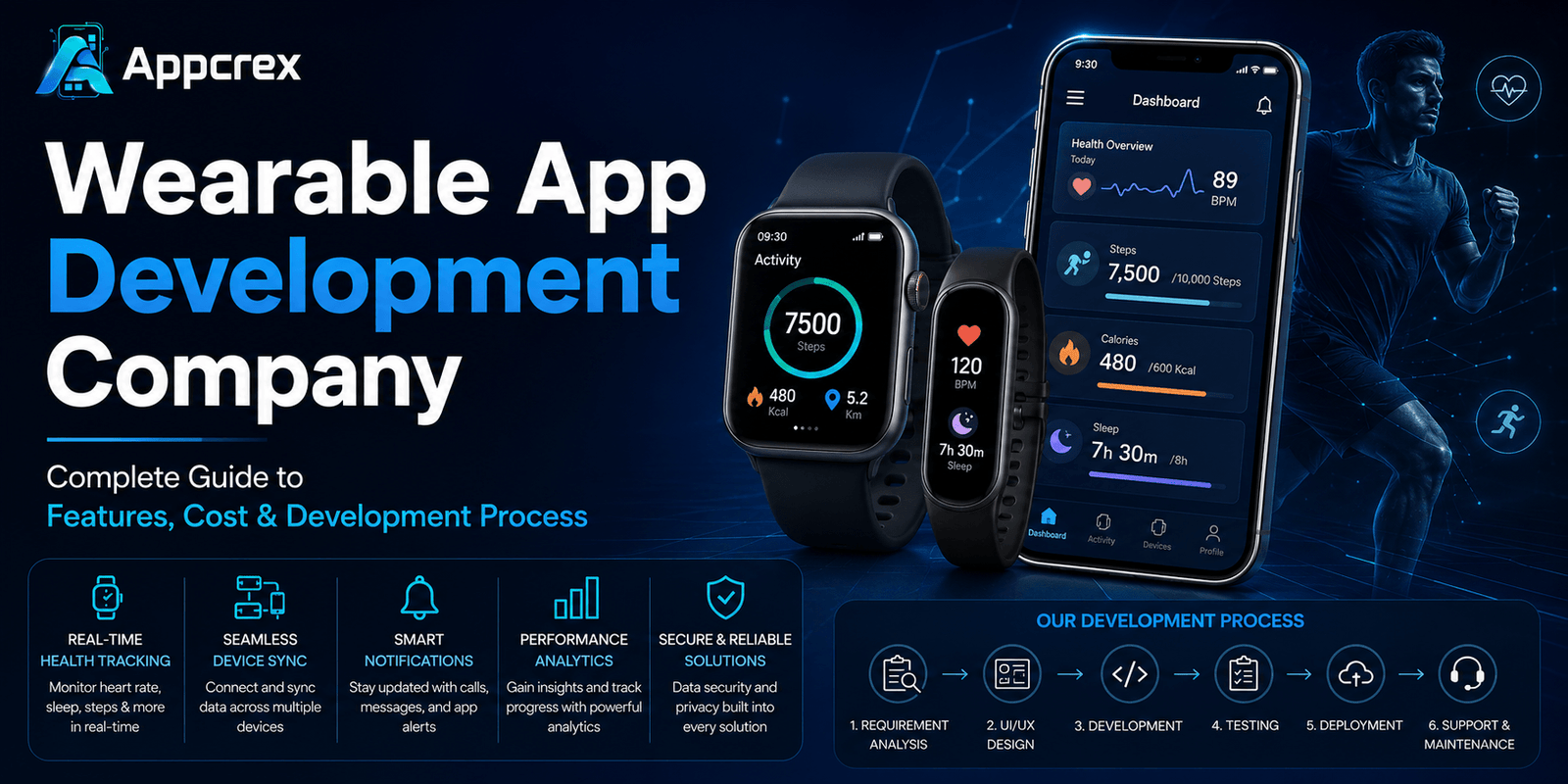
Wearable App Development Process
At AppCrex, we follow an agile development approach to build secure, scalable, and future-ready wearable applications.
Step 1: Discovery & Planning
Understand business goals, target users, supported devices, and technical requirements.
Step 2: UI/UX Design
Design intuitive interfaces optimized for wearable screens and touch interactions.
Step 3: MVP Development
Build a Minimum Viable Product with essential features to validate the concept quickly.
Step 4: Application Development
Develop the wearable app, mobile companion app, backend services, APIs, and cloud infrastructure.
Step 5: AI & IoT Integration
Integrate AI-powered recommendations, health monitoring, IoT connectivity, and Bluetooth communication.
Step 6: Testing & Quality Assurance
Perform functional, security, performance, battery usage, connectivity, and compatibility testing.
Step 7: Deployment
Launch the application on the appropriate app stores and wearable ecosystems.
Step 8: Maintenance & Continuous Improvement
Provide ongoing monitoring, updates, feature enhancements, and technical support.
Best Technology Stack for Wearable App Development
| Layer | Technologies |
|---|---|
| Mobile Development | Flutter, React Native |
| Apple Watch | Swift, WatchKit, HealthKit |
| Wear OS | Kotlin, Java, Wear OS SDK |
| Backend | Node.js, Laravel, Django, .NET |
| Database | PostgreSQL, MongoDB, MySQL |
| Cloud | AWS, Google Cloud, Microsoft Azure |
| AI & ML | OpenAI, Google Gemini, TensorFlow |
| Bluetooth | Bluetooth Low Energy (BLE) |
| Notifications | Firebase Cloud Messaging, OneSignal |
| Analytics | Firebase Analytics, Google Analytics |
Why Choose AppCrex for Wearable App Development?
At AppCrex, we specialize in building secure, scalable, and AI-powered wearable applications that deliver exceptional user experiences across industries.
Our Expertise Includes
- Custom Wearable App Development
- Apple Watch App Development
- Wear OS App Development
- Fitbit App Development
- Garmin App Development
- Healthcare Wearable Solutions
- Fitness Wearable Apps
- IoT Integration
- AI Integration
- Flutter & React Native Development
- Android & iOS Companion Apps
- Cloud Solutions
- API Integration
- Ongoing Maintenance & Support
Our experienced developers create high-performance wearable solutions tailored to your business goals while ensuring security, scalability, and future readiness.
(FAQs)
Q. What is wearable app development?
Wearable app development involves creating applications for devices such as smartwatches, fitness trackers, healthcare wearables, and smart glasses to deliver real-time data, health monitoring, and connected experiences.
Q. How much does it cost to develop a wearable app?
A basic wearable application typically costs between $20,000 and $40,000, while advanced AI-powered enterprise solutions can range from $150,000 to $300,000+, depending on features and complexity.
Q. How long does it take to build a wearable app?
A basic MVP generally takes 3–4 months, while enterprise-grade wearable solutions may require 9–12 months or more.
Q. Which wearable devices do you support?
We develop applications for Apple Watch, Wear OS, Fitbit, Garmin, Samsung Galaxy Watch, and Huawei Watch, along with custom IoT wearable devices.
Q. Can AI be integrated into wearable applications?
Yes. AI can power health monitoring, fitness coaching, predictive analytics, smart alerts, voice assistants, and personalized recommendations.
Conclusion
Wearable technology is reshaping healthcare, fitness, sports, and enterprise operations by enabling real-time monitoring, intelligent automation, and connected user experiences. A custom wearable application can help businesses improve engagement, optimize operations, and create new revenue opportunities while meeting the growing demand for smart, data-driven solutions.
Whether you’re building a healthcare wearable app, fitness tracker, smartwatch application, or enterprise wearable platform, partnering with an experienced development company ensures your solution is secure, scalable, and ready for future innovation.
Ready to Build Your Wearable App?
Whether you’re planning to develop a healthcare wearable app, fitness tracker, smartwatch application, IoT wearable solution, or enterprise wearable platform, AppCrex is your trusted technology partner.
From strategy and UI/UX design to AI integration, wearable connectivity, custom development, cloud deployment, testing, and post-launch support, we provide end-to-end wearable app development services tailored to your business objectives.
Contact AppCrex today to build a powerful, AI-enabled wearable application that delivers exceptional user experiences and drives long-term business success.