📌 Key Takeaways
- Vehicle Tracking Software enables real-time GPS tracking, fleet monitoring, and route optimization.
- AI-powered features improve driver safety, predictive maintenance, fuel efficiency, and fleet performance.
- Integration with GPS devices, IoT sensors, ERP systems, and Google Maps APIs enhances operational efficiency.
- Vehicle Tracking Software development typically costs $25,000–$250,000+, depending on features, integrations, and customization.
- Custom tracking solutions help logistics, transportation, courier, construction, healthcare, retail, and fleet management businesses improve visibility and reduce operating costs.
Introduction
Businesses that rely on transportation, logistics, delivery services, field operations, or fleet management need complete visibility into their vehicles. Without real-time tracking, companies often face challenges such as delayed deliveries, unauthorized vehicle usage, increased fuel costs, poor route planning, and inefficient fleet operations.
To overcome these challenges, businesses are investing in Vehicle Tracking Software. Powered by GPS, IoT, cloud computing, and Artificial Intelligence (AI), vehicle tracking solutions provide real-time location monitoring, route optimization, driver behavior analysis, fuel tracking, geofencing, and comprehensive fleet analytics.
The demand for Vehicle Tracking Software Development is growing rapidly across industries such as logistics, transportation, courier services, construction, public transportation, healthcare, retail, field services, and fleet management. Organizations are adopting intelligent tracking solutions to improve operational efficiency, reduce costs, enhance driver safety, and deliver better customer experiences.
Countries including the USA, Canada, UK, UAE, and Australia are investing heavily in smart transportation technologies and connected fleet solutions as businesses continue their digital transformation journey.
Unlike generic GPS tracking platforms, custom-built vehicle tracking software allows organizations to integrate business-specific workflows, automate fleet operations, connect with ERP and logistics systems, and generate actionable business insights through AI-powered analytics.
In this guide, you’ll learn everything about Vehicle Tracking Software Development, including its key features, business benefits, development process, AI capabilities, technology stack, estimated development cost, and the latest industry trends shaping connected fleet management in 2026.
What is Vehicle Tracking Software?
Vehicle Tracking Software is a digital platform that enables businesses to monitor, manage, and optimize their vehicles using GPS technology, mobile connectivity, and cloud-based analytics.
The software continuously collects location and vehicle data, allowing businesses to track vehicles in real time, monitor driver performance, optimize routes, improve fuel efficiency, and ensure timely deliveries.
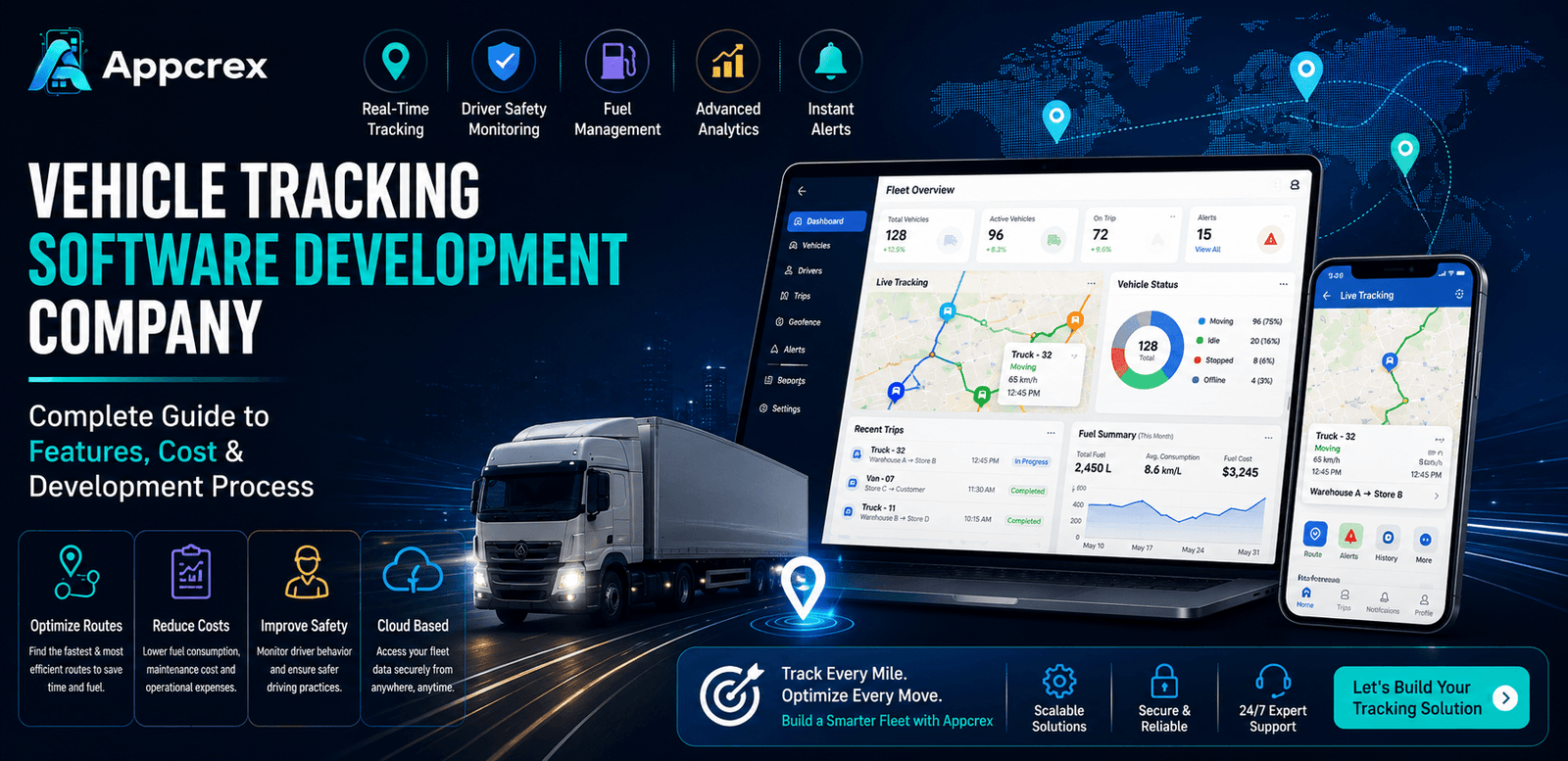
A modern Vehicle Tracking Software solution generally includes the following modules:
GPS Vehicle Tracking
Monitor the real-time location of every vehicle on an interactive map with live updates.
Fleet Monitoring
Track vehicle status, trip history, mileage, idle time, fuel consumption, and overall fleet performance from a centralized dashboard.
Driver Management
Monitor driver behavior, trip activity, speeding events, harsh braking, acceleration, and route compliance to improve safety and efficiency.
Alerts & Notifications
Receive instant alerts for:
- Geofence entry or exit
- Speed violations
- Unauthorized vehicle usage
- Engine status
- Maintenance reminders
- Emergency events
Reports & Analytics
Generate detailed reports on fleet utilization, travel history, fuel efficiency, maintenance schedules, driver performance, and operational costs to support informed business decisions.
A professionally developed Vehicle Tracking Software helps organizations reduce operational expenses, improve fleet visibility, enhance security, and maximize productivity.
Also Read : Enterprise Software Development: Complete Guide for Growing Businesses
How Vehicle Tracking Software Works?
Vehicle Tracking Software combines GPS devices, mobile networks, cloud infrastructure, and analytics to deliver accurate real-time fleet information.
A typical workflow includes:
- A GPS tracking device is installed in the vehicle.
- The device captures location, speed, mileage, and vehicle status.
- Data is transmitted securely to the cloud.
- The software processes and displays vehicle information on a live dashboard.
- Managers monitor trips, routes, driver activity, and fleet performance.
- Automated alerts notify users of overspeeding, route deviations, or maintenance requirements.
- Reports and analytics help optimize fleet operations and reduce operational costs.
This automated workflow gives businesses complete control over their fleet while improving efficiency and customer service.
Why Businesses Need Vehicle Tracking Software?
As fleets grow larger and transportation becomes more complex, real-time vehicle visibility becomes essential.
Real-Time Fleet Visibility
Monitor the live location of every vehicle to improve dispatching, coordination, and operational control.
Route Optimization
Identify the fastest and most efficient routes to reduce travel time, fuel consumption, and delivery delays.
Improved Driver Safety
Track speeding, harsh braking, rapid acceleration, and unsafe driving patterns to promote safer driving behavior.
Lower Fuel & Operational Costs
Reduce unnecessary mileage, idle time, and inefficient routes, leading to lower fuel expenses and improved profitability.
Better Customer Experience
Provide accurate delivery updates and estimated arrival times, improving transparency and customer satisfaction.
Smarter Business Decisions
Use real-time dashboards and analytics to evaluate fleet performance, optimize operations, and support future business growth.
Vehicle Tracking Software Market Opportunities in USA, Canada, UK, UAE & Australia
The demand for Vehicle Tracking Software Development is increasing rapidly as businesses seek smarter ways to monitor fleets, improve operational efficiency, and reduce transportation costs. Advances in GPS technology, IoT, cloud computing, and AI have made real-time vehicle tracking an essential part of modern fleet operations.
Businesses across the USA, Canada, UK, UAE, and Australia are investing in intelligent vehicle tracking solutions to optimize routes, improve driver safety, reduce fuel consumption, and deliver better customer experiences.
USA
The United States has one of the world’s largest commercial fleet industries. Logistics companies, transportation providers, field service businesses, and delivery platforms use Vehicle Tracking Software to improve fleet visibility, reduce operating costs, and support same-day delivery operations.
Canada
Canadian businesses rely on GPS-based vehicle tracking to manage fleets across long travel distances and varying weather conditions. Industries such as logistics, construction, mining, and public transportation increasingly use connected fleet solutions to improve operational efficiency.
United Kingdom
The UK’s transportation and logistics sector is adopting cloud-based Vehicle Tracking Software to improve route planning, monitor driver performance, and ensure timely deliveries while meeting regulatory compliance.
UAE
As a regional logistics hub, the UAE has seen rapid adoption of smart fleet technologies. Businesses use Vehicle Tracking Software to manage delivery vehicles, monitor commercial fleets, improve fuel efficiency, and support digital transformation initiatives.
Australia
Australia’s transportation, mining, agriculture, and logistics industries use Vehicle Tracking Software to monitor vehicles operating across large geographic areas. GPS tracking helps businesses improve fleet productivity, safety, and maintenance planning.
Industries Using Vehicle Tracking Software
Vehicle Tracking Software supports businesses that depend on transportation, mobile workforces, and fleet operations.
Logistics & Transportation
Track commercial vehicles, monitor deliveries, optimize routes, and improve fleet utilization.
Courier & Parcel Delivery
Delivery companies use GPS tracking to provide real-time shipment visibility and accurate estimated arrival times (ETAs).
Field Service Businesses
Service providers such as electricians, plumbers, HVAC technicians, and maintenance companies use vehicle tracking to dispatch teams efficiently and reduce response times.
Construction
Construction companies monitor heavy equipment, trucks, and service vehicles to improve utilization and reduce unauthorized usage.
Public Transportation
Bus operators and transport agencies use tracking software to monitor routes, improve passenger services, and optimize fleet performance.
Healthcare
Hospitals and medical logistics providers track ambulances, medical transport vehicles, and pharmaceutical deliveries to ensure timely operations.
Retail & eCommerce
Retailers and eCommerce businesses use Vehicle Tracking Software to improve last-mile delivery, monitor distribution vehicles, and enhance customer satisfaction.
Rental & Leasing Companies
Vehicle rental businesses track vehicle locations, monitor usage, improve security, and manage maintenance schedules efficiently.
Types of Vehicle Tracking Software
Different organizations require different tracking solutions based on fleet size and business objectives.
Also Read : Last Mile Delivery Software Development Company: Complete Guide to Features, Cost & Development Process
| Software Type | Best For |
|---|---|
| GPS Vehicle Tracking Software | Small and medium businesses |
| Fleet Tracking Software | Logistics & transportation companies |
| Real-Time Vehicle Monitoring System | Commercial fleet operators |
| Asset Tracking Software | Construction & industrial businesses |
| Fleet Telematics Platform | Large enterprise fleets |
| AI-Powered Vehicle Tracking Software | Businesses requiring predictive analytics and automation |
Selecting the right solution depends on fleet size, industry, operational complexity, and long-term business goals.
Benefits of Vehicle Tracking Software
A custom-built Vehicle Tracking Software solution provides measurable business advantages.
Real-Time Vehicle Monitoring
Monitor every vehicle’s location, speed, route, and trip status from a centralized dashboard.
Improved Route Planning
Optimize routes to reduce travel time, improve delivery efficiency, and lower operational expenses.
Lower Fuel Costs
Identify excessive idling, inefficient routes, and unnecessary mileage to improve fuel efficiency.
Enhanced Driver Safety
Track speeding, harsh braking, rapid acceleration, and unsafe driving behaviors while promoting responsible driving practices.
Better Fleet Utilization
Analyze vehicle usage, maintenance schedules, and operational performance to maximize fleet productivity.
Increased Customer Satisfaction
Provide customers with live tracking links, accurate ETAs, and real-time delivery updates for a better service experience.
Vehicle Tracking Software vs Traditional Fleet Monitoring
| Feature | Vehicle Tracking Software | Traditional Fleet Monitoring |
|---|---|---|
| Live GPS Tracking | ✔ Real-Time | ✘ Limited |
| Route Optimization | ✔ AI-Based | ✘ Manual |
| Driver Behavior Monitoring | ✔ Yes | ✘ No |
| Geofencing Alerts | ✔ Available | ✘ Limited |
| Analytics & Reporting | ✔ Advanced Dashboards | ✘ Basic Reports |
| Cloud Access | ✔ Anywhere | ✘ Often Local Only |
| Scalability | ✔ High | ✘ Limited |
Modern Vehicle Tracking Software provides businesses with significantly greater visibility, automation, and operational intelligence compared to traditional fleet monitoring systems.
Essential Features of Vehicle Tracking Software
A modern Vehicle Tracking Software solution should provide complete visibility into fleet operations while helping businesses improve efficiency, reduce costs, and enhance driver safety.
A complete platform generally consists of four major modules:
- Driver Mobile App
- Fleet Manager Dashboard
- Admin Panel
- Customer Tracking Portal (Optional)
Together, these modules streamline fleet management and enable real-time monitoring.
Driver Mobile App Features
The driver app allows drivers to receive trip assignments, navigate routes, and communicate with fleet managers efficiently.
1. Secure Login & Authentication
Drivers can securely log in using role-based access with multi-factor authentication to protect fleet data.
Drivers receive optimized routes with turn-by-turn navigation, helping reduce travel time and fuel consumption.
3. Trip Management
Drivers can:
- View assigned trips
- Accept or reject assignments
- Start and complete trips
- Update trip status
- Record delivery completion
4. Real-Time Location Sharing
The app continuously shares the vehicle’s live location with the central system, allowing fleet managers to monitor every trip.
5. Driver Communication
Built-in messaging and notifications enable drivers to receive route updates, emergency alerts, and dispatch instructions instantly.
6. Fuel & Mileage Logging
Drivers can record:
- Fuel purchases
- Mileage
- Odometer readings
- Vehicle inspections
This helps maintain accurate operational records.
7. Digital Proof of Delivery
Drivers can capture:
- Customer signatures
- Photos
- Delivery notes
- Time stamps
to confirm successful deliveries.
Fleet Manager Dashboard Features
Fleet managers require complete visibility into vehicles, drivers, and operations.
1. Live Fleet Tracking
Monitor every vehicle on an interactive GPS map with:
- Current location
- Trip status
- Vehicle speed
- Travel history
- Idle time
2. Driver Monitoring
Track:
- Driver performance
- Speeding incidents
- Harsh braking
- Rapid acceleration
- Route deviations
- Driving hours
3. Route Optimization
Managers can identify the fastest and most efficient routes while minimizing traffic delays and fuel costs.
4. Vehicle Health Monitoring
Monitor important vehicle information including:
- Engine status
- Battery health
- Fuel level
- Maintenance schedule
- Service reminders
5. Reports & Analytics
Generate detailed reports on:
- Fleet utilization
- Fuel consumption
- Driver performance
- Distance traveled
- Maintenance costs
- Delivery performance
These insights help improve fleet efficiency and reduce operational expenses.
Admin Panel Features
The admin panel provides centralized control over the entire Vehicle Tracking Software platform.
1. User & Role Management
Manage:
- Drivers
- Fleet managers
- Dispatch operators
- Administrators
- Business users
using role-based permissions.
2. Vehicle Management
Maintain complete records for every vehicle, including:
- Registration details
- Insurance
- Service history
- Ownership
- Vehicle category
3. Fleet Configuration
Configure:
- Geofences
- Alert rules
- Speed limits
- Driver permissions
- Route preferences
4. Business Reports
Access dashboards covering:
- Fleet performance
- Operational costs
- Fuel usage
- Vehicle utilization
- Driver efficiency
- Business KPIs
5. Security & Compliance
Protect fleet data using:
- Role-Based Access Control (RBAC)
- Multi-Factor Authentication (MFA)
- Data Encryption
- Audit Logs
- Secure Cloud Backup
AI-Powered Features in Vehicle Tracking Software
Artificial Intelligence helps businesses make fleet operations smarter and more efficient.
AI Route Optimization
AI analyzes traffic, road conditions, weather, and historical trip data to recommend the fastest and most fuel-efficient routes.
Predictive Vehicle Maintenance
AI monitors vehicle performance and predicts maintenance needs before breakdowns occur, reducing downtime and repair costs.
Driver Behavior Analysis
Machine learning detects:
- Harsh braking
- Speeding
- Rapid acceleration
- Excessive idling
- Unsafe driving patterns
This improves road safety and reduces accident risks.
Fuel Consumption Analytics
AI identifies inefficient driving habits and recommends improvements to lower fuel costs and increase fleet efficiency.
Geofencing Intelligence
Automatically trigger alerts when vehicles enter or leave designated service areas, customer locations, or restricted zones.
Predictive Fleet Analytics
AI-powered dashboards forecast maintenance costs, fleet utilization, operational trends, and business performance to support better decision-making.
Technology Stack for Vehicle Tracking Software Development
Selecting the right technology stack ensures the platform is scalable, secure, and capable of handling real-time GPS data.
| Component | Recommended Technologies |
|---|---|
| Mobile App | Flutter, React Native |
| Frontend | React.js, Angular, Next.js |
| Backend | Node.js, Java, Python, .NET |
| Database | PostgreSQL, MongoDB, MySQL |
| Cloud Hosting | AWS, Microsoft Azure, Google Cloud |
| Maps & GPS | Google Maps API, Mapbox, OpenStreetMap |
| IoT Integration | MQTT, IoT APIs |
| Notifications | Firebase Cloud Messaging, Twilio |
| Analytics | Power BI, Google Analytics |
Vehicle Tracking Software Development Process
Building a reliable Vehicle Tracking Software requires careful planning, GPS expertise, cloud infrastructure, and scalable architecture. A structured development approach ensures your software delivers real-time tracking, accurate analytics, and seamless fleet management.
Step 1: Business Analysis & Requirement Gathering
The development process begins by understanding your business operations, fleet size, industry requirements, and long-term objectives.
This phase includes:
- Business requirement analysis
- Fleet workflow assessment
- Competitor research
- Feature planning
- Technology selection
- Project roadmap
This helps create a solution tailored to your operational needs.
Step 2: UI/UX Design
An intuitive interface allows drivers, fleet managers, and administrators to use the platform efficiently.
The design process includes:
- Wireframes
- Interactive prototypes
- Mobile-first UI
- Dashboard design
- User journey mapping
The goal is to provide a simple and user-friendly experience across web and mobile platforms.
Step 3: Vehicle Tracking Software Development
Developers build the platform using scalable technologies and modular architecture.
Core modules include:
- GPS Tracking
- Driver App
- Fleet Dashboard
- Admin Panel
- Route Optimization
- Geofencing
- Reports & Analytics
- Notification System
The software is optimized for handling thousands of vehicles with real-time updates.
Step 4: Third-Party Integrations
To enhance functionality, the platform integrates with various external services.
Common integrations include:
- Google Maps API
- Mapbox
- GPS Tracking Devices
- IoT Platforms
- ERP Software
- CRM Systems
- Payment Gateways
- Email & SMS Services
- Fleet Management Solutions
These integrations improve automation and simplify fleet operations.
Also Read : AI Integration Services: Complete Guide to Benefits, Use Cases, Cost & Implementation (2026)
Step 5: Testing & Quality Assurance
Before deployment, the software undergoes comprehensive testing to ensure performance, security, and reliability.
Testing includes:
- Functional Testing
- GPS Accuracy Testing
- Performance Testing
- Security Testing
- API Testing
- User Acceptance Testing (UAT)
This ensures stable performance under real-world fleet conditions.
Step 6: Deployment & Ongoing Maintenance
After successful testing, the software is deployed to cloud infrastructure or enterprise servers.
Post-launch services include:
- Performance monitoring
- Bug fixes
- Security updates
- GPS optimization
- Feature enhancements
- Technical support
Regular maintenance keeps the platform secure, scalable, and up to date.
How Much Does Vehicle Tracking Software Development Cost?
The cost of Vehicle Tracking Software Development depends on features, GPS integrations, AI capabilities, fleet size, and project complexity.
| Software Type | Estimated Cost |
|---|---|
| Basic Vehicle Tracking Software | $25,000–$50,000 |
| Advanced Fleet Tracking Solution | $50,000–$120,000 |
| Enterprise AI-Powered Vehicle Tracking Platform | $120,000–$250,000+ |
The final cost depends on customization, number of users, third-party integrations, and advanced functionality.
Factors Affecting Development Cost
Several factors influence the overall project budget.
Software Complexity
Advanced capabilities such as AI-powered route optimization, predictive maintenance, geofencing, and telematics require additional development effort.
Fleet Size
Supporting hundreds or thousands of vehicles requires scalable infrastructure, higher database performance, and optimized cloud architecture.
Third-Party Integrations
Integrating services such as:
- GPS Hardware
- Google Maps API
- ERP Software
- CRM Platforms
- IoT Devices
- Fleet Sensors
adds to the development scope.
AI & Automation
Features including:
- Predictive Analytics
- Driver Behavior Analysis
- Fuel Optimization
- Smart Route Planning
- Automated Alerts
increase functionality and development costs.
Security & Compliance
Enterprise solutions require:
- Role-Based Access Control (RBAC)
- Multi-Factor Authentication (MFA)
- Data Encryption
- Audit Logs
- Secure Cloud Backup
to protect sensitive fleet data.
Maintenance & Support
Businesses should also consider long-term costs for:
- Cloud Hosting
- GPS Services
- Software Updates
- Performance Optimization
- Technical Support
Monetization Models
If you’re building a commercial Vehicle Tracking platform, these business models can generate recurring revenue.
SaaS Subscription
Offer monthly or annual subscription plans based on:
- Number of vehicles
- Fleet size
- Features
- Storage
Enterprise Licensing
Develop customized Vehicle Tracking Software for logistics companies, transportation providers, and enterprise fleets.
White-Label Platform
Allow other businesses to launch the platform under their own brand.
Premium Features
Generate additional revenue through advanced features such as:
- AI Analytics
- Predictive Maintenance
- Driver Safety Monitoring
- Advanced Reports
- Fleet Intelligence Dashboard
Implementation & Support Services
Provide:
- GPS Device Installation
- Software Setup
- Data Migration
- Staff Training
- Ongoing Maintenance
as additional revenue streams.
Why Choose AppCrex for Vehicle Tracking Software Development?
At AppCrex, we build secure, scalable, and AI-powered Vehicle Tracking Software that helps businesses monitor fleets in real time, improve operational efficiency, and reduce transportation costs.
Our development team creates customized solutions with GPS tracking, route optimization, geofencing, driver management, fleet analytics, IoT integration, and cloud-based dashboards. We serve industries including logistics, transportation, courier services, healthcare, construction, field services, retail, and fleet management.
From business analysis and UI/UX design to development, deployment, and long-term maintenance, AppCrex delivers end-to-end vehicle tracking solutions tailored to your business goals.
Also Read : Custom Software Development Company: Complete Guide to Services, Process, Cost & Benefits (2026)
(FAQs)
1. What is Vehicle Tracking Software?
Vehicle Tracking Software is a GPS-enabled solution that allows businesses to monitor vehicle locations, optimize routes, track driver behavior, and manage fleets in real time.
2. How much does Vehicle Tracking Software development cost?
The development cost typically ranges from $25,000 to $250,000+, depending on features, AI capabilities, GPS integrations, and customization.
3. How long does it take to build Vehicle Tracking Software?
A standard solution generally takes 4–8 months, while enterprise-grade platforms with advanced AI and telematics may require 8–12 months.
4. Can AI be integrated into Vehicle Tracking Software?
Yes. AI can enhance route optimization, predictive maintenance, driver behavior analysis, fuel efficiency monitoring, and fleet performance analytics.
5. Which industries use Vehicle Tracking Software?
Vehicle Tracking Software is widely used by logistics, transportation, courier services, construction, healthcare, public transportation, field service, retail, rental, and fleet management companies.
Conclusion
As businesses increasingly rely on connected fleets and real-time logistics, Vehicle Tracking Software has become essential for improving visibility, reducing operational costs, and enhancing driver safety. By combining GPS, AI, IoT, cloud computing, and advanced analytics, organizations can optimize routes, monitor fleet performance, and make data-driven operational decisions.
Whether you’re managing a small delivery fleet or a large transportation network, investing in Vehicle Tracking Software Development provides a scalable, future-ready solution that supports business growth and operational efficiency.
Partnering with an experienced Vehicle Tracking Software Development Company like AppCrex ensures you receive a secure, customizable, and high-performance platform tailored to your fleet management requirements. From planning and development to deployment and ongoing support, we help businesses build intelligent vehicle tracking solutions that drive long-term success.