📌 Key Takeaways
- Automate HR processes like payroll, attendance, leave, and employee management with a custom HRMS.
- AI-powered HR software improves recruitment, workforce analytics, and employee productivity.
- Build a scalable HRMS using modern technologies like Flutter, React, Node.js, and AWS.
- Development costs typically range from $20,000 to $150,000+, depending on features and customization.
- Partner with AppCrex to build a secure, scalable, and custom HR Management Software solution tailored to your business needs.
Introduction
Managing employees efficiently has become one of the biggest priorities for modern businesses. As organizations grow, handling recruitment, attendance, payroll, employee records, leave management, performance evaluations, and compliance manually becomes time-consuming and error-prone. This is where HR Management Software (HRMS) plays a vital role.
HR Management Software helps businesses automate repetitive HR tasks, improve employee engagement, streamline workforce management, and make data-driven decisions. Whether you’re a startup, SME, or large enterprise, investing in a custom HR Management System can reduce administrative workload, increase productivity, and enhance the overall employee experience.
Today’s HR platforms go beyond basic employee management. They integrate Artificial Intelligence (AI), cloud computing, payroll automation, analytics, and employee self-service portals to create a smarter and more efficient workplace.
In this comprehensive guide, you’ll learn everything about HR Management Software Development, including its key features, benefits, modules, technology stack, development process, AI capabilities, estimated development cost, and future trends.
What is HR Management Software?
HR Management Software (HRMS) is a digital solution that automates and streamlines various human resource processes, including employee management, recruitment, payroll, attendance, leave management, performance tracking, and compliance.
Instead of handling HR operations manually through spreadsheets and paperwork, businesses can manage their entire workforce from a centralized platform.
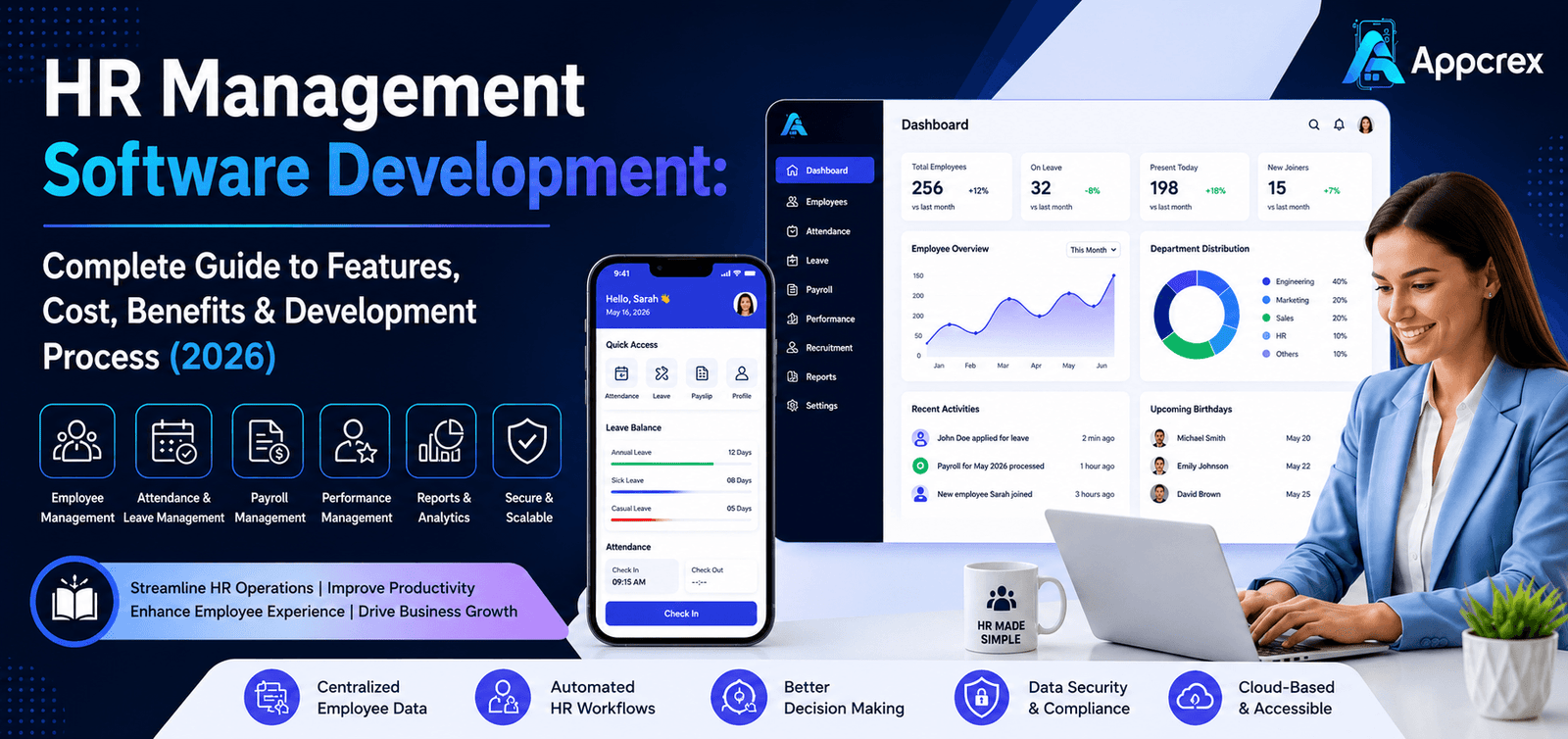
A modern HR Management System typically consists of:
- Employee Portal
- HR/Admin Dashboard
- Payroll Management
- Attendance System
- Recruitment Module
- Performance Management
- Training & Learning
- Reports & Analytics
Whether you’re a startup or a large enterprise, HRMS helps improve operational efficiency, reduce administrative work, and enhance employee satisfaction.
Why Invest in HR Management Software Development?
Businesses today are embracing digital transformation, and HR is no exception. Investing in custom HR software helps organizations automate repetitive tasks, reduce operational costs, and improve workforce productivity.
Increased Productivity
Automation eliminates repetitive administrative work, allowing HR teams to focus on strategic initiatives such as talent development and employee engagement.
Better Employee Experience
Employees can easily:
- Apply for leave
- View payslips
- Update profiles
- Access company policies
- Track attendance
through a self-service portal.
Improved Accuracy
Automation minimizes manual errors in payroll processing, attendance tracking, and employee records.
Scalability
Custom HR software can easily support growing teams, multiple office locations, and thousands of employees.
Data-Driven Decisions
Real-time dashboards and analytics help management make informed workforce decisions.
Benefits of HR Management Software
A well-designed HRMS offers advantages for both employees and HR departments.
1. Faster Recruitment
Simplify hiring by automating job postings, applicant tracking, interview scheduling, and candidate communication.
2. Automated Payroll
Reduce payroll processing time while ensuring accurate salary calculations and statutory compliance.
3. Employee Self-Service
Employees can independently manage personal information, leave requests, attendance, and payroll documents.
4. Improved Compliance
HR software helps organizations comply with labor laws, tax regulations, and internal policies.
5. Better Workforce Planning
Analyze employee performance, hiring trends, and workforce data to support business growth.
6. Reduced Operational Costs
Automation lowers administrative overhead and minimizes manual HR tasks.
Also Read : Custom Software Development Company: Complete Guide to Services, Process, Cost & Benefits (2026)
Core HR Management Modules
A complete HR Management Software solution consists of several integrated modules.
Employee Management Module
This module stores and manages all employee information in one place.
Features
- Employee Profiles
- Department Management
- Job Roles
- Employment History
- Document Management
- Emergency Contacts
Recruitment Management
Manage the complete hiring lifecycle.
Features
- Job Posting
- Applicant Tracking
- Resume Management
- Interview Scheduling
- Candidate Evaluation
- Offer Letter Generation
Onboarding Module
Provide a seamless onboarding experience for new employees.
Features
- Digital Documentation
- Welcome Checklist
- Policy Acknowledgment
- Training Assignment
- Equipment Allocation
Attendance Management
Automatically track employee attendance.
Features
- Clock In/Out
- Biometric Integration
- GPS Attendance
- Shift Management
- Overtime Tracking
Leave Management
Employees can request leave online while managers approve or reject requests.
Features
- Annual Leave
- Sick Leave
- Casual Leave
- Maternity/Paternity Leave
- Holiday Calendar
Payroll Management
Automate salary calculations and payment processing.
Features
- Salary Calculation
- Tax Deductions
- Bonus Management
- Payslip Generation
- Reimbursements
Performance Management
Evaluate employee performance using measurable KPIs.
Features
- Goal Setting
- Performance Reviews
- Employee Feedback
- Appraisals
- Promotion Tracking
Learning & Development
Support employee growth with training programs.
Features
- Online Courses
- Certifications
- Skill Assessment
- Progress Tracking
Employee Portal Features
A self-service employee portal empowers employees to manage HR-related tasks independently.
Secure Login
Support:
- Email Login
- Mobile OTP
- Single Sign-On (SSO)
- Multi-Factor Authentication (MFA)
Personal Profile
Employees can:
- Update Contact Details
- Upload Documents
- Change Password
- View Employment Information
Attendance Dashboard
Track:
- Daily Attendance
- Monthly Attendance
- Working Hours
- Overtime
Leave Requests
Employees can:
- Apply for Leave
- View Leave Balance
- Track Approval Status
- Cancel Requests
Payroll Access
Employees can:
- Download Payslips
- View Salary History
- Access Tax Documents
- Check Reimbursements
Performance Dashboard
Employees can monitor:
- Goals
- KPIs
- Reviews
- Feedback
- Appraisal History
Notifications
Receive updates about:
- Leave Approval
- Payroll Processing
- Company Announcements
- Training Sessions
- Performance Reviews
Also Read : Digital Wallet App Development: Complete Guide to Features, Cost, Security & Trends (2026)
HR/Admin Dashboard Features
The HR dashboard provides complete control over workforce operations.
Employee Management
Manage:
- Employee Profiles
- Departments
- Designations
- Office Locations
- Employment Status
Recruitment Dashboard
Monitor:
- Active Jobs
- Candidates
- Interviews
- Hiring Pipeline
- Offer Acceptance
Attendance Monitoring
Track:
- Daily Attendance
- Absentees
- Late Arrivals
- Overtime
- Shift Reports
Leave Approval
HR managers can:
- Approve Leave
- Reject Requests
- Monitor Leave Balances
- Generate Leave Reports
Payroll Administration
Manage:
- Salary Structures
- Payroll Processing
- Bonuses
- Incentives
- Tax Deductions
Reports & Analytics
Generate reports on:
- Employee Growth
- Payroll Expenses
- Attendance Trends
- Performance Metrics
- Recruitment Statistics
Payroll Management Features
Payroll automation is one of the most valuable components of an HRMS.
Core Payroll Features
- Automatic Salary Calculation
- Tax Management
- PF/Insurance Deductions
- Overtime Calculation
- Bonus Processing
- Payslip Generation
- Direct Bank Transfers
Attendance & Leave Management
Managing attendance manually is inefficient for growing organizations.
Essential Features
- Biometric Attendance
- GPS Attendance
- QR Code Check-In
- Shift Scheduling
- Holiday Calendar
- Leave Approval Workflow
- Attendance Reports
Why These Features Matter?
A successful HR Management Software solution should serve every stakeholder:
- Employees need a simple self-service portal.
- HR teams require automation and workforce insights.
- Managers need performance tracking and approvals.
- Business leaders rely on analytics for strategic decision-making.
By combining these modules into a single platform, organizations can improve efficiency, reduce costs, and create a better employee experience.
Also Read : AI Agent Development Company: Complete Guide to Features, Benefits, Cost & Development Process (2026)
AI Features in HR Management Software
Artificial Intelligence (AI) is transforming Human Resource Management by automating repetitive tasks, improving hiring decisions, and enhancing employee engagement.
AI Resume Screening
AI automatically analyzes resumes and shortlists the most qualified candidates based on job requirements.
Benefits
- Faster recruitment
- Reduced manual screening
- Better candidate matching
- Improved hiring efficiency
AI Chatbot for HR Support
An AI-powered chatbot can answer common employee questions instantly.
Examples
- Leave Balance
- Payroll Queries
- Company Policies
- Holiday Calendar
- Benefits Information
Employee Performance Analytics
AI evaluates employee performance using KPIs, attendance records, productivity metrics, and feedback.
Features
- Performance Scoring
- Productivity Analysis
- Goal Tracking
- Promotion Recommendations
Predictive Workforce Analytics
AI predicts workforce trends such as:
- Employee Turnover
- Hiring Needs
- Skill Gaps
- Workforce Planning
This helps HR teams make proactive decisions.
AI Attendance Monitoring
AI detects attendance anomalies including:
- Late Check-ins
- Frequent Absences
- Overtime Patterns
- Shift Irregularities
Learning Recommendations
AI recommends personalized training programs based on employee roles, skills, and career goals.
Business Benefits of HR Management Software
Implementing HR software provides long-term operational and financial advantages.
Improved Productivity
Automating HR tasks allows teams to focus on strategic initiatives instead of administrative work.
Better Employee Experience
Employees can manage leave requests, attendance, payroll, and personal information through a self-service portal.
Reduced Operational Costs
Automation minimizes paperwork, manual errors, and repetitive administrative tasks.
Enhanced Data Security
Centralized systems protect employee information with encryption, role-based access, and secure authentication.
Better Decision Making
Real-time dashboards and reports enable HR managers to make data-driven decisions.
Increased Compliance
Ensure compliance with labor laws, payroll regulations, and company policies.
Technology Stack
Choosing the right technology stack ensures scalability, performance, and security.
Frontend
- React.js
- Angular
- Vue.js
Mobile App
- Flutter
- React Native
- Swift
- Kotlin
Backend
- Node.js
- Python
- Django
- FastAPI
- ASP.NET Core
Database
- PostgreSQL
- MySQL
- MongoDB
Cloud Platform
- AWS
- Microsoft Azure
- Google Cloud Platform
Authentication
- OAuth 2.0
- JWT
- Multi-Factor Authentication (MFA)
Notifications
- Firebase Cloud Messaging
- OneSignal
- Email Services
HR Management Software Development Process
Developing a custom HRMS involves multiple stages to ensure quality and scalability.
Step 1: Requirement Analysis
Identify:
- Business Goals
- HR Processes
- User Roles
- Required Modules
- Compliance Requirements
Step 2: UI/UX Design
Create:
- User Flow
- Wireframes
- Interactive Prototype
- Final UI Design
Step 3: Software Development
Develop core modules:
- Employee Portal
- HR Dashboard
- Payroll
- Attendance
- Recruitment
- Reports
Step 4: Third-Party Integration
Integrate:
- Biometric Devices
- Payroll Systems
- Email Services
- SMS Gateway
- ERP Systems
- Accounting Software
Step 5: Testing
Perform:
- Functional Testing
- Security Testing
- Performance Testing
- Compatibility Testing
- User Acceptance Testing (UAT)
Step 6: Deployment
Deploy on:
- Cloud Infrastructure
- Private Servers
- Enterprise Environment
Step 7: Maintenance
Regular updates include:
- Bug Fixes
- Security Patches
- Performance Improvements
- Feature Enhancements
Also Read : AI Chatbot Integration Services: Benefits, Cost, Process & Business Use Cases (2026)
Third-Party Integrations
Modern HR software works best when integrated with other business systems.
Essential Integrations
- Payroll Systems
- Biometric Attendance Devices
- ERP Software
- Accounting Software
- Email Services
- SMS Gateway
- Calendar Integration
- Microsoft Teams
- Slack
- Zoom
Security Features
Employee information is highly sensitive, making security a top priority.
Essential Security Measures
- End-to-End Data Encryption
- Role-Based Access Control (RBAC)
- Multi-Factor Authentication (MFA)
- Secure Cloud Backup
- Audit Logs
- Single Sign-On (SSO)
- Data Loss Prevention
- GDPR & Regional Privacy Compliance
How Much Does HR Management Software Development Cost?
The development cost depends on the number of modules, integrations, user roles, and customization requirements.
| Software Type | Estimated Cost |
|---|---|
| Basic HRMS | $20,000–$40,000 |
| Medium HRMS | $40,000–$80,000 |
| Enterprise HRMS | $80,000–$150,000+ |
Cost Breakdown
| Development Phase | Estimated Cost |
|---|---|
| Business Analysis | $3,000–$7,000 |
| UI/UX Design | $4,000–$10,000 |
| Frontend Development | $8,000–$20,000 |
| Backend Development | $12,000–$35,000 |
| Third-Party Integrations | $5,000–$15,000 |
| Testing & QA | $5,000–$10,000 |
| Deployment | $2,000–$5,000 |
| Annual Maintenance | 15–20% of Development Cost |
Common Challenges & Solutions
| Challenge | Solution |
|---|---|
| Manual HR Processes | HR Workflow Automation |
| Payroll Errors | Automated Payroll Engine |
| Employee Data Security | Encryption & RBAC |
| Attendance Tracking | Biometric & GPS Integration |
| Workforce Analytics | AI-Based Reporting |
Future Trends in HR Management Software
AI-Powered Recruitment
AI will continue improving resume screening and candidate matching.
Predictive HR Analytics
Organizations will use predictive analytics to reduce employee turnover and improve workforce planning.
Cloud-Based HRMS
Cloud-native HR software offers greater scalability, flexibility, and remote accessibility.
Employee Self-Service
Self-service portals will become more advanced with AI chatbots and personalized dashboards.
AI Copilots for HR
Generative AI assistants will help HR teams draft job descriptions, answer employee questions, and automate HR documentation.
Why Choose AppCrex for HR Management Software Development?
AppCrex builds custom HR Management Software tailored to startups, SMEs, and enterprises.
Our Expertise
- Custom HRMS Development
- Payroll Software Development
- Employee Management Systems
- Attendance & Leave Management
- Recruitment Software
- AI-Powered HR Solutions
- Cloud-Based HR Platforms
- Enterprise Software Development
We deliver secure, scalable, and user-friendly HR solutions designed to streamline workforce management and improve business productivity.
(FAQs)
What is HR Management Software?
HR Management Software is a digital platform that automates recruitment, payroll, attendance, leave management, performance tracking, and employee records.
How much does HRMS development cost?
The estimated cost ranges from $20,000 to $150,000+, depending on features and customization.
How long does it take to build HR software?
A custom HR Management System typically takes 3–8 months to develop.
Which technologies are best for HRMS development?
Popular technologies include Flutter, React Native, Node.js, Python, PostgreSQL, AWS, and Azure.
Can HR software integrate with payroll systems?
Yes. Modern HRMS platforms can integrate with payroll, accounting, ERP, biometric devices, and communication tools.
Is HR software secure?
Yes. With encryption, role-based access, MFA, audit logs, and secure cloud infrastructure, HRMS platforms can provide enterprise-grade security.
Can AI improve HR management?
Yes. AI helps with recruitment, resume screening, workforce analytics, performance tracking, employee support, and predictive planning.
Can HRMS support remote teams?
Absolutely. Cloud-based HR software enables employees and managers to access the platform securely from anywhere.
Conclusion
HR Management Software has become an essential tool for businesses looking to automate workforce management, improve employee experiences, and increase operational efficiency. By integrating modules such as recruitment, payroll, attendance, leave management, performance tracking, and AI-powered analytics, organizations can streamline HR operations while making better data-driven decisions.
Whether you’re a startup or a large enterprise, investing in custom HR Management Software can reduce manual work, improve compliance, and support long-term business growth. Choosing the right technology stack and an experienced development partner ensures your HR platform is secure, scalable, and future-ready.
Looking to build custom HR Management Software for your business?
AppCrex specializes in developing secure, scalable, and AI-powered HR Management Software tailored to your organization’s unique requirements. From planning and UI/UX design to development, deployment, and ongoing support, we help businesses build intelligent HR solutions that improve productivity and workforce management.