📌 Key Takeaways
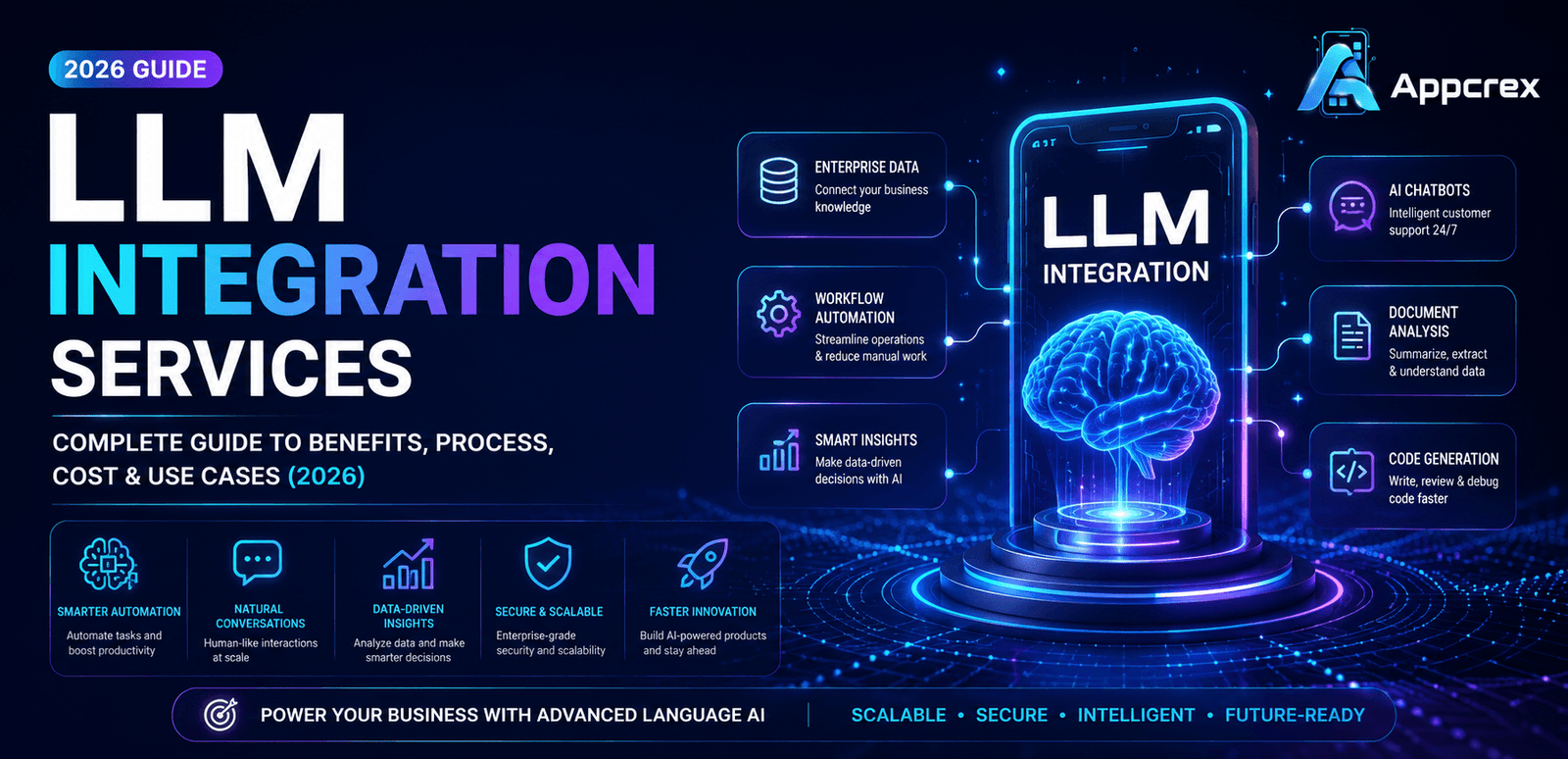
- LLM integration enables businesses to automate workflows, improve customer experiences, and increase productivity.
- Popular LLMs include OpenAI GPT, Claude, Gemini, Llama, and Mistral.
- Businesses can integrate LLMs into websites, mobile apps, CRMs, ERPs, and enterprise systems.
- Development costs range from $8,000 to $100,000+ depending on complexity.
- Secure implementation with RAG, MCP, and enterprise-grade security is essential for scalable AI applications.
Introduction
Artificial Intelligence is transforming the way businesses operate, and Large Language Models (LLMs) are leading this revolution. From intelligent chatbots and AI agents to automated content generation, customer support, software development, and enterprise workflow automation, LLMs are helping organizations become more efficient, productive, and customer-centric.
Modern AI models such as OpenAI GPT, Anthropic Claude, Google Gemini, Meta Llama, and Mistral AI have made it possible for businesses to build applications that understand natural language, generate human-like responses, analyze documents, summarize information, write code, and automate complex tasks.
However, implementing these powerful models into existing business systems requires technical expertise. This is where LLM Integration Services become essential. By integrating Large Language Models into websites, mobile applications, CRMs, ERPs, customer support platforms, and internal business tools, organizations can unlock new levels of automation and intelligence.
Whether you are a startup looking to launch an AI-powered product or an enterprise planning digital transformation, understanding the LLM integration process is critical for long-term success.
In this comprehensive guide, we’ll explore everything you need to know about Large Language Model Integration Services, including benefits, implementation process, technology stack, development costs, security considerations, and future trends.
What Is Large Language Model (LLM) Integration?
Large Language Model (LLM) Integration is the process of connecting advanced AI language models with existing software applications, websites, mobile apps, enterprise systems, or business workflows to enable intelligent automation and natural language interactions.
Instead of building an AI model from scratch, businesses integrate pre-trained models through APIs or custom deployment to add powerful AI capabilities to their products.
LLM Integration Enables Businesses To:
- Automate customer support
- Generate content
- Answer customer queries
- Summarize documents
- Analyze business data
- Translate languages
- Automate workflows
- Generate code
- Improve decision-making
By integrating LLMs into existing systems, businesses can significantly reduce manual work while improving productivity and customer satisfaction.
Just Read : AI Agent Development Company: Complete Guide to Features, Benefits, Cost & Development Process (2026)
Why Businesses Need LLM Integration?
Organizations across industries are adopting Large Language Models to remain competitive in the AI-driven economy.
1. Automate Repetitive Tasks
LLMs reduce manual work by automating repetitive business processes such as documentation, report generation, email drafting, and customer interactions.
2. Improve Customer Experience
AI-powered applications provide faster, more personalized, and more accurate responses, leading to higher customer satisfaction.
3. Increase Employee Productivity
Employees spend less time on repetitive tasks and more time on strategic initiatives.
4. Reduce Operational Costs
Automation powered by LLMs helps businesses lower support costs, improve operational efficiency, and optimize resources.
5. Accelerate Innovation
Businesses can quickly build AI-powered products and services without developing proprietary language models from scratch.
Benefits of LLM Integration
1. Intelligent Automation
LLMs automate repetitive tasks while improving operational efficiency.
2. Better Decision-Making
AI analyzes large datasets and generates valuable business insights.
3. Personalized User Experiences
LLMs understand user preferences and provide context-aware recommendations.
4. Faster Software Development
Developers use LLMs to generate code, documentation, and debugging assistance.
5. Multilingual Communication
Modern LLMs support multiple languages, helping businesses serve global audiences.
6. Scalable AI Solutions
LLMs can handle thousands of simultaneous interactions without compromising performance.
Popular Large Language Models
Several enterprise-grade LLMs are available today, each with unique strengths.
1. OpenAI GPT
One of the most widely adopted language models for conversational AI, coding assistance, content generation, and business automation.
Best For
- Chatbots
- AI Agents
- Customer Support
- Content Generation
2. Anthropic Claude
Claude is known for its strong reasoning abilities, safety-focused design, and handling of long-context conversations.
Best For
- Enterprise AI
- Document Analysis
- Knowledge Management
- Research
3. Google Gemini
Gemini supports multimodal AI, allowing businesses to work with text, images, and other data formats.
Best For
- Search
- Productivity Tools
- Enterprise Applications
- Multimodal AI
4. Meta Llama
Llama is an open-weight language model widely used for custom AI applications.
Best For
- Custom AI Development
- Research
- Enterprise Solutions
5. Mistral AI
Mistral provides efficient open-source language models optimized for speed and cost-effectiveness.
Best For
- Startups
- AI Products
- Cost-Optimized Deployments
Types of LLM Integration
Businesses integrate Large Language Models in different ways depending on their objectives.
API-Based Integration
The fastest and most common approach using APIs from providers such as OpenAI, Anthropic, or Google.
Custom LLM Integration
Ideal for organizations requiring domain-specific AI capabilities and deeper customization.
On-Premises Deployment
Suitable for businesses handling highly sensitive data and strict compliance requirements.
Hybrid Integration
Combines cloud-based AI services with private infrastructure for flexibility and enhanced security.
Features of LLM-Powered Applications
Modern businesses integrate Large Language Models (LLMs) to create intelligent applications that go far beyond simple chatbots. From content generation and document analysis to workflow automation and enterprise search, LLM-powered applications help organizations improve productivity, reduce costs, and deliver exceptional user experiences.
Also Read : AI Chatbot Integration Services: Benefits, Cost, Process & Business Use Cases (2026)
1. Natural Language Understanding (NLU)
Natural Language Understanding enables LLMs to understand user intent, context, and meaning instead of simply matching keywords.
Key Features
- Intent recognition
- Context awareness
- Sentiment analysis
- Multi-language understanding
- Human-like conversations
Benefits
- More accurate responses
- Better customer satisfaction
- Personalized experiences
2. Content Generation
LLMs can generate high-quality content in seconds.
Examples
- Blog articles
- Marketing copy
- Product descriptions
- Emails
- Reports
- Documentation
- Social media posts
Benefits
- Faster content production
- Improved productivity
- Reduced manual effort
3. Intelligent Search
Instead of traditional keyword search, LLM-powered applications allow users to search using natural language.
Example
Instead of searching:
“Invoice policy PDF”
Users can ask:
“Show me our invoice approval process.”
The AI retrieves the correct information instantly.
5. Document Summarization
Businesses often deal with lengthy documents.
LLMs can summarize:
- Contracts
- Reports
- PDFs
- Medical records
- Research papers
- Meeting notes
This helps employees save valuable time.
6. Translation & Localization
LLMs support multiple languages, making global communication easier.
Features
- Language translation
- Localization
- Tone adaptation
- Grammar correction
7. Workflow Automation
LLMs can automate repetitive business tasks.
Examples
- Creating emails
- Updating CRM
- Scheduling meetings
- Generating invoices
- Processing support tickets
Also Read : AI Workflow Automation Guide: Everything You Need to Know in 2026
8. Code Generation
Modern LLMs assist software developers by:
- Writing code
- Explaining code
- Debugging
- Code review
- Documentation generation
9. Data Analysis
Businesses can analyze structured and unstructured data using LLMs.
Examples
- Sales reports
- Customer feedback
- Financial documents
- Business insights
10. AI-Powered Recommendations
LLMs analyze user behavior to deliver personalized recommendations.
Examples
- Ecommerce products
- Learning courses
- Financial products
- Entertainment content
LLM Integration Architecture
A scalable architecture ensures that LLM-powered applications remain secure, efficient, and easy to maintain.
1. User Interface Layer
The user interacts with the AI through:
- Website
- Mobile application
- Web portal
- Slack
- Microsoft Teams
2. API Layer
The application communicates with the selected LLM using secure APIs.
Examples include:
- OpenAI API
- Claude API
- Gemini API
- Azure OpenAI
3. Business Logic Layer
This layer manages:
- Authentication
- User roles
- Workflow execution
- Validation
- Data processing
4. Knowledge Layer
The AI accesses enterprise information from:
- PDFs
- Word documents
- CRM
- ERP
- Databases
- Websites
5. LLM Layer
The language model processes requests and generates intelligent responses.
6. Monitoring Layer
Tracks:
- Usage
- Costs
- Performance
- Accuracy
- Security
Retrieval-Augmented Generation (RAG)
One of the biggest challenges with Large Language Models is ensuring responses are based on current and accurate business data.
Retrieval-Augmented Generation (RAG) solves this problem by allowing the AI to retrieve relevant information from trusted sources before generating a response.
How RAG Works?
Step 1
User asks a question.
↓
Step 2
Relevant documents are retrieved.
↓
Step 3
The LLM reads the retrieved content.
↓
Step 4
The AI generates an accurate, context-aware response.
Benefits of RAG
- More accurate answers
- Reduced hallucinations
- Enterprise knowledge access
- Real-time information retrieval
- Better compliance
Vector Databases
Vector databases store document embeddings, enabling semantic search and fast information retrieval for AI applications.
Unlike traditional databases, vector databases understand meaning instead of exact keywords.
Also Read : Cross-Platform App Development Cost: Complete Pricing Guide (2026)
Popular Vector Databases
Pinecone
Highly scalable managed vector database.
Weaviate
Open-source vector database supporting enterprise AI applications.
Chroma
Simple and lightweight solution for AI prototypes.
Milvus
Designed for large-scale AI deployments.
Qdrant
Optimized for high-performance semantic search.
Model Context Protocol (MCP)
Model Context Protocol (MCP) is an emerging open standard that enables AI models to securely connect with external tools, enterprise systems, and data sources through a consistent interface.
Instead of building separate integrations for every application, MCP provides a standardized way for AI assistants and agents to access business resources.
Benefits of MCP
Standardized Integration
Simplifies connectivity between AI models and enterprise applications.
Better Security
Controls how AI systems access business data.
Improved Scalability
Makes it easier to expand AI capabilities as business needs grow.
Faster Development
Reduces custom integration work and accelerates implementation.
AI Agents + LLM Integration
AI agents become significantly more powerful when combined with Large Language Models.
LLM Responsibilities
- Understand user requests
- Generate responses
- Plan actions
- Reason through problems
AI Agent Responsibilities
- Execute workflows
- Call APIs
- Access enterprise systems
- Complete business tasks
- Automate operations
Together, they create intelligent systems capable of autonomous business automation.
Business Use Cases of LLM Integration
LLM Integration is transforming businesses across departments.
Customer Support
Businesses use LLMs to:
- Resolve customer queries
- Provide 24/7 assistance
- Reduce response times
- Improve customer satisfaction
Sales
Sales teams automate:
- Lead qualification
- Proposal generation
- Follow-up emails
- CRM updates
Marketing
Marketing teams use LLMs for:
- Blog writing
- SEO optimization
- Campaign planning
- Email marketing
- Content personalization
Human Resources
HR departments automate:
- Resume screening
- Employee onboarding
- Policy assistance
- Training support
Software Development
Development teams use LLMs for:
- Code generation
- Documentation
- Testing
- Debugging
Healthcare
Healthcare organizations integrate LLMs for:
- Medical documentation
- Patient communication
- Clinical summaries
- Appointment assistance
Financial Services
Banks and fintech companies leverage LLMs for:
- Fraud detection support
- Financial analysis
- Customer assistance
- Loan processing
Industries Using LLM Integration
Large Language Models are rapidly becoming essential across industries.
Also Read : Healthcare App Development Guide: Features, Cost & Process (2026)
Healthcare
- Clinical documentation
- Virtual assistants
- Patient engagement
Banking & Finance
- AI banking assistants
- Risk assessment
- Customer service
Ecommerce
- Personalized shopping
- Product recommendations
- Customer support
Education
- AI tutors
- Learning assistants
- Content generation
Legal
- Contract analysis
- Legal research
- Compliance assistance
Manufacturing
- SOP documentation
- Predictive maintenance support
- Quality control insights
Logistics
- Route optimization
- Shipment tracking
- Supply chain analytics
Real Estate
- Property recommendations
- Lead qualification
- Document generation
LLM Integration Development Process
Successfully integrating a Large Language Model (LLM) into your business requires more than simply connecting an API. A structured development process ensures the solution is secure, scalable, cost-effective, and aligned with business objectives.
Business Requirement Analysis
The first step is understanding why your organization needs LLM integration.
Questions to Answer
- What business problem are you solving?
- Which processes need automation?
- Who are the end users?
- Which systems need AI integration?
- What KPIs will define success?
A clear roadmap helps reduce development costs and implementation risks.
Selecting the Right LLM
Different Large Language Models are optimized for different business needs.
| LLM | Best For |
|---|---|
| GPT | General AI, Chatbots, Content Generation |
| Claude | Long Documents, Enterprise Knowledge |
| Gemini | Multimodal AI, Google Ecosystem |
| Llama | Private Deployment, Custom AI |
| Mistral | Cost-Effective AI Applications |
Choosing the right model depends on performance, cost, privacy, and scalability.
Data Preparation
The AI system is only as effective as the information it can access.
Common Data Sources
- PDFs
- Company documents
- CRM data
- ERP systems
- Product catalogs
- Knowledge bases
- Websites
- FAQs
- Databases
Well-organized data improves AI accuracy and user satisfaction.
Knowledge Base Integration
Connect the LLM with trusted business information.
Integration Options
- Internal documentation
- SharePoint
- Notion
- Confluence
- SQL databases
- Cloud storage
- APIs
This enables the AI to provide accurate, business-specific answers.
Backend Development
Develop the server-side infrastructure that powers the AI application.
Components
- Authentication
- User management
- API gateway
- Business logic
- Workflow engine
- Logging
- Analytics
Frontend Development
Create an intuitive interface where users interact with AI.
Platforms
- Websites
- Mobile Apps
- Enterprise Dashboards
- Customer Portals
- Internal Business Tools
Third-Party Integration
Most businesses connect AI with existing software.
Common Integrations
- Salesforce
- HubSpot
- SAP
- Microsoft Dynamics
- Slack
- Microsoft Teams
- Shopify
- Stripe
- Gmail
- Outlook
AI Testing
Comprehensive testing ensures reliability and performance.
Testing Includes
- Functional Testing
- AI Accuracy Testing
- Hallucination Testing
- Security Testing
- Performance Testing
- Load Testing
- User Acceptance Testing
Deployment
Deploy AI across business channels.
Supported Platforms
- Websites
- Mobile Apps
- CRM
- ERP
- Slack
- Microsoft Teams
- Internal Portals
Continuous Optimization
LLM integration is an ongoing process.
Continuous Improvements
- Prompt optimization
- Knowledge updates
- Model upgrades
- Performance monitoring
- User feedback analysis
Technology Stack for LLM Integration
Choosing the right technology stack is essential for building secure and scalable AI applications.
AI Models
- OpenAI GPT
- Anthropic Claude
- Google Gemini
- Meta Llama
- Mistral AI
AI Frameworks
- LangChain
- LangGraph
- CrewAI
- AutoGen
- Semantic Kernel
Backend Technologies
- Python
- FastAPI
- Django
- Node.js
- .NET
Frontend Technologies
- React.js
- Next.js
- Flutter
- React Native
- Angular
Vector Databases
- Pinecone
- Weaviate
- Milvus
- Chroma
- Qdrant
Cloud Platforms
- Amazon Web Services (AWS)
- Microsoft Azure
- Google Cloud Platform (GCP)
DevOps Tools
- Docker
- Kubernetes
- GitHub Actions
- Terraform
Security & Compliance
Security is one of the most important aspects of LLM integration, especially when handling sensitive customer or enterprise data.
Data Encryption
Protect sensitive information during storage and transmission.
Benefits
- Prevent unauthorized access
- Improve data privacy
- Protect customer information
Authentication & Authorization
Secure access using:
- OAuth 2.0
- JWT
- Multi-Factor Authentication (MFA)
- Role-Based Access Control (RBAC)
Data Privacy
Organizations should comply with applicable regulations such as:
Prompt Security
Prevent prompt injection attacks through:
- Input validation
- Output filtering
- Access restrictions
- Prompt guardrails
Audit Logs
Maintain detailed logs for:
- User activities
- AI responses
- System access
- Security monitoring
LLM Integration Cost in 2026
The cost of integrating Large Language Models depends on project complexity, integrations, customization, and deployment model.
1. Basic LLM Integration
Features
- API integration
- AI chatbot
- Basic knowledge base
Estimated Cost
$8,000 – $20,000
2. Medium Complexity Solution
Features
- CRM integration
- Document analysis
- Workflow automation
- Analytics dashboard
Estimated Cost
$20,000 – $50,000
2. Enterprise LLM Platform
Features
- RAG implementation
- MCP integration
- Multi-agent workflows
- Enterprise security
- Custom dashboards
- Advanced analytics
Estimated Cost
$50,000 – $150,000+
Cost Breakdown
| Development Stage | Estimated Cost |
|---|---|
| Business Analysis | $2,000 – $5,000 |
| UI/UX Design | $3,000 – $8,000 |
| Backend Development | $8,000 – $25,000 |
| Frontend Development | $5,000 – $20,000 |
| LLM Integration | $5,000 – $25,000 |
| RAG Implementation | $5,000 – $20,000 |
| Security Implementation | $3,000 – $15,000 |
| Testing & Deployment | $3,000 – $10,000 |
Challenges in LLM Integration
Despite the advantages, businesses should address several implementation challenges.
1. Hallucinations
LLMs may occasionally generate inaccurate or fabricated information.
Solution: Use RAG with trusted enterprise knowledge sources.
2. Data Privacy
Sensitive business information must be protected.
Solution: Implement encryption, RBAC, and compliance frameworks.
3. Integration Complexity
Connecting AI with multiple enterprise systems can be technically challenging.
Solution: Use APIs, MCP, and scalable integration architecture.
4. Cost Management
API usage can become expensive as usage grows.
Solution: Monitor token usage, optimize prompts, and cache responses where appropriate.
Future Trends in LLM Integration
Large Language Models will continue to evolve rapidly.
1. Agentic AI
AI systems will increasingly plan and complete complex business workflows independently.
2. Multimodal AI
Future models will seamlessly understand text, images, audio, and video within a single workflow.
3. Enterprise AI Platforms
Organizations will build centralized AI platforms that support multiple departments using shared infrastructure.
4. Smaller Domain-Specific Models
Many businesses will adopt specialized models tailored to their industry or use case.
5. AI Governance
Organizations will invest more in responsible AI practices, governance, transparency, and compliance.
Why Choose AppCrex for LLM Integration Services?
AppCrex helps startups, enterprises, and growing businesses integrate powerful Large Language Models into their digital products and internal systems.
Our Expertise
- Custom LLM Integration
- AI Agent Development
- AI Chatbot Development
- Generative AI Solutions
- RAG Implementation
- MCP Integration
- Enterprise AI Consulting
- AI Workflow Automation
Our team builds secure, scalable, and future-ready AI solutions designed to improve efficiency, automate operations, and enhance customer experiences.
FAQs
Q. What is LLM Integration?
LLM Integration is the process of connecting Large Language Models such as GPT, Claude, Gemini, or Llama with business applications to enable intelligent automation and natural language interactions.
Q. Which industries benefit from LLM Integration?
Healthcare, banking, finance, ecommerce, education, manufacturing, logistics, legal, real estate, and customer support all benefit from LLM-powered applications.
Q. How much does LLM Integration cost?
Depending on complexity, costs generally range from $8,000 to $150,000+.
Q. Which LLM is best for enterprise applications?
There is no single best option. GPT, Claude, Gemini, and Llama each have strengths depending on your requirements, budget, privacy needs, and deployment preferences.
Q. What is the difference between LLM Integration and AI Agent Development?
LLM Integration focuses on adding AI capabilities to applications, while AI Agent Development builds autonomous systems that use LLMs, external tools, and workflows to complete tasks independently.
Q. Is LLM Integration secure?
Yes. When implemented correctly using encryption, authentication, RAG, access controls, and compliance standards, LLM Integration can be highly secure.
Conclusion
Large Language Model Integration is helping businesses unlock the full potential of artificial intelligence by embedding advanced language capabilities into websites, mobile apps, enterprise software, and business workflows. From intelligent customer support and document analysis to AI agents and workflow automation, LLM integration delivers measurable improvements in productivity, efficiency, and customer experience.
As AI adoption accelerates, organizations that invest in scalable, secure, and well-architected LLM solutions will be better positioned to innovate and stay ahead of the competition. Whether you’re integrating GPT, Claude, Gemini, Llama, or another leading model, partnering with an experienced LLM Integration Services provider ensures successful implementation and long-term value.
At AppCrex, we specialize in building enterprise-grade AI solutions that combine modern LLMs with secure integrations, RAG architectures, and intelligent automation to help businesses transform their operations.