📌 Key Takeaways
- AI agents automate complex business workflows with minimal human intervention.
- Modern AI agents leverage LLMs, RAG, MCP, APIs, and workflow automation for intelligent decision-making.
- Key industries adopting AI agents include healthcare, finance, ecommerce, education, manufacturing, and logistics.
- Development costs typically range from $10,000 to $200,000+, depending on complexity and integrations.
- AI agents represent the next generation of enterprise automation, helping businesses improve efficiency, reduce costs, and deliver better customer experiences.
Introduction
Artificial Intelligence is evolving rapidly, and businesses are moving beyond traditional chatbots toward intelligent AI agents capable of understanding goals, making decisions, and completing complex tasks with minimal human intervention. Unlike conventional automation tools, AI agents can reason, plan, interact with multiple systems, and continuously improve based on user interactions and real-time data.
From customer support and sales automation to healthcare, finance, logistics, and enterprise operations, AI agents are transforming the way organizations work. Companies are increasingly investing in AI Agent Development to improve productivity, reduce operational costs, automate repetitive workflows, and deliver personalized customer experiences.
Leading organizations such as Microsoft, OpenAI, Google, Salesforce, Amazon, and many startups are integrating AI agents into their products and internal operations. As AI technology continues to mature, businesses of every size are looking for reliable AI Agent Development Companies to build secure, scalable, and industry-specific AI solutions.
Just Read : AI Integration Services: Complete Guide to Benefits, Use Cases, Cost & Implementation (2026)
What Is an AI Agent?
An AI agent is an intelligent software system that can perceive information, understand objectives, make decisions, and perform tasks autonomously or with minimal human supervision.
Unlike a traditional chatbot that mainly answers questions, an AI agent can analyze situations, plan actions, use external tools, retrieve information from multiple sources, and execute workflows to achieve specific goals.
Examples of AI Agents
- Customer support assistants
- AI sales representatives
- HR recruitment assistants
- Healthcare virtual assistants
- Finance automation agents
- IT helpdesk agents
- Personal productivity assistants
- Coding assistants
- AI research assistants
Modern AI agents combine Large Language Models (LLMs), machine learning, APIs, automation tools, and enterprise data to deliver intelligent, context-aware interactions.
Why Businesses Are Investing in AI Agent Development?
Organizations across industries are adopting AI agents because they help streamline operations, improve customer experiences, and increase efficiency.
1. Increased Productivity
AI agents automate repetitive and time-consuming tasks, allowing employees to focus on strategic work.
2. 24/7 Availability
Unlike human teams, AI agents can provide continuous support and assistance around the clock.
3. Cost Savings
Automation reduces operational costs by minimizing manual effort and improving resource utilization.
4. Improved Decision-Making
AI agents analyze large volumes of data to generate actionable insights and recommendations.
5. Personalized Customer Experiences
AI agents use customer history and preferences to deliver tailored responses and recommendations.
6. Scalable Operations
Businesses can handle thousands of simultaneous interactions without increasing staffing costs.
Types of AI Agents
AI agents are designed to perform different levels of reasoning, decision-making, and automation. Depending on business requirements, organizations can develop simple task-based agents or advanced autonomous AI systems capable of managing complex workflows.
1. Simple Reflex AI Agents
Simple reflex agents operate based on predefined rules and respond immediately to specific inputs without considering previous interactions.
Characteristics
- Rule-based decision making
- Fast responses
- Limited intelligence
- Best for repetitive tasks
Use Cases
- FAQ chatbots
- Password reset assistants
- Appointment booking bots
- Basic customer support
2. Model-Based AI Agents
Model-based agents maintain an internal understanding of their environment, allowing them to make more informed decisions.
Features
- Context awareness
- Memory of previous interactions
- Better accuracy
- Adaptive responses
Use Cases
- Customer service automation
- Virtual banking assistants
- Smart healthcare systems
3. Goal-Based AI Agents
Goal-based AI agents evaluate multiple actions and determine the best approach to achieve a specific objective.
Features
- Intelligent planning
- Decision making
- Multi-step task execution
- Workflow automation
Use Cases
- Sales automation
- AI travel planners
- Recruitment automation
- Supply chain management
4. Utility-Based AI Agents
Utility-based agents evaluate multiple outcomes and choose the option that provides the highest value or efficiency.
Features
- Optimization
- Intelligent recommendations
- Performance analysis
- Risk evaluation
Use Cases
- Financial planning
- Investment advisory
- Route optimization
- Dynamic pricing systems
5. Learning AI Agents
Learning agents continuously improve their performance by analyzing new data, user interactions, and feedback.
Features
- Continuous learning
- Self-improvement
- Personalized responses
- Predictive capabilities
Use Cases
- AI recommendation engines
- Personalized education
- Marketing automation
- Fraud detection
6. Autonomous AI Agents
Autonomous AI agents are the most advanced type of AI systems. They can independently plan, reason, use external tools, retrieve information, and execute complete workflows with minimal human intervention.
Features
- Multi-step reasoning
- API integration
- Autonomous task execution
- Continuous learning
- Enterprise workflow automation
Examples
- AI coding assistants
- Enterprise workflow agents
- AI research assistants
- AI operations managers
- AI customer service agents
AI Agent vs AI Chatbot
Although people often use these terms interchangeably, AI agents and AI chatbots serve different purposes.
| Feature | AI Agent | AI Chatbot |
|---|---|---|
| Intelligence | Advanced | Basic to Moderate |
| Decision Making | Yes | Limited |
| Multi-Step Tasks | Yes | Mostly No |
| Workflow Automation | Yes | Limited |
| API Integration | Extensive | Basic |
| Learning Capability | Continuous | Limited |
| Business Automation | Excellent | Moderate |
AI Chatbots
AI chatbots primarily answer user questions and provide conversational support. They work well for FAQs, customer service, and basic interactions.
AI Agents
AI agents go beyond conversations by understanding goals, planning actions, interacting with multiple systems, executing workflows, and delivering outcomes without constant human guidance.
AI Agent vs AI Copilot
Many businesses also compare AI agents with AI copilots.
| Feature | AI Agent | AI Copilot |
|---|---|---|
| Autonomy | High | Moderate |
| Human Assistance Required | Minimal | Continuous |
| Task Execution | Independent | Collaborative |
| Workflow Automation | Complete | Partial |
| Best For | Business Process Automation | Employee Productivity |
AI Copilot
AI copilots assist users while they work. They provide suggestions, recommendations, and content generation but typically require user approval before completing tasks.
AI Agent
AI agents can independently perform assigned tasks, interact with external applications, and automate complete business workflows.
Benefits of AI Agent Development
Businesses across industries are adopting AI agents because they deliver measurable improvements in efficiency, productivity, and customer satisfaction.
1. Automates Repetitive Tasks
AI agents handle repetitive activities such as data entry, scheduling, document processing, and email management, reducing manual effort.
2. Improves Customer Support
AI agents provide instant responses, resolve customer issues faster, and offer personalized support 24/7.
3. Increases Employee Productivity
Employees spend less time on routine tasks and more time focusing on strategic initiatives and innovation.
4. Reduces Operational Costs
By automating workflows and minimizing manual intervention, AI agents help organizations lower operating expenses.
5. Enhances Decision-Making
AI agents analyze large datasets, identify trends, and generate actionable insights that support better business decisions.
6. Scales Business Operations
Unlike traditional systems, AI agents can simultaneously manage thousands of interactions and workflows without sacrificing performance.
7. Delivers Personalized Experiences
AI agents understand user preferences, historical interactions, and contextual information to provide highly personalized recommendations.
AI Agent Use Cases
AI agents are transforming operations across multiple business functions.
1. Customer Support Automation
AI agents can:
- Answer customer queries
- Resolve support tickets
- Track orders
- Process refunds
- Escalate complex issues
2. Sales Automation
Sales teams use AI agents to:
- Qualify leads
- Schedule meetings
- Follow up with prospects
- Generate sales reports
- Recommend products
3. Human Resources
HR departments leverage AI agents for:
- Resume screening
- Interview scheduling
- Employee onboarding
- Leave management
- HR policy assistance
4. Marketing Automation
Marketing teams use AI agents to:
- Generate content
- Manage campaigns
- Analyze customer behavior
- Personalize marketing messages
- Optimize advertising performance
5. Software Development
AI agents assist developers by:
- Writing code
- Debugging applications
- Reviewing pull requests
- Generating documentation
- Automating testing
6. Financial Services
Banks and fintech companies use AI agents for:
- Fraud detection
- Risk analysis
- Loan processing
- Investment recommendations
- Customer support
7. Healthcare
Healthcare organizations implement AI agents for:
- Patient scheduling
- Clinical documentation
- Medical data analysis
- Virtual health assistants
- Appointment reminders
8. IT Operations
AI agents automate:
- System monitoring
- Incident management
- Infrastructure optimization
- Ticket resolution
- Security monitoring
Industries Using AI Agents
AI agent technology is being adopted across nearly every industry.
1. Healthcare
- Virtual patient assistants
- Clinical workflow automation
- Medical documentation
2. Banking and Finance
- AI financial advisors
- Fraud detection
- Digital banking support
3. Ecommerce
- Personalized shopping assistants
- Order tracking
- Customer engagement
Also Read : eCommerce App Development Cost in 2026: Features, Pricing, Timeline & Complete Cost Breakdown
4. Education
- AI tutors
- Student support assistants
- Learning recommendations
5. Manufacturing
- Predictive maintenance
- Quality control
- Production optimization
6. Logistics
- Route planning
- Inventory management
- Delivery optimization
7. Real Estate
- Property recommendations
- Lead qualification
- Virtual property assistants
8. Legal Services
- Contract analysis
- Legal research
- Document summarization
Core Features of an AI Agent
The capabilities of an AI agent determine how effectively it can automate workflows, solve problems, and interact with users. A modern AI agent should be intelligent, secure, scalable, and capable of integrating with existing business systems.
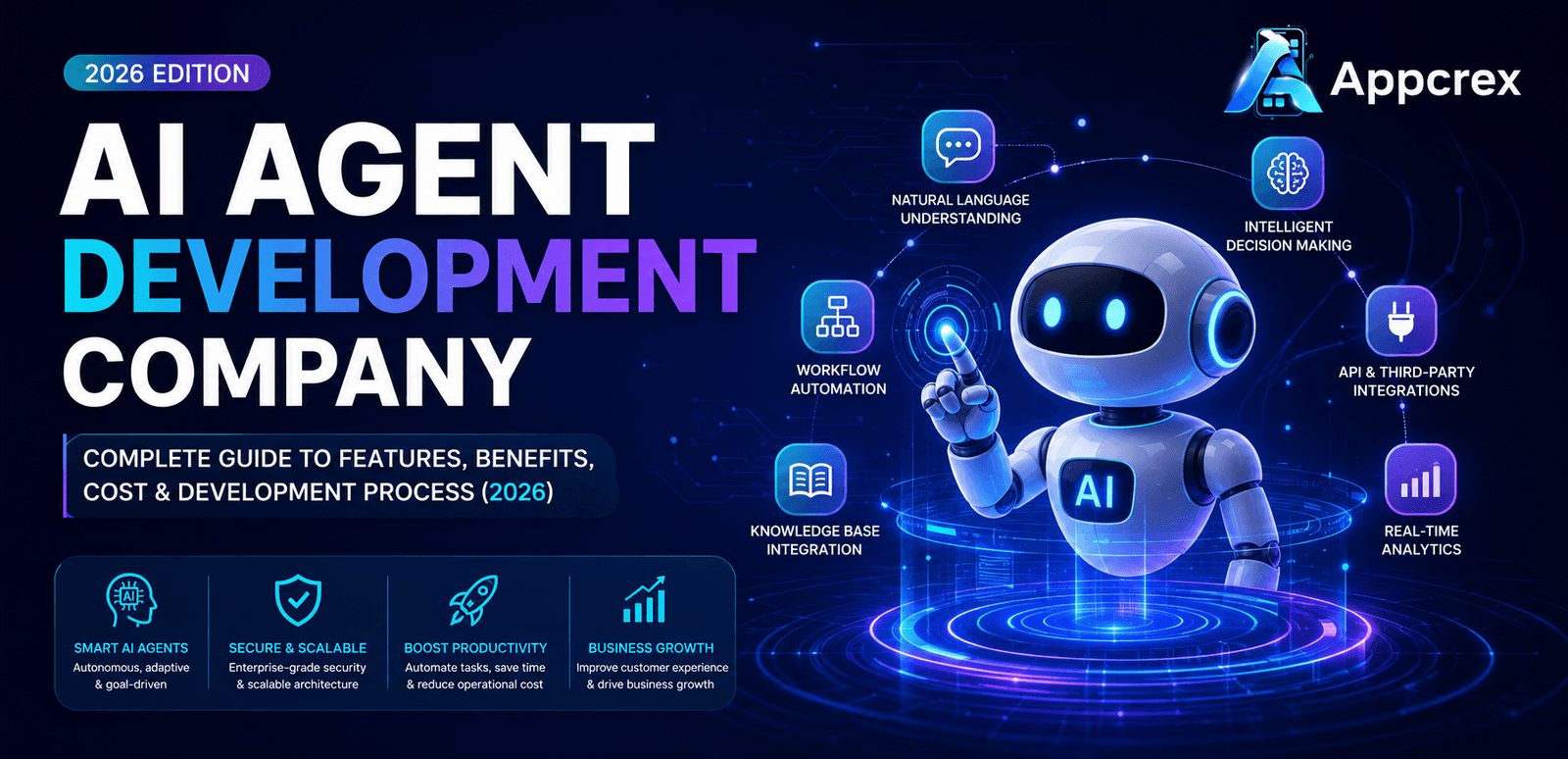
1. Natural Language Understanding (NLU)
Natural Language Understanding enables AI agents to understand human language, context, and intent rather than simply matching keywords.
Capabilities
- Intent recognition
- Context awareness
- Sentiment analysis
- Multi-language conversations
Benefits
- More accurate responses
- Better customer experience
- Human-like interactions
2. Large Language Model (LLM) Integration
Modern AI agents rely on advanced language models to reason, generate content, and solve complex problems.
Popular LLMs
- OpenAI GPT
- Anthropic Claude
- Google Gemini
- Meta Llama
- Mistral AI
These models provide advanced reasoning, coding, summarization, and conversational capabilities.
3. Memory Management
Unlike traditional chatbots, AI agents maintain memory to provide contextual and personalized interactions.
Types of Memory
Short-Term Memory
Maintains context during an ongoing conversation.
Long-Term Memory
Stores user preferences, historical interactions, and important business information for future use.
4. Knowledge Base Integration
AI agents should retrieve accurate information from enterprise knowledge sources.
Supported Data Sources
- PDF documents
- Word documents
- Internal databases
- CRM systems
- Company websites
- FAQs
- Wikis
Benefits
- Accurate responses
- Up-to-date information
- Reduced hallucinations
5. Workflow Automation
AI agents should automate complete business workflows rather than only answering questions.
Examples
- Creating invoices
- Sending emails
- Booking meetings
- Updating CRM records
- Generating reports
- Creating support tickets
6. API Integration
AI agents become significantly more powerful when connected to external applications.
Popular Integrations
- Salesforce
- HubSpot
- Microsoft Dynamics
- Slack
- Microsoft Teams
- Gmail
- Outlook
- Shopify
- Stripe
- Jira
7. Multi-Agent Collaboration
Multiple AI agents can collaborate to solve complex tasks.
Example
A sales AI agent qualifies leads, a marketing AI agent prepares personalized campaigns, and a support AI agent manages customer onboarding.
Real-Time Analytics
Businesses need visibility into AI performance.
Dashboard Metrics
- Total conversations
- Successful task completion
- Response time
- User satisfaction
- Cost savings
- Automation rate
Advanced AI Agent Capabilities
Enterprise AI agents include advanced features that significantly improve automation and business productivity.
Autonomous Task Execution
Modern AI agents can complete tasks independently without requiring constant human supervision.
Examples
- Schedule meetings
- Generate invoices
- Send follow-up emails
- Create project tasks
- Update databases
Multi-Step Reasoning
Instead of answering one question at a time, AI agents can break complex objectives into smaller tasks and complete them sequentially.
Example
User Request:
“Plan my business trip to Dubai.”
The AI agent can:
- Search flights
- Compare hotels
- Create itinerary
- Schedule meetings
- Prepare travel checklist
Tool Calling
AI agents can use external software tools to perform real-world actions.
Examples
- Send emails
- Search databases
- Execute SQL queries
- Generate invoices
- Update CRM records
Retrieval-Augmented Generation (RAG)
RAG allows AI agents to retrieve relevant business information before generating responses.
Benefits
- Higher accuracy
- Reduced hallucinations
- Enterprise knowledge access
Planning and Goal Management
AI agents analyze objectives, create execution plans, and track progress until goals are completed.
AI Agent Development Process
Developing a successful AI agent requires a structured approach that combines AI expertise with business strategy.
Requirement Analysis
Identify:
- Business objectives
- User personas
- Automation opportunities
- Success metrics
AI Strategy Planning
Define:
- Agent capabilities
- Knowledge sources
- Integration requirements
- Security policies
UI/UX Design
Create intuitive interfaces for users.
Deliverables
- User journeys
- Wireframes
- Conversation flows
- Dashboards
AI Model Selection
Choose the most suitable language model based on business requirements.
Options
- GPT
- Claude
- Gemini
- Llama
Knowledge Base Development
Train or connect the AI agent with business knowledge.
Sources
- Internal documents
- Product catalogs
- CRM
- ERP
- FAQs
Backend Development
Build scalable backend infrastructure.
Components
- APIs
- Authentication
- Databases
- Workflow engine
- Logging system
Integration Development
Connect the AI agent with third-party systems.
Examples include:
- CRM
- ERP
- Payment systems
- Email platforms
- Cloud storage
Testing
Comprehensive testing should include:
- Functional testing
- AI accuracy testing
- Security testing
- Load testing
- User acceptance testing
Deployment
Deploy AI agents on:
- Websites
- Mobile apps
- Slack
- Microsoft Teams
- Internal enterprise systems
Continuous Improvement
Monitor AI performance and continuously improve through:
- User feedback
- Model updates
- Knowledge base expansion
- Workflow optimization
Technology Stack for AI Agent Development
Choosing the right technology stack is essential for building scalable, secure, and intelligent AI agents.
1. AI Models
- OpenAI GPT
- Anthropic Claude
- Google Gemini
- Meta Llama
- Mistral AI
2. AI Frameworks
- LangChain
- LangGraph
- CrewAI
- AutoGen
- Semantic Kernel
Model Context Protocol (MCP)
MCP enables AI agents to securely communicate with external tools, databases, and enterprise applications through a standardized interface, making integrations easier and more reliable.
Vector Databases
Used to power semantic search and Retrieval-Augmented Generation (RAG).
Popular options include:
- Pinecone
- Weaviate
- Chroma
- Milvus
- Qdrant
Backend Technologies
- Python
- Node.js
- FastAPI
- Django
- .NET
Frontend Technologies
- React.js
- Next.js
- Flutter
- React Native
Cloud Platforms
- AWS
- Microsoft Azure
- Google Cloud Platform
AI Agent Development Cost in 2026
The cost depends on the complexity, integrations, AI model selection, and deployment requirements.
Basic AI Agent
Features
- FAQ automation
- Simple workflows
- Knowledge base
Estimated Cost
$10,000 – $25,000
Medium Complexity AI Agent
Features
- CRM integration
- Workflow automation
- Analytics dashboard
- Multi-channel support
Estimated Cost
$25,000 – $60,000
Enterprise AI Agent
Features
- Multi-agent architecture
- Advanced reasoning
- Custom AI models
- ERP/CRM integrations
- RAG implementation
- Enterprise security
Estimated Cost
$60,000 – $200,000+
Security & Compliance
AI agents often process sensitive business information, making security a critical requirement.
Essential Security Measures
Data Encryption
Protects data both in transit and at rest.
Role-Based Access Control (RBAC)
Ensures users only access authorized resources.
Multi-Factor Authentication (MFA)
Adds an additional layer of user authentication.
Audit Logs
Tracks all AI activities for monitoring and compliance.
Data Privacy
Support compliance with regulations such as:
Why Choose AppCrex for AI Agent Development?
AppCrex develops intelligent AI agents tailored to your business goals, helping organizations automate operations, improve customer engagement, and accelerate growth.
Our AI Expertise
- Custom AI Agent Development
- Enterprise AI Solutions
- AI Workflow Automation
- AI Copilot Development
- Generative AI Integration
- RAG Implementation
- Multi-Agent Systems
- AI Consulting Services
We build secure, scalable, and enterprise-ready AI agents that integrate seamlessly with your existing business systems.
FAQs
Q. What is an AI agent?
An AI agent is an intelligent software system that can understand goals, make decisions, use tools, and complete tasks with minimal human intervention.
Q. How is an AI agent different from a chatbot?
A chatbot primarily answers questions, while an AI agent can reason, plan, interact with external systems, and automate complete workflows.
Q. How much does AI Agent Development cost?
Development costs generally range from $10,000 to $200,000+, depending on complexity, integrations, and enterprise requirements.
Q. Which industries benefit from AI agents?
Healthcare, finance, ecommerce, manufacturing, logistics, education, legal services, customer support, and enterprise IT all benefit from AI agent technology.
Q. Can AI agents integrate with CRM and ERP systems?
Yes. AI agents can integrate with platforms such as Salesforce, HubSpot, SAP, Microsoft Dynamics, and many other enterprise systems.
Q. What technologies are used for AI Agent Development?
Common technologies include GPT, Claude, Gemini, Llama, LangChain, LangGraph, CrewAI, AutoGen, Python, FastAPI, and vector databases.
Q. Are AI agents secure?
Yes. When implemented correctly, AI agents use encryption, authentication, access controls, audit logging, and compliance standards to protect sensitive data.
Conclusion
AI agents are transforming the future of business automation by going beyond traditional chatbots and enabling intelligent, autonomous decision-making. They can understand complex requests, reason through multi-step tasks, interact with enterprise systems, and automate workflows across departments.
As organizations embrace digital transformation, investing in AI Agent Development provides a competitive advantage through increased productivity, lower operational costs, improved customer experiences, and scalable automation. Whether you’re building an AI-powered customer support assistant, sales agent, HR automation platform, or enterprise workflow solution, partnering with an experienced AI Agent Development Company is essential for long-term success.
At AppCrex, we specialize in developing secure, scalable, and enterprise-grade AI agents tailored to your business needs. From strategy and design to deployment and ongoing optimization, our team helps businesses unlock the full potential of AI-driven automation.