📌 Key Takeaways
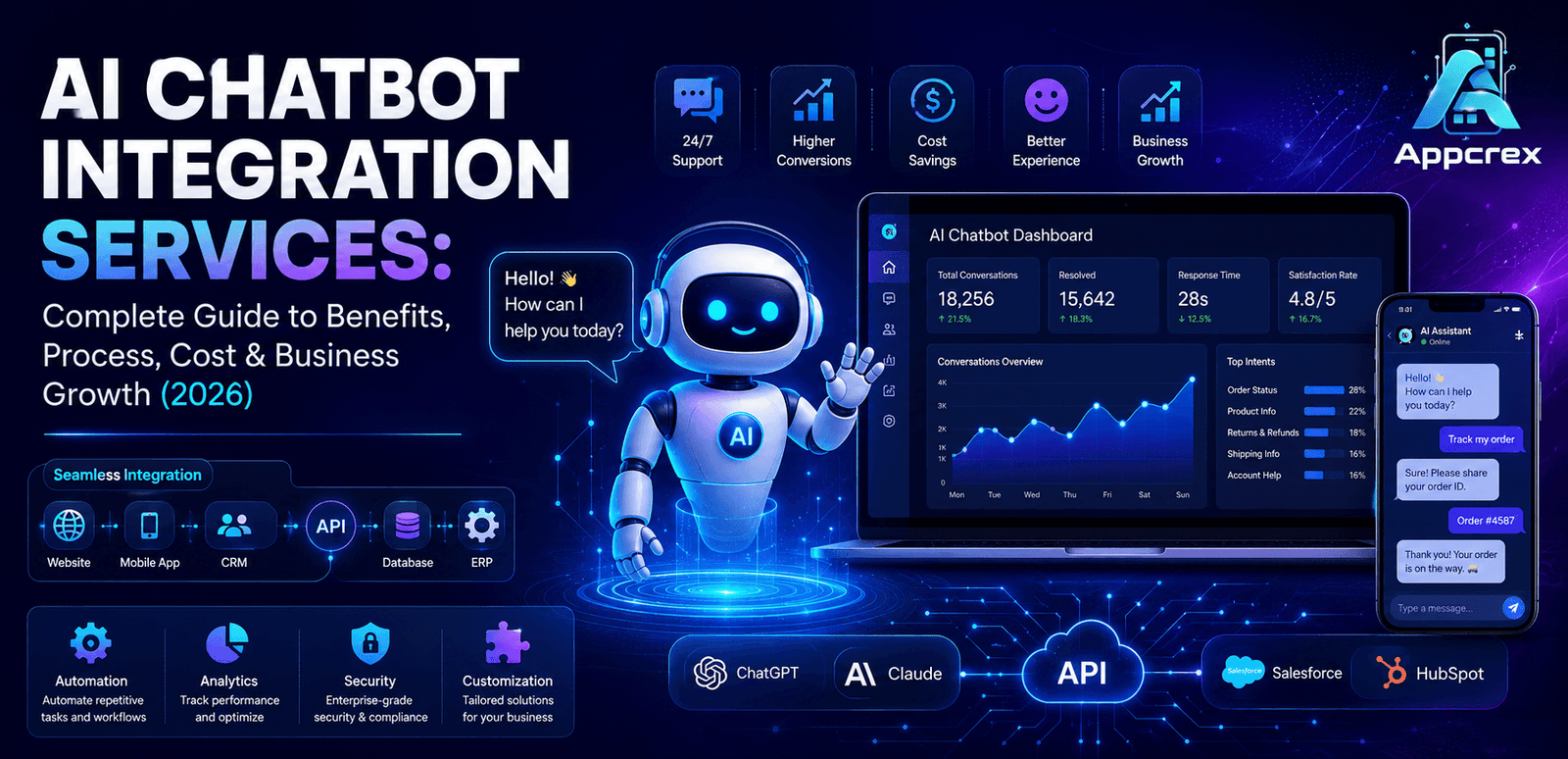
- AI chatbot integration helps businesses automate customer support, sales, lead generation, and operational workflows.
- Modern AI chatbots powered by Generative AI and LLMs provide human-like conversations and personalized customer experiences.
- AI chatbot integration can reduce support costs by up to 60–70% while improving customer satisfaction.
- Businesses can integrate AI chatbots with websites, mobile apps, CRMs, WhatsApp, ERP systems, and internal platforms.
- Investing in AI chatbot integration services helps companies scale customer engagement and increase conversions.
Introduction
Customer expectations have changed dramatically over the last few years. Today’s consumers expect businesses to provide instant responses, personalized experiences, and support available around the clock. Whether they are browsing a website, shopping online, booking a healthcare appointment, or requesting financial assistance, customers want quick and accurate answers.
Unfortunately, many organizations struggle to meet these expectations using traditional customer service methods. Hiring large support teams can be expensive, and human agents cannot always provide instant assistance to every customer.
This is where AI chatbot integration services have emerged as a game-changing solution.
AI chatbots powered by Artificial Intelligence, Natural Language Processing (NLP), Machine Learning (ML), and Large Language Models (LLMs) can understand customer queries, generate intelligent responses, and automate business processes without human intervention.
From startups and eCommerce stores to healthcare providers, financial institutions, and enterprise organizations, businesses are increasingly integrating AI chatbots into their digital platforms to improve efficiency, reduce operational costs, and enhance customer engagement.
What Are AI Chatbot Integration Services?
AI chatbot integration services involve connecting intelligent conversational AI systems with existing business platforms, applications, websites, communication channels, and databases.
The objective is to enable chatbots to interact with users while accessing business information and automating workflows.
Unlike traditional chatbots that follow fixed rules and scripted responses, AI-powered chatbots use advanced technologies to understand user intent and generate contextual responses.
These integrations allow businesses to automate interactions across multiple touchpoints, including:
- Business Websites
- Mobile Applications
- Customer Support Portals
- WhatsApp Business
- Facebook Messenger
- Telegram
- Slack
- Microsoft Teams
- CRM Systems
- ERP Platforms
- E-commerce Stores
For example, if a customer asks about their order status, an AI chatbot can connect with the order management system, retrieve tracking information, and provide real-time updates instantly.
This level of automation significantly improves customer experiences while reducing manual workloads.
Why Businesses Are Investing in AI Chatbot Integration Services?
The growing demand for AI chatbot solutions is driven by several business challenges.
Increasing Customer Expectations
Modern consumers expect businesses to provide immediate responses regardless of time zones or business hours.
Delays in customer support often result in:
- Lost sales
- Poor customer satisfaction
- Negative reviews
- Reduced brand loyalty
AI chatbots eliminate waiting times and provide instant assistance.
Rising Operational Costs
Managing large customer support teams requires significant investment.
Businesses must cover:
- Salaries
- Training
- Infrastructure
- Software tools
AI chatbots help automate repetitive tasks and reduce support costs.
Digital Transformation Initiatives
Organizations worldwide are embracing automation and artificial intelligence to improve efficiency.
AI chatbot integration aligns perfectly with digital transformation goals.
Need for Scalable Customer Support
As businesses grow, customer inquiries increase.
Instead of hiring additional staff, companies can scale support through AI-powered automation.
Key Benefits of AI Chatbot Integration Services
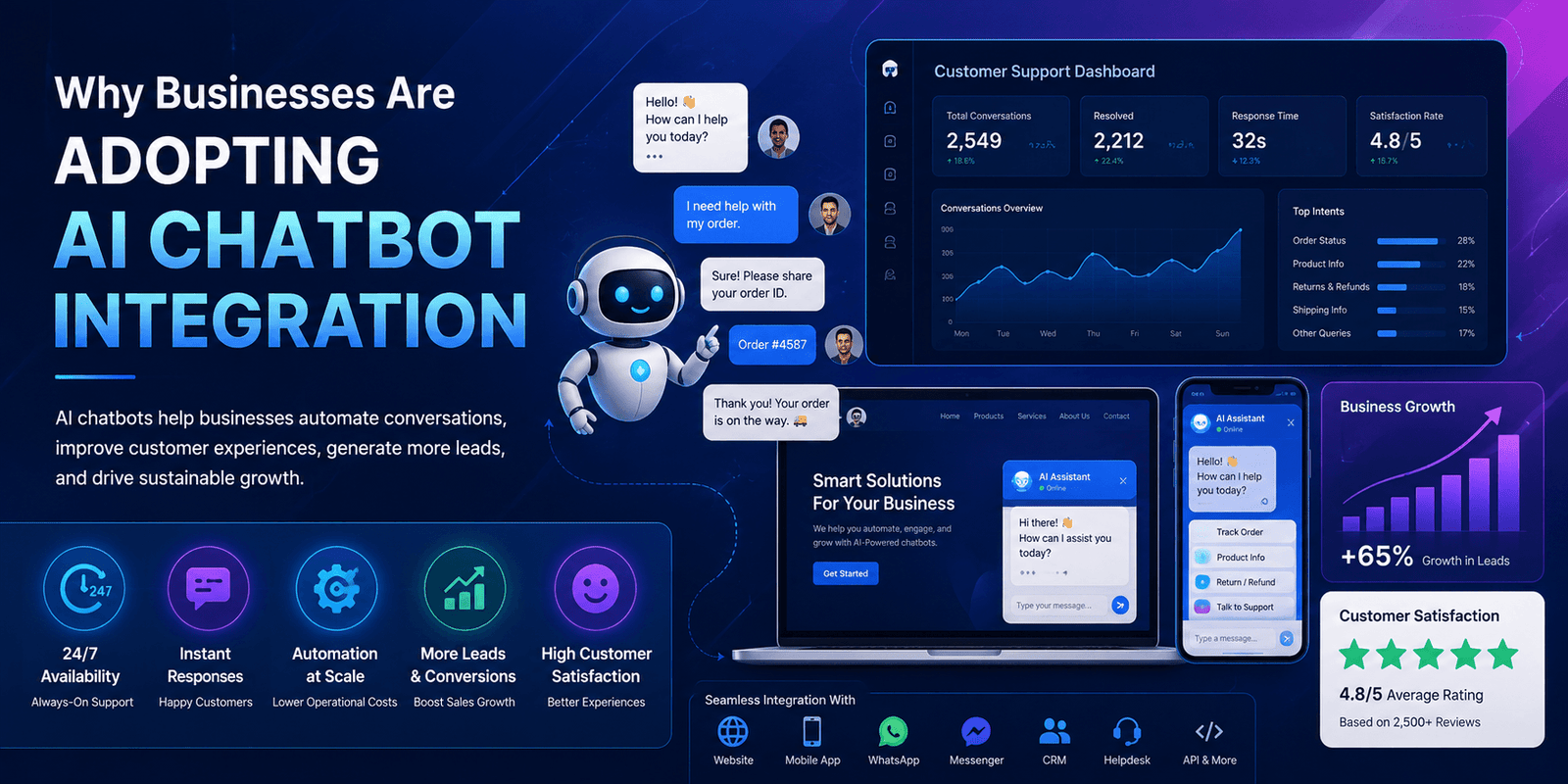
AI chatbot integration provides substantial advantages for businesses of all sizes.
1. 24/7 Customer Support
One of the most significant benefits of AI chatbots is round-the-clock availability.
Unlike human agents, chatbots never sleep, take breaks, or require shifts.
Customers receive immediate support regardless of:
- Time zones
- Holidays
- Weekends
- Peak traffic periods
This improves customer satisfaction and business accessibility.
2. Faster Response Times
Research consistently shows that customers prefer businesses that respond quickly.
AI chatbots can respond within seconds, reducing frustration and improving user experiences.
This is particularly valuable for:
- eCommerce stores
- Healthcare platforms
- Financial services
- SaaS businesses
3. Reduced Operational Costs
Customer support represents a major expense for many organizations.
AI chatbot integration reduces costs by automating:
- Frequently asked questions
- Appointment scheduling
- Lead qualification
- Order tracking
- Account inquiries
Businesses can save thousands of dollars annually while maintaining high service quality.
4. Improved Customer Experience
AI-powered chatbots can provide personalized interactions by accessing customer information and behavioral data.
This allows businesses to deliver:
- Personalized recommendations
- Customized support
- Relevant product suggestions
- Better engagement
5. Increased Lead Generation
AI chatbots are excellent lead-generation tools.
They can:
- Engage website visitors
- Ask qualifying questions
- Collect contact information
- Schedule consultations
- Route leads to sales teams
This helps businesses convert more prospects into customers.
Types of AI Chatbots
Not all AI chatbots are created equal.
Different business objectives require different chatbot solutions.
Rule-Based Chatbots
Rule-based chatbots follow predefined workflows and decision trees.
They are suitable for:
- Basic FAQs
- Appointment booking
- Simple support requests
Advantages include:
- Lower costs
- Faster implementation
- Predictable behavior
However, they lack flexibility and intelligence.
AI-Powered Chatbots
AI-powered chatbots use machine learning and NLP to understand user intent.
Capabilities include:
- Context awareness
- Dynamic conversations
- Intelligent responses
- Learning from interactions
These chatbots offer more advanced customer experiences.
Generative AI Chatbots
Generative AI chatbots represent the latest evolution in conversational AI.
Powered by models such as:
- GPT
- Gemini
- Claude
- Llama
These systems can generate highly natural and human-like responses.
They are ideal for:
- Customer support
- Content generation
- Virtual assistants
- Knowledge management
Hybrid Chatbots
Hybrid chatbots combine rule-based workflows with AI intelligence.
This approach provides:
- Better control
- Improved accuracy
- Enhanced scalability
Many enterprise organizations prefer hybrid solutions because they balance automation and governance.
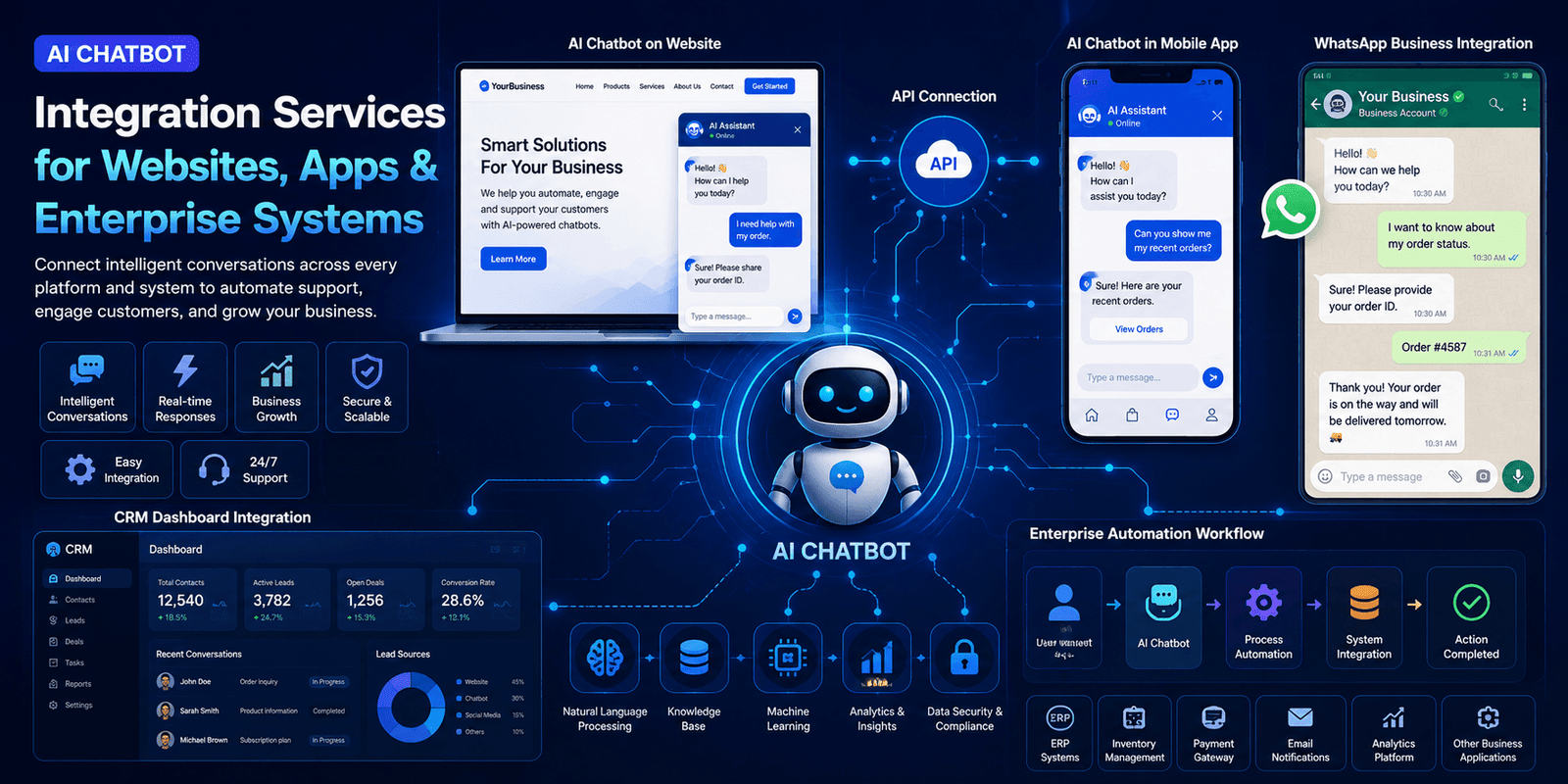
AI Chatbot Integration Services We Offer
Every business has unique requirements, which is why AI chatbot integration is not a one-size-fits-all solution.
At AppCrex, we help organizations integrate AI-powered chatbots into their digital ecosystems to automate communication, improve customer engagement, and increase operational efficiency.
1. Website AI Chatbot Integration
A website is often the first interaction point between a business and its customers.
AI chatbots can transform websites into intelligent engagement platforms.
Benefits
- Instant customer support
- Lead generation
- Product recommendations
- FAQ automation
- Appointment scheduling
For example, an eCommerce website can use an AI chatbot to help customers find products, answer shipping questions, and complete purchases.
2. Mobile App Chatbot Integration
Mobile applications are increasingly becoming the primary channel for customer interactions.
Integrating AI chatbots into mobile apps provides users with:
- In-app support
- Personalized assistance
- Real-time recommendations
- Automated onboarding
Industries such as healthcare, fintech, education, and retail heavily rely on mobile chatbot experiences.
3. WhatsApp AI Chatbot Integration
WhatsApp has become one of the most popular business communication channels globally.
AI-powered WhatsApp chatbots enable businesses to:
- Automate customer inquiries
- Send order updates
- Manage bookings
- Provide product information
- Generate leads
WhatsApp chatbot integration is particularly effective for businesses seeking direct customer engagement.
4. CRM Chatbot Integration
Customer Relationship Management systems contain valuable customer data.
Integrating AI chatbots with CRM platforms allows businesses to deliver personalized experiences.
Popular CRM integrations include:
- Salesforce
- HubSpot
- Zoho CRM
- Microsoft Dynamics
Benefits include:
- Customer data access
- Lead qualification
- Sales automation
- Customer support enhancement
5. ERP Chatbot Integration
Enterprise Resource Planning systems manage critical business operations.
AI chatbot integration with ERP systems allows users to access information through conversational interfaces.
Examples include:
- Inventory status
- Purchase orders
- Employee information
- Operational reports
This improves productivity and accessibility.
6. AI Customer Support Chatbot Development
Customer support remains one of the most common use cases for AI chatbots.
AI-powered support bots can:
- Answer frequently asked questions
- Resolve common issues
- Escalate complex cases
- Provide multilingual assistance
Organizations can reduce support workloads while maintaining service quality.
7. AI Sales & Lead Generation Chatbots
Sales teams often spend significant time qualifying leads.
AI chatbots can automate this process.
Capabilities include:
- Visitor engagement
- Lead qualification
- Contact information collection
- Meeting scheduling
- Product recommendations
These features help businesses increase conversion rates.
8. Internal Employee Assistant Chatbots
AI chatbots are not limited to customer-facing applications.
Many organizations deploy internal AI assistants for employees.
Examples include:
- HR support
- IT help desk
- Employee onboarding
- Knowledge management
These solutions improve workplace productivity.
Industries Benefiting from AI Chatbot Integration
AI chatbot technology is transforming virtually every industry.
1. Healthcare
Healthcare organizations use AI chatbots to improve patient experiences.
Common applications include:
- Appointment scheduling
- Patient support
- Medical information
- Prescription reminders
- Telemedicine assistance
Healthcare providers benefit from improved efficiency and reduced administrative burdens.
2. Finance & Banking
Financial institutions leverage AI chatbots for:
- Account inquiries
- Loan assistance
- Fraud alerts
- Investment information
- Customer support
AI automation improves customer service while maintaining security.
3. E-Commerce
Online retailers use AI chatbots to:
- Recommend products
- Recover abandoned carts
- Track orders
- Handle returns
- Answer customer questions
This directly impacts revenue and customer retention.
4. Education
Educational institutions deploy AI assistants to support students.
Applications include:
- Admissions assistance
- Course recommendations
- Student support
- Learning guidance
AI chatbots help educational organizations scale student engagement.
5. Real Estate
Real estate businesses use AI chatbots for:
- Property inquiries
- Lead qualification
- Appointment scheduling
- Virtual assistance
This improves lead management and sales processes.
6. SaaS Businesses
Software companies rely on AI chatbots to improve customer experiences.
Use cases include:
- User onboarding
- Product guidance
- Technical support
- Subscription management
AI chatbots help reduce churn and improve customer satisfaction.
Also Read : What is SaaS Application Development? A Complete Guide (2026)
AI Chatbot Integration Development Process
Successful AI chatbot implementation requires a structured approach.
Step 1: Business Discovery & Requirement Analysis
Every project begins with understanding business objectives.
This phase includes:
- Identifying challenges
- Defining use cases
- Understanding customer journeys
- Establishing project goals
A strong foundation ensures long-term success.
Step 2: Platform & Channel Selection
Businesses must determine where the chatbot will operate.
Common deployment channels include:
- Websites
- Mobile applications
- Facebook Messenger
- Slack
- Microsoft Teams
Selecting the right channels is critical.
Step 3: AI Model Selection
The chatbot’s intelligence depends largely on the AI model used.
Popular options include:
OpenAI GPT
Ideal for advanced conversational experiences.
Google Gemini
Strong multimodal capabilities.
Claude AI
Known for safety-focused responses.
Meta Llama
Suitable for custom deployments.
Model selection depends on business goals and budget.
Step 4: Conversation Design
A chatbot’s success depends on effective conversation flows.
This stage involves:
- User journey mapping
- Dialogue creation
- Intent design
- Escalation paths
The goal is to provide natural and helpful interactions.
Step 5: Backend Integration
This is where the chatbot connects with business systems.
Integrations may include:
- CRM platforms
- ERP software
- Databases
- APIs
- Payment gateways
- Analytics tools
Backend integration enables real-time information access.
Step 6: AI Training & Optimization
AI chatbots must be trained using relevant data.
This includes:
- FAQs
- Knowledge bases
- Documentation
- Historical conversations
Continuous optimization improves response quality.
Step 7: Testing & Quality Assurance
Before deployment, extensive testing is required.
Areas tested include:
- Accuracy
- Security
- Performance
- Scalability
- User experience
Testing minimizes deployment risks.
Step 8: Deployment & Monitoring
Once testing is complete, the chatbot is deployed.
Post-launch monitoring tracks:
- Usage metrics
- Customer satisfaction
- Conversion rates
- Performance issues
Continuous improvements ensure long-term success.
Technologies Used in AI Chatbot Development
Modern AI chatbot solutions rely on multiple technologies working together.
1. Artificial Intelligence Platforms
- OpenAI GPT
- Gemini AI
- Claude AI
- Meta Llama
2. Programming Languages
- Python
- JavaScript
- TypeScript
- Java
3. Backend Frameworks
- Node.js
- Django
- FastAPI
- .NET
4. Databases
- PostgreSQL
- MongoDB
- MySQL
5. Vector Databases
- Pinecone
- Weaviate
- ChromaDB
6. Cloud Platforms
- AWS
- Microsoft Azure
- Google Cloud Platform
These technologies create secure and scalable chatbot solutions.
Why Businesses Choose AppCrex for AI Chatbot Integration
Businesses require more than chatbot development.
They need a strategic technology partner.
At AppCrex, we help organizations:
- Build custom AI chatbot solutions
- Integrate Generative AI technologies
- Automate customer support
- Improve lead generation
- Streamline business operations
- Scale digital experiences
Our AI experts create secure, scalable, and future-ready chatbot solutions tailored to business objectives.
How Much Do AI Chatbot Integration Services Cost in 2026?
One of the most common questions businesses ask is:
“How much does AI chatbot integration cost?”
The answer depends on several factors, including chatbot complexity, integrations, AI model usage, security requirements, and custom features.
1. Basic AI Chatbot
Suitable for:
- Small businesses
- Startup websites
- FAQ automation
Estimated Cost: $3,000 – $8,000
Features include:
- Basic NLP
- Website integration
- FAQ support
- Lead capture forms
2. Business AI Chatbot
Suitable for:
- Growing businesses
- E-commerce stores
- SaaS companies
Estimated Cost: $8,000 – $20,000
Features include:
- CRM integration
- Multi-channel support
- Analytics dashboard
- Workflow automation
3. Generative AI Chatbot
Suitable for:
- Enterprises
- Healthcare organizations
- Financial institutions
Estimated Cost: $20,000 – $50,000+
Features include:
- GPT integration
- Context-aware responses
- Advanced automation
- Knowledge base integration
4. Enterprise AI Assistant
Suitable for:
- Large enterprises
- Government organizations
- Global businesses
Estimated Cost: $50,000 – $200,000+
Features include:
- Multiple integrations
- AI agents
- Voice AI
- Enterprise security
- Custom workflows
Factors Affecting AI Chatbot Integration Costs
Several factors influence project pricing.
1. AI Model Selection
Different AI models have different pricing structures.
Examples:
- OpenAI GPT
- Google Gemini
- Claude AI
- Meta Llama
Usage-based API costs can impact long-term expenses.
2. Number of Integrations
Integrating with:
- CRM systems
- ERP software
- Payment gateways
- Databases
requires additional development effort.
3. Security & Compliance
Industries such as healthcare and finance require:
- HIPAA Compliance
- GDPR Compliance
- Data Encryption
- Access Controls
Additional security increases project costs.
4. Custom Features
Features such as:
- Voice AI
- AI Agents
- Recommendation Engines
- Advanced Analytics
require more development resources.
Return on Investment (ROI) of AI Chatbot Integration
Businesses often recover their investment quickly through automation and efficiency improvements.
1. Reduced Customer Support Costs
AI chatbots can automate up to 70% of repetitive customer inquiries.
Benefits include:
- Lower staffing costs
- Reduced workload
- Faster issue resolution
2. Higher Lead Conversion Rates
AI chatbots engage visitors instantly.
Benefits include:
- Better lead qualification
- Increased engagement
- More sales opportunities
Many businesses report higher conversion rates after implementing AI-powered chatbots.
3. Improved Customer Retention
Customers appreciate:
- Faster support
- Personalized experiences
- Immediate responses
This contributes to stronger customer loyalty.
Increased Operational Efficiency
Automation allows employees to focus on strategic activities rather than repetitive tasks.
Common Challenges in AI Chatbot Integration
Although AI chatbots provide significant benefits, organizations may encounter challenges during implementation.
1. Data Security Concerns
Businesses must protect customer information and ensure compliance with privacy regulations.
Best practices include:
- Encryption
- Secure APIs
- Authentication controls
- Regular security audits
2. Integration Complexity
Enterprise environments often contain multiple systems.
Examples:
- CRM platforms
- ERP systems
- Legacy software
- Databases
Connecting these systems requires technical expertise.
3. Response Accuracy
AI chatbots must provide reliable and relevant answers.
Poor responses can negatively impact customer trust.
Continuous training and monitoring are essential.
4. Change Management
Employees may initially resist automation initiatives.
Organizations should:
- Provide training
- Communicate benefits
- Encourage adoption
Successful implementation requires organizational support.
AI Chatbot vs Traditional Customer Support
Businesses frequently compare AI chatbots with human support teams.
| Feature | AI Chatbot | Human Agent |
|---|---|---|
| Availability | 24/7 | Business Hours |
| Response Speed | Instant | Variable |
| Scalability | High | Limited |
| Cost | Lower | Higher |
| Consistency | High | Varies |
| Complex Problem Solving | Moderate | Excellent |
| Multitasking | Unlimited | Limited |
The most effective strategy is often a hybrid approach combining AI automation with human expertise.
Future Trends in AI Chatbot Integration
The AI chatbot industry continues to evolve rapidly.
Several emerging trends are shaping the future of conversational AI.
1. Generative AI Expansion
Generative AI is making chatbot interactions increasingly natural.
Future systems will:
- Understand context better
- Generate personalized responses
- Handle complex conversations
2. Voice AI Assistants
Voice-based interactions are becoming more common.
Businesses are integrating:
- Voice chatbots
- Virtual assistants
- Speech recognition systems
into customer experiences.
3. Multimodal AI
Future AI chatbots will understand:
- Text
- Images
- Audio
- Documents
- Video content
This will unlock more advanced business use cases.
4. Autonomous AI Agents
AI agents will go beyond answering questions.
Future capabilities include:
- Completing tasks
- Scheduling appointments
- Processing transactions
- Managing workflows
with minimal human involvement.
5. Hyper-Personalization
AI systems will leverage customer data to create highly personalized experiences.
Benefits include:
- Better engagement
- Improved retention
- Higher conversions
Why Hire an AI Chatbot Development Company?
Building a successful chatbot requires expertise across multiple disciplines.
Businesses often partner with experienced development companies to reduce risk and accelerate deployment.
Benefits include:
1. Faster Development
Experienced teams follow proven processes and best practices.
2. Custom Solutions
Every business has unique requirements.
Professional developers create tailored chatbot experiences.
3. Better Security
Security is integrated throughout development.
4. Scalable Architecture
Solutions are designed to grow alongside business needs.
5. Ongoing Support
Continuous maintenance ensures optimal performance.
Why Choose AppCrex for AI Chatbot Integration Services?
At AppCrex, we help startups, enterprises, and growing businesses leverage the power of AI-driven automation.
Our services include:
1. Custom AI Chatbot Development
Build intelligent conversational experiences tailored to your business goals.
2. ChatGPT Integration Services
Integrate advanced Generative AI capabilities into existing platforms.
3. WhatsApp Chatbot Development
Automate customer engagement through WhatsApp Business.
4. AI Agent Development
Create intelligent agents capable of handling complex workflows.
5. CRM & ERP Integration
Connect AI chatbots with critical business systems.
6. Voice AI Solutions
Enable voice-enabled customer interactions.
7. AI Consulting Services
Develop AI strategies aligned with business objectives.
Whether you’re looking to automate customer support, generate more leads, improve customer engagement, or streamline internal operations, AppCrex delivers scalable and future-ready AI chatbot solutions.
Ready to Transform Your Business with AI Chatbot Integration?
Modern customers expect instant, personalized, and intelligent interactions.
AI chatbot integration helps businesses:
✅ Improve customer support
✅ Generate more leads
✅ Reduce operational costs
✅ Automate repetitive tasks
✅ Increase customer satisfaction
✅ Scale efficiently
If you’re looking to implement AI chatbot solutions for your website, mobile application, CRM, ERP platform, or enterprise systems, AppCrex can help.
Contact AppCrex today for a free AI chatbot consultation and discover how intelligent automation can accelerate your business growth.
Frequently Asked Questions (FAQs)
What are AI Chatbot Integration Services?
AI chatbot integration services connect intelligent conversational assistants with websites, applications, CRM systems, ERP platforms, and communication channels to automate interactions and business processes.
Q. How much does AI chatbot integration cost?
Costs typically range from $3,000 to $200,000+, depending on complexity, integrations, AI models, and customization requirements.
Q. Which industries benefit most from AI chatbots?
Healthcare, finance, retail, education, real estate, SaaS, logistics, and customer support industries benefit significantly from chatbot automation.
Q. Can AI chatbots integrate with WhatsApp?
Yes. AI chatbots can integrate with WhatsApp Business, Facebook Messenger, Telegram, Slack, Microsoft Teams, and other communication platforms.
Q. Are AI chatbots secure?
When built using proper security practices, AI chatbots can be highly secure and compliant with industry regulations such as GDPR and HIPAA.
Q. What AI models are commonly used?
Popular models include OpenAI GPT, Google Gemini, Anthropic Claude, and Meta Llama.
Q. How long does AI chatbot integration take?
Basic chatbot integrations may take 2–4 weeks, while enterprise-grade implementations can require several months.
Q. Can AI chatbots replace human agents?
AI chatbots can automate repetitive tasks and common inquiries, but human agents remain essential for handling complex issues and relationship-driven interactions.
Q. What is the difference between a chatbot and an AI agent?
A chatbot primarily handles conversations and customer interactions, while an AI agent can perform actions, automate workflows, access systems, and complete tasks autonomously.
Q. Do AI chatbots support multiple languages?
Yes. Modern AI chatbots can communicate in multiple languages, enabling businesses to serve global audiences effectively.
Conclusion
AI chatbot integration services have become an essential investment for businesses seeking to improve customer engagement, automate operations, and scale efficiently in the digital economy. By integrating intelligent conversational AI into websites, mobile applications, CRM systems, ERP platforms, and communication channels, organizations can deliver faster support, reduce operational costs, and create highly personalized customer experiences.
As Generative AI, Voice AI, and Autonomous AI Agents continue to evolve, businesses that embrace AI chatbot integration today will be better positioned to compete, innovate, and grow in 2026 and beyond. Whether you’re a startup looking to automate lead generation or an enterprise seeking advanced workflow automation, AI chatbot integration offers significant opportunities for long-term success.