
📌 Key Takeaways
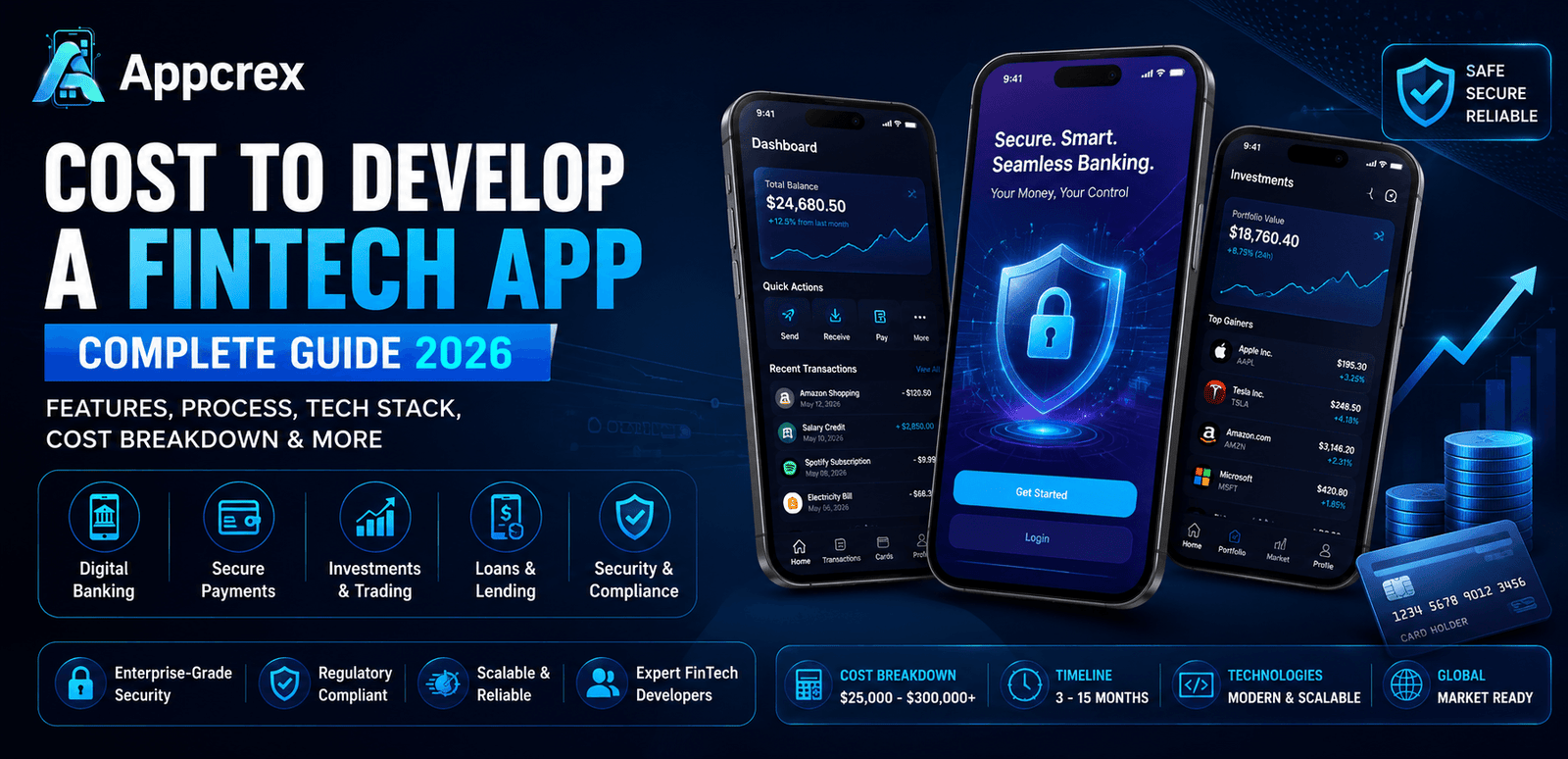
- FinTech app development costs typically range from $25,000 to $300,000+.
- Security, KYC, AML, and compliance requirements significantly impact development costs.
- AI-powered fraud detection and financial insights are becoming standard FinTech features.
- Flutter, React Native, Node.js, PostgreSQL, and AWS are among the most popular technologies for FinTech app development.
- Working with an experienced FinTech app development company helps ensure security, scalability, and regulatory compliance.
Introduction
The financial services industry is undergoing a massive digital transformation. Consumers no longer want to visit banks for every transaction, apply for loans through paperwork, or wait days to transfer money. Instead, they expect instant access to financial services through secure and user-friendly mobile applications.
This shift has fueled the growth of FinTech (Financial Technology) applications. From digital wallets and mobile banking apps to investment platforms and lending solutions, FinTech apps are revolutionizing how individuals and businesses manage money.
As startups and enterprises enter this rapidly growing market, one question consistently arises:
How Much Does It Cost to Develop a FinTech App?
The answer depends on several factors, including:
- App complexity
- Security requirements
- Compliance regulations
- Features and functionality
- Platform selection
- Third-party integrations
- Development team expertise
In this comprehensive guide, we’ll explore everything you need to know about FinTech app development costs, features, technology stack, timelines, and future trends.
What Is a FinTech App?
A FinTech app is a software application that uses technology to provide financial services digitally.
These applications help users:
- Transfer money
- Make payments
- Invest funds
- Apply for loans
- Manage budgets
- Track expenses
- Buy insurance
- Trade stocks
FinTech applications simplify financial processes while improving accessibility, convenience, and security.
Why Is FinTech App Development Growing Rapidly?
Several factors are driving FinTech adoption worldwide.
1. Increased Smartphone Usage
Millions of consumers now prefer managing finances through mobile apps.
2. Digital Payment Adoption
Cashless transactions continue to rise globally.
3. Faster Financial Services
Consumers expect real-time banking and instant transactions.
4. Financial Inclusion
FinTech apps provide services to previously underserved populations.
5. AI & Automation
Artificial intelligence improves customer experience and fraud prevention.
FinTech Market Overview
The global FinTech industry is expected to continue growing significantly through 2026 and beyond.
Major growth areas include:
- Digital Banking
- Payment Solutions
- Investment Platforms
- Lending Apps
- InsurTech
- Cryptocurrency Applications
- Personal Finance Tools
Businesses investing in FinTech app development today can capitalize on increasing consumer demand for digital financial services.
Also Read : Push Notification Guide: Benefits, Types & Best Practices (2026)
Types of FinTech Applications
Understanding the different categories helps determine development costs and feature requirements.
1. Digital Banking Apps
Digital banking applications allow users to manage accounts entirely online.
Common Features
- Account Management
- Fund Transfers
- Bill Payments
- Transaction History
- Mobile Check Deposits
Examples
- Chime
- Revolut
- Monzo
2. Payment & Digital Wallet Apps
These apps facilitate online payments and money transfers.
Features
- Peer-to-Peer Transfers
- QR Payments
- Merchant Payments
- Wallet Management
Examples
- PayPal
- Venmo
- Cash App
3. Investment Apps
Investment platforms help users invest in stocks, ETFs, mutual funds, and other assets.
Features
- Portfolio Management
- Market Tracking
- Investment Analytics
- Trading Functions
Examples
- Robinhood
- E*TRADE
- Webull
4. Lending Apps
Lending applications simplify loan application and approval processes.
Features
- Loan Applications
- Credit Assessment
- EMI Calculators
- Loan Tracking
Examples
- LendingClub
- SoFi
5. Personal Finance Apps
These applications help users manage budgets and expenses.
Features
- Expense Tracking
- Budget Planning
- Savings Goals
- Financial Reports
Examples
- Mint
- YNAB
6. Cryptocurrency Apps
Crypto apps allow users to buy, sell, and manage digital assets.
Features
- Wallet Integration
- Trading
- Portfolio Tracking
- Security Monitoring
Examples
- Coinbase
- Binance
Why Businesses Invest in FinTech App Development?
FinTech applications create significant business opportunities.
1. Growing Consumer Demand
Users increasingly prefer digital financial services.
2. Recurring Revenue Models
Subscription plans and transaction fees generate ongoing income.
3. Global Market Reach
Financial services can be offered across regions and countries.
4. Scalability
Digital platforms can support millions of users.
5. Competitive Advantage
Modern FinTech solutions differentiate businesses in crowded markets.
Essential Features of a FinTech Application
The exact feature set depends on the app type, but most FinTech platforms share several core functionalities.
1. User Registration & Authentication
Secure onboarding is critical.
Options Include
- Email Registration
- Mobile Registration
- Social Login
- Biometric Authentication
Security Features
- OTP Verification
- Two-Factor Authentication (2FA)
- Device Verification
Estimated Cost
$3,000 – $8,000
2. User Profile Management
Users should be able to manage:
- Personal Information
- Account Settings
- Payment Methods
- Linked Bank Accounts
Estimated Cost
$2,000 – $6,000
3. Dashboard & Account Overview
A financial dashboard provides visibility into user activities.
Display Information
- Account Balance
- Recent Transactions
- Spending Insights
- Investment Performance
Estimated Cost
$4,000 – $12,000
4. Secure Payments & Transfers
This is a core feature for most FinTech applications.
Capabilities
- Bank Transfers
- P2P Payments
- Merchant Payments
- Scheduled Transfers
Estimated Cost
$8,000 – $20,000
5. Transaction History
Users need detailed records of financial activities.
Features
- Filters
- Search
- Export Statements
- Download Reports
Estimated Cost
$3,000 – $8,000
6. Push Notifications
Real-time alerts improve user engagement and security.
Examples
- Payment Completed
- Account Login
- Low Balance Alerts
- Investment Updates
Estimated Cost
$2,000 – $5,000
7. Customer Support
Support channels help users resolve issues quickly.
Options
- Live Chat
- AI Chatbot
- Help Center
- Ticket Management
Estimated Cost
$3,000 – $10,000
8. KYC Verification
Know Your Customer (KYC) verification is mandatory for many FinTech applications.
Verification Methods
- Government ID Verification
- Passport Verification
- Facial Recognition
- Address Verification
Benefits
- Regulatory Compliance
- Fraud Prevention
- Enhanced Security
Estimated Cost
$5,000 – $15,000
9. Multi-Layer Security Features
Security is the foundation of every successful FinTech platform.
Essential Security Features
- End-to-End Encryption
- SSL Security
- Tokenization
- Biometric Authentication
- Fraud Detection Systems
Estimated Cost
$10,000 – $30,000
Advanced Features for Modern FinTech Apps
Leading FinTech applications increasingly rely on artificial intelligence.
AI-Powered Financial Insights
AI can analyze spending habits and provide recommendations.
Benefits
- Better Financial Planning
- Personalized Suggestions
- Increased User Engagement
AI Fraud Detection
AI systems identify suspicious activities in real time.
Benefits
- Reduced Fraud
- Improved Security
- Better Compliance
AI Chatbots
Modern AI assistants can:
- Answer Questions
- Provide Account Information
- Assist with Transactions
Cost Impact of Core FinTech Features
| Feature | Estimated Cost |
|---|---|
| User Registration | $3,000 – $8,000 |
| User Profiles | $2,000 – $6,000 |
| Dashboard | $4,000 – $12,000 |
| Payments & Transfers | $8,000 – $20,000 |
| Transaction History | $3,000 – $8,000 |
| Push Notifications | $2,000 – $5,000 |
| Customer Support | $3,000 – $10,000 |
| KYC Verification | $5,000 – $15,000 |
| Security Features | $10,000 – $30,000 |
Why Security Matters in FinTech Development?
Unlike many other app categories, FinTech platforms manage highly sensitive financial data.
Security failures can result in:
- Financial Losses
- Legal Penalties
- Brand Damage
- Customer Churn
This is why security and compliance often account for a significant portion of the total FinTech app development cost.
Admin Panel, Compliance, Security, Technology Stack & Development Process
In Part 1, we explored the FinTech market, app types, essential features, and the key factors driving FinTech app development.
Now let’s dive deeper into the technical and compliance aspects that significantly impact the overall cost of building a FinTech application.
Admin Panel Features
The admin dashboard acts as the central control hub of the FinTech ecosystem.
Administrators use this panel to manage users, transactions, compliance, security, and business operations.
1. User Management
Administrators should be able to:
- View Users
- Approve Accounts
- Suspend Accounts
- Manage Permissions
- Verify User Information
Benefits
- Better security control
- Improved compliance
- Fraud prevention
Estimated Cost
$3,000 – $8,000
2. Transaction Monitoring
Financial transactions must be monitored continuously.
Features
- Live Transaction Tracking
- Failed Transaction Monitoring
- Suspicious Activity Detection
- Payment Verification
Estimated Cost
$5,000 – $15,000
3. Compliance Dashboard
Compliance is one of the most important components of FinTech applications.
The admin panel should provide:
- KYC Status Monitoring
- AML Reporting
- Audit Logs
- Regulatory Reports
Estimated Cost
$5,000 – $12,000
4. Analytics & Reporting
Administrators need access to business insights.
Metrics Include
- User Growth
- Revenue Reports
- Transaction Volume
- Retention Rates
- Active Users
Estimated Cost
$4,000 – $10,000
5. Customer Support Management
Support teams require tools to manage user inquiries.
Features
- Ticket System
- Live Chat Monitoring
- Complaint Resolution
- Escalation Management
Estimated Cost
$3,000 – $8,000
Regulatory Compliance Requirements
Compliance is often the biggest difference between a standard mobile application and a FinTech application.
Failure to comply with regulations can result in heavy fines and legal issues.
1. KYC (Know Your Customer)
KYC helps verify user identities.
Required Verification
- Government ID
- Passport
- Driving License
- Facial Recognition
- Address Verification
Benefits
- Fraud Prevention
- Identity Verification
- Regulatory Compliance
Integration Cost
$5,000 – $15,000
2. AML (Anti-Money Laundering)
AML systems help identify suspicious financial activity.
AML Features
- Risk Assessment
- Transaction Monitoring
- Suspicious Activity Reporting
- User Screening
Benefits
- Legal Compliance
- Fraud Detection
- Risk Management
Estimated Cost
$10,000 – $30,000
3. PCI DSS Compliance
Apps processing card payments must comply with PCI DSS standards.
Benefits
- Secure Card Processing
- Customer Trust
- Reduced Fraud Risk
Estimated Cost
$5,000 – $20,000
4. GDPR Compliance
For businesses serving European users.
Requirements
- User Data Protection
- Privacy Controls
- Consent Management
Estimated Cost
$3,000 – $10,000
Security Requirements for FinTech Apps
Security is the foundation of every financial application.
Unlike social media or eCommerce apps, FinTech platforms handle highly sensitive financial information.
1. Multi-Factor Authentication (MFA)
Adds additional security layers.
Examples
- OTP Verification
- Biometric Login
- Authentication Apps
Estimated Cost
$3,000 – $8,000
2. End-to-End Encryption
Protects user data during transmission.
Benefits
- Secure Transactions
- Data Protection
- Regulatory Compliance
Estimated Cost
$5,000 – $15,000
3. Biometric Authentication
Modern FinTech apps increasingly use:
- Face ID
- Fingerprint Authentication
Benefits
- Better User Experience
- Enhanced Security
Estimated Cost
$3,000 – $10,000
4. Fraud Detection Systems
AI-powered fraud detection identifies unusual activities.
Examples
- Suspicious Login Attempts
- Unusual Spending Patterns
- High-Risk Transactions
Estimated Cost
$10,000 – $40,000
AI Features in FinTech Applications
Artificial Intelligence is transforming the financial industry.
Many modern FinTech applications now integrate AI-powered services.
1. AI Financial Assistant
Acts as a virtual financial advisor.
Capabilities
- Spending Analysis
- Savings Suggestions
- Budget Recommendations
Estimated Cost
$8,000 – $25,000
2. AI Fraud Detection
Machine learning models can detect fraudulent behavior in real time.
Benefits
- Reduced Financial Risk
- Better Security
- Improved Customer Trust
Estimated Cost
$10,000 – $40,000
3. AI Chatbots
Modern FinTech chatbots can:
- Answer Questions
- Check Account Information
- Assist with Transactions
Estimated Cost
$5,000 – $20,000
4. Predictive Analytics
AI can forecast:
- User Spending Patterns
- Credit Risk
- Loan Eligibility
- Customer Churn
Estimated Cost
$8,000 – $25,000
Technology Stack for FinTech App Development
Selecting the right technology stack is critical for security and scalability.
1. Frontend Development
For mobile applications:
Flutter
Benefits:
- Single Codebase
- Faster Development
- Lower Cost
React Native
Benefits:
- Cross-Platform Development
- Large Community
- Faster Deployment
2. Backend Development
Popular technologies include:
Node.js
Ideal for:
- Real-Time Transactions
- High Scalability
Python
Popular for:
- AI Features
- Data Processing
Java
Preferred for enterprise-grade financial systems.
3. Database Technologies
FinTech apps process large amounts of financial data.
Popular Databases
- PostgreSQL
- MySQL
- MongoDB
Recommended Choice
PostgreSQL is widely used for financial applications due to reliability and performance.
4. Cloud Infrastructure
Cloud platforms provide scalability and security.
AWS
Popular services:
- EC2
- RDS
- Lambda
Microsoft Azure
Strong enterprise support.
Google Cloud
Excellent AI integration capabilities.
5. Third-Party Integrations
Most FinTech apps require external integrations.
Payment Gateways
Popular options:
- Stripe
- PayPal
- Razorpay
Banking APIs
Examples:
- Plaid
- Yodlee
- TrueLayer
KYC Providers
Examples:
- Onfido
- Jumio
- Veriff
6. SMS & Notification Services
Examples:
- Twilio
- Firebase Cloud Messaging
FinTech App Development Process
A structured development process helps reduce risks and improve project success.
Phase 1: Discovery & Research
Activities include:
- Market Analysis
- Competitor Research
- Requirement Gathering
Duration
2–4 Weeks
Phase 2: UI/UX Design
Create:
- Wireframes
- User Flows
- Interactive Prototypes
Duration
3–6 Weeks
Phase 3: Development
Build:
- Mobile Application
- Backend Infrastructure
- Admin Dashboard
Duration
12–24 Weeks
Phase 4: Security & Compliance Testing
Perform:
- Vulnerability Testing
- Compliance Validation
- Penetration Testing
Duration
3–6 Weeks
Phase 5: Deployment
Launch on:
- App Store
- Google Play
- Cloud Servers
Duration
1–2 Weeks
Detailed FinTech App Development Cost Breakdown
| Component | Estimated Cost |
|---|---|
| Market Research | $3,000 – $10,000 |
| UI/UX Design | $5,000 – $20,000 |
| Mobile App Development | $15,000 – $80,000 |
| Backend Development | $10,000 – $50,000 |
| Admin Dashboard | $5,000 – $20,000 |
| KYC Integration | $5,000 – $15,000 |
| AML Systems | $10,000 – $30,000 |
| Security Features | $10,000 – $40,000 |
| AI Features | $8,000 – $40,000 |
| Testing & QA | $5,000 – $20,000 |
Development Timeline
| Project Type | Timeline |
|---|---|
| MVP FinTech App | 3–5 Months |
| Mid-Level FinTech Platform | 5–8 Months |
| Enterprise FinTech Solution | 8–15 Months |
Cost Breakdown, Revenue Model, Future Trends, FAQs & Conclusion
In Part 1 and Part 2, we explored FinTech app types, features, compliance requirements, security standards, technology stack, and the development process.
Now let’s complete the guide by understanding the actual development costs, monetization opportunities, future trends, and frequently asked questions.
Also Read : What Is an MVP in App Development? A Complete Guide
How Much Does It Cost to Develop a FinTech App?
The development cost depends on several factors:
- App Complexity
- Security Requirements
- Compliance Needs
- Platforms (Android/iOS/Web)
- Third-Party Integrations
- AI Features
- Development Team Location
Let’s look at different development levels.
1. MVP FinTech App Development Cost
An MVP (Minimum Viable Product) contains only essential features.
Features Included
- User Registration
- Login & Authentication
- Basic Dashboard
- Payment Transfers
- Transaction History
- Basic Security
Estimated Cost
$25,000 – $50,000
Development Time
3–5 Months
An MVP is ideal for startups validating a business idea.
2. Mid-Level FinTech Application
This level includes advanced functionality.
Features Included
- KYC Verification
- Payment Processing
- Push Notifications
- User Analytics
- Enhanced Security
- Customer Support
Estimated Cost
$50,000 – $120,000
Development Time
5–8 Months
Suitable for growing FinTech startups.
3. Enterprise FinTech Platform
Enterprise-grade solutions require extensive development.
Features Included
- AI Fraud Detection
- AML Compliance
- Open Banking Integration
- Advanced Analytics
- Multi-Currency Support
- Enterprise Security
Estimated Cost
$120,000 – $300,000+
Development Time
8–15 Months
Best suited for banks, financial institutions, and large enterprises.
Factors Affecting FinTech App Development Cost
1. Security Requirements
Security is one of the biggest cost drivers.
Financial applications require:
- Encryption
- Fraud Detection
- Secure APIs
- Compliance Systems
Higher security means higher development costs.
2. Compliance Requirements
FinTech apps often require:
- KYC
- AML
- PCI DSS
- GDPR
Compliance implementation increases both cost and development time.
3. Third-Party Integrations
Most FinTech applications integrate with:
- Banks
- Payment Gateways
- Credit Bureaus
- Identity Verification Providers
Every integration adds complexity.
4. AI Features
Artificial intelligence can significantly increase development costs.
Examples include:
- AI Financial Advisors
- Fraud Detection
- Predictive Analytics
- Smart Chatbots
5. Platform Selection
Single Platform
- Android Only
- iOS Only
Lower Cost
Cross-Platform
- Flutter
- React Native
Moderate Cost
6. Native Development
Separate Android and iOS applications.
Highest Cost
Revenue Models for FinTech Apps
One reason FinTech attracts investors is the variety of revenue opportunities.
1. Transaction Fees
Charge users a fee for:
- Transfers
- Payments
- Withdrawals
Example
A 1% transaction fee on every payment.
2. Subscription Plans
Premium memberships provide:
- Advanced Analytics
- Investment Tools
- Faster Transfers
- Priority Support
Benefits
Recurring monthly revenue.
3. Loan Processing Fees
Lending apps can charge:
- Application Fees
- Processing Fees
- Interest Revenue
4. Investment Commissions
Investment platforms earn from:
- Stock Trades
- ETF Purchases
- Asset Management
5. Currency Exchange Fees
FinTech apps offering international payments can earn from:
- Exchange Rate Margins
- Transfer Fees
6. Advertising Revenue
Promote:
- Financial Products
- Insurance Services
- Credit Cards
- Investment Opportunities
Also Read : How Much Does It Cost to Build a React Native App in UAE? Complete Guide (2026)
Challenges in FinTech App Development
Building financial applications presents unique challenges.
1. Regulatory Compliance
Different countries have different financial regulations.
Examples:
- GDPR (Europe)
- PCI DSS
- AML Regulations
- KYC Requirements
2. Security Threats
Common threats include:
- Data Breaches
- Fraud
- Identity Theft
- Account Takeovers
3. User Trust
Consumers trust financial applications only if they feel secure.
Strong branding and security are essential.
4. Scalability
FinTech applications must support:
- High Transaction Volumes
- Large User Bases
- Real-Time Processing
5. Integration Complexity
Connecting with:
- Banks
- Payment Processors
- Financial Institutions
can significantly increase development effort.
Future Trends in FinTech App Development (2026)
The FinTech industry continues to evolve rapidly.
Businesses planning financial app development should prepare for emerging trends.
1. AI-Powered Banking
Artificial intelligence will increasingly handle:
- Financial Advice
- Fraud Prevention
- Credit Scoring
- Investment Recommendations
2. Open Banking
Open Banking enables secure sharing of financial data through APIs.
Benefits
- Better User Experience
- Personalized Services
- Increased Competition
3. Blockchain Technology
Blockchain is expanding beyond cryptocurrencies.
Applications include:
- Cross-Border Payments
- Digital Identity Verification
- Smart Contracts
4. Embedded Finance
Financial services are increasingly integrated into non-financial applications.
Examples:
- Buy Now Pay Later
- In-App Banking
- Integrated Insurance
5. Biometric Security
Future FinTech apps will rely heavily on:
- Facial Recognition
- Fingerprint Authentication
- Behavioral Biometrics
Why Choose AppCrex for FinTech App Development?
AppCrex helps startups and enterprises build secure, scalable, and future-ready FinTech solutions.
Our FinTech Development Services
- Digital Banking App Development
- Mobile Wallet Development
- Payment App Development
- Investment App Development
- Lending Platform Development
- FinTech Software Development
- AI Integration Services
Why Businesses Choose AppCrex
✔ Experienced FinTech Developers
✔ Regulatory Compliance Expertise
✔ Secure Development Practices
✔ AI & Automation Integration
✔ Scalable Cloud Architecture
✔ Ongoing Support & Maintenance
Whether you’re building a digital banking platform, investment application, or payment solution, AppCrex can help turn your vision into reality.
Frequently Asked Questions
Q. How much does it cost to develop a FinTech app?
The average cost ranges from $25,000 to $300,000+ depending on complexity and compliance requirements.
Q. How long does FinTech app development take?
Most projects require between 3 and 15 months.
Q. Which technology is best for FinTech app development?
Popular technologies include:
- Flutter
- React Native
- Node.js
- Python
- PostgreSQL
- AWS
Q. Why is FinTech app development expensive?
Financial applications require:
- Advanced Security
- Regulatory Compliance
- Fraud Detection
- Complex Integrations
These factors increase development effort.
Q. What is the most important feature in a FinTech app?
Security is the most critical component because financial applications handle sensitive user data and transactions.
Q. Can AI be integrated into FinTech applications?
Yes. AI can support:
- Fraud Detection
- Financial Insights
- Chatbots
- Credit Scoring
- Personalized Recommendations
Q. Is FinTech app development profitable?
Yes. FinTech remains one of the fastest-growing technology sectors worldwide and offers multiple revenue streams.
Q. What industries use FinTech solutions?
FinTech solutions are used by:
- Banks
- Credit Unions
- Insurance Companies
- Investment Firms
- Payment Providers
- Lending Platforms
Final Cost Summary
| FinTech App Type | Estimated Cost |
|---|---|
| Basic MVP | $25,000 – $50,000 |
| Mid-Level App | $50,000 – $120,000 |
| Enterprise FinTech Platform | $120,000 – $300,000+ |
Conclusion
FinTech applications are transforming the way consumers and businesses manage financial services. From digital banking and mobile payments to investment platforms and lending solutions, the demand for secure and user-friendly financial applications continues to grow.
The cost to develop a FinTech app typically ranges from $25,000 for a basic MVP to more than $300,000 for a feature-rich enterprise solution. Development costs depend heavily on security requirements, compliance standards, integrations, AI capabilities, and scalability goals.
Businesses that prioritize user experience, robust security, regulatory compliance, and modern technologies will be better positioned for long-term success in the competitive FinTech industry. Partnering with an experienced FinTech app development company like AppCrex can help accelerate development while ensuring quality, compliance, and scalability.