📌 Key Takeaways
- API integration enables seamless communication between applications and automates business workflows.
- REST APIs are the preferred choice for modern web and mobile application development.
- Secure authentication, encryption, and monitoring are essential for protecting API integrations.
- API integration accelerates development, improves efficiency, and enhances user experiences.
- Partnering with an experienced API integration company ensures reliable, scalable, and future-ready solutions.
In today’s interconnected digital ecosystem, businesses rely on multiple software applications to manage operations, improve customer experiences, and drive growth. However, using disconnected systems often leads to data silos, manual processes, and inefficiencies. This is where API integration plays a vital role. By enabling different applications to communicate and exchange data seamlessly, API integration helps organizations automate workflows, improve productivity, and deliver better user experiences.
Whether you’re developing a mobile app, an eCommerce platform, a healthcare solution, or enterprise software, integrating APIs allows your application to connect with payment gateways, CRM systems, cloud services, social media platforms, analytics tools, and countless third-party services. Instead of building every feature from scratch, businesses can leverage APIs to accelerate development, reduce costs, and enhance functionality.
At Appcrex, we provide secure and scalable API integration services for web and mobile applications. Our team specializes in integrating REST APIs, payment gateways, cloud platforms, AI services, ERP systems, CRM software, and healthcare APIs to create reliable, high-performing digital solutions. As a trusted mobile app development company, we help businesses streamline operations through seamless API connectivity.
In this guide, you’ll learn what API integration is, how it works, its key benefits, common types, implementation methods, challenges, and best practices for building secure and scalable applications in 2026.
What Is API Integration?
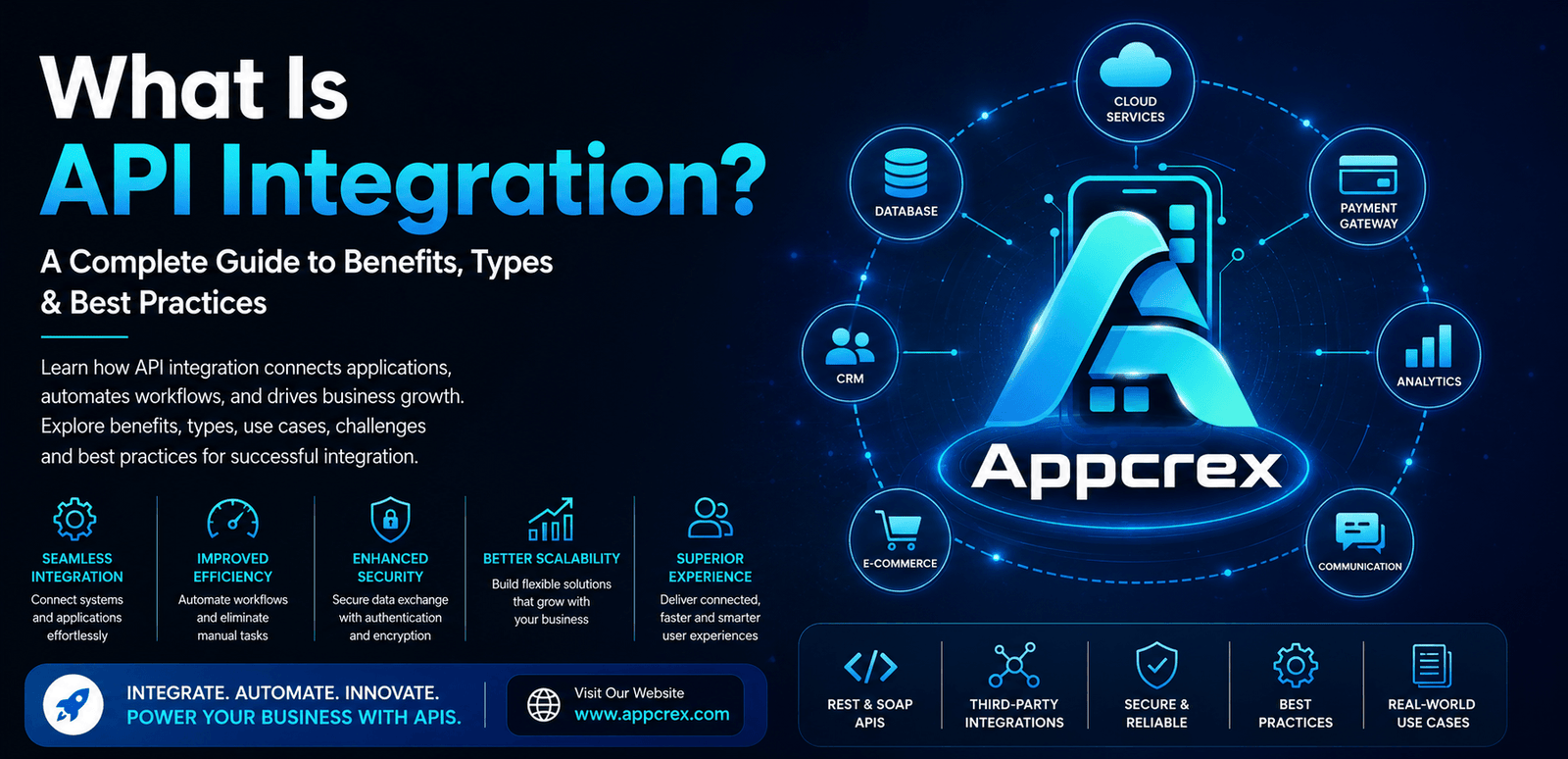
API (Application Programming Interface) integration is the process of connecting two or more software applications so they can communicate, exchange data, and perform tasks automatically. APIs act as intermediaries that allow different systems to interact without requiring direct access to each other’s source code.
For example, when you log into an app using your Google account, process an online payment through Stripe, or view a location using Google Maps, your application is using APIs to retrieve and exchange data in real time.
Instead of manually transferring information between systems, API integration automates communication, improving efficiency and reducing errors. Businesses use APIs to connect internal systems, third-party platforms, cloud services, and mobile applications, enabling a seamless flow of data across their digital ecosystem.
Modern API integrations support real-time communication, secure authentication, and scalable architectures, making them a critical component of digital transformation initiatives.
How Does API Integration Work?
API integration follows a request-and-response model.
- A user performs an action within an application.
- The application sends a request to an external API.
- The API processes the request and retrieves the required data or performs the requested action.
- The API sends a response back to the application.
- The application displays the updated information or completes the requested process.
For example, in an eCommerce app:
- A customer places an order.
- The app sends payment details to a payment gateway API.
- The payment provider verifies the transaction.
- The API returns the payment status.
- The order is confirmed, and the customer receives a notification.
This entire process happens within seconds, providing a smooth and efficient user experience.
Why Is API Integration Important?
Businesses today use multiple software solutions for customer relationship management, accounting, marketing, payments, inventory management, communication, and analytics. Without API integration, these systems operate independently, requiring manual data entry and increasing the risk of errors.
API integration eliminates these challenges by enabling systems to communicate automatically.
Key Advantages
- Eliminates manual data entry
- Improves operational efficiency
- Enhances customer experience
- Reduces development costs
- Accelerates software development
- Enables real-time data synchronization
- Supports business scalability
- Simplifies digital transformation
As organizations continue to adopt cloud technologies and AI-powered solutions, API integration has become essential for building connected, intelligent, and scalable applications.
Benefits of API Integration
1. Improved Business Efficiency
API integration automates repetitive tasks by enabling software applications to exchange data without human intervention. This reduces manual work, minimizes errors, and allows employees to focus on higher-value activities.
2. Faster Application Development
Instead of developing every feature from scratch, developers can integrate existing APIs for payments, maps, messaging, authentication, and analytics. This significantly reduces development time and speeds up product launches.
3. Enhanced User Experience
Seamless integrations allow users to access multiple services from a single application. Features such as social logins, real-time tracking, online payments, and cloud storage create a more convenient and engaging experience.
4. Better Data Accuracy
By synchronizing data across multiple systems in real time, API integration eliminates duplicate entries and ensures consistency throughout your business operations.
5. Increased Scalability
As your business grows, APIs make it easy to integrate new tools, services, and platforms without rebuilding your entire application, enabling your software to scale efficiently.
6. Cost Savings
Using third-party APIs reduces development effort and infrastructure costs, allowing businesses to leverage proven services instead of creating custom solutions for every feature.
7. Stronger Collaboration
APIs enable seamless communication between departments, partners, suppliers, and customers by connecting different business systems and ensuring information flows smoothly across the organization.
Types of API Integration & Real-World Use Cases
API integration enables businesses to connect applications, automate workflows, and exchange data seamlessly. Depending on business requirements, APIs can be integrated in different ways to support communication between internal systems, cloud platforms, third-party services, and enterprise applications.
Understanding the different types of API integration helps businesses choose the right approach for building scalable and secure digital solutions.
Types of API Integration
1. REST API Integration
REST (Representational State Transfer) APIs are the most widely used type of API because they are lightweight, flexible, and easy to implement. REST APIs use standard HTTP methods such as GET, POST, PUT, and DELETE to exchange data in JSON or XML format.
REST APIs are commonly used for:
- Mobile Applications
- Web Applications
- Payment Systems
- CRM Software
- Cloud Services
- Social Media Platforms
Benefits
- Fast performance
- Easy implementation
- Lightweight architecture
- High scalability
- Excellent mobile compatibility
2. SOAP API Integration
SOAP (Simple Object Access Protocol) is a protocol-based API commonly used in enterprise environments where high security and strict standards are required.
SOAP APIs are popular in:
- Banking
- Healthcare
- Insurance
- Government Applications
- Enterprise Software
Benefits
- Strong security
- Reliable messaging
- Built-in error handling
- Enterprise-grade standards
Although SOAP APIs are more complex than REST APIs, they remain important for industries handling sensitive information.
3. Third-Party API Integration
Third-party APIs allow businesses to add advanced functionality without building everything from scratch.
Common integrations include:
- Payment Gateways
- SMS Services
- Email Platforms
- Maps & Location Services
- Social Login
- Video Calling
- Cloud Storage
- Analytics Tools
Third-party integrations reduce development time while improving application functionality.
4. Internal API Integration
Internal APIs connect systems within the same organization, enabling departments and applications to share data securely.
Examples include:
- HR Software
- Inventory Systems
- CRM
- ERP
- Finance Applications
- Employee Portals
Internal APIs improve operational efficiency by eliminating manual data transfers.
5. Cloud API Integration
Cloud APIs connect applications with cloud platforms, enabling secure storage, scalability, and real-time collaboration.
Popular cloud integrations include:
- AWS
- Microsoft Azure
- Google Cloud Platform
- Firebase
- Dropbox
- OneDrive
Cloud API integration enables businesses to build scalable, cloud-native applications that are always available.
Popular API Integrations for Businesses
Payment Gateway API Integration
Secure payment processing is essential for eCommerce platforms, marketplaces, subscription services, and mobile applications.
We integrate payment gateways such as:
- Stripe
- PayPal
- Razorpay
- Square
- Authorize.Net
Benefits include:
- Secure online payments
- Multiple payment methods
- Subscription billing
- Fraud detection
- Faster checkout
CRM API Integration
Customer Relationship Management (CRM) integration helps businesses manage customer interactions more effectively.
Popular CRM integrations include:
- Salesforce
- HubSpot
- Zoho CRM
- Microsoft Dynamics
CRM integration enables automatic synchronization of customer data, leads, and sales activities.
ERP API Integration
Enterprise Resource Planning (ERP) systems streamline business operations by connecting finance, inventory, procurement, and human resources.
Common ERP integrations include:
- SAP
- Oracle ERP
- Microsoft Dynamics 365
- Odoo
Benefits include:
- Real-time reporting
- Automated workflows
- Better resource planning
- Improved operational efficiency
AI API Integration
Artificial Intelligence APIs enable businesses to add intelligent features without building AI models from scratch.
Examples include:
- Chatbots
- Image Recognition
- Speech-to-Text
- Language Translation
- Recommendation Engines
- Predictive Analytics
AI integration enhances user experiences while improving automation and decision-making.
Communication API Integration
Modern applications rely on communication APIs to provide real-time interactions.
Examples include:
- WhatsApp Integration
- SMS APIs
- Email APIs
- Push Notifications
- Voice Calling
- Video Conferencing
These APIs improve customer engagement and communication.
API Integration Use Cases Across Industries
1. Healthcare
Healthcare organizations use API integration to connect:
- Electronic Health Records (EHR)
- Telemedicine Platforms
- Pharmacy Systems
- Laboratory Software
- Insurance Providers
Benefits include improved patient care, secure medical data sharing, and streamlined healthcare workflows.
2. eCommerce
API integration powers modern eCommerce platforms by connecting:
- Payment Gateways
- Shipping Providers
- Inventory Systems
- CRM Platforms
- Marketing Automation Tools
This creates a seamless shopping experience while improving operational efficiency.
3. Finance
Financial institutions integrate APIs for:
- Digital Banking
- Online Payments
- Fraud Detection
- Investment Platforms
- Loan Processing
Secure APIs enable fast and reliable financial transactions.
4. Education
Educational institutions use APIs to connect:
- Learning Management Systems (LMS)
- Student Information Systems
- Video Conferencing Platforms
- Assessment Tools
- Payment Systems
These integrations support online learning and improve administrative efficiency.
5. Logistics
Logistics companies rely on APIs for:
- Shipment Tracking
- Fleet Management
- Warehouse Automation
- Route Optimization
- Delivery Notifications
API integration provides real-time visibility throughout the supply chain.
6. Real Estate
Real estate platforms integrate APIs for:
- Property Listings
- Maps & Location Services
- Mortgage Calculators
- Payment Processing
- Customer Relationship Management
These integrations enhance the buying and renting experience.
Why API Integration Matters for Mobile & Web Applications?
Modern digital products depend on APIs to deliver fast, connected, and feature-rich experiences. Whether you’re building a mobile app or a web platform, API integration enables seamless communication between services, reduces development effort, and accelerates innovation.
At Appcrex, we provide secure and scalable API integration services that help businesses connect applications, automate workflows, and build future-ready digital solutions tailored to their industry needs.
API Integration Process, Challenges, Security & Best Practices
Implementing API integration is more than simply connecting two applications. A successful integration requires careful planning, secure architecture, proper documentation, and ongoing monitoring to ensure reliable communication between systems. At Appcrex, we follow industry best practices to build secure, scalable, and high-performance API integrations that support business growth and digital transformation.
Our API Integration Process
As a trusted API Integration Services Company, we follow a structured development approach that ensures seamless connectivity and long-term reliability.
1. Requirement Analysis
Every successful integration starts with understanding your business objectives, existing systems, and integration requirements.
During this phase, we:
- Analyze business workflows
- Identify systems to integrate
- Define data exchange requirements
- Review API documentation
- Evaluate security requirements
- Select the appropriate integration approach
This planning helps reduce development risks and ensures the API aligns with your business goals.
2. API Architecture & Planning
Our architects design a scalable API integration strategy that supports future growth while maintaining security and performance.
This includes:
- API architecture design
- Data mapping
- Authentication strategy
- Endpoint planning
- Error handling
- Performance optimization
A well-designed architecture ensures smooth communication between applications.
3. API Development & Integration
Once the architecture is finalized, our developers begin integrating APIs into your web or mobile application.
Our development services include:
- REST API Integration
- SOAP API Integration
- Third-Party API Integration
- Custom API Development
- Cloud API Integration
- Database Connectivity
- Middleware Development
Every integration is built using clean, maintainable, and secure coding standards.
4. Testing & Quality Assurance
API integrations undergo extensive testing before deployment to ensure reliability and performance.
Our testing process includes:
- Functional Testing
- API Endpoint Testing
- Load Testing
- Performance Testing
- Security Testing
- Integration Testing
- Regression Testing
- User Acceptance Testing (UAT)
This helps identify potential issues before they affect end users.
5. Deployment & Monitoring
After successful testing, we deploy the integration to your production environment.
Deployment services include:
- Server Configuration
- API Gateway Setup
- SSL Configuration
- Performance Monitoring
- Logging
- Error Tracking
- Health Monitoring
Continuous monitoring helps ensure optimal performance and high availability.
6. Ongoing Maintenance & Support
API ecosystems continuously evolve. We provide long-term maintenance to keep integrations secure and compatible with changing platforms.
Our support services include:
- API Updates
- Version Upgrades
- Bug Fixes
- Performance Optimization
- Security Patches
- Documentation Updates
- New Feature Integration
Common API Integration Challenges
Although API integration provides significant business benefits, organizations often encounter technical challenges during implementation.
1. Compatibility Issues
Different software platforms may use different communication protocols, data formats, or authentication methods, making integration more complex.
2. Data Synchronization
Keeping information consistent across multiple systems requires efficient synchronization and conflict resolution strategies.
3. Security Risks
Poorly secured APIs can expose sensitive business and customer data to unauthorized access or cyberattacks.
4. Rate Limits
Many third-party APIs restrict the number of requests that applications can make within a specific time period.
Proper request management and caching strategies help avoid service interruptions.
5. API Version Changes
Third-party providers regularly update their APIs, which can impact existing integrations if applications are not maintained properly.
6. Performance Bottlenecks
Slow API responses may negatively affect application performance.
Optimizing API requests, caching responses, and implementing asynchronous processing help improve speed.
API Security Best Practices
Security should be a top priority when integrating APIs, especially when handling financial transactions, healthcare records, or customer data.
At Appcrex, we implement multiple layers of protection to ensure secure API communication.
Secure Authentication
We implement modern authentication mechanisms such as:
- OAuth 2.0
- JWT (JSON Web Tokens)
- API Keys
- Multi-Factor Authentication (MFA)
Data Encryption
Sensitive information is encrypted during transmission using HTTPS and SSL/TLS protocols to prevent unauthorized access.
Role-Based Access Control
Only authorized users and applications can access specific API resources based on predefined permissions.
Rate Limiting
We configure rate limiting to protect APIs against abuse, excessive requests, and denial-of-service (DoS) attacks.
Input Validation
All incoming data is validated to prevent common security vulnerabilities such as SQL injection, cross-site scripting (XSS), and malicious payloads.
API Logging & Monitoring
Continuous monitoring helps identify suspicious activities, performance issues, and unauthorized access attempts before they become critical problems.
Best Practices for Successful API Integration
A well-planned integration strategy improves reliability, scalability, and long-term maintainability.
1. Choose the Right API
Select APIs that are well-documented, secure, reliable, and actively maintained by the provider.
2. Use Standard Protocols
REST APIs with JSON remain the preferred choice for most modern web and mobile applications because of their simplicity and scalability.
3. Prioritize Security
Always implement authentication, encryption, access control, and regular security audits.
4. Optimize Performance
Reduce unnecessary API calls by implementing:
- Caching
- Pagination
- Compression
- Asynchronous Processing
These techniques improve response times and reduce server load.
5. Monitor API Performance
Use monitoring tools to track:
- Response Time
- Error Rates
- API Availability
- Request Volume
- Usage Trends
Proactive monitoring ensures reliable application performance.
6. Maintain Proper Documentation
Comprehensive API documentation simplifies future maintenance, onboarding, and feature enhancements.
Development Tools We Use
Our developers use industry-leading technologies and tools to build secure and scalable API integrations.
Backend Technologies
- Node.js
- Python
- Java
- .NET
- PHP (Laravel)
API Development Tools
- Postman
- Swagger (OpenAPI)
- GraphQL
- RESTful APIs
- SOAP APIs
Cloud Platforms
- Amazon Web Services (AWS)
- Microsoft Azure
- Google Cloud Platform (GCP)
DevOps Tools
- Docker
- Kubernetes
- Jenkins
- GitHub Actions
- GitLab CI/CD
Why Choose Appcrex for API Integration Services?
At Appcrex, we help businesses build connected digital ecosystems through secure, scalable, and high-performance API integrations. Whether you need to integrate payment gateways, CRM platforms, ERP systems, cloud services, AI tools, or custom business applications, our experienced team delivers reliable solutions tailored to your requirements.
Our expertise includes:
- Custom API Development
- REST & SOAP API Integration
- Third-Party API Integration
- Payment Gateway Integration
- Cloud API Integration
- AI API Integration
- Mobile & Web API Development
- Enterprise System Integration
- Ongoing Maintenance & Support
We focus on building integrations that improve efficiency, enhance user experiences, and support long-term business growth.
API Integration Cost, Trends, FAQs & Conclusion
How Much Does API Integration Cost?
The cost of API integration depends on the complexity of your project, the number of APIs involved, security requirements, customization, and third-party services. A simple payment gateway integration costs significantly less than integrating multiple enterprise systems such as CRM, ERP, cloud platforms, and AI services.
Factors That Affect API Integration Cost
1. Number of APIs
Integrating multiple APIs requires additional development, testing, monitoring, and maintenance.
2. API Complexity
Custom APIs and enterprise integrations generally require more time than standard REST APIs.
3. Third-Party Services
Some APIs charge based on usage, subscription plans, or request volume, which can influence the overall project cost.
4. Security Requirements
Applications handling financial transactions, healthcare data, or sensitive customer information require advanced authentication, encryption, and compliance measures.
5. Data Mapping & Transformation
Integrating systems that use different data formats often requires custom data transformation and validation logic.
6. Mobile & Web Compatibility
If APIs need to support Android, iOS, and web applications simultaneously, additional testing and optimization are required.
Estimated API Integration Timeline
| Project Type | Estimated Timeline |
|---|---|
| Simple API Integration | 1–2 Weeks |
| Medium Business Integration | 2–6 Weeks |
| Enterprise API Integration | 6–12+ Weeks |
Using Agile development, Appcrex delivers API integrations in iterative phases, ensuring faster deployment while maintaining quality and reliability.
API Integration Trends (2026)
API technology continues to evolve as businesses embrace cloud computing, artificial intelligence, automation, and connected digital ecosystems. Staying ahead of these trends helps organizations build future-ready applications.
AI-Powered APIs
Artificial Intelligence APIs are becoming increasingly popular for integrating chatbots, recommendation engines, predictive analytics, image recognition, and natural language processing into web and mobile applications.
API-First Development
Businesses are increasingly adopting an API-first approach, where APIs are designed before application development begins. This improves scalability, consistency, and collaboration across development teams.
GraphQL Adoption
GraphQL is gaining popularity as an alternative to traditional REST APIs because it allows applications to request only the data they need, improving performance and reducing bandwidth usage.
Serverless API Architecture
Cloud providers now offer serverless computing services that allow APIs to scale automatically without businesses managing servers, reducing infrastructure costs and improving efficiency.
Event-Driven APIs
Modern applications increasingly rely on event-driven architectures that enable real-time updates, instant notifications, and faster communication between systems.
Zero Trust API Security
Organizations are strengthening API security by adopting Zero Trust principles, including continuous authentication, least-privilege access, encrypted communication, and proactive threat detection.
Why Businesses Should Invest in API Integration
API integration is no longer optional—it’s a strategic investment that helps businesses remain competitive in today’s digital landscape. By connecting applications and automating data exchange, organizations can improve efficiency, reduce operational costs, and deliver seamless customer experiences.
Key business benefits include:
- Faster digital transformation
- Improved workflow automation
- Enhanced customer experiences
- Reduced manual processes
- Better data accuracy
- Scalable application architecture
- Faster product development
- Easy integration with cloud services
- Increased operational efficiency
- Support for future business growth
Whether you’re developing a mobile app, SaaS platform, healthcare solution, or enterprise software, API integration provides the flexibility and connectivity needed to support modern business operations.
Why Choose Appcrex for API Integration Services?
At Appcrex, we help businesses build connected, intelligent, and scalable digital ecosystems through secure API integration services. Our experienced developers integrate payment gateways, CRM systems, ERP platforms, AI services, cloud infrastructure, and third-party applications to streamline operations and accelerate innovation.
Our Expertise Includes:
- Custom API Development
- REST API Integration
- SOAP API Integration
- Third-Party API Integration
- Payment Gateway Integration
- CRM & ERP Integration
- Cloud API Integration
- AI & Machine Learning API Integration
- Mobile & Web API Development
- API Testing & Maintenance
We focus on delivering secure, scalable, and high-performance integrations that support your long-term business objectives.
Final Thoughts
API integration is the foundation of modern digital applications, enabling businesses to connect systems, automate processes, and deliver seamless user experiences. Whether you’re integrating payment gateways, cloud services, CRM platforms, AI tools, or enterprise software, a well-planned API strategy can significantly improve operational efficiency and scalability.
At Appcrex, we provide end-to-end API Integration Services that help businesses build secure, reliable, and high-performance applications. From custom API development to third-party integrations and ongoing support, our team delivers solutions designed to accelerate digital transformation and drive long-term business success.
Frequently Asked Questions (FAQs)
1. What is API integration?
API integration is the process of connecting two or more software applications using APIs so they can exchange data and automate workflows securely.
2. Why is API integration important?
API integration improves efficiency, reduces manual work, enhances user experiences, and enables real-time communication between business systems.
3. What is the difference between REST and SOAP APIs?
REST APIs are lightweight, faster, and commonly used for modern web and mobile applications, while SOAP APIs provide enterprise-level security and standardized messaging for complex business environments.
4. Which industries benefit from API integration?
Healthcare, eCommerce, finance, education, logistics, real estate, manufacturing, travel, and SaaS businesses all benefit from API integration.
5. How long does API integration take?
Simple integrations may take 1–2 weeks, while complex enterprise API projects can take several weeks or months, depending on requirements.
6. Is API integration secure?
Yes. When implemented correctly using encryption, OAuth 2.0, JWT authentication, API gateways, and secure coding practices, API integrations are highly secure.
7. Can you integrate third-party APIs into existing applications?
Absolutely. We integrate payment gateways, CRM systems, ERP platforms, cloud services, communication tools, AI APIs, and many other third-party solutions.
8. Do you provide custom API development?
Yes. We develop custom APIs tailored to your business requirements, enabling seamless communication between internal systems and external applications.
9. Do you offer API maintenance and support?
Yes. We provide continuous monitoring, performance optimization, version upgrades, bug fixes, and security updates to ensure your API integrations remain reliable.
10. Why choose Appcrex for API integration services?
Appcrex combines technical expertise, modern development practices, and a security-first approach to deliver scalable, high-performance API integrations that support long-term business growth.