📌 Key Takeaways
- Umrah apps can combine pilgrimage travel, booking, accommodation, transportation, and support services.
- Saudi-specific localization and operational planning are important for a successful platform.
- AI can improve customer support, itinerary assistance, personalization, and business operations.
- Development cost depends mainly on features, integrations, platforms, security, and backend complexity.
- A scalable multi-vendor model can turn an Umrah app into a broader pilgrimage travel platform.
Introduction
Umrah is one of the most important pilgrimage journeys for Muslims around the world, and Saudi Arabia is at the center of the entire Umrah travel ecosystem. As pilgrims increasingly use smartphones to plan trips, book services, manage itineraries, find transportation, access important information, and communicate with service providers, digital platforms are becoming an important part of the Umrah experience.
This creates opportunities for Umrah travel agencies, tour operators, hospitality businesses, transportation companies, pilgrimage service providers, and technology startups to build dedicated Umrah applications.
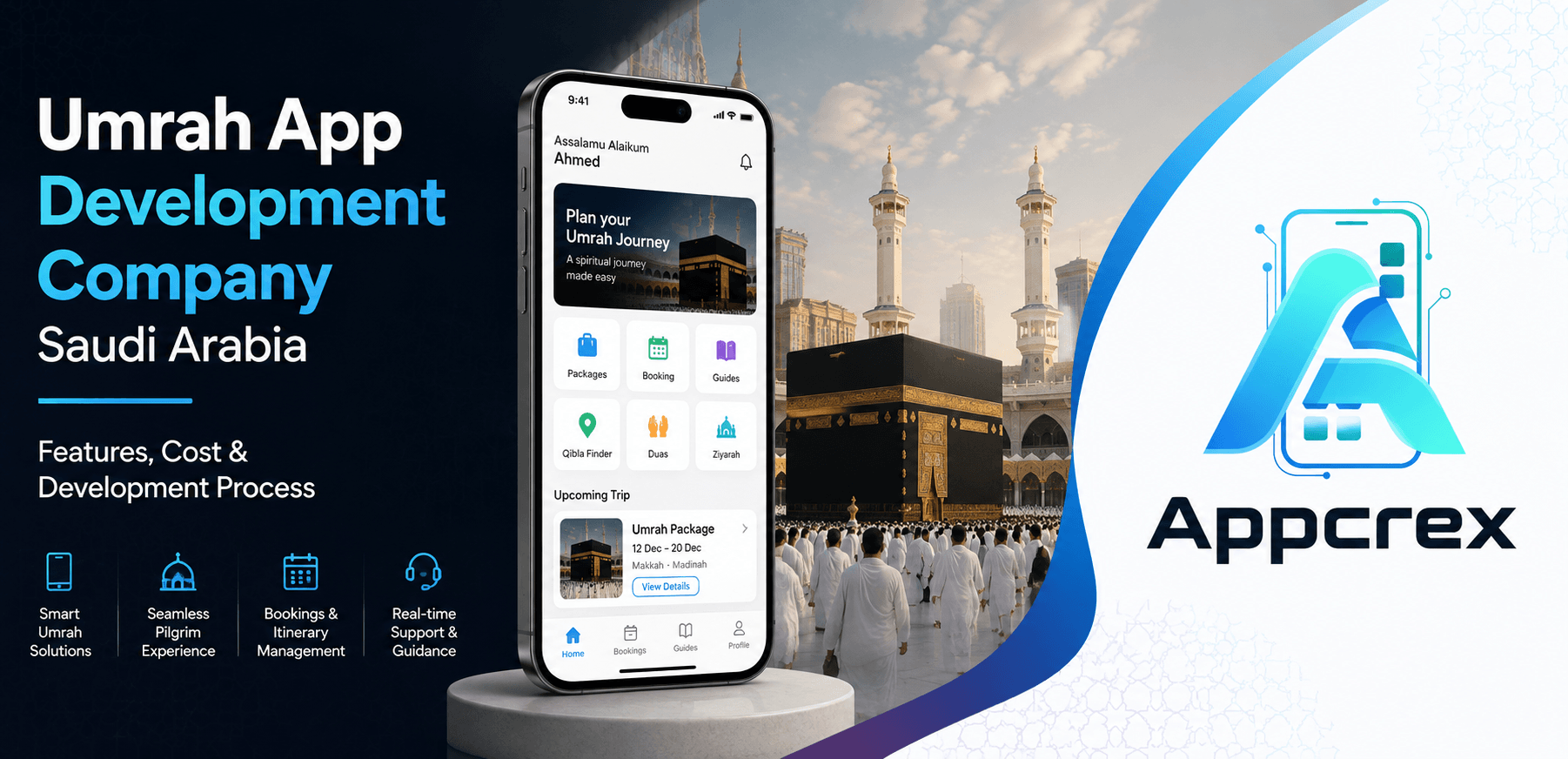
An Umrah app can bring multiple services into one platform, including package discovery, hotel booking, transportation, itinerary management, location services, notifications, multilingual assistance, and customer support.
This guide explains Umrah app development in Saudi Arabia, including features, types of applications, technology, AI capabilities, development process, integrations, estimated cost, timeline, monetization, and important considerations for businesses planning an Umrah platform.
What Is Umrah App Development?
Umrah app development is the process of building a mobile or web-based digital platform that helps pilgrims, travel agencies, operators, and service providers manage different parts of the Umrah journey.
Depending on the business model, an Umrah application can provide:
- Umrah package booking
- Hotel reservations
- Flight information
- Transportation booking
- Pilgrimage itineraries
- Makkah and Madinah location services
- Ziyarat information
- Prayer-related information
- Notifications and reminders
- Multilingual support
- Customer assistance
- Payment processing
- Vendor management
Some platforms are designed primarily for pilgrims, while others are built for Umrah agencies and operators to manage bookings, customers, hotels, transportation providers, guides, and packages.
Why Build an Umrah App in Saudi Arabia?
Saudi Arabia has a unique ecosystem around pilgrimage travel. An Umrah platform can therefore be designed around the specific needs of international and domestic pilgrims.
Centralized Travel Experience
Instead of using separate applications for different services, an Umrah platform can combine travel planning, bookings, transportation, accommodation, and pilgrimage information.
Better Customer Communication
Travel operators can communicate with pilgrims through notifications, in-app messaging, booking updates, and support channels.
Easier Package Management
Agencies can create and manage different Umrah packages based on duration, hotel category, transportation, and other services.
Multilingual Pilgrim Support
Pilgrims come from different countries and may prefer different languages. Multilingual interfaces can make the application easier to use.
Digital Booking Management
Bookings, payments, customer details, itineraries, and service information can be managed digitally instead of relying entirely on manual processes.
Business Automation
An Umrah platform can automate repetitive activities such as booking confirmations, reminders, notifications, customer updates, and vendor coordination.
Just Read : Travel App Development Company: Features, Cost, Types & Development Process
Types of Umrah Apps You Can Build
There is no single Umrah app model. The right product depends on the target customers and revenue model.
1. Umrah Booking App
This type of platform focuses on discovering and booking Umrah packages.
Users can compare packages, view inclusions, select dates, make payments, and receive booking confirmations.
2. Umrah Travel App
A broader travel platform can combine:
- Packages
- Hotels
- Flights
- Transportation
- Itinerary management
- Location services
- Pilgrimage information
3. Umrah Agency Management App
This is designed for travel agencies and operators.
It can help businesses manage:
- Pilgrims
- Bookings
- Packages
- Payments
- Hotels
- Transportation
- Vendors
- Customer communication
4. Pilgrim Companion App
A pilgrim-focused application can provide useful information throughout the journey.
Potential features include:
- Itinerary
- Maps
- Notifications
- Prayer information
- Important locations
- Ziyarat information
- Emergency contacts
- Customer support
5. Hajj and Umrah Platform
Businesses can build a broader pilgrimage platform supporting both Hajj and Umrah.
However, Hajj and Umrah should be treated as separate product journeys because their operational requirements and customer workflows can differ.
Essential Features of an Umrah App
A successful Umrah application should make the journey easier rather than simply adding more features.
User Registration and Profile
Users can register using:
- Phone number
- Social login where appropriate
- OTP verification
The profile can contain basic customer information, booking details, preferences, and travel information.
Umrah Package Search
Users should be able to discover packages based on:
- Travel dates
- Duration
- Hotel category
- Budget
- Number of travelers
- Transportation options
- Package inclusions
Filters can make it easier to compare available packages.
Package Details
Each package should clearly display:
- Price
- Duration
- Hotel information
- Transportation
- Included services
- Exclusions
- Itinerary
- Cancellation terms
- Booking conditions
Clear package information is particularly important for travel-related applications because customers need to understand exactly what they are purchasing.
Just Read : How Much Does It Cost to Develop a Hotel Booking App?
Hotel Booking
The application can allow users to browse accommodation options in Makkah and Madinah.
Possible functionality includes:
- Hotel search
- Room selection
- Availability
- Pricing
- Hotel images
- Amenities
- Distance information
- Booking confirmation
Transportation Booking
Transportation is an important part of the pilgrimage journey.
Depending on the business model, the application can support:
- Airport transfers
- Hotel transfers
- Intercity transportation
- Group transportation
- Private vehicles
- Scheduled buses
Flight Information
An Umrah platform can integrate flight-related services to help users manage their travel itinerary.
The exact functionality depends on the airline, travel partner, or flight API integration.
Digital Itinerary
A centralized itinerary can show:
- Departure information
- Hotel check-in
- Transportation
- Activities
- Ziyarat plans
- Return travel
- Important reminders
This allows the pilgrim to access travel information from one place.
Location services can be particularly useful in an Umrah application.
Potential functionality includes:
- GPS-based navigation
- Hotel location
- Nearby services
- Important pilgrimage locations
- Transportation pickup points
- Saved locations
- Route guidance
The map experience should be designed carefully for crowded environments and users who may have limited connectivity.
Multilingual Support
An Umrah application may serve customers from many countries.
Depending on the target market, language support can include:
- Arabic
- English
- Urdu
- Hindi
- Turkish
- Indonesian
- Malay
- French
- Bengali
The exact language list should be based on the target customer base.
Localization should cover more than translated text. Dates, currencies, phone formats, notifications, support content, and booking information may also need localization.
Also Read : Flight Booking App Development Guide: Features, Cost, APIs & Development Process
Prayer and Pilgrimage Information
A pilgrim companion application can provide information such as:
- Prayer times
- Qibla direction
- Pilgrimage guidance
- Important locations
- Ziyarat information
- General travel reminders
Religious guidance should be handled carefully and sourced appropriately rather than generated without verification.
AI Features for Umrah Apps
AI can make an Umrah platform more personalized and useful when applied to specific customer problems.
AI Travel Assistant
An AI assistant can answer common questions about:
- Bookings
- Itineraries
- Hotel information
- Transportation
- Application features
- General travel information
Personalized Itinerary Assistance
AI can help organize available travel information into a personalized itinerary based on booking details and user preferences.
Multilingual AI Support
AI-powered language capabilities can help customer support teams handle questions in multiple languages.
Smart Recommendations
Based on permitted data and user preferences, the application can recommend relevant services, packages, transportation options, or accommodation.
Also Read : AI App Development Guide: Features, Cost & Process (2026)
AI Customer Support
Frequently asked questions can be handled through an AI-powered support assistant, while complex cases can be transferred to human agents.
Intelligent Operations
For Umrah operators, AI can help analyze:
- Booking patterns
- Customer demand
- Package performance
- Support requests
- Operational trends
AI should support human decision-making rather than replace necessary operational or religious expertise.
Admin Dashboard for an Umrah App
A strong admin panel is essential for managing an Umrah platform.
Administrators may need to manage:
Users
- Pilgrim profiles
- Verification status
- Booking history
- Customer communication
Packages
- Package creation
- Pricing
- Availability
- Inclusions
- Promotions
Hotels
- Hotel listings
- Room availability
- Pricing
- Booking status
Transportation
- Vehicles
- Drivers
- Routes
- Pickup schedules
- Assignments
Payments
- Transactions
- Refunds
- Payment status
- Revenue reports
Customer Support
- Support tickets
- Messages
- Complaints
- Booking issues
Analytics
The dashboard can provide insights into:
- Bookings
- Revenue
- Popular packages
- Customer locations
- Cancellation rates
- Service performance
Vendor Management
If the platform connects multiple service providers, vendor management becomes an important part of the system.
The admin can manage:
- Hotels
- Transportation companies
- Tour operators
- Travel agencies
- Guides
- Other approved service providers
Vendors may receive their own dashboards to manage availability, pricing, bookings, and service requests.
This model can turn an Umrah application into a multi-vendor pilgrimage marketplace rather than a simple booking app.
Payment Integration
The application can support secure payment options based on the target market and available payment providers.
Potential capabilities include:
- Card payments
- Digital wallets
- Bank transfers
- Payment links
- Installment options where legally and commercially supported
- Refund processing
The exact payment integrations should be selected according to the countries being served and the applicable financial requirements.
Security Features
An Umrah application may process personal information, passport-related information, booking information, payment data, and travel details.
Important security measures can include:
- Secure authentication
- OTP verification
- Multi-factor authentication
- Encryption
- Secure APIs
- Role-based access
- Payment security
- Access logging
- Data backup
- Security monitoring
Sensitive information should only be collected when necessary and should be handled according to applicable privacy and data protection requirements.
Technology Stack for Umrah App Development
A typical technology stack can include:
| Development Layer | Possible Technologies |
|---|---|
| Mobile App | Flutter, React Native, Swift, Kotlin |
| Frontend | React, Next.js |
| Backend | Node.js, Python, Java, .NET |
| Database | PostgreSQL, MySQL, MongoDB |
| APIs | REST, GraphQL |
| Cloud | AWS, Microsoft Azure, Google Cloud |
| Maps | Google Maps or other suitable mapping services |
| AI/ML | Python, TensorFlow, PyTorch |
| Notifications | Firebase Cloud Messaging, Apple Push Notification Service |
| Analytics | Firebase, cloud analytics, BI platforms |
The final technology stack depends on the application’s features, integrations, scale, security requirements, and long-term maintenance strategy.
How to Build an Umrah App in Saudi Arabia
Developing an Umrah application requires more than creating mobile screens. The travel, booking, vendor, payment, and operational workflows need to work together.
Step 1: Define Your Business Model
First decide whether you are building:
- An Umrah booking platform
- A travel agency app
- A pilgrim companion app
- A multi-vendor marketplace
- An agency management platform
- A broader Hajj and Umrah platform
Step 2: Identify Your Target Users
Your primary users could be:
- International pilgrims
- Saudi residents
- Travel agencies
- Umrah operators
- Hotels
- Transportation providers
- Travel partners
This decision determines the feature set.
Step 3: Plan the MVP
Start with the most important functions instead of building everything at once.
An MVP could include:
- Registration
- Package search
- Package details
- Booking
- Payment
- Hotel information
- Transportation
- Itinerary
- Notifications
- Admin dashboard
Advanced AI and marketplace functionality can be added later.
Step 4: Design the User Experience
The UX should be simple because users may be accessing the app while traveling.
Important design principles include:
- Simple navigation
- Clear booking steps
- Large touch targets
- Multilingual interface
- Accessible information
- Clear pricing
- Easy support access
Step 5: Build the Backend
The backend manages:
- Users
- Packages
- Bookings
- Payments
- Hotels
- Transportation
- Notifications
- Vendor data
- APIs
Step 6: Integrate Third-Party Services
Depending on the platform, integrations may include:
- Maps
- Payments
- Hotels
- Flights
- Identity verification
- Notifications
- Analytics
- Customer support
Step 7: Test the Application
Testing should include:
- Functional testing
- Payment testing
- API testing
- Security testing
- Device testing
- Performance testing
- Localization testing
- Usability testing
Step 8: Launch and Improve
After launch, analyze user behavior and feedback to identify areas for improvement.
You can then add advanced features such as AI assistance, vendor management, personalized recommendations, and advanced analytics.
How Much Does It Cost to Develop an Umrah App?
The cost depends on the type of Umrah application, number of platforms, booking complexity, integrations, design, backend infrastructure, and advanced features.
A general estimate can be:
| App Type | Estimated Development Cost |
|---|---|
| Basic Umrah App MVP | $25,000–$45,000 |
| Medium Umrah Booking App | $45,000–$80,000 |
| Advanced Umrah Platform | $80,000–$150,000+ |
| Multi-Vendor Umrah Marketplace | $120,000–$200,000+ |
These are planning estimates rather than fixed development quotes.
Major Cost Factors
Features:
A simple pilgrim companion app costs less than a platform supporting bookings, payments, hotels, transportation, vendors, and AI.
Platforms:
Building iOS and Android applications separately can increase development effort.
Backend:
A marketplace or agency-management system requires a significantly more sophisticated backend.
Integrations:
Hotel, flight, payment, map, identity, and other APIs add development and testing requirements.
AI:
AI assistants, recommendations, multilingual AI, and analytics increase technical complexity.
Security:
Applications processing sensitive customer and payment information require stronger security architecture and testing.
Admin Panel:
A complex operational dashboard can significantly affect the overall project cost.
Umrah App Development Timeline
A basic Umrah application can take approximately 3–5 months to develop.
A medium-sized booking platform may require 5–8 months, while a large multi-vendor platform with advanced integrations can take 8–12 months or longer.
A typical project may include:
- Planning: 2–4 weeks
- UI/UX design: 3–6 weeks
- Backend development: 8–14 weeks
- Mobile development: 8–14 weeks
- API integrations: 4–10 weeks
- Testing: 4–8 weeks
- Launch preparation: 2–4 weeks
Some phases can overlap, so the total project timeline depends on the development methodology and team size.
How Can an Umrah App Make Money?
An Umrah application can use several revenue models.
Commission on Bookings
The platform can earn a commission from eligible hotel, transportation, package, or other bookings.
Service Fees
A platform can charge a transparent service fee for selected services.
Vendor Subscription
Travel agencies or service providers can pay for premium access or vendor tools.
Featured Listings
Approved businesses may pay for enhanced visibility, subject to platform rules and transparency.
Premium Packages
The platform can offer premium travel packages or additional services.
B2B SaaS Model
An Umrah management platform can charge travel agencies a recurring subscription for booking, customer, vendor, and operational management tools.
Challenges in Umrah App Development
Handling Large Numbers of Users
Demand can increase significantly during important travel periods, requiring scalable infrastructure.
Multilingual Experience
Serving international pilgrims requires more than translating the home page. Booking flows, support, notifications, dates, currencies, and other content may also need localization.
Real-Time Information
Hotel availability, transportation schedules, booking status, and other information may change quickly.
Connectivity
Users may experience network limitations while traveling, so important information should be accessible efficiently and selected features can support appropriate offline or low-connectivity experiences.
Data Security
The platform may process sensitive identity, travel, and payment information.
Operational Coordination
If the application manages hotels, transportation, packages, and multiple vendors, the backend becomes an important part of the business operation.
Saudi Arabia-Specific Considerations
An Umrah application targeting Saudi Arabia should be designed around the local pilgrimage and travel ecosystem.
Depending on the business model, the platform may need to consider:
- Local payment methods
- Arabic and English support
- Saudi-specific customer workflows
- Travel operator requirements
- Hotel and transportation integrations
- Location services
- Applicable data protection requirements
- Applicable tourism and pilgrimage regulations
- Customer support in relevant languages
Businesses should validate current regulatory and licensing requirements with qualified local advisors before launching a commercial pilgrimage platform. Requirements can change based on the exact services offered and the business’s role in the travel ecosystem.
Future of Umrah App Development
The future of pilgrimage technology is likely to move toward more connected and personalized digital experiences.
Potential developments include:
AI-Powered Pilgrim Assistants
AI can help users navigate bookings, schedules, travel information, and general application support.
Smart Travel Planning
Applications can increasingly combine flights, hotels, transportation, and itineraries into one personalized journey.
Real-Time Operations
Operators can use live information to manage transportation, bookings, customer support, and service availability.
Predictive Analytics
Businesses can analyze demand patterns to improve package planning, staffing, and operational decisions.
Wearable and Location Technology
Future platforms may integrate additional location and wearable technologies where appropriate and permitted.
FAQs
Q. How much does it cost to develop an Umrah app in Saudi Arabia?
A basic MVP can cost approximately $25,000–$45,000, while advanced or multi-vendor platforms can cost $80,000–$200,000+ depending on features, integrations, security, and complexity.
Q. How long does it take to build an Umrah app?
A basic Umrah app may take around 3–5 months. A larger booking or multi-vendor platform can require 5–12 months or longer.
Q. What features should an Umrah booking app have?
Important features can include package search, booking, hotel information, transportation, itinerary management, payments, notifications, multilingual support, maps, customer support, and an admin dashboard.
Q. Can I build an Umrah app for international pilgrims?
Yes. International-focused platforms can support multiple languages, currencies, travel information, accommodation, transportation, package booking, and customer support.
Q. Can AI be integrated into an Umrah application?
Yes. AI can be used for customer support, itinerary assistance, multilingual communication, recommendations, demand analytics, and operational automation.
Q. Can an Umrah app include hotel and transportation booking?
Yes. Hotel and transportation functionality can be integrated directly or connected through suitable third-party services and business partnerships.
Q. Can an Umrah app support multiple vendors?
Yes. A multi-vendor Umrah marketplace can allow approved travel agencies, hotels, transportation providers, and other service providers to manage their offerings through dedicated dashboards.
Q. What is the difference between an Umrah app and a Hajj app?
Both can support pilgrimage-related services, but their workflows and operational requirements can differ. Businesses planning a combined platform should design separate user journeys for each service.
Q. Which technologies can be used to build an Umrah app?
Flutter, React Native, Swift, Kotlin, Node.js, Python, Java, .NET, PostgreSQL, cloud platforms, mapping APIs, payment APIs, and AI technologies can all be considered depending on the project’s requirements.
Conclusion
Umrah app development in Saudi Arabia offers businesses an opportunity to create digital platforms around one of the world’s major pilgrimage travel ecosystems. Instead of building a basic booking application, businesses can develop a complete platform connecting pilgrims with packages, hotels, transportation, itineraries, support, and other travel services.
The right approach is to start with a clearly defined target audience and MVP, then build the technical architecture around secure payments, booking workflows, integrations, multilingual support, and scalable backend infrastructure.
For businesses planning a larger platform, AI, vendor management, personalization, analytics, and automation can be added as the product grows.
Build Your Umrah App with AppCrex
Looking to build an Umrah app in Saudi Arabia? AppCrex provides mobile app development, travel app development, FinTech and payment integration, AI app development, backend engineering, API integration, UI/UX design, and scalable software development services. Our team can help you turn your Umrah platform idea into a secure, scalable, and user-friendly digital solution based on your target market and business model.