📌 Key Takeaways
- Understand what makes WePlay successful and why users love social entertainment apps.
- Explore the essential features required to build a competitive platform.
- Learn the latest AI technologies that enhance user engagement and safety.
- Discover the estimated development costs, timeline, and technology stack.
- Find practical strategies to monetize your app and achieve long-term business growth.
WePlay has become one of the most popular social gaming platforms, bringing together millions of users who enjoy multiplayer games, voice chat, interactive entertainment, and online communities. Rather than being just another gaming app, WePlay combines casual gaming with social networking, making it an engaging platform where users can connect, compete, and build friendships.
If you’re planning to build an app like WePlay, you’re entering one of the fastest-growing segments of the mobile app industry. The demand for social gaming applications has increased significantly as users seek platforms that offer entertainment alongside meaningful social interactions.
In this comprehensive guide, you’ll learn everything you need to know about developing an app like WePlay—from understanding its features and technology stack to development costs, monetization strategies, and future trends.
What is WePlay?
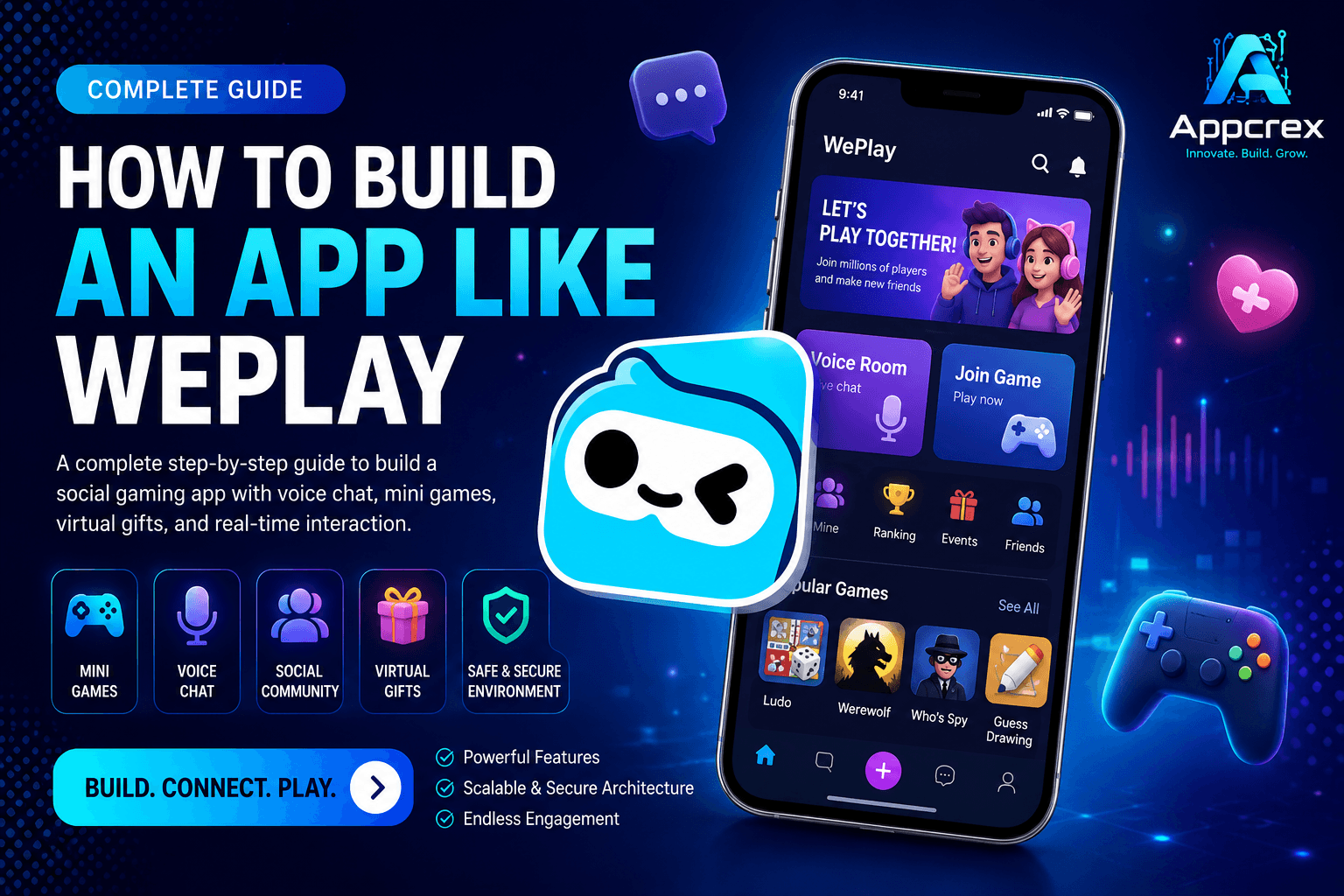
WePlay is a social entertainment platform that combines multiplayer mini-games, voice chat rooms, interactive activities, and virtual gifting into one seamless experience. Unlike traditional gaming apps that focus solely on gameplay, WePlay emphasizes social interaction, allowing users to play games while communicating with friends through real-time voice conversations.
The platform appeals to users looking for casual entertainment rather than competitive esports experiences. Features like avatars, matchmaking, live voice rooms, party games, and virtual rewards encourage long-term user engagement.
Its success lies in transforming gaming into a social experience where users spend hours chatting, playing, and participating in community events.
Why Build an App Like WePlay?
The social gaming industry continues to grow rapidly due to increasing smartphone usage, faster internet connectivity, and changing consumer behavior.
Some compelling reasons to build a WePlay-like app include:
- Rising demand for social gaming platforms
- High user engagement and retention
- Multiple monetization opportunities
- Global audience reach
- Growing popularity of virtual communities
- Expansion of digital gifting economies
- Increasing adoption of voice-based social networking
Users today prefer applications that combine entertainment and communication, making this niche highly profitable for startups and enterprises alike.
Market Overview
The mobile gaming industry has evolved beyond traditional games. Modern users seek interactive experiences where they can play, socialize, and express themselves simultaneously.
Some notable trends include:
- Mobile gaming dominates global gaming revenue.
- Voice chat communities continue expanding.
- Multiplayer mini-games are becoming increasingly popular.
- Virtual gifting generates billions in annual revenue.
- AI-powered recommendations improve user engagement.
- Live social entertainment is replacing passive content consumption.
These trends indicate that platforms similar to WePlay have significant long-term growth potential.
Key Features of an App Like WePlay
Creating a successful social gaming application requires a combination of gaming mechanics and community-building features.
1. User Registration
Allow users to sign up using:
- Phone number
- Apple ID
A smooth onboarding experience improves user retention.
2. User Profiles
Each user should have:
- Profile photo
- Username
- Bio
- Level
- Badges
- Achievements
- Followers
- Friend list
- Gaming history
Customizable profiles encourage identity and engagement.
3. Voice Chat Rooms
Voice chat is one of the biggest attractions of WePlay.
Features include:
- Public rooms
- Private rooms
- Group conversations
- Voice moderation
- Mute options
- Speaker management
- Background music
- Noise cancellation
Real-time communication significantly enhances user experience.
4. Multiplayer Mini Games
Offer lightweight games that users can quickly join.
Examples include:
- Ludo
- Werewolf
- Uno-style card games
- Truth or Dare
- Draw and Guess
- Puzzle games
- Quiz competitions
- Word games
Simple games generally achieve higher participation than complex titles.
5. Smart Matchmaking
Users should easily discover:
- Friends
- Random players
- Nearby users
- Similar interests
- Language preferences
- Skill levels
AI-based recommendations improve matchmaking quality.
6. Friend System
Enable users to:
- Send requests
- Accept invitations
- Block users
- Follow creators
- Create private groups
- Invite friends to games
Strong social networks increase retention.
7. Live Events
Host regular activities such as:
- Seasonal tournaments
- Daily challenges
- Community contests
- Trivia nights
- Virtual parties
- Festival celebrations
Live events keep users returning frequently.
8. Virtual Gifts
Users enjoy sending digital gifts during voice chats and live interactions.
Popular gift types include:
- Flowers
- Hearts
- Cars
- Luxury items
- Animated gifts
- Stickers
- Emojis
Virtual gifting creates significant revenue opportunities.
9. Rewards System
Gamification encourages longer engagement.
Include:
- XP points
- Daily rewards
- Login bonuses
- Missions
- Achievement badges
- Leaderboards
- Premium rewards
10. In-App Messaging
Provide:
- One-to-one chat
- Group messaging
- Image sharing
- GIFs
- Voice messages
- Emoji reactions
Messaging complements voice interactions.
11. Notifications
Push notifications should alert users about:
- Friend requests
- New messages
- Event reminders
- Game invitations
- Rewards
- Promotions
Timely notifications improve engagement.
12. Moderation System
Community safety is essential.
Include:
- User reporting
- Content filtering
- AI moderation
- Human moderators
- Temporary bans
- Permanent suspensions
A safe environment builds user trust.
Advanced Features
To differentiate your app, consider implementing advanced capabilities.
1. AI Recommendations
Artificial Intelligence can recommend:
- Friends
- Games
- Voice rooms
- Events
- Communities
Personalization increases user satisfaction.
2. Avatar Customization
Offer:
- Hairstyles
- Clothing
- Accessories
- Animations
- Expressions
Many users spend money customizing digital identities.
3. Voice Effects
Add:
- Funny filters
- Robot voice
- Echo effects
- Pitch modification
These features make conversations more entertaining.
4. AR Filters
Augmented Reality can enhance profile creation and live interactions.
5. AI Chat Companion
Users increasingly appreciate AI-powered companions that:
- Suggest games
- Moderate chats
- Answer questions
- Recommend communities
6. Live Streaming
Allow creators to:
- Broadcast gameplay
- Host discussions
- Organize events
- Receive gifts
Streaming creates additional engagement.
Technology Stack
Selecting the right technology stack is critical for scalability and performance.
1. Frontend
- Flutter
- React Native
- Swift
- Kotlin
2. Backend
- Node.js
- Django
- Go
- Java Spring Boot
3. Database
- PostgreSQL
- MongoDB
- Redis
4. Cloud Infrastructure
- AWS
- Google Cloud
- Microsoft Azure
5. Real-Time Communication
- WebRTC
- Agora
- LiveKit
- Socket.IO
Authentication
- Firebase Authentication
- Auth0
- OAuth
Payments
- Stripe
- Razorpay
- Apple Pay
- Google Pay
Development Process
Step 1: Market Research
Study:
- User behavior
- Competitors
- Monetization models
- Target audience
Understanding user expectations reduces development risks.
Step 2: Define Features
Prioritize features for your Minimum Viable Product (MVP).
Avoid launching with every possible feature.
Step 3: UI/UX Design
Design intuitive interfaces focusing on:
- Simple navigation
- Attractive visuals
- Fast interactions
- Accessibility
Excellent design significantly impacts user retention.
Step 4: Backend Development
Develop:
- APIs
- Authentication
- User management
- Voice infrastructure
- Messaging services
- Notification systems
Step 5: Mobile App Development
Build Android and iOS applications using a shared or native codebase.
Step 6: Game Integration
Integrate multiplayer games using game engines or custom frameworks.
Optimize games for low latency and smooth performance.
Step 7: Testing
Perform:
- Functional testing
- Security testing
- Performance testing
- Load testing
- Device compatibility testing
- User acceptance testing
Step 8: Deployment
Launch on:
- Google Play Store
- Apple App Store
Monitor analytics and user feedback for continuous improvement.
Monetization Strategies
Building an engaging app is only part of the journey. A sustainable revenue model ensures long-term success.
1. In-App Purchases
Sell:
- Virtual gifts
- Avatar items
- Premium rooms
- Stickers
- Animations
2. Subscription Plans
Offer premium memberships featuring:
- Exclusive games
- VIP badges
- Ad-free experience
- Enhanced customization
- Priority matchmaking
3. Advertisements
Include:
- Rewarded videos
- Banner ads
- Native ads
- Interstitial ads
Avoid excessive advertising that disrupts the user experience.
4. Virtual Currency
Create an in-app economy where users purchase coins to:
- Send gifts
- Unlock features
- Buy avatars
- Join premium events
5. Event Tickets
Charge users for:
- Exclusive tournaments
- Premium competitions
- Celebrity sessions
- VIP voice rooms
Estimated Development Cost
The total cost depends on factors such as feature complexity, development team location, technology choices, and project timeline.
Approximate estimates:
Basic MVP
- $40,000–$70,000
Features:
- Registration
- Profiles
- Voice chat
- Messaging
- Basic games
Medium Complexity
- $70,000–$150,000
Includes:
- Matchmaking
- Virtual gifts
- Notifications
- Payments
- Multiple games
Advanced Platform
- $150,000–$400,000+
Includes:
- AI recommendations
- Live streaming
- AR features
- Large-scale infrastructure
- Advanced moderation
- Analytics dashboards
Challenges in Building a WePlay Clone
Developers commonly face several technical and operational challenges.
1. Real-Time Performance
Voice chat and multiplayer games require minimal latency.
Solutions include:
- Edge servers
- WebRTC optimization
- Global CDN deployment
2. User Safety
Online communities need strong moderation systems.
Use:
- AI moderation
- Human review
- Keyword filtering
- Community guidelines
3. Scalability
Millions of concurrent users demand highly scalable architecture.
Use:
- Kubernetes
- Microservices
- Auto-scaling
- Load balancing
4. Security
Protect user data using:
- End-to-end encryption
- SSL
- Secure authentication
- Regular security audits
5. User Retention
Maintain engagement through:
- Daily challenges
- Seasonal events
- Personalized recommendations
- Loyalty rewards
6. Best Practices
To build a competitive social gaming platform:
- Launch an MVP first.
- Continuously gather user feedback.
- Optimize app performance.
- Focus on community building.
- Regularly introduce new games.
- Keep the UI fresh.
- Improve moderation.
- Invest in analytics.
- Support multiple languages.
- Prioritize privacy and security.
Future Trends
The next generation of social gaming platforms will likely incorporate emerging technologies that enhance user engagement and personalization.
Key trends include:
- AI-powered matchmaking and recommendations
- AI-generated avatars
- Spatial audio for immersive voice chat
- Cross-platform gameplay
- Cloud gaming integration
- Blockchain-based digital collectibles
- Mixed reality experiences
- Intelligent content moderation
- Personalized virtual events
- Advanced creator monetization tools
Adopting these innovations can help your platform remain competitive in a rapidly evolving market.
Final Thoughts
Building an app like WePlay requires much more than developing multiplayer games. Success comes from creating an ecosystem where users can play, communicate, express themselves, and build lasting social connections. A combination of intuitive design, reliable real-time communication, engaging mini-games, personalized recommendations, and strong community moderation forms the foundation of a successful social gaming platform.
Start by launching a feature-rich MVP that focuses on core experiences such as user profiles, voice chat, multiplayer games, and messaging. As your user base grows, expand the platform with advanced capabilities like AI-powered recommendations, virtual gifting, live streaming, premium memberships, and interactive community events. Pair these features with a scalable cloud infrastructure, robust security measures, and continuous performance optimization to ensure a smooth experience even as traffic increases.
The global demand for social entertainment applications continues to rise, presenting a valuable opportunity for startups and established businesses alike. By understanding your audience, prioritizing user engagement, and implementing sustainable monetization strategies, you can build an application that not only rivals WePlay but also establishes its own unique identity in the competitive social gaming market. With careful planning, innovative features, and ongoing improvements, your app can become a thriving digital community that keeps users entertained, connected, and coming back for more.
1. What is a WePlay-like app?
A WePlay-like app is a social gaming platform that combines multiplayer mini-games, real-time voice chat, messaging, virtual gifting, and community features. It allows users to play games while interacting with friends and other players in an engaging social environment.
2. How much does it cost to build an app like WePlay?
The development cost depends on the app’s complexity, features, and development team. A basic MVP typically costs between $40,000 and $70,000, while a fully featured platform with AI, live streaming, and advanced social features can cost $150,000 to $400,000 or more.
3. How long does it take to develop a WePlay-like app?
A basic version can take 4–6 months to develop. A medium-complexity app usually requires 6–9 months, while an enterprise-level platform with advanced features may take 9–15 months or longer.
4. What are the essential features of a social gaming app like WePlay?
Core features include user registration, customizable profiles, multiplayer mini-games, voice chat rooms, messaging, friend management, matchmaking, virtual gifts, push notifications, leaderboards, and secure payment integration.
5. Which technologies are best for developing a WePlay-like app?
Popular technologies include Flutter or React Native for cross-platform development, Node.js or Django for the backend, MongoDB or PostgreSQL for databases, WebRTC or Agora for real-time voice communication, and cloud platforms like AWS or Google Cloud for scalable hosting.
6. How does WePlay generate revenue?
Social gaming platforms typically earn revenue through in-app purchases, virtual gifts, premium subscriptions, advertising, virtual currency sales, event tickets, and brand partnerships.
7. Can I launch an MVP before building the full app?
Yes. Launching a Minimum Viable Product (MVP) is recommended. An MVP usually includes user registration, profiles, voice chat, messaging, and a few multiplayer games, allowing you to validate your idea before investing in advanced features.
8. Is real-time voice chat difficult to implement?
Real-time voice communication requires low-latency infrastructure and technologies such as WebRTC, Agora, or LiveKit. While technically challenging, using reliable communication SDKs can significantly simplify implementation.
9. How can I keep users engaged with my app?
User engagement can be improved by offering daily rewards, seasonal events, achievement badges, leaderboards, personalized recommendations, new mini-games, community challenges, and frequent feature updates.
10. What security measures should a WePlay-like app include?
Your app should implement secure authentication, encrypted data transmission, user reporting tools, AI-powered content moderation, privacy controls, anti-spam systems, and regular security audits to protect users and maintain a safe community.
11. Can AI improve a social gaming app?
Yes. AI can enhance user experiences through personalized game recommendations, intelligent matchmaking, automated moderation, chatbot support, fraud detection, and behavior-based content suggestions.
12. Is it possible to build a WePlay-like app for both Android and iOS?
Absolutely. Cross-platform frameworks such as Flutter and React Native allow developers to build apps for both Android and iOS from a single codebase, reducing development time and costs while maintaining a consistent user experience.