📌 Key Takeaways
- An AI-native security maturity model helps organizations evaluate and improve security across AI adoption, governance, data, models, applications, and operations.
- Businesses should assess both how they secure their AI systems and how they use AI to strengthen cybersecurity operations.
- A maturity assessment can reveal gaps in AI governance, access controls, monitoring, incident response, and risk management.
- Organizations should progress from basic policies to measurable, continuously monitored AI security practices.
- Secure AI implementation requires collaboration between cybersecurity, engineering, data, compliance, and business teams.
Introduction
Artificial intelligence is changing how organizations build software, manage data, automate workflows, and protect digital systems. However, as businesses adopt generative AI, large language models (LLMs), and AI agents, traditional cybersecurity practices may not address every new risk.
An AI-native security maturity model helps organizations evaluate how effectively they secure AI systems, govern AI usage, manage emerging threats, and integrate AI into their cybersecurity operations. It provides a structured way to understand current capabilities, identify security gaps, and plan improvements.
For enterprises investing in AI-powered applications, security maturity is no longer limited to firewalls, endpoint protection, and access controls. Organizations must also consider prompt injection, sensitive data exposure, model vulnerabilities, AI-generated outputs, unauthorized AI tools, and risks from AI agents that can interact with business systems.
This guide explains the AI-native security maturity model, its core components, maturity levels, assessment process, implementation roadmap, business benefits, and the role of AI security consulting services in building a secure AI environment.
What Is an AI-Native Security Maturity Model?
An AI-native security maturity model is a structured framework for assessing how prepared an organization is to secure AI technologies and use AI capabilities responsibly within its security operations.
It evaluates whether an organization has the policies, people, processes, and technical controls needed to manage AI-related risks throughout the AI lifecycle.
Unlike a conventional cybersecurity maturity assessment, which typically focuses on infrastructure, networks, applications, identities, and data, an AI-focused assessment also considers model behavior, prompt security, AI-specific threats, model access, data retrieval, automated decisions, and the risks associated with autonomous AI agents.
For example, a business might have strong cloud security but allow employees to upload confidential documents to unapproved AI tools. Another organization might use AI to detect suspicious activity but lack processes to validate alerts or review automated response actions.
Both organizations have security capabilities, but each has maturity gaps that require a different improvement plan.
An AI-native approach helps organizations identify these gaps and establish security practices that evolve with their AI adoption.
Why Is AI-Native Security Different from Traditional Cybersecurity?
Traditional cybersecurity remains essential, but AI introduces additional attack surfaces and operational considerations.
| Security area | Traditional cybersecurity focus | Additional AI security considerations |
|---|---|---|
| Identity and access | User accounts and permissions | AI agents, model identities, tool permissions, and delegated access |
| Data protection | Databases, files, and network traffic | Prompt data, model inputs, retrieval indexes, training data, and generated outputs |
| Application security | Code vulnerabilities and API protection | Prompt injection, unsafe outputs, model-specific vulnerabilities, and tool misuse |
| Threat detection | Logs, alerts, and known attack patterns | AI-assisted analysis, model abuse, unusual AI activity, and emerging attack patterns |
| Governance | Security policies and regulatory controls | Approved AI use, model inventories, AI risk classifications, and human oversight |
| Incident response | Investigation and system recovery | AI-specific incidents, model rollback, compromised agents, and prompt or data exposure |
The goal is not to replace existing cybersecurity controls. It is to extend them so they address the new risks created by AI adoption.
Why Do Businesses Need an AI Security Maturity Assessment?
Many organizations adopt AI tools before establishing consistent governance and security practices. Teams may experiment with public models, integrate AI APIs into applications, or deploy internal copilots without fully understanding how information flows through those systems.
An AI security maturity assessment provides a baseline for understanding these risks.
1. Identify AI Security Gaps
Organizations need visibility into where AI is being used, which systems it accesses, what information it processes, and who is responsible for its operation.
A maturity assessment can reveal gaps such as:
-
AI applications without designated owners
-
Unapproved AI tools used for business tasks
-
Excessive access to sensitive company information
-
Missing AI-specific threat models
-
Inadequate logging and monitoring
-
No documented process for responding to AI-related incidents
Identifying these gaps helps security teams prioritize improvements based on business impact and risk.
2. Establish AI Governance
AI governance defines how an organization approves, develops, deploys, monitors, and retires AI systems.
A mature governance program should clarify who can approve AI projects, what information AI systems can access, which risks require additional review, and when human approval is necessary.
It should also define acceptable AI usage and establish accountability across business and technical teams.
3. Protect Enterprise Data
AI systems can process confidential documents, customer records, financial information, source code, and internal business data.
Without appropriate safeguards, sensitive information may be exposed through prompts, poorly configured integrations, excessive retrieval permissions, or insecure application logs.
An AI security maturity framework evaluates whether organizations apply data classification, least-privilege access, encryption, retention policies, and monitoring to their AI environments.
4. Improve AI Threat Detection and Response
AI can support cybersecurity teams by summarizing alerts, identifying suspicious patterns, prioritizing investigations, and helping analysts understand complex incidents.
However, organizations must validate AI-generated findings and maintain clear approval boundaries for automated actions.
A mature security program combines AI-assisted capabilities with reliable telemetry, established incident response procedures, and appropriate human oversight.
5. Support Responsible and Scalable AI Adoption
Security should enable innovation rather than become an obstacle to every AI initiative.
A defined maturity roadmap helps businesses introduce controls proportionate to each system’s purpose, data sensitivity, autonomy, and potential impact.
This allows organizations to scale low-risk AI applications while applying stronger safeguards to systems that handle sensitive information or make consequential decisions.
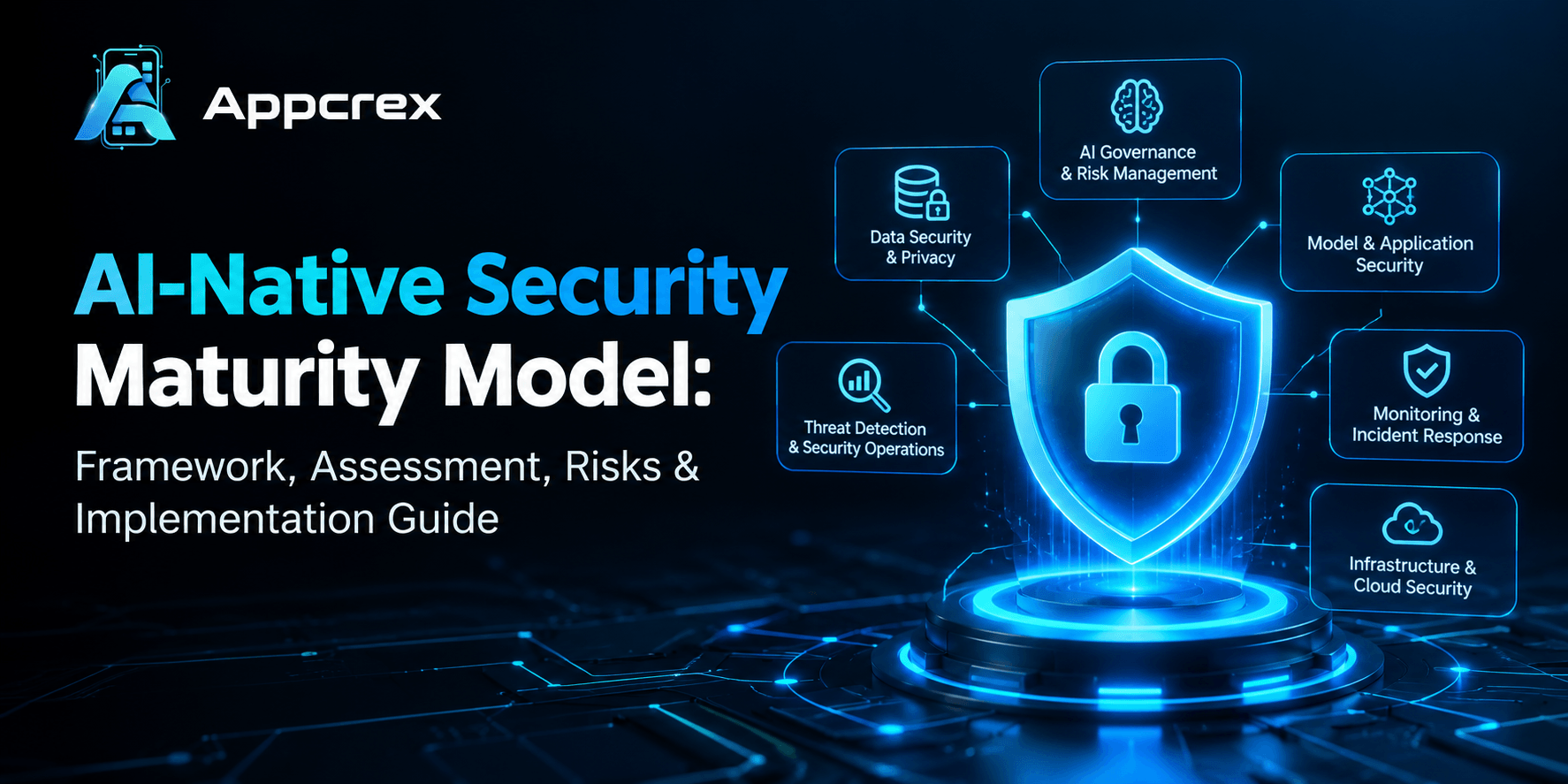
Core Components of an AI-Native Security Maturity Model
A practical assessment should cover several connected domains instead of measuring security through a single score.
The following framework is a proposed assessment structure for businesses. It is not a claim that every organization follows one universally standardized AI-native maturity model. Established resources such as the Cloud Security Alliance’s AI Security Maturity Model and the NIST AI Risk Management Framework can help organizations develop their own assessment approach.
1. AI Governance and Risk Management
AI governance establishes the policies, responsibilities, and decision-making processes required to manage AI securely.
Key assessment areas include:
-
AI usage policies and approval procedures
-
AI system inventories and ownership
-
Risk classification based on intended use
-
Responsible AI principles and oversight
-
Vendor and third-party AI risk management
-
Regulatory and contractual requirements
-
Periodic reviews of AI systems and risks
Organizations should document who is responsible for each AI system and define the conditions under which its deployment, use, or access must be restricted.
Just Read : Cybersecurity Risk Management Solution Company: Services, Benefits, Cost & Process
2. Data Security and Privacy
AI systems depend on data, making information protection a core part of AI security.
A maturity assessment should examine how data is collected, classified, stored, accessed, processed, and retained.
Important controls include:
-
Data classification and minimization
-
Encryption in transit and at rest
-
Role-based and attribute-based access controls
-
Sensitive information detection and redaction
-
Secure data pipelines
-
Retention and deletion policies
-
Permission-aware retrieval for RAG systems
-
Monitoring for unauthorized data access
For applications using Retrieval-Augmented Generation (RAG), retrieval permissions must reflect the user’s actual access rights. A document should not become available to an unauthorized user simply because it has been added to an AI search index.
3. AI Model and Application Security
AI models and the applications built around them introduce security concerns that differ from those of conventional software.
Organizations should evaluate:
-
Approved model selection and version control
-
Model provenance and integrity
-
Prompt and instruction handling
-
Input and output validation
-
Prompt injection defenses
-
Model abuse and rate limiting
-
API authentication and authorization
-
Secure integration with external tools
-
AI application security testing
Security teams should also examine how the application behaves when a model produces incorrect, malicious, irrelevant, or unexpected output.
4. AI Threat Detection and Security Operations
AI can strengthen security operations when it is integrated with reliable data sources and established response procedures.
Potential capabilities include:
-
Security alert summarization
-
Threat intelligence analysis
-
Anomaly detection
-
Phishing investigation assistance
-
Incident classification and prioritization
-
Security log analysis
-
Investigation workflow automation
-
Analyst decision support
Organizations should measure whether these capabilities improve detection quality, investigation speed, and analyst productivity. They should also track false positives, missed threats, and the risks of acting on incorrect AI-generated recommendations.
5. AI Infrastructure and Cloud Security
AI applications may rely on cloud infrastructure, model hosting platforms, APIs, vector databases, data pipelines, and specialized computing resources.
Security controls should cover:
-
Cloud identity and access management
-
Network segmentation
-
Secure configuration and secrets management
-
Infrastructure vulnerability management
-
API and service authentication
-
Model endpoint protection
-
Workload isolation
-
Backup and recovery
-
Availability and resilience planning
Organizations using third-party AI services should also understand how their data is processed, retained, and protected under the relevant service terms.
6. AI Monitoring, Auditing, and Incident Response
Security maturity must extend beyond initial deployment.
AI systems can change as models, prompts, connected data sources, and user behavior evolve. Continuous monitoring helps organizations identify performance degradation, misuse, unexpected behavior, and security incidents.
Key capabilities include:
-
Audit logs for AI interactions and actions
-
Monitoring of model and application behavior
-
Alerts for suspicious access or usage
-
AI-specific incident response procedures
-
Model and prompt version tracking
-
Rollback and recovery mechanisms
-
Human review and escalation processes
-
Periodic security reassessments
The level of monitoring should match the system’s risk. A low-risk internal summarization tool may need fewer controls than an AI agent capable of modifying customer records or executing financial workflows.
Five Levels of AI Security Maturity
Organizations can use a five-level model to understand their current security posture and define a practical improvement roadmap.
The following levels are a proposed model for this guide, not a reproduction of a single third-party framework. Actual maturity levels and scoring methods vary by framework.
Initial: Ad Hoc AI Security
AI adoption is informal. Teams may use public AI tools or experiment with AI applications without consistent policies, ownership, or security reviews.
Priority: Create an AI inventory, define basic usage rules, and identify high-risk systems.
Developing: Basic Controls
The organization introduces AI policies, approved tools, access controls, and initial risk reviews. However, implementation may vary between departments.
Priority: Standardize policies, data handling, and approval processes.
Defined: Risk-Based Security
AI governance, security testing, ownership, and monitoring are documented. Controls are applied according to the system’s data access, purpose, and potential impact.
Priority: Integrate AI security into software development and enterprise risk management.
Managed: Integrated AI Security
AI security is integrated into development, deployment, cloud operations, and incident response. Monitoring and measurable controls are established across production systems.
Priority: Automate repeatable controls and improve cross-team visibility.
Optimized: Adaptive AI Security
Security practices are continuously evaluated and improved using operational evidence, threat intelligence, testing, and risk signals. Automation operates within defined permissions and oversight.
Priority: Maintain resilience, adapt to new threats, and continuously validate controls.
How Should Organizations Interpret These Levels?
Not every organization needs to reach the highest maturity level immediately.
A company using AI for low-risk internal productivity tasks may require a different level of investment from a financial institution deploying customer-facing AI or an agent with access to sensitive systems.
Maturity targets should depend on:
-
Business objectives and AI adoption plans
-
Sensitivity of the data being processed
-
System autonomy and available permissions
-
Potential impact of incorrect or malicious outputs
-
Applicable regulatory and contractual obligations
-
Available security resources and technical capabilities
The objective is to reach a maturity level appropriate to the organization’s risk profile, then improve capabilities as AI usage expands.
How to Conduct an AI Security Maturity Assessment?
An AI security maturity assessment provides a structured view of current capabilities, weaknesses, and improvement opportunities.
Step 1: Build an AI System Inventory
Identify the AI technologies used across the organization.
Include internally developed applications, third-party AI services, embedded AI features, employee productivity tools, LLM APIs, RAG systems, and AI agents.
For each system, document its owner, purpose, deployment model, connected data, users, integrations, and business criticality.
Step 2: Classify Systems by Risk
Not all AI systems present the same level of risk.
Classify them according to the sensitivity of the data they process, their autonomy, their access to external systems, and the potential consequences of failure.
For example, an AI tool that summarizes public documents generally has a different risk profile from an agent that can access confidential customer records or initiate operational changes.
Step 3: Assess Existing Controls
Evaluate current policies, security procedures, architecture, and operational capabilities across the maturity domains.
Review areas such as data protection, identity management, model selection, application security, logging, monitoring, incident response, and vendor risk.
Use documented evidence wherever possible. A written policy alone does not demonstrate maturity if the organization cannot show that the control is implemented and working.
Step 4: Identify and Prioritize Gaps
Compare current capabilities with the controls required for each system’s risk level.
A gap assessment may reveal missing ownership, excessive permissions, weak monitoring, inadequate AI testing, or unclear incident response responsibilities.
Prioritize remediation based on likelihood, potential impact, exposure, and the effort required to address the problem.
Step 5: Create an Improvement Roadmap
Turn the assessment results into a sequence of practical actions.
A roadmap should identify the required control, accountable owner, expected completion date, dependencies, and measurable success criteria.
Begin with high-impact foundational controls before investing heavily in advanced AI security automation.
Step 6: Measure Progress and Reassess
AI security maturity is not a one-time score.
Reassess systems when significant changes occur, such as adding new AI capabilities, connecting new data sources, changing models, granting additional agent permissions, or entering a new regulatory environment.
Regular reviews help organizations maintain security as their AI environment evolves.
AI Security Maturity Assessment Checklist
Use this checklist as an initial internal review. It is a practical starting point, not a formal certification or comprehensive security audit.
Initial readiness review
Governance
Data protection
Model and application security
Monitoring and response
Common AI Security Risks That Reduce Maturity
Understanding AI-related threats is essential for creating an effective maturity roadmap.
Prompt Injection
Prompt injection occurs when malicious or untrusted content attempts to influence an AI system’s instructions or behavior.
For example, a document retrieved by an AI assistant may contain instructions intended to override its normal behavior. If the application does not adequately separate trusted instructions from untrusted content, the assistant may respond in unintended ways or attempt unauthorized actions.
Mitigation should include constrained permissions, trusted system instructions, input and output controls, careful tool design, and testing against realistic attack scenarios.
Sensitive Data Exposure
AI systems may process confidential data through prompts, retrieved documents, application logs, or external service integrations.
Organizations should minimize the data shared with models, enforce authorization at retrieval and application layers, and understand the retention and processing practices of their providers.
Shadow AI
Shadow AI refers to AI usage that falls outside an organization’s approved policies or security oversight.
Employees may adopt tools to work faster without realizing that the tools process sensitive business information.
Businesses can reduce this risk by establishing clear policies, providing approved alternatives, educating employees, and improving visibility into AI usage.
Model and Data Integrity Risks
Untrusted models, compromised dependencies, manipulated data, or poisoned knowledge sources can affect AI system behavior.
Organizations should maintain provenance records, validate data sources, manage model versions, and test the system before and after significant changes.
AI Agent Permission Abuse
AI agents can interact with tools, APIs, files, and business applications. Excessive permissions can turn a limited error into a wider operational or security problem.
Apply least-privilege access, restrict available tools, require human approval for sensitive actions, and log important agent activities.
Inadequate Monitoring
A system may pass initial testing but behave differently when users, data, models, and connected services change.
Continuous monitoring should cover security events, application errors, suspicious access, output quality, and changes to the system’s risk profile.
How AI Can Improve Cybersecurity Operations?
An AI-native security strategy is not only about protecting AI applications. It can also involve using AI to improve how an organization detects, investigates, and responds to threats.
AI-Powered Threat Detection
AI models can help identify unusual patterns across logs, endpoint activity, network telemetry, and other security data.
These capabilities can support analysts, but they should be evaluated against known baselines and realistic attack scenarios.
Automated Security Investigation
AI assistants can summarize incident timelines, correlate relevant alerts, retrieve internal response procedures, and suggest investigative steps.
For high-impact actions, human approval and established incident response procedures should remain in place.
Security Knowledge Assistants
RAG-based assistants can retrieve approved security documentation, playbooks, architecture guidance, and incident response procedures.
This can help security analysts locate relevant information faster without manually searching large collections of documents.
Vulnerability Management Support
AI can help summarize vulnerability reports, explain technical findings, group related issues, and assist with remediation planning.
However, AI-generated severity assessments should be checked against reliable technical evidence and the organization’s actual exposure.
Phishing and Threat Intelligence Analysis
AI can assist with analyzing suspicious messages, summarizing threat intelligence, and identifying patterns that warrant investigation.
Security teams should avoid relying on a single AI-generated judgment to determine whether a threat is genuine.
AI Security Maturity Model vs. Traditional Security Maturity Model
Both approaches support risk management, but an AI-focused assessment requires additional capabilities.
| Comparison area | Traditional security maturity | AI security maturity |
|---|---|---|
| Main objective | Protect enterprise IT systems and information | Protect AI systems and address risks from enterprise AI usage |
| Core assets | Networks, applications, endpoints, identities, and databases | Traditional assets plus models, prompts, embeddings, AI agents, and AI data flows |
| Governance | IT security policies and enterprise risk controls | AI usage rules, model approval, AI risk classification, and human oversight |
| Testing | Vulnerability scanning, penetration testing, and code security | Conventional testing plus AI-specific adversarial and behavior testing |
| Monitoring | System logs, network events, and security alerts | Traditional telemetry plus AI interactions, model behavior, and agent actions |
| Response | Contain incidents and restore services | Traditional response plus AI-specific containment, access revocation, and model or prompt rollback where appropriate |
An effective AI security maturity model should complement the organization’s existing cybersecurity framework instead of creating a disconnected security program.
Frameworks and Standards That Can Support AI Security Maturity
Businesses do not need to design every control from scratch. Existing frameworks can provide guidance for governance, risk assessment, and technical security.
NIST AI Risk Management Framework
The NIST AI Risk Management Framework helps organizations structure AI risk management across the system lifecycle.
It can support risk identification, governance, measurement, and management activities. Organizations can use its principles to inform their AI risk processes while tailoring controls to their use cases.
ISO/IEC 42001
ISO/IEC 42001 provides requirements and guidance for establishing an AI management system.
It can help organizations structure responsibilities, policies, risk processes, and continual improvement related to AI management. Certification, where pursued, is distinct from simply adopting selected practices.
OWASP Guidance for AI and LLM Security
The OWASP community publishes guidance on application security, including risks associated with large language models and AI applications.
Such guidance can help development and security teams identify relevant attack scenarios and incorporate AI-specific testing into secure development processes.
Cloud Security Alliance AI Security Maturity Model
The Cloud Security Alliance AI Security Maturity Model provides a structured way to evaluate enterprise AI security capabilities and plan improvements.
Organizations should choose frameworks based on their risk profile, existing controls, business objectives, and compliance needs. No single framework automatically guarantees that an AI system is secure.
How to Implement an AI-Native Security Maturity Model?
A structured implementation plan helps turn assessment findings into practical improvements.
Phase 1: Discovery and Assessment
Start by identifying AI applications, business use cases, data sources, third-party services, and AI-related workflows.
Assess current controls, document ownership, identify high-risk systems, and establish a baseline maturity score using a defined methodology.
Deliverable: AI inventory, initial risk register, and prioritized gap assessment.
Phase 2: Governance and Security Foundations
Establish AI usage policies, approval procedures, data protection rules, and risk classification criteria.
Define responsibilities across cybersecurity, engineering, legal, compliance, and business teams. Select the controls required for each risk category.
Deliverable: AI governance policy, ownership model, and minimum security requirements.
Phase 3: Technical Control Implementation
Integrate security requirements into AI architecture and development workflows.
Depending on the system, this may include identity controls, data filtering, model access restrictions, secure APIs, prompt-injection testing, output validation, and audit logging.
Deliverable: Security controls implemented and tested against defined requirements.
Phase 4: Monitoring and Operational Integration
Connect AI applications to appropriate logging, monitoring, incident response, and change management processes.
Create procedures for suspicious activity, data exposure, model changes, unsafe agent actions, and other AI-related incidents.
Deliverable: Monitoring dashboards, response procedures, and operational ownership.
Phase 5: Continuous Improvement
Track maturity indicators, conduct periodic reviews, evaluate emerging threats, and update controls as AI systems change.
Use the assessment results to refine investment priorities and improve the effectiveness of security practices.
Deliverable: An ongoing improvement roadmap supported by measurable results.
How Much Does AI Security Maturity Assessment and Implementation Cost?
AI security maturity assessment and implementation costs depend on the size of the organization, the number of AI systems, the complexity of integrations, the sensitivity of data, and the level of assurance required.
A lightweight review of a few AI tools is significantly different from a comprehensive enterprise assessment covering cloud infrastructure, custom AI applications, third-party models, RAG systems, and autonomous agents.
Rather than relying on a single universal price, organizations should request a scoped estimate based on deliverables.
| Project scope | Typical activities | Main cost drivers |
|---|---|---|
| Initial assessment | AI inventory, interviews, gap analysis, and risk prioritization | Number of systems and stakeholders |
| Governance setup | Policies, ownership, risk classification, and approval workflows | Organizational complexity and compliance needs |
| Technical security review | Architecture review, access testing, and AI-specific security testing | Application complexity and integrations |
| Security implementation | Access controls, logging, guardrails, monitoring, and remediation | Engineering effort and infrastructure |
| Continuous security program | Monitoring, reassessments, incident response, and improvement | Ongoing service levels and system scale |
To estimate a project accurately, define the number of systems to assess, required standards, deliverables, testing depth, remediation scope, and ongoing support requirements.
For businesses planning broader AI initiatives, AppCrex can also help scope related AI app development services where that service URL is available and appropriate.
How to Measure AI Security Maturity Progress?
A maturity model becomes more useful when the organization measures results rather than relying only on policy documentation.
The following indicators can help track progress:
| KPI | What it measures |
|---|---|
| AI inventory coverage | Proportion of identified AI systems recorded in the approved inventory |
| Ownership coverage | Proportion of AI systems with accountable owners |
| Risk assessment coverage | Proportion of in-scope systems assessed according to the required process |
| Control implementation | Proportion of required security controls implemented and verified |
| Remediation time | Time required to address prioritized AI security gaps |
| Monitoring coverage | Proportion of production AI systems with required logging and monitoring |
| Incident response readiness | Whether AI-specific scenarios are documented and tested |
| AI security testing | Frequency and coverage of relevant security evaluations |
Targets should reflect business risk and available resources. Organizations should avoid treating a single numerical score as proof of security, because a high average can hide a critical weakness in a sensitive system.
Common Challenges in Improving AI Security Maturity
Fragmented AI Adoption
Different departments may use different models, vendors, and workflows. Without a central inventory and clear ownership, security teams may struggle to understand the organization’s actual exposure.
How to address it: Establish organization-wide visibility while allowing departments to follow approved, risk-based adoption processes.
Limited AI Security Expertise
AI security involves conventional cybersecurity, data engineering, application development, model behavior, and governance.
How to address it: Train existing teams, define cross-functional responsibilities, and involve specialists where internal expertise is limited.
Balancing Security with Innovation
Excessively restrictive policies can encourage employees to use unapproved tools, while insufficient controls can expose sensitive data.
How to address it: Provide approved AI tools, clear usage guidance, and security controls proportional to risk.
Difficulty Evaluating AI Behavior
AI outputs can vary depending on prompts, context, data, and model changes. Traditional software tests alone may not adequately measure all relevant failure modes.
How to address it: Create representative test cases, define expected behaviors, conduct adversarial testing, and monitor performance after deployment.
Evolving Threats and Technologies
New AI capabilities, integrations, and attack methods can change an application’s risk profile.
How to address it: Make reassessment part of the AI lifecycle and update controls when systems or threats change materially.
Also Read : AI App Development Company in Australia: Services, Use Cases & Cost
How to Choose an AI Security Consulting or Development Partner?
Organizations may need external support to assess AI security maturity, implement controls, or develop secure AI-powered applications.
Before choosing a partner, evaluate the following areas.
AI Security and Architecture Expertise
Look for a partner that understands AI application architecture, model integrations, data pipelines, access control, cloud infrastructure, and AI-specific security risks.
Risk-Based Implementation Approach
The partner should assess the business context and recommend controls based on actual exposure rather than applying the same checklist to every AI application.
Integration with Existing Systems
Security controls must work with the organization’s existing identity provider, cloud environment, monitoring tools, data platforms, and application architecture.
Testing and Documentation
Ask how the partner will test security controls, document findings, prioritize remediation, and verify that fixes work as intended.
Clear Ownership and Deliverables
Agree on project scope, responsibilities, timelines, access requirements, deliverables, and ongoing support before implementation begins.
A suitable partner should help the organization build internal capability and maintain security after the initial engagement, rather than leaving it with a report and no clear implementation path.
The Future of AI-Native Security
AI security is likely to become increasingly integrated with software development, cloud operations, governance, and security operations.
As AI agents gain access to more business tools and workflows, organizations will need stronger identity controls, clearer permission boundaries, more effective monitoring, and reliable human oversight.
Several developments are likely to shape AI security maturity:
-
AI-assisted security operations: More security workflows will use AI for investigation support, prioritization, and information retrieval.
-
Agent identity and authorization: Organizations will need to manage the identities, permissions, and actions of AI agents.
-
Continuous AI security evaluation: Testing will increasingly cover behavior, data access, model changes, and application integrations.
-
Automated governance evidence: Tools may help collect records of approvals, controls, testing, and monitoring for internal reviews.
-
Security by design: AI risk assessment and testing will increasingly become part of product planning and software development.
These developments do not remove the need for human accountability. The most effective security programs will combine automation with defined decision rights, measurable controls, and appropriate oversight.
Conclusion
An AI-native security maturity model helps organizations understand how prepared they are to adopt AI while managing the risks associated with models, data, applications, agents, and automated security workflows.
The most effective approach begins with visibility, clear governance, and a risk-based assessment. Organizations can then strengthen data protection, application security, monitoring, and incident response before advancing toward more integrated and adaptive security capabilities.
AI security maturity is not about reaching the highest level as quickly as possible. It is about implementing the controls that match the organization’s risks, validating that those controls work, and improving them as AI adoption evolves.
For businesses developing custom AI solutions, security should be part of the architecture from the beginning—not a final step after deployment.
AppCrex helps businesses plan and develop AI-powered applications around their product requirements, integrations, and operational needs. If your organization is planning an AI initiative, define its security requirements early so the resulting solution can be designed for responsible and scalable adoption.