📌 Key Takeaways
- Hire Flutter app developers based on practical experience, technical skills, and your application’s requirements.
- Choose between an individual developer, a dedicated team, and a Flutter app development company according to your project scope.
- Consider the USA, UK, Australia, UAE, Canada, and India as potential markets, then validate demand and lead quality with real data.
- Evaluate Flutter against native development before finalizing your technology stack.
- Include design, backend integration, testing, deployment, security, and maintenance in your development plan.
Introduction
Businesses are increasingly choosing cross-platform technologies to build mobile applications for iOS and Android without maintaining entirely separate codebases for every feature. Flutter has become one option for companies that want a consistent user experience, efficient development, and flexibility as their digital products grow.
However, choosing the right developers is just as important as choosing the technology. Businesses need a team that understands mobile architecture, UI/UX design, backend integration, security, testing, and long-term maintenance.
AppCrex helps businesses explore custom mobile app development solutions based on their product requirements, business goals, and target audience. Whether you are launching a startup MVP, building an enterprise application, or upgrading an existing product, selecting the right Flutter development approach can help you plan your investment and move toward launch with greater clarity.
If you want to hire Flutter app developers, this guide explains developer skills, hiring models, costs, development timelines, technology choices, and the global markets you can consider when building your team.
Why Hire Flutter App Developers for Your Business?
Flutter is an open-source UI development framework that enables developers to build applications for multiple platforms using a shared codebase. It uses the Dart programming language and provides tools for creating customized interfaces and reusable components.
For many businesses, this approach can simplify development when compared with maintaining completely separate application codebases. However, the actual benefits depend on the product’s complexity, platform requirements, and implementation.
Here are some reasons to consider hiring Flutter developers.
1. Build Apps for iOS and Android
A Flutter development team can build applications for both major mobile platforms using shared application code where appropriate.
This can be useful for startups that want to reach users on iPhones and Android devices without duplicating every part of the development effort.
The team must still test platform-specific behavior, handle differences in permissions, and integrate native functionality when necessary.
2. Create Consistent User Experiences
Flutter provides a flexible UI framework for creating customized layouts, interactive components, and consistent design systems.
Experienced developers can translate your product designs into reusable components while adapting the interface to different screen sizes and platform expectations.
This is particularly useful for consumer applications, booking platforms, e-commerce products, and SaaS mobile interfaces.
3. Support Faster Product Iteration
Flutter includes development tools such as hot reload, which can help developers see many code changes quickly during development.
This makes it easier to experiment with interface layouts and refine features during implementation. However, hot reload does not eliminate the need for proper testing, architecture, or release validation.
4. Reduce Code Duplication Where Appropriate
A shared codebase can reduce duplicated implementation across iOS and Android. This may simplify feature development and maintenance, although some platform-specific code and testing will still be necessary.
Businesses should evaluate the total cost of development and maintenance rather than assuming that cross-platform always means cheaper.
5. Build Beyond Basic Mobile Applications
Flutter can support many types of applications, including customer-facing products, internal business tools, dashboards, and applications that connect to backend services.
Depending on the requirements, Flutter can also be considered for additional platforms. The feasibility should be assessed against the target platform’s capabilities and the application’s specific needs.
What Services Can a Flutter App Development Company Provide?
A Flutter app development company can support different stages of a digital product, from initial planning to launch and ongoing improvement.
The exact scope depends on whether you need individual developers, a dedicated team, or an end-to-end application development partner.
Custom Flutter App Development
Custom development is suitable when your business needs functionality tailored to its users, workflows, and revenue model.
A project may include user registration, dashboards, search, bookings, notifications, payment integrations, and administrative features.
Before development begins, define the main problem the application should solve and identify the essential features for the first release.
Flutter MVP Development
A minimum viable product (MVP) includes the essential functionality needed to test a business idea or validate demand.
For example, a marketplace MVP may initially include user registration, product listings, search, and a basic transaction workflow. Additional features can be prioritized after receiving feedback from early users.
Hiring Flutter developers for an MVP can help a startup focus on its core product rather than building every planned feature at once.
Flutter UI/UX Design and Prototyping
A good application should be easy to understand and use.
UI/UX work may include user journeys, wireframes, interactive prototypes, design systems, accessibility considerations, and responsive layouts.
Designing key screens before development can reveal usability problems early and help reduce avoidable rework.
Flutter Backend and API Integration
Most business applications require a backend to manage accounts, data, transactions, permissions, or business rules.
Developers may connect Flutter applications with backend services, databases, authentication systems, payment gateways, CRM platforms, ERP software, mapping APIs, and other third-party tools.
The architecture should account for security, data consistency, performance, and error handling.
Flutter App Modernization
An existing application may need modernization when its codebase becomes difficult to maintain, performance declines, or the product requires new functionality.
A development team can assess the current architecture, identify technical debt, improve interfaces, upgrade dependencies, and implement new features.
A full rebuild is not always necessary. A technical assessment can help determine whether targeted improvements are sufficient.
Flutter App Testing and Maintenance
Testing and maintenance help protect the quality of an application after development.
Services may include functional testing, device compatibility checks, integration testing, performance analysis, crash monitoring, dependency updates, bug fixes, and feature improvements.
Businesses should define post-launch responsibilities before signing a development agreement.
What Skills Should You Look for When Hiring Flutter Developers?
The quality of your application depends on more than a developer’s familiarity with Flutter. Look for a combination of technical skills, practical experience, problem-solving ability, and communication.
1. Dart Programming
Dart is the primary programming language used for Flutter development.
Developers should understand object-oriented programming, asynchronous operations, error handling, data structures, and effective code organization.
These skills are important when an application needs to handle network requests, background operations, and complex user interactions.
2. Flutter Framework Knowledge
A capable developer should understand Flutter widgets, layout systems, navigation, state management, theming, and responsive UI implementation.
Ask candidates how they structure reusable components and manage changes as an application grows.
3. State Management
State management helps an application maintain and update information across its interface.
Developers may use approaches such as Provider, Riverpod, Bloc, or other suitable patterns. The choice depends on the application’s complexity, team familiarity, and architectural requirements.
The important factor is whether the chosen approach makes the code predictable, testable, and maintainable.
4. API and Backend Integration
Flutter developers frequently work with REST APIs, authentication flows, JSON data, error responses, and backend services.
They should understand how to handle network failures, loading states, invalid responses, and sensitive information.
For more complex projects, coordination with backend engineers is essential.
5. Database and Data Storage Knowledge
Applications may use local storage, relational databases, cloud databases, or other storage solutions depending on the requirements.
Developers should understand data synchronization, caching, offline behavior, and secure storage where appropriate.
The right approach depends on how the application uses information and whether it needs to work without a reliable network connection.
6. Testing and Debugging
A strong developer should be familiar with debugging tools and appropriate unit, widget, and integration testing.
Testing should cover core workflows and common failure scenarios, not just the screens that work under ideal conditions.
7. Native Platform Integration
Some applications require camera access, location services, push notifications, biometric authentication, or other device capabilities.
Flutter developers should understand plugins, platform channels, and when native iOS or Android development may be needed.
8. Security and Code Quality
Developers should follow secure coding practices, avoid exposing secrets in the client application, validate data appropriately, and use suitable authentication and authorization patterns.
Sensitive operations should be protected by backend controls rather than relying entirely on the mobile interface.
9. Communication and Problem-Solving
Developers need to explain technical decisions, identify risks, discuss trade-offs, and collaborate with designers, product managers, and other engineers.
Good communication helps businesses avoid misunderstandings and manage scope throughout the project.
Where Should You Hire Flutter App Developers?
The right hiring market depends on your budget, target customers, preferred working arrangements, and the level of technical expertise your project requires.
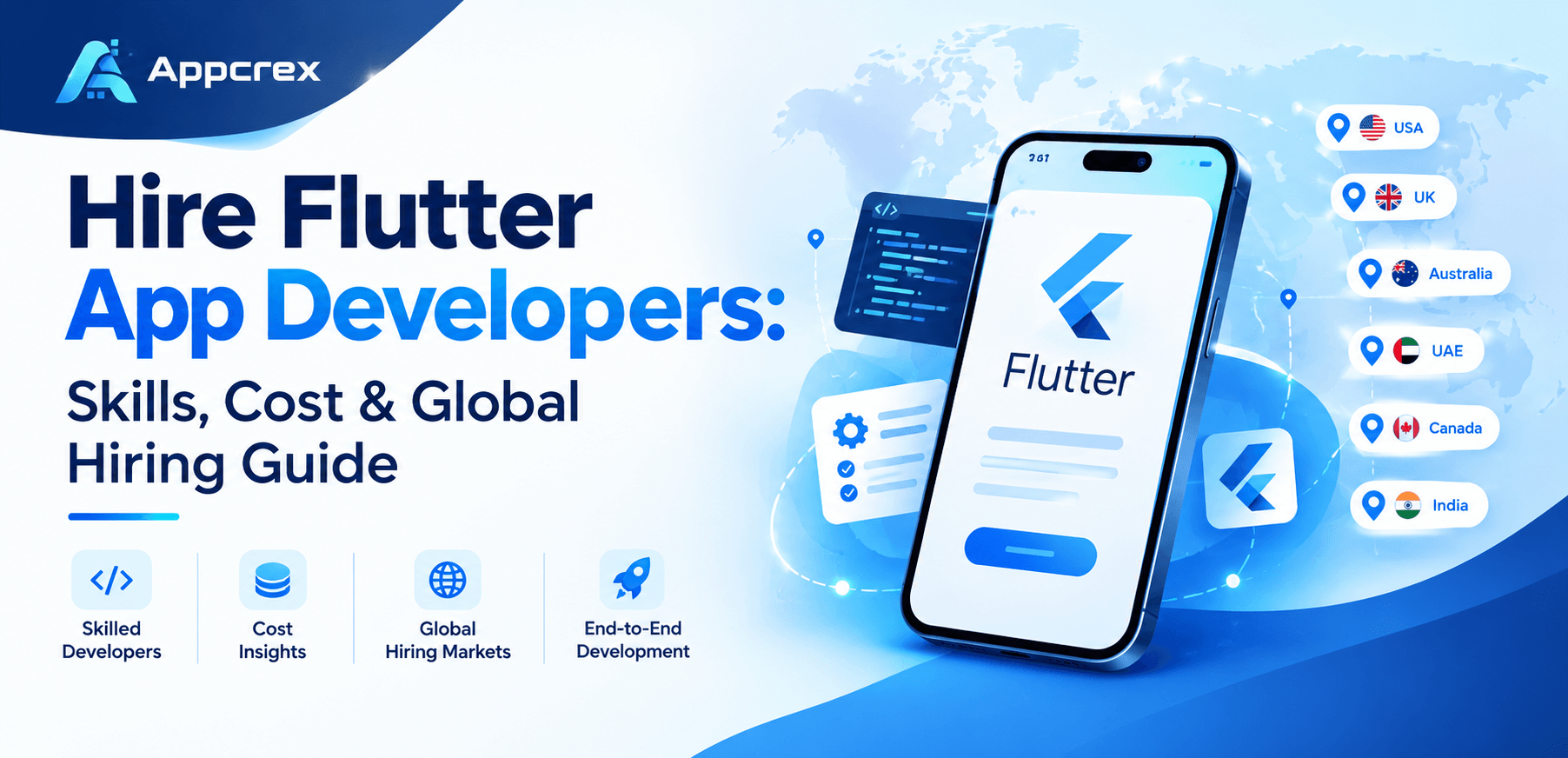
For AppCrex, I recommend initially evaluating the United States, United Kingdom, Australia, UAE, Canada, and India. These are practical markets to test for client acquisition and developer hiring, but the actual priority should be validated through keyword research, qualified inquiries, and project economics.
1. Hire Flutter Developers United States
The United States is a useful market to target when seeking businesses that need custom mobile applications, startup MVPs, SaaS products, and enterprise software.
For AppCrex, this market can be approached through content that explains product development, engagement models, technical capabilities, and project planning.
2. Hire Flutter Developers United Kingdom
The UK can be considered for businesses looking to build fintech products, digital services, customer applications, and business software.
Relevant cities include London, Manchester, and Birmingham.
Content targeting UK businesses should address communication, project delivery, technical requirements, and ongoing support rather than simply listing developer skills.
3. Hire Flutter Developers Australia
Australia is another market worth evaluating for cross-platform development services, startup products, and business applications.
For this market, discuss product requirements, collaboration arrangements, project estimates, and the benefits and limitations of cross-platform development.
4. Hire Flutter Developers United Arab Emirates
The UAE is relevant to businesses building digital services, e-commerce applications, fintech products, and enterprise platforms.
Projects targeting the UAE may need to consider Arabic and English interfaces, right-to-left layout support, local payment integrations, and regional business requirements where relevant.
5. Hire Flutter Developers Canada
Canada can be included when targeting businesses that need mobile applications, SaaS products, marketplaces, and enterprise software.
Focus on the business problem, technical expertise, product scope, and communication model rather than using city names without supporting information.
6. Hire Flutter Developers India
India is worth considering for developer recruitment, dedicated development teams, and businesses comparing software delivery models.
If AppCrex is targeting international clients, explain how project management, communication, quality assurance, intellectual property ownership, and post-launch support will work across locations.
How should you prioritize these markets?
Do not assume that every country has equal search demand or conversion potential.
Use Google Search Console to identify country-specific impressions and clicks. Then compare qualified leads, project sizes, conversion rates, and the effort required to serve each market.
For the global hiring guide, keep the main topic broad. Create separate country pages only when they can provide unique information and satisfy a distinct commercial search intent.
Dedicated Flutter Developers vs. a Complete App Development Company
Before hiring, decide whether you need an individual developer, a dedicated team, or a company that manages the entire application development process.
| Hiring model | Best suited for | Main consideration |
|---|---|---|
| Freelance Flutter developer | Small tasks, prototypes, or limited feature development | Availability and dependency on one person |
| Dedicated Flutter developer | Ongoing development with an existing product team | Your business may need to manage other project responsibilities |
| Dedicated Flutter development team | Products requiring mobile, backend, design, and QA collaboration | Requires clear coordination and defined responsibilities |
| Flutter app development company | Businesses seeking broader product planning and delivery | Confirm the actual scope, team structure, and deliverables |
| Staff augmentation | Businesses that already manage software development internally | Requires technical leadership and project oversight on your side |
When should you hire individual Flutter developers?
Hiring an individual developer can make sense when your product requirements are already clear and your business has someone who can manage the project.
For example, you may need a developer to implement new screens, fix bugs, connect an API, or maintain an existing Flutter application.
However, one developer may not cover every responsibility required for a complex product. Design, backend engineering, testing, security, and release management may require additional specialists.
When should you choose a Flutter app development company?
A Flutter app development company may be a better fit when you need help with multiple stages of the product lifecycle.
Depending on the agreed scope, a company may coordinate product discovery, design, development, backend integration, testing, deployment, and maintenance.
For startups without an established engineering team, this approach can make project coordination easier. For enterprises, the decision depends on whether the external team can work with existing systems, internal engineers, and established processes.
Before choosing a model, clarify who is responsible for architecture, delivery management, testing, deployment, and ongoing support. This is often more important than the job title alone.
How Much Does It Cost to Hire Flutter App Developers?
The cost of hiring Flutter developers depends on their experience, location, engagement model, project complexity, and the level of support required.
A developer hired for a short task will have a different cost structure from a dedicated engineer working on an application over several months. Similarly, hiring a full development team involves more than the developer’s coding time.
Rather than using a single price for every project, businesses should compare the complete cost of delivering and maintaining the application.
Factors that influence Flutter development costs
Developer experience: Senior developers may cost more, but their experience can be valuable for complex architecture, technical decisions, and debugging.
Location and hiring market: Rates can vary by country, city, employment model, and specialization. Compare actual proposals instead of assuming that location alone determines quality.
Project complexity: An application with authentication, payments, multiple user roles, real-time functionality, and external integrations requires more work than a simple MVP.
Design requirements: Custom animations, complex interfaces, accessibility requirements, and extensive prototyping can increase design and development effort.
Backend development: Applications requiring APIs, databases, administration dashboards, or integrations may need additional backend specialists.
Testing and security: Functional testing, device compatibility, performance optimization, and security reviews require time and appropriate expertise.
Ongoing maintenance: Software updates, bug fixes, monitoring, hosting, and new features contribute to the application’s total cost of ownership.
How to estimate your Flutter app development budget
Start by defining your essential features and then estimate the effort required for each development stage.
A useful planning formula is:
Estimated development budget = Development effort × Applicable team rates + Additional project expenses
Additional expenses may include design, testing, third-party services, cloud infrastructure, software licenses, app store-related costs, and post-launch support.
This is a planning framework, not a fixed quote. The actual budget should be based on the team’s proposed scope and delivery plan.
How can you control the cost?
-
Start with an MVP that solves one clear problem.
-
Prioritize features according to business value.
-
Reuse suitable components instead of rebuilding common functionality.
-
Select the technology stack based on requirements.
-
Confirm integration dependencies before development.
-
Define acceptance criteria for each milestone.
-
Reserve budget for testing, maintenance, and future improvements.
Avoid choosing a development partner solely because its initial quote is the lowest. Unclear scope, poor code quality, and missing documentation can create additional costs later.
How Long Does Flutter App Development Take?
The timeline depends on application complexity, the number of platforms, team size, integrations, and the speed of feedback.
The following ranges are illustrative planning estimates rather than guaranteed delivery commitments.
| Project stage | Typical planning range |
|---|---|
| Discovery and requirements | 1–3 weeks |
| UI/UX design and prototyping | 2–5 weeks |
| Basic MVP development | 4–12+ weeks |
| Advanced application development | 3–6+ months |
| Testing and release preparation | 2–4+ weeks |
Some activities can happen in parallel, so the total duration will not always equal the sum of each stage.
A project with complex payments, third-party systems, real-time updates, specialized device features, or regulated data may take longer.
To improve delivery predictability, agree on milestones, define which features belong in the first release, and establish a process for handling new requirements.
Our Flutter App Development Process
Whether you hire a dedicated developer or work with an app development company, a clear process helps keep the project aligned with its objectives.
Step 1: Requirement Analysis
Define the target audience, business model, main user journeys, core features, integrations, and success metrics.
At this stage, the team should also identify technical constraints and decide which features are essential for the first release.
Step 2: Product Planning and Architecture
Choose the appropriate application architecture, state management approach, backend services, database, and integration strategy.
The architecture should support the expected product requirements without introducing unnecessary complexity.
Step 3: UI/UX Design
Create wireframes, prototypes, and interface designs for the key user journeys.
Reviewing the design before implementation can help identify usability issues and reduce rework.
Step 4: Flutter Application Development
Develop the interface, navigation, application logic, state management, and platform integrations.
Code reviews, version control, and clear documentation help keep the project maintainable as the codebase grows.
Step 5: Backend and API Integration
Connect the application to the required backend services, authentication systems, databases, payment gateways, and other third-party tools.
The team should test both successful and unsuccessful responses, including network errors and invalid data.
Step 6: Testing and Quality Assurance
Test important workflows, screen layouts, device compatibility, performance, and security controls.
Unit tests, widget tests, and integration tests can help identify issues before release.
Step 7: Deployment
Prepare the application for release through the relevant distribution channels.
The release process may include production configuration, store listing preparation, signing, final testing, and submission to the appropriate app store.
Step 8: Maintenance and Improvement
Monitor the application after launch, resolve defects, update dependencies, and prioritize improvements based on user feedback and product performance.
An application should have a clear ownership and maintenance plan rather than depending entirely on the original developer’s continued availability.
Flutter vs. Native App Development: Which Is Better?
Flutter and native development solve overlapping but different needs. The right choice depends on the product’s functionality, performance requirements, team expertise, and maintenance strategy.
| Factor | Flutter | Native iOS and Android |
|---|---|---|
| Codebase | Shared code across supported platforms where appropriate | Separate platform-specific implementations |
| User interface | Customizable UI framework | Platform-specific UI frameworks |
| Device integration | Supported through plugins and native integration | Direct access to platform APIs |
| Development approach | Shared implementation for many features | Platform-specific implementation |
| Specialized functionality | May require plugins or custom native code | Can provide direct platform-specific access |
| Maintenance | Shared code can simplify some updates | Separate platform code may require additional coordination |
When should you choose Flutter?
Flutter may be suitable when:
-
You want to launch on iOS and Android.
-
A consistent interface across platforms is important.
-
The application fits Flutter’s supported capabilities.
-
Your team wants to share much of the application code.
-
You want a practical foundation for an MVP or business application.
When is native development worth considering?
Native development may be appropriate when the product depends heavily on specialized platform capabilities, specific SDKs, advanced device integrations, or platform-specific performance requirements.
A technical assessment should determine whether Flutter can meet these needs without creating unnecessary complexity.
An experienced development partner should explain the trade-offs before recommending either approach.
Questions to Ask Before Hiring Flutter Developers
Before signing a contract, ask candidates or companies questions that reveal how they approach real projects.
-
Can you show relevant Flutter projects? Review the developer’s contribution, technical responsibilities, and experience with similar applications.
-
How would you structure my application? Ask about architecture, state management, APIs, testing, and future maintenance.
-
How will progress be measured? Confirm milestones, demonstrations, acceptance criteria, and reporting.
-
What is included in the quote? Clarify design, development, backend work, testing, deployment, and support.
-
Who owns the source code? Establish intellectual property rights, repository access, and documentation requirements.
-
How will security be handled? Ask about authentication, authorization, secrets management, and data protection.
-
What happens after launch? Clarify maintenance, bug fixes, response times, and additional charges.
-
How will changes be managed? Agree on how new features and changes to the original scope will be estimated and approved.
These questions help you compare developers on more than price and availability.
Why Consider AppCrex for Flutter App Development?
Choosing the right development partner starts with understanding the business problem and defining what a successful application should achieve.
AppCrex can discuss custom mobile application requirements for startups, growing businesses, and enterprises. Depending on the project, the engagement may include:
-
Custom mobile app development: Plan an application around your users, workflows, and business model.
-
Flutter development: Evaluate whether a cross-platform approach suits your product requirements.
-
Product planning: Define the MVP, essential features, technical scope, and development milestones.
-
Backend and API integration: Connect the application with appropriate business systems and external services.
-
AI integration: Assess opportunities for chatbots, intelligent search, recommendations, or workflow automation.
-
Testing and maintenance planning: Establish quality checks, deployment responsibilities, and post-launch requirements.
The right scope depends on your project, so confirm the proposed team, deliverables, technology choices, costs, and support arrangements before starting.
FAQs
1. How do I hire Flutter app developers for my project?
Start by defining your application requirements, target users, essential features, and budget. Review developers’ portfolios, assess their Flutter and Dart knowledge, discuss architecture and testing, and agree on deliverables before signing a contract.
2. What is the difference between a Flutter developer and a Flutter app development company?
A Flutter developer primarily implements application functionality. A Flutter app development company may provide a broader team for planning, UI/UX design, mobile development, backend integration, testing, deployment, and maintenance. The exact responsibilities depend on the engagement.
3. Is Flutter suitable for startup MVP development?
Yes. Flutter can be a suitable choice for startups that want to launch on iOS and Android using a shared codebase. However, the technology should be selected according to the product’s requirements, integrations, and long-term roadmap.
4. Can I hire dedicated Flutter developers for long-term projects?
Yes. A dedicated engagement can support ongoing feature development, maintenance, and product improvements. Define the developer’s responsibilities, working arrangements, expected availability, reporting process, and replacement or handover provisions.
5. How much does it cost to hire Flutter developers?
The cost depends on developer experience, location, engagement model, project complexity, and required support. Request a detailed estimate based on the actual scope rather than relying on a generic rate.
6. Can Flutter developers build both iOS and Android applications?
Yes. Flutter supports development for both platforms using a shared codebase for much of the application. Certain features may still require platform-specific configuration, plugins, or native code.
7. Which industries can benefit from Flutter app development?
Flutter can support applications in fintech, healthcare, e-commerce, logistics, education, travel, real estate, and enterprise software. The suitability depends on the application’s technical and operational requirements.
8. Should I hire a Flutter developer or a complete development team?
An individual developer may be suitable for smaller tasks or projects with established technical leadership. A complete team may be more appropriate when you need product design, backend engineering, quality assurance, and coordinated delivery.
9. Can Flutter integrate AI features?
Yes. Flutter applications can connect to AI services through APIs and suitable backend architectures. Potential features include chatbots, intelligent search, recommendations, document processing, and AI-assisted workflows.
10. Where should I hire Flutter developers?
You can evaluate developers and development companies in markets such as the United States, United Kingdom, Australia, UAE, Canada, and India. Compare technical expertise, communication, costs, time-zone compatibility, and support arrangements rather than relying on location alone.
11. How can I evaluate a Flutter developer’s technical skills?
Review practical projects, ask about Dart, state management, API integration, debugging, testing, and native platform integration. A short technical assessment based on realistic tasks can help you evaluate problem-solving ability.
12. Why should I choose a Flutter app development company instead of a freelancer?
A development company may provide a broader range of skills and coordinated project delivery. A freelancer may be more suitable for a limited scope. Compare the actual team, responsibilities, project requirements, and support arrangements before deciding.
Conclusion
Hiring the right Flutter developers can help your business build a mobile application that serves users effectively and supports future product development. However, successful delivery depends on more than choosing a framework or finding the lowest development quote.
Define your core requirements, evaluate the team’s technical skills, compare engagement models, and establish clear milestones before development begins. If your goal is to launch on both iOS and Android, assess whether Flutter offers the right balance of development efficiency, user experience, and long-term maintainability.
Whether you need a dedicated Flutter developer, a complete development team, or an experienced app development company, focus on finding a partner that understands your business objectives and can support the product beyond its initial release.