📌 Key Takeaways
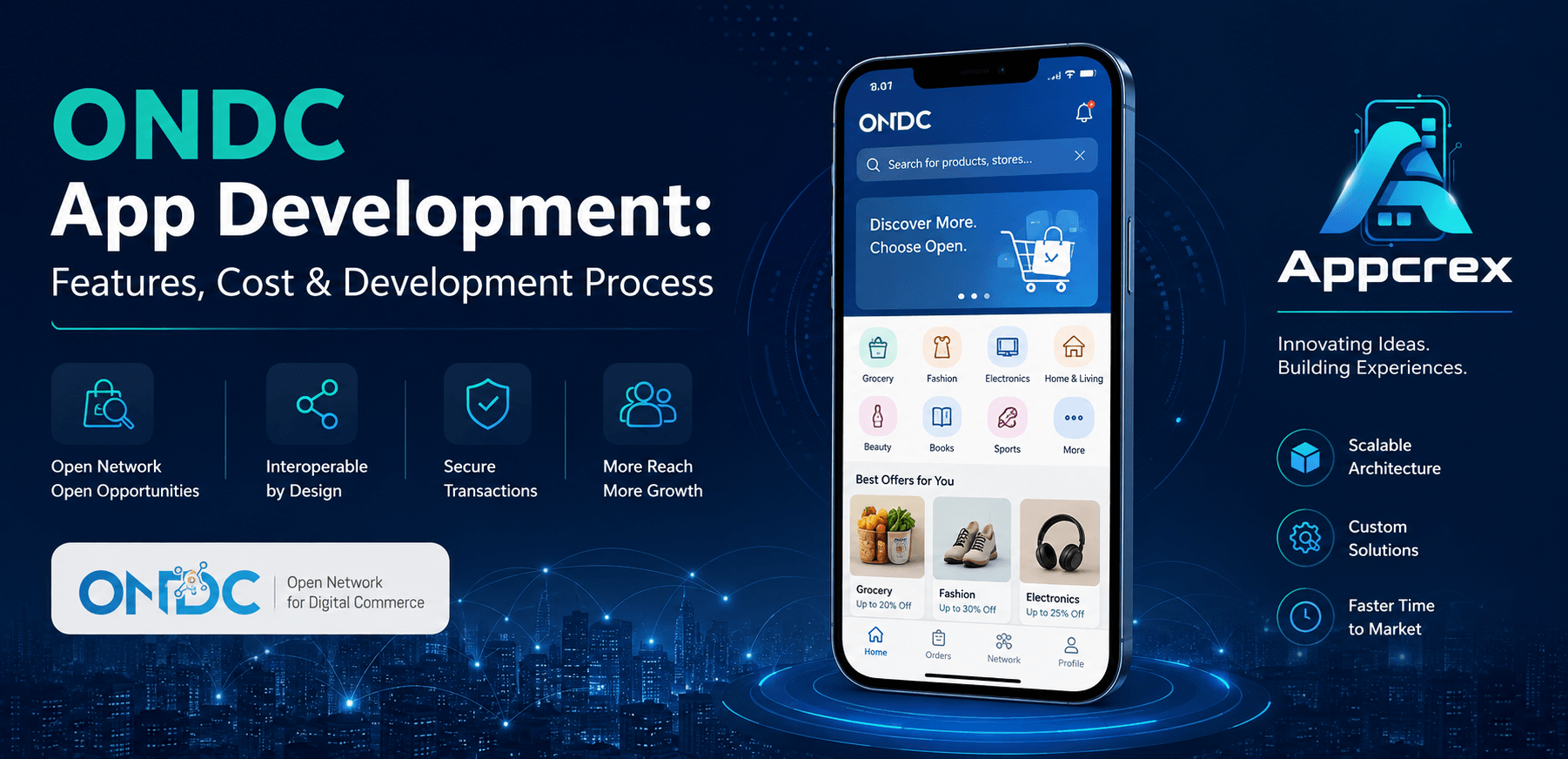
- ONDC is an open digital commerce network, not a single shopping app.
- Businesses can build buyer, seller, logistics, or integration solutions.
- APIs and integrations are a major part of ONDC development.
- Development cost depends heavily on features and integrations.
- AI, analytics, automation, and scalable architecture can extend the platform’s capabilities.
Introduction
India’s digital commerce ecosystem is moving beyond traditional marketplace models. Instead of businesses depending entirely on one large platform to reach customers, open digital networks are creating new ways for buyers, sellers, logistics providers, and technology companies to connect.
One of the most important initiatives in this space is ONDC (Open Network for Digital Commerce).
For businesses and technology companies, ONDC creates opportunities to build buyer applications, seller applications, commerce platforms, integrations, and specialized digital solutions that can participate in an open commerce ecosystem.
If you are planning to build an ONDC-compatible application or integrate an existing business platform with ONDC, this guide explains the major features, development process, technology requirements, estimated cost, and business models.
What Is ONDC?
ONDC stands for Open Network for Digital Commerce.
It is an open network designed to make digital commerce more interoperable. Rather than operating as a single marketplace, ONDC connects different participants through standardized network protocols.
In a traditional marketplace model, customers, sellers, payments, logistics, and other services may operate within one platform.
With an open network approach, different participants can provide different parts of the commerce experience.
For example:
Customer → Buyer App → ONDC Network → Seller → Logistics → Customer
This creates opportunities for businesses to develop specialized applications while participating in a wider digital commerce ecosystem.
ONDC has expanded beyond basic retail use cases and can support areas such as retail, food, mobility, logistics, travel, and other digital commerce services.
Why Build an ONDC App?
The biggest reason businesses consider ONDC development is flexibility.
A business can build its own digital experience instead of depending entirely on a single closed marketplace ecosystem.
An ONDC-based solution can be useful for:
- Retail businesses
- Grocery businesses
- Restaurants
- D2C brands
- Seller networks
- Local merchants
- Logistics companies
- Mobility businesses
- Travel businesses
- Large enterprises
- Digital commerce startups
For technology companies, ONDC also creates opportunities to develop specialized platforms for buyers, sellers, logistics providers, and other network participants.
Types of ONDC Applications You Can Build
ONDC is not limited to one type of application. The right solution depends on the business model and the role the company wants to play in the network.
1. ONDC Buyer App
A buyer application allows customers to discover products or services, compare available options, place orders, make payments, and track deliveries.
Typical features include:
- User registration
- Product discovery
- Search and filters
- Categories
- Product details
- Cart
- Checkout
- Multiple payment options
- Order tracking
- Reviews and ratings
- Notifications
- Customer support
2. ONDC Seller App
A seller application helps merchants manage their products and orders while participating in the digital commerce network.
Important features can include:
- Seller registration
- Business profile
- Product catalog
- Inventory management
- Pricing
- Order management
- Order status updates
- Offers and discounts
- Payment tracking
- Sales reports
- Customer management
- Notifications
For businesses managing multiple stores, the application can also include multi-location inventory and centralized administration.
3. ONDC Integration Platform
Existing e-commerce or business software does not necessarily need to be rebuilt from scratch.
Businesses can develop an integration layer that connects their existing systems with the ONDC ecosystem.
This may include:
- Catalog synchronization
- Order synchronization
- Inventory synchronization
- Payment integration
- Logistics integration
- Customer data workflows
- Status updates
- API communication
- Business dashboards
This type of development is particularly useful for businesses that already have an ERP, e-commerce platform, POS system, or marketplace solution.
4. ONDC Logistics Solution
Logistics companies can build solutions that support order fulfillment and delivery workflows.
Features may include:
- Delivery assignment
- Driver management
- GPS tracking
- Route optimization
- Delivery status
- Proof of delivery
- Delivery notifications
- Fleet management
- Performance reports
5. Industry-Specific ONDC Platform
Businesses can also build specialized solutions around particular industries.
Examples include:
- Grocery commerce
- Food ordering
- Retail
- Fashion
- Healthcare products
- Local services
- Travel
- Mobility
- Logistics
The application architecture can then be designed around the specific requirements of that industry.
Key Features of ONDC App Development
A successful ONDC application needs more than a basic shopping interface. The system needs to handle users, products, orders, payments, APIs, network communication, and business operations.
User Registration and Authentication
Users should be able to create accounts using options such as:
- Mobile number
- OTP
- Social login
- Password-based authentication
Businesses can also implement additional authentication methods for sensitive operations.
Product and Service Discovery
Search is one of the most important parts of a commerce application.
The application can provide:
- Keyword search
- Categories
- Filters
- Location-based discovery
- Price filters
- Availability
- Sorting
- Recommendations
For larger platforms, AI-powered search can make product discovery more relevant.
Product Catalog Management
Seller-side systems should allow businesses to manage:
- Product names
- Images
- Descriptions
- Pricing
- Stock
- Variants
- Categories
- Taxes
- Offers
- Availability
Catalog synchronization becomes particularly important when sellers are already using external inventory or ERP systems.
Cart and Checkout
The buyer application should provide a smooth checkout experience.
Core functionality includes:
- Add to cart
- Update quantity
- Address management
- Delivery options
- Order summary
- Coupons
- Taxes
- Payment selection
- Final confirmation
Digital Payments
ONDC applications can integrate appropriate payment services based on the business model.
Payment functionality may include:
- UPI
- Cards
- Net banking
- Digital wallets
- Payment gateways
- Refunds
- Payment status
- Transaction history
Security and reconciliation should be considered during development rather than added later.
Order Management
Both buyers and sellers need clear order workflows.
The system can support:
Order Placed → Confirmed → Packed → Dispatched → Out for Delivery → Delivered
Depending on the business model, cancellation, return, refund, replacement, and failed delivery workflows can also be included.
Real-Time Order Tracking
For delivery-based businesses, customers expect visibility after placing an order.
GPS and logistics APIs can be used to provide:
- Driver location
- Estimated delivery time
- Delivery status
- Route information
- Delivery notifications
Seller Dashboard
A seller dashboard can provide a central place to manage daily operations.
It can show:
- Orders
- Revenue
- Inventory
- Products
- Customers
- Payments
- Returns
- Delivery status
- Sales analytics
Admin Panel
The admin panel controls the wider platform.
Depending on the application, administrators may manage:
- Users
- Sellers
- Products
- Orders
- Payments
- Disputes
- Promotions
- Categories
- Reports
- Integrations
- Permissions
A role-based access control system can prevent unauthorized users from accessing sensitive information.
Advanced Features for an ONDC Application
Once the basic platform is ready, advanced functionality can improve efficiency and user experience.
AI-Powered Recommendations
AI can analyze customer behavior and suggest relevant products or services.
Intelligent Search
Natural-language search can allow users to search in a more conversational way instead of relying only on exact product names.
Demand Forecasting
Businesses can use historical sales data to estimate future demand and plan inventory.
Dynamic Business Analytics
Dashboards can track:
- Sales
- Orders
- Conversion
- Product performance
- Customer activity
- Seller performance
- Delivery performance
Automated Notifications
Push notifications, SMS, email, or WhatsApp-based communication can be integrated depending on the workflow.
Multi-Vendor Management
A marketplace-style platform can support multiple sellers, stores, brands, or service providers.
Multi-Location Management
Businesses operating across multiple cities can manage stores, inventory, orders, and employees from a centralized system.
ONDC API and Integration Development
API development is one of the most important technical parts of an ONDC solution.
An application may need to communicate with different systems for:
- Catalog
- Orders
- Payments
- Logistics
- Inventory
- Customer notifications
- Business management
- Analytics
The development team needs to understand the required network specifications and design the application architecture accordingly.
Existing systems such as ERP, CRM, POS, warehouse software, payment systems, and logistics platforms can also be connected through APIs.
This means a company does not always need to replace its existing software.
Instead, an integration layer can connect its current infrastructure with the required ONDC workflows.
Technology Stack for ONDC App Development
The technology stack depends on the application’s complexity and business requirements.
Mobile App
- Flutter
- React Native
- Kotlin
- Swift
Flutter or React Native can be considered when a business wants cross-platform applications.
Frontend
- React.js
- Next.js
- Angular
- Vue.js
Backend
- Node.js
- Python
- Java
- .NET
Databases
- PostgreSQL
- MySQL
- MongoDB
- Redis
Cloud
- AWS
- Microsoft Azure
- Google Cloud
APIs and Integrations
- REST APIs
- Webhooks
- Payment APIs
- Maps APIs
- Logistics APIs
- ERP/CRM APIs
The final technology stack should be selected according to scalability, security, integrations, development speed, and long-term maintenance.
How to Build an ONDC App?
Developing an ONDC application should start with the business model rather than coding.
Step 1: Define the Business Model
First determine whether you are building:
- Buyer application
- Seller application
- Logistics solution
- Integration platform
- Marketplace solution
- Industry-specific commerce platform
This decision affects the complete architecture.
Step 2: Identify ONDC Requirements
The development team should understand the relevant network specifications, workflows, APIs, and participant requirements for the selected use case.
Step 3: Plan the Application Architecture
The architecture should define:
- Frontend
- Backend
- Database
- APIs
- Authentication
- Payment system
- Admin panel
- Third-party integrations
- Cloud infrastructure
Step 4: Design UI/UX
The user experience should be simple, particularly for commerce workflows such as product discovery, checkout, order tracking, and seller management.
Step 5: Develop the MVP
The first version should focus on essential functionality instead of trying to build every possible feature.
For example, an initial buyer application may include:
- Registration
- Search
- Product discovery
- Cart
- Checkout
- Payment
- Orders
- Tracking
Also Read : What Is an MVP in App Development? A Complete Guide
Step 6: Build Integrations
The required APIs, payment systems, logistics services, ERP, inventory systems, and other business tools can then be integrated.
Step 7: Testing
Testing should cover:
- API communication
- Payments
- Orders
- Catalog
- Inventory
- Security
- Performance
- Mobile responsiveness
- Error handling
Step 8: Deployment
After testing, the platform can be deployed on cloud infrastructure and prepared for production use.
Step 9: Monitoring and Optimization
After launch, performance, errors, transactions, API responses, and user behavior should be monitored.
Continuous optimization becomes important as transaction volume grows.
How Much Does It Cost to Build an ONDC App?
The cost depends heavily on the type of application, number of integrations, UI/UX complexity, backend architecture, security requirements, and advanced features.
A general estimate is:
| ONDC Solution | Estimated Cost |
|---|---|
| Basic MVP | $20,000 – $40,000 |
| Medium Application | $40,000 – $80,000 |
| Advanced Platform | $80,000 – $150,000+ |
| Enterprise ONDC Platform | $150,000 – $300,000+ |
These are development estimates rather than fixed quotes.
For example, a simple seller application with limited functionality will have a very different budget from an enterprise commerce platform integrating ERP, inventory, logistics, payments, analytics, AI, and multiple business locations.
Factors That Affect ONDC App Development Cost
The major cost factors include:
- Number of applications
- Buyer/seller/admin modules
- UI/UX complexity
- API integrations
- Payment integration
- Logistics integration
- ERP/CRM integration
- AI features
- Real-time tracking
- Security requirements
- Cloud infrastructure
- Testing
- Maintenance
- Development team location
Building both buyer and seller applications will naturally require more development effort than building a single application.
How Long Does It Take to Build an ONDC App?
The development timeline can vary depending on scope.
Typical estimates are:
- Basic MVP: 3–5 months
- Medium application: 5–8 months
- Advanced platform: 8–12+ months
- Enterprise solution: 12+ months
Integration-heavy projects can take longer because the timeline depends not only on development but also on testing and coordination across connected systems.
ONDC App Monetization Models
Businesses can use different monetization strategies depending on their role in the ecosystem.
Transaction Commission
Charge a percentage or fixed fee on completed transactions.
Subscription
Offer sellers or businesses monthly or annual plans.
SaaS Model
Provide commerce software as a recurring service.
Premium Features
Charge for advanced analytics, automation, AI, marketing tools, or enterprise functionality.
Logistics Revenue
A logistics-focused platform can earn revenue from delivery services.
Enterprise Licensing
Large businesses can pay for customized software and enterprise integrations.
Who Can Benefit From ONDC App Development?
ONDC-based solutions can be relevant for several types of businesses.
Retailers
Retail businesses can develop their own digital commerce presence.
D2C Brands
Brands can build technology around their own customer and commerce operations.
Seller Networks
Organizations managing multiple merchants can develop centralized seller solutions.
Logistics Companies
Delivery providers can build software around order fulfillment and transportation.
Startups
Startups can build specialized commerce solutions around specific industries.
Enterprises
Large businesses can connect their existing digital infrastructure with open commerce workflows.
ONDC App vs Traditional Marketplace App
These two approaches are not exactly the same.
| Traditional Marketplace | ONDC-Based Approach |
|---|---|
| Usually controlled by one platform | Designed around an open network |
| Participants operate within the platform | Different network participants can connect |
| Platform owns the primary marketplace experience | Buyer/seller roles can be distributed |
| Integration depends on platform architecture | Uses defined network protocols |
| Business model depends on marketplace structure | Multiple participant and service models are possible |
The right choice depends on the company’s business model, target users, technology requirements, and desired ecosystem.
Security Considerations
Commerce applications handle sensitive business and customer information, so security should be built into the architecture.
Important areas include:
- Secure authentication
- OTP protection
- Encryption
- API security
- Role-based access
- Secure payment processing
- Data protection
- Audit logs
- Fraud monitoring
- Secure cloud infrastructure
- Regular security testing
For enterprise applications, security requirements can become significantly more complex.
Why Businesses Should Focus on Scalability?
An application may start with a few thousand transactions but eventually need to support a much larger customer and seller base.
The architecture should therefore be designed for:
- Horizontal scaling
- Database optimization
- API performance
- Caching
- Load balancing
- Cloud scalability
- Monitoring
- Automated deployment
Scalability is especially important when the application handles real-time orders, inventory, payments, and logistics.
Why Choose AppCrex for ONDC App Development?
AppCrex can help businesses develop custom commerce applications and software around their specific business requirements.
Our development approach can include:
- Business and technical consultation
- UI/UX design
- Mobile app development
- Web application development
- Backend development
- API integration
- Payment integration
- ERP/CRM integration
- Admin dashboard development
- Cloud deployment
- Testing
- Maintenance and support
Whether you need a buyer application, seller platform, commerce integration, or a larger digital commerce solution, the architecture can be planned around your business model and growth requirements.
FAQs
Q. What is ONDC app development?
ONDC app development involves building applications or software that participate in the ONDC digital commerce ecosystem, such as buyer apps, seller apps, logistics solutions, or integration platforms.
Q. How much does it cost to develop an ONDC app?
A basic ONDC application may start around $20,000–$40,000, while advanced and enterprise solutions can cost $80,000 to $300,000 or more depending on integrations and functionality.
Q. Can I build a seller app for ONDC?
Yes. A seller-focused application can provide catalog, inventory, order, payment, analytics, and business management functionality while connecting with the relevant ONDC ecosystem requirements.
Q. Can an existing e-commerce platform be integrated with ONDC?
Yes, depending on the existing platform and business requirements. An integration layer can connect systems such as inventory, catalog, order management, payments, and logistics.
Q. Can AI be added to an ONDC application?
Yes. AI can be used for recommendations, search, demand forecasting, customer support, fraud detection, analytics, and business automation.
Q. How long does ONDC app development take?
A basic MVP may take around 3–5 months, while a more advanced platform can take 8–12 months or longer.
Q. Can ONDC apps support multiple sellers?
Yes. A multi-seller architecture can support multiple merchants, stores, catalogs, inventory systems, orders, and seller dashboards.
Conclusion
ONDC is creating a different approach to digital commerce by allowing different participants and technology platforms to connect through an open network.
For businesses, this creates opportunities to develop specialized buyer apps, seller platforms, logistics solutions, commerce integrations, and industry-focused applications.
The right development approach starts with understanding the business model and the specific ONDC role you want to support. From there, the application architecture, APIs, features, security, technology stack, and development roadmap can be planned accordingly.
If you are considering building an ONDC application or connecting your existing commerce platform with the ONDC ecosystem, working with an experienced mobile app development company and software development team can help turn the idea into a scalable product.
Build Your ONDC Application with AppCrex
Looking to build an ONDC-compatible app, seller platform, buyer application, or custom digital commerce solution? AppCrex provides custom mobile app development, web development, API integration, AI development, and enterprise software development services.
Talk to AppCrex today to discuss your ONDC app idea, required features, technology stack, development timeline, and estimated budget.