📌 Key Takeaways
- BNPL apps combine payments, credit, risk management, and mobile technology.
- KYC, fraud detection, installment management, and secure payments are core components.
- AI can improve risk assessment, fraud detection, personalization, and customer support.
- Development cost can range from roughly $50,000 for a focused MVP to $800,000+ for large enterprise platforms.
- Regulatory requirements should be considered from the beginning, especially when launching in regulated markets such as Australia.
Introduction
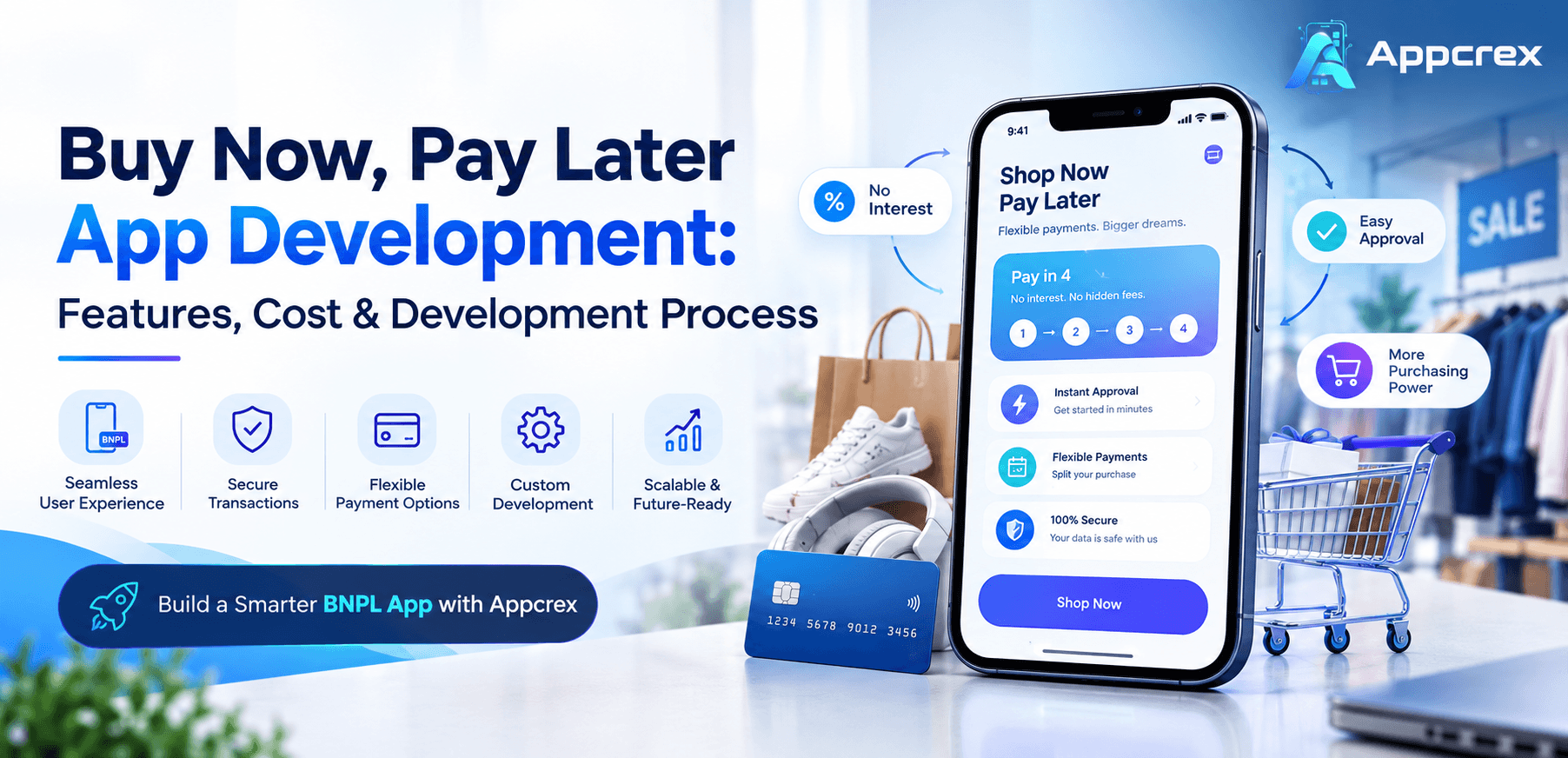
Buy Now, Pay Later (BNPL) has become an important part of the digital payments and fintech ecosystem. Instead of paying the full amount at checkout, customers can split a purchase into scheduled instalments while merchants receive payment through the BNPL provider.
For businesses, a BNPL platform is much more than a payment app. It combines mobile app development, payment processing, credit decisioning, KYC, fraud detection, repayment management, merchant integrations, analytics, and financial compliance into one technology ecosystem.
If you are planning to build a BNPL app similar to popular installment-payment platforms, this guide explains the essential features, technology, development process, estimated cost, monetization models, security requirements, and the role of AI.
What Is a Buy Now, Pay Later App?
A BNPL app allows customers to purchase products or services and pay for them over multiple instalments instead of making the entire payment immediately.
A typical BNPL transaction works like this:
- The customer selects BNPL at checkout.
- The platform verifies the customer’s identity and eligibility.
- The BNPL engine evaluates the transaction and available spending limit.
- The purchase is approved or declined.
- The merchant receives payment according to the platform’s settlement arrangement.
- The customer repays the BNPL provider according to the agreed schedule.
- The platform tracks repayments, failed payments, refunds, disputes, and account status.
The Reserve Bank of Australia describes BNPL as a form of credit where customers purchase goods or services and repay the BNPL provider through instalments. BNPL services can operate through mobile apps, websites, merchant integrations, and virtual cards.
This means a serious BNPL product requires both fintech infrastructure and a customer-friendly mobile experience.
Why Build a BNPL App?
The growth of digital commerce has created demand for flexible payment options. BNPL can be integrated directly into eCommerce checkout, mobile applications, marketplaces, and physical retail environments.
For example, the RBA reported that BNPL transaction value in Australia was around $20 billion in 2023, representing approximately 2% of Australian card purchases at that time. Its 2026 consumer-payment research also indicates that BNPL remains part of Australia’s digital payment landscape.
A BNPL platform can serve several business models:
- Consumer BNPL
- Merchant-focused BNPL
- Embedded BNPL
- eCommerce payment solutions
- Healthcare financing
- Travel payment plans
- Education payment plans
- Retail installment platforms
- B2B installment payment solutions
- Digital lending and financing platforms
For startups, the opportunity is not necessarily to copy an existing BNPL provider. A more focused platform can target a particular industry, customer segment, geography, or merchant network.
How Does a BNPL App Work?
The backend of a BNPL platform connects customers, merchants, payment providers, risk systems, and administrators.
A simplified architecture looks like:
Customer App → BNPL Backend → Risk & Eligibility Engine → Payment Gateway → Merchant → Repayment System
The process begins when the customer chooses the installment option. The system then checks account information, transaction details, previous repayment behaviour, available limits, identity information, and other risk signals.
Once approved, the platform creates an installment schedule and processes the transaction. Future payments are automatically scheduled and monitored.
Customer Side
Customers should be able to:
- Create an account
- Complete identity verification
- Add payment methods
- View available spending limits
- Browse participating merchants
- Select BNPL at checkout
- View installment schedules
- Make repayments
- Receive payment reminders
- Manage refunds
- View transaction history
- Freeze or manage virtual cards
- Contact customer support
Merchant Side
Merchants can receive:
- BNPL checkout integration
- Payment confirmation
- Transaction management
- Settlement reports
- Refund management
- Customer transaction information
- Analytics
- Payment reconciliation
- API and SDK integration
- Merchant dashboard
Admin Side
The administration system manages:
- Customers
- Merchants
- Transactions
- Credit limits
- Repayments
- Refunds
- Disputes
- Fraud alerts
- KYC verification
- Risk rules
- Reports
- Notifications
- System configuration
Essential Features of a BNPL App
The feature set determines both the user experience and the complexity of the platform. A basic BNPL MVP can start with essential payment and installment functionality, while an enterprise platform may require sophisticated risk, fraud, analytics, and merchant infrastructure.
1. Customer Registration and Login
Users can register using email, phone number, social login, or other supported authentication methods.
For fintech applications, authentication should be combined with appropriate identity verification and security controls.
2. KYC and Identity Verification
KYC functionality can collect and verify required customer information through appropriate third-party services.
Depending on the target market, this may include:
- Identity document verification
- Facial verification
- Address verification
- Phone verification
- Database checks
- Age verification
- Customer risk screening
The exact requirements depend on the jurisdiction and business model.
3. BNPL Eligibility and Credit Decisioning
This is one of the most important components of a BNPL platform.
The system can evaluate factors such as:
- Transaction amount
- Customer history
- Previous repayments
- Account activity
- Existing exposure
- Fraud signals
- Identity information
- Internal risk rules
- External data sources where legally permitted
The objective is to determine whether a particular transaction should be approved and under what conditions.
4. Installment Management
The platform needs an installment engine that can create and manage:
- Initial payments
- Future installments
- Due dates
- Payment status
- Failed payments
- Rescheduling rules
- Refund adjustments
- Outstanding balances
Every transaction should have a clear repayment timeline that customers can easily understand.
5. Payment Gateway Integration
Payment integration enables the platform to collect installments and process customer payments.
Depending on the market, integrations may include:
- Debit cards
- Credit cards
- Bank payments
- Digital wallets
- Local payment methods
- Open banking services
- Payment APIs
The right payment infrastructure depends on the target geography and regulatory structure.
6. Merchant Integration
A BNPL platform needs an efficient way for merchants to add installment payments to their checkout.
Possible integration methods include:
- REST APIs
- SDKs
- Plugins
- Hosted checkout
- Payment links
- Mobile SDKs
- eCommerce extensions
This allows the BNPL provider to work with multiple merchants without creating a completely different integration for every business.
7. Fraud Detection
Fraud prevention should be integrated into the platform from the beginning.
A BNPL fraud detection system can monitor:
- Suspicious transactions
- Device information
- Account behaviour
- Unusual purchase patterns
- Multiple account activity
- Velocity checks
- Location inconsistencies
- Payment behaviour
- Identity anomalies
AI and machine learning can be added to improve anomaly detection as transaction volume grows.
8. Repayment Notifications
Customers should receive timely notifications for:
- Upcoming installments
- Successful payments
- Failed payments
- Overdue amounts
- Refunds
- Account changes
- Spending-limit updates
Push notifications, email, SMS, and in-app notifications can be combined depending on the market.
9. Refund and Dispute Management
BNPL transactions can involve product returns, cancellations, partial refunds, or payment disputes.
The platform should automatically update the installment schedule when a transaction is refunded and maintain accurate records for both the customer and merchant.
10. Analytics and Reporting
A BNPL admin dashboard can provide insights into:
- Transaction volume
- Approval rates
- Repayment rates
- Failed payments
- Merchant performance
- Customer activity
- Fraud attempts
- Revenue
- Outstanding balances
- Refunds
- Delinquencies
These analytics can help operators improve product performance and risk controls.
AI in Buy Now, Pay Later App Development
AI can make a BNPL platform more intelligent, particularly in risk management, fraud detection, customer support, personalization, and operational automation.
AI-Powered Credit Risk
Machine learning models can evaluate large numbers of signals and identify patterns associated with repayment behaviour.
Instead of relying exclusively on static rules, an AI-enabled risk engine can continuously improve as more legitimate transaction and repayment data become available.
AI Fraud Detection
Machine learning can identify unusual behaviour and flag transactions for additional review.
For example, an AI system could detect:
- Unusual transaction frequency
- Abnormal purchase amounts
- Suspicious device patterns
- Account takeover indicators
- Coordinated fraud behaviour
- Unusual payment activity
AI Customer Support
A generative AI chatbot can answer common questions about:
- Installment schedules
- Payment status
- Refunds
- Account information
- Merchant transactions
- Basic BNPL policies
Sensitive financial actions should still be protected by authentication, permissions, and appropriate human escalation.
Personalized Offers
AI can also help personalize merchant recommendations, payment options, or offers based on permitted customer behaviour and business rules.
However, AI-driven credit decisions require careful governance, testing, explainability, monitoring, and compliance with applicable laws.
Technology Stack for BNPL App Development
A scalable BNPL application generally requires several technology layers.
| Technology Layer | Possible Technologies |
|---|---|
| Mobile App | Flutter, React Native, Swift, Kotlin |
| Frontend | React, Next.js, Angular |
| Backend | Node.js, Python, Java, .NET |
| Database | PostgreSQL, MySQL, MongoDB |
| APIs | REST, GraphQL, Webhooks |
| Cloud | AWS, Microsoft Azure, Google Cloud |
| AI/ML | Python, TensorFlow, PyTorch |
| Authentication | OAuth, JWT, MFA |
| Payments | Payment gateway APIs |
| Infrastructure | Docker, Kubernetes, CI/CD |
| Monitoring | Cloud monitoring and logging tools |
For businesses targeting both iOS and Android, Flutter or React Native development can reduce duplication across mobile platforms while still allowing native integrations where required.
For a large fintech platform, however, architecture should be selected according to transaction volume, security requirements, regulatory obligations, integration requirements, and long-term scalability rather than simply choosing the cheapest framework.
BNPL App Development Process
Building a BNPL application requires more planning than a standard consumer mobile app because financial transactions, risk management, and regulatory requirements are part of the product architecture.
1. Business and Product Discovery
The first stage defines:
- Target market
- Customer segment
- Merchant segment
- BNPL business model
- Installment structure
- Revenue model
- Target platforms
- Geographic expansion plans
- Compliance requirements
The development team also determines which features belong in the MVP and which can be introduced later.
2. UX/UI Design
The design should make financial information easy to understand.
Important screens may include:
- Registration
- KYC
- Home dashboard
- Merchant discovery
- Checkout
- Payment schedule
- Transaction history
- Repayment
- Notifications
- Support
- Account settings
The installment amount, total payable amount, due dates, fees where applicable, and transaction status should be clearly presented.
3. Backend and Fintech Architecture
Developers then build the backend services responsible for:
- User management
- Transactions
- Installments
- Payment processing
- Merchant accounts
- Risk decisions
- KYC
- Notifications
- Reporting
- Reconciliation
A modular architecture makes it easier to introduce additional payment methods and services later.
4. API and Third-Party Integration
The BNPL platform may require integrations with:
- Payment gateways
- KYC providers
- Fraud detection services
- Credit data providers
- Banking APIs
- Merchant platforms
- SMS providers
- Email services
- Analytics tools
The exact integrations depend on the target country and business model.
5. Mobile App Development
The customer application can be developed for:
- iOS
- Android
A merchant application may also be required, although many BNPL businesses use a web-based merchant dashboard.
6. Risk, Security and Testing
Before launch, the platform should be tested for:
- Authentication vulnerabilities
- API security
- Payment failures
- Fraud scenarios
- Data protection
- Load performance
- Installment calculations
- Refund handling
- Account takeover
- Unauthorized transactions
Financial applications require extensive testing because errors can directly affect customer balances and merchant settlements.
7. Launch and Continuous Improvement
After deployment, the platform should be monitored continuously.
The team can use production data to improve:
- Approval rules
- Fraud detection
- User experience
- Merchant onboarding
- Payment success rates
- Customer support
- Performance
- AI models
A BNPL product should be treated as an evolving fintech platform rather than a one-time mobile app project.
How Much Does It Cost to Build a BNPL App?
The cost of BNPL app development depends heavily on the number of platforms, integrations, risk engine complexity, security requirements, geographic markets, and regulatory requirements.
As an indicative software-development planning range, a project may fall into the following bands:
| BNPL App Type | Estimated Development Cost |
|---|---|
| Basic BNPL MVP | $50,000 – $100,000 |
| Standard BNPL Platform | $100,000 – $200,000 |
| Advanced BNPL Platform | $200,000 – $400,000 |
| Enterprise BNPL Platform | $400,000 – $800,000+ |
| Multi-Market / Banking-Grade Platform | $800,000 – $1.5M+ |
These are planning estimates rather than fixed market prices. A final quote depends on the actual product specification.
Major Cost Factors
The development budget can increase when you add:
AI credit scoring: Developing, training, validating, and monitoring risk models requires additional infrastructure and specialist expertise.
Fraud detection: Real-time fraud monitoring and behavioural analysis add backend and data-engineering complexity.
Multiple payment gateways: Every additional payment integration requires development, testing, reconciliation, and ongoing maintenance.
KYC and identity verification: Third-party verification services introduce integration and operational costs.
Multiple countries: Different markets can require different payment methods, currencies, regulations, languages, and risk policies.
Merchant ecosystem: Supporting hundreds or thousands of merchants requires scalable APIs, dashboards, onboarding workflows, reporting, and reconciliation.
Security: Advanced authentication, encryption, monitoring, logging, infrastructure security, and security testing can significantly affect the budget.
How Does a BNPL App Make Money?
BNPL businesses can use different revenue models depending on their product structure.
Merchant Fees
Merchants may pay a transaction fee for offering BNPL at checkout. Historically, the RBA has reported that BNPL merchant fees can be higher than traditional card payment costs.
Late or Service Fees
Depending on the product and applicable regulations, providers may generate revenue through permitted fees.
Subscription Plans
A platform can offer premium plans with additional benefits, features, or services.
Merchant Services
BNPL providers can potentially generate additional revenue through merchant analytics, promotional tools, customer acquisition services, or other business services.
Financial Products
Some platforms expand into related products such as:
- Virtual cards
- Digital wallets
- Personal finance tools
- Consumer credit
- Merchant financing
The monetization model should be designed alongside the regulatory and risk framework rather than added after development.
BNPL Security and Compliance Considerations
Security is one of the most important parts of BNPL software development because the platform handles identity information, payment data, transaction records, and potentially credit-related information.
Important areas include:
- Data encryption
- Secure APIs
- Multi-factor authentication
- Role-based access
- Tokenization
- Fraud monitoring
- Secure payment processing
- Audit logs
- Data backup
- Vulnerability testing
- Infrastructure monitoring
- Incident response
Australia-Specific BNPL Regulation
If you plan to launch a BNPL service in Australia, regulatory planning is especially important.
ASIC states that amendments to Australia’s National Consumer Credit Protection framework extended the National Credit Code to BNPL contracts. From 10 June 2025, anyone engaging in credit activities involving BNPL contracts must hold an Australian credit licence with appropriate authorisations.
The RBA also continues to examine the payments landscape, including BNPL services, as part of its broader review of payments-system regulation.
Therefore, BNPL software development should involve legal and compliance professionals in the target jurisdiction. A development company can build the technical controls required by the product specification, but software development itself does not guarantee regulatory compliance or licensing approval.
BNPL App Development: MVP vs Full Platform
A startup does not necessarily need to build a complete enterprise BNPL ecosystem on day one.
BNPL MVP
A practical MVP could include:
- Customer registration
- Basic KYC
- Merchant onboarding
- BNPL checkout
- Installment calculation
- Payment gateway
- Repayment schedule
- Notifications
- Basic admin dashboard
- Transaction reporting
Once the business model is validated, additional capabilities can be introduced.
Also Read : What Is an MVP in App Development? A Complete Guide
Advanced Platform
A mature platform could add:
- AI-powered risk scoring
- Real-time fraud detection
- Virtual cards
- Advanced merchant APIs
- Multiple currencies
- Multiple payment gateways
- Open banking
- Advanced analytics
- Automated collections
- AI customer support
- Multi-country infrastructure
Starting with an MVP can help reduce initial development complexity while leaving the architecture ready for future expansion.
Why Choose AppCrex for BNPL App Development?
Building a BNPL product requires expertise across mobile app development, fintech software, payment integrations, backend architecture, AI, APIs, cloud infrastructure, and security.
AppCrex can help businesses develop customized BNPL solutions for specific markets and business models, including:
- BNPL mobile app development
- FinTech app development
- Payment app development
- Digital lending platforms
- Merchant checkout systems
- AI-powered risk management
- Fraud detection integration
- KYC and identity verification integration
- Payment gateway integration
- iOS and Android development
- Flutter and React Native development
- Admin and merchant dashboards
- Cloud-based fintech infrastructure
The development approach can be structured around an MVP first, followed by additional risk, AI, analytics, merchant, and geographic capabilities as the platform grows.
FAQs
Q. How much does it cost to develop a Buy Now, Pay Later app?
A basic BNPL MVP can start around $50,000–$100,000, while an advanced or enterprise platform can cost several hundred thousand dollars or more. The final cost depends on features, integrations, security, AI, geographic markets, and compliance requirements.
Q. How long does it take to build a BNPL app?
A focused MVP may take around 4–7 months, while a complex multi-market BNPL platform can require significantly longer development, testing, integration, and compliance preparation.
Q. Can I build a BNPL app like Afterpay?
Yes, you can develop a BNPL platform with similar core functionality such as installment payments, merchant checkout, customer accounts, payment processing, risk management, and repayment tracking. However, the product architecture, business model, branding, technology, and compliance framework should be developed independently.
Q. Can AI be used in BNPL software?
Yes. AI can support credit-risk analysis, fraud detection, customer service, transaction monitoring, personalization, and operational automation. AI-based financial decisioning should be appropriately governed, tested, monitored, and aligned with applicable regulations.
Q. Which technology is best for BNPL app development?
The right stack depends on the platform’s requirements. Flutter or React Native can be suitable for cross-platform mobile development, while technologies such as Node.js, Python, Java, PostgreSQL, AWS, Azure, and Google Cloud can support scalable fintech backends.
Q. Is BNPL regulated?
BNPL regulation depends on the country and the specific product structure. For example, in Australia, BNPL contracts have been brought within the National Credit Code framework, and ASIC states that credit activities involving BNPL contracts require the appropriate Australian credit licence and authorisations from 10 June 2025.
Conclusion
A Buy Now, Pay Later app is a complex fintech product that combines mobile applications with payment processing, installment management, merchant integrations, KYC, fraud prevention, credit decisioning, analytics, and secure backend infrastructure.
For startups, launching with a focused MVP can provide a practical starting point. As transaction volume and merchant adoption increase, the platform can evolve with AI-powered risk management, advanced fraud detection, virtual cards, additional payment methods, merchant APIs, analytics, and multi-market support.
The most important step is to design the technology, risk model, payment infrastructure, and compliance strategy together rather than treating BNPL as a standard mobile application.
Build Your Buy Now, Pay Later App with AppCrex
Planning to launch a BNPL, payment, or digital lending platform? AppCrex can help you turn your fintech concept into a secure, scalable mobile and web solution with payment integrations, KYC, risk management, AI, merchant systems, and cloud infrastructure. Get in touch with our team to discuss your BNPL app development requirements.