📌 Key Takeaways
- A Revolut-like fintech MVP can start around $70,000–$130,000.
- Banking integrations, security, compliance and financial infrastructure significantly affect the final budget.
- Multi-currency payments, cards, wallets, budgeting and financial insights are important feature areas.
- Subscriptions, payments, lending, business banking and partnerships can create multiple revenue streams.
- The strongest fintech strategy is to solve a specific customer problem rather than simply copying Revolut.
Introduction
If you have ever tried sending money abroad, managing multiple currencies, or keeping track of everyday spending through a traditional bank, you probably know how frustrating the experience can be.
That gap in the banking experience is one of the reasons fintech platforms such as Revolut have grown so quickly.
Revolut combines payments, cards, currency exchange, money management and other financial services inside a mobile-first platform. For entrepreneurs, it offers an interesting example of how a fintech product can start with a focused problem and gradually grow into a much broader financial ecosystem.
But there is an important point to understand before starting development:
Building an app like Revolut does not mean copying Revolut.
The better approach is to understand what makes the product useful, identify a specific audience, and build a fintech solution around a problem that your customers actually have.
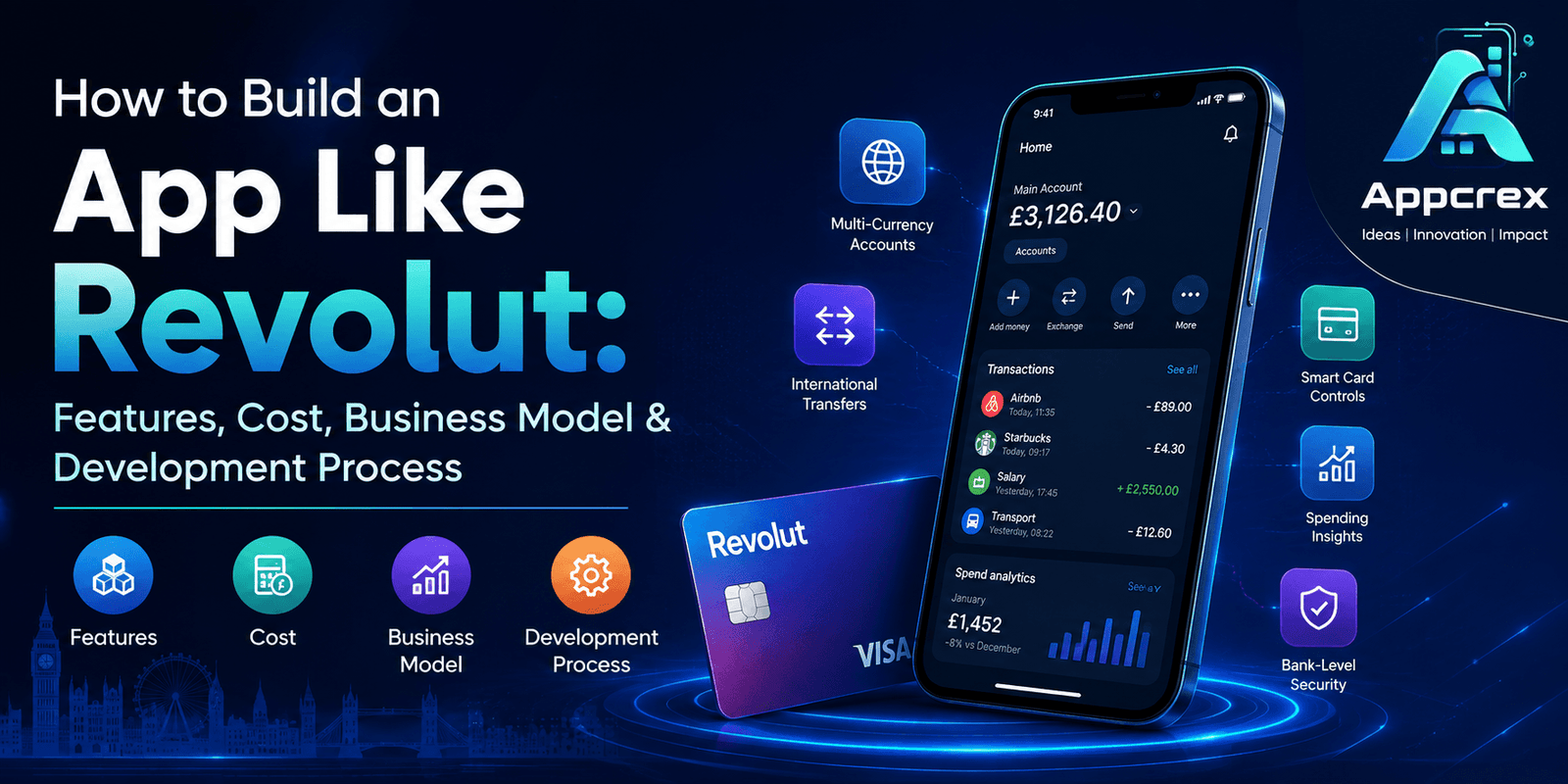
So, if you are planning a similar product, this guide covers the features, development process, technology, business model, timeline and cost to build an app like Revolut.
Just Read : FinTech API Integration Services: Complete Guide to Banking APIs, Payments & Security
What Is Revolut?
Revolut is a fintech platform that started with a strong focus on international spending and currency exchange and has expanded into a much broader range of financial services.
Depending on the market and product, users can access services related to:
- Digital payments
- Cards
- Currency exchange
- International transfers
- Savings
- Investments
- Personal finance
- Business banking
- Premium subscriptions
The interesting part is not simply the number of features.
It is the way those features are brought together inside one mobile experience.
Instead of asking users to switch between different financial services, a fintech platform can give them a single place to manage their money.
That is the opportunity entrepreneurs can learn from.
Why Build an App Like Revolut?
The demand for convenient digital financial services continues to create opportunities for fintech startups.
Customers increasingly expect financial products to provide:
- Fast onboarding
- Simple interfaces
- Real-time notifications
- Easy transfers
- Transparent fees
- Digital cards
- Spending insights
- International payments
- Personalized financial tools
However, you don’t necessarily need to build a general-purpose financial platform.
A startup could focus on a specific audience such as:
- Freelancers
- International workers
- Students
- Digital nomads
- Small businesses
- Travelers
- Expats
- Online sellers
For example, instead of building another generic banking app, you could create a financial platform specifically for UK freelancers who receive payments from overseas.
That immediately gives the product a clearer purpose.
Just Read : Hire App Developers in the UK: Complete Guide to Hiring Mobile App Developers
How Much Does It Cost to Build an App Like Revolut?
There is no single development price because the scope of a fintech application can vary dramatically.
A basic financial management app and a fully integrated digital banking platform are two very different projects.
| App Type | Estimated Development Cost | Approx. Timeline |
|---|---|---|
| Basic Fintech MVP | $70,000–$130,000 | 5–7 months |
| Advanced Fintech App | $130,000–$250,000 | 7–12 months |
| Revolut-Like Financial Platform | $250,000–$450,000+ | 12–18+ months |
| Enterprise Fintech Ecosystem | $450,000+ | 18–24+ months |
These figures primarily represent software development costs.
A real fintech business may also need separate budgets for:
- Regulatory licensing
- Legal services
- Compliance
- Banking partnerships
- KYC/AML services
- Security audits
- Fraud monitoring
- Payment infrastructure
- Cloud infrastructure
- Customer support
- Operations
So, when calculating the overall investment, don’t look at the development quote alone.
Key Features of a Revolut-Like App
The feature set will depend on your business model, but these are some of the most important components to consider.
1. Digital Account Registration
The onboarding process should be simple while still collecting the information required for verification.
A typical flow might include:
- Enter phone number
- Verify OTP
- Enter personal information
- Submit identification
- Complete verification
- Set security credentials
- Activate the account
The exact process depends on the services your company offers and the jurisdiction in which you operate.
2. KYC and Identity Verification
KYC is a fundamental part of a serious fintech platform.
Depending on the business model, customers may need to complete:
- ID verification
- Passport verification
- Address verification
- Facial verification
- Liveness checks
- Risk assessment
Many fintech startups integrate specialist identity-verification providers rather than building every component internally.
This can reduce development time while providing access to established verification infrastructure.
3. Digital Wallet
The wallet becomes the central financial area of the app.
Users can potentially:
- View their balance
- Receive money
- Send money
- Review transactions
- Manage currencies
- Transfer funds
For multi-currency products, the wallet needs to support separate balances and accurate currency transactions.
4. Multi-Currency Accounts
Multi-currency functionality is one of the major concepts associated with Revolut.
A similar product could allow customers to hold different currencies, depending on the markets and financial infrastructure you support.
For example:
- GBP
- EUR
- USD
- CAD
- AED
Users can then manage their international finances from one interface.
5. Currency Exchange
Customers should be able to exchange currencies without navigating through complicated banking processes.
The exchange screen should clearly display:
- Current exchange rate
- Amount being converted
- Applicable fees
- Final amount
Transparency is especially important in financial products because unexpected charges can quickly damage customer trust.
6. International Money Transfers
International transfers can be a major feature for a fintech platform.
Possible functionality includes:
- Recipient management
- Transfer tracking
- Exchange-rate information
- Transfer status
- Transaction history
- Notifications
A startup could even make international transfers its primary product rather than treating them as one feature among many.
7. Physical Card Management
If your product offers cards, customers should be able to control them directly from the app.
Useful features include:
- Activate card
- Freeze card
- Unfreeze card
- Change PIN
- View card transactions
- Report lost card
- Request replacement
This requires integration with appropriate card issuing and payment-processing infrastructure.
8. Virtual Cards
Virtual cards are useful for online payments.
Depending on the product, users could receive:
- Standard virtual cards
- Disposable virtual cards
- Business virtual cards
- Additional virtual cards
Virtual cards can also become part of a premium subscription strategy.
9. Spending Analytics
A good financial app should help users understand their money rather than simply display a balance.
For example, instead of showing:
Current balance: £2,400
the app could show:
You spent £1,180 this month, which is 8% less than last month.
It could then break spending into categories such as:
- Food
- Shopping
- Transport
- Bills
- Entertainment
- Travel
This makes the app more useful as a financial management tool.
10. Budgeting Tools
Users can create spending limits for different categories.
For example:
Food — £300/month
Shopping — £200/month
Transport — £150/month
The app can send notifications when the customer approaches a limit.
This feature is relatively straightforward compared with banking infrastructure, but it can significantly improve engagement.
11. Savings Goals
A savings feature can allow users to create separate goals.
For example:
- Emergency fund
- Holiday
- New car
- Education
- Home deposit
The user could set a target amount and deadline.
The application can then track progress toward the goal.
12. Automated Savings
You can make saving more convenient through automation.
For example:
Transfer £50 to my holiday fund every Friday.
Or:
Move 10% of my salary into savings.
Automated rules can make the platform feel more personalized without requiring customers to manually move money every time.
13. Peer-to-Peer Payments
Users should be able to send money to friends and family quickly.
The flow could be:
Select contact → Enter amount → Confirm → Send
Additional functionality can include:
- Payment requests
- Payment links
- Group payments
- Bill splitting
- Reminders
These features are especially useful for everyday financial interactions.
14. Direct Debit Management
A financial app can give users a central place to view recurring payments.
The screen could show:
- Merchant
- Amount
- Payment date
- Frequency
- Payment status
This helps customers understand their regular financial commitments.
15. Investment Features
Once the core financial product is established, investment functionality can become an expansion opportunity.
Potential features include:
- Stocks
- ETFs
- Funds
- Portfolio tracking
- Investment history
- Market information
However, investment services can introduce additional regulatory requirements, so they should not simply be treated as another standard app feature.
16. Cryptocurrency Features
Depending on the market and regulatory environment, a fintech platform may also offer digital-asset functionality.
Possible features include:
- Buy
- Sell
- Hold
- Transfer
- Price tracking
- Portfolio management
This should be considered carefully because digital-asset services can involve additional compliance and operational requirements.
17. Business Banking
A fintech platform can also target businesses.
Useful business features include:
- Business accounts
- Employee cards
- Expense management
- Invoicing
- Accounting integrations
- Payment tracking
- Multi-user access
- Approval workflows
Business banking can also provide opportunities for higher-value subscription plans.
Also Read : AI Software Development Company: Custom AI Solutions, Cost & Development Process
18. Premium Subscription Plans
A free plan can attract users while premium plans provide additional revenue.
For example:
Free
- Basic account
- Payments
- Transactions
- Basic budgeting
Premium
- Additional cards
- Advanced analytics
- Higher limits
- Premium support
- Additional financial tools
Business
- Team members
- Expense management
- Business cards
- Accounting integrations
The exact features and pricing should be based on customer research rather than simply copying another fintech’s plans.
19. AI Financial Assistant
AI can give a modern fintech application a major usability advantage.
Imagine asking:
“How much did I spend on restaurants last month?”
The app could analyze permitted transaction data and respond immediately.
Other possible AI features include:
- Spending summaries
- Budget suggestions
- Transaction categorization
- Financial alerts
- Customer support
- Personalized insights
- Fraud monitoring
AI should assist users while respecting privacy, security and applicable financial-advice regulations.
20. Real-Time Notifications
Notifications should keep customers informed about important financial events.
Examples:
£45.50 paid to Tesco.
£800 received from Alex.
Your transfer has been completed.
A new device signed into your account.
Real-time alerts can also help users identify potentially unauthorized activity quickly.
Security Features for a Revolut-Like App
Security should be considered from the beginning of development.
Important areas include:
Multi-Factor Authentication
Add additional verification for sensitive activities.
Biometric Authentication
Support device-level authentication such as fingerprint or face recognition where appropriate.
Encryption
Protect sensitive data during transmission and storage.
Device Monitoring
Identify unusual login or device activity.
Transaction Monitoring
Monitor transactions for suspicious behavior.
Fraud Detection
Use rules and machine-learning models to identify unusual patterns.
Role-Based Access
Ensure employees only have access to the information they need.
Audit Logs
Keep records of important financial and administrative actions.
Technology Stack
There is no single technology stack that is mandatory for a fintech platform. The choice should depend on security, scalability, team expertise and long-term product requirements.
Mobile Development
Possible options include:
- Flutter
- React Native
- Swift
- Kotlin
Backend
Common technologies include:
- Node.js
- Java
- Python
- Go
Database
Potential choices include:
- PostgreSQL
- MySQL
- Redis
Cloud Infrastructure
A fintech platform may use:
- AWS
- Microsoft Azure
- Google Cloud
Third-Party Integrations
Depending on the business model, integrations may include:
- Banking APIs
- Payment APIs
- Card issuing
- KYC
- AML
- Open Banking
- Fraud detection
- Currency exchange
The biggest challenge is not choosing one programming language.
It is making all these systems work together securely and reliably.
Also Read : React Native vs Flutter: Which Framework Should You Choose for Mobile App Development in 2026?
How to Build an App Like Revolut
Step 1: Identify Your Target Customer
Don’t start with:
“I want to build Revolut.”
Start with:
“Who am I building this for?”
For example:
UK freelancers who regularly receive international payments.
Now the product has a clear direction.
Step 2: Define the MVP
Your first version could include:
- Registration
- KYC
- Wallet
- Payments
- Transfers
- Transactions
- Notifications
- Customer support
You don’t need investments, crypto, lending and insurance on day one.
Step 3: Plan the Regulatory Structure
Before development, determine:
- What financial services you will provide
- Where you will operate
- What licenses may apply
- Which regulated partners you need
- What KYC/AML processes are required
This is particularly important if your goal is to launch in the UK.
Step 4: Select Banking and Fintech Partners
Depending on your model, you may need providers for:
- Banking infrastructure
- Card issuing
- Payments
- Identity verification
- Open Banking
- Foreign exchange
- Fraud detection
Choosing these integrations early can prevent major architecture changes later.
Step 5: Design the User Experience
Map the complete customer journey:
Registration → Verification → Account → Payment → Transaction → Support
The goal should be to make financial activities feel simple and predictable.
Step 6: Build the Backend
The backend will manage:
- Customers
- Accounts
- Transactions
- Payments
- Cards
- Currency balances
- Notifications
- Security
- Third-party integrations
This is the foundation of the product.
Step 7: Develop the Mobile Apps
You can build iOS and Android apps separately or use a cross-platform approach.
For a fintech project, the choice should consider:
- Security
- Performance
- Team expertise
- Long-term maintenance
- Integration requirements
Cost savings should not be the only deciding factor.
Step 8: Implement Security and Compliance
Add:
- Authentication
- Encryption
- KYC
- AML workflows
- Fraud monitoring
- Access controls
- Audit logging
These systems should be tested thoroughly before launch.
Step 9: Test Real Financial Scenarios
Testing needs to cover more than the user interface.
Important scenarios include:
- Failed payments
- Duplicate transactions
- Incorrect transfers
- KYC rejection
- Refunds
- Chargebacks
- Network failure
- Suspicious transactions
- Account recovery
- Unauthorized access
Financial applications have many edge cases, and they need to be tested accordingly.
Step 10: Launch With a Controlled Audience
Start with a limited group of users.
Track:
- Registration completion
- KYC completion
- Payment success
- User retention
- Support requests
- Fraud alerts
- App performance
Then use those insights to improve the product before scaling.
How Long Does It Take to Build an App Like Revolut?
A realistic development timeline can look like this:
| Stage | Estimated Time |
|---|---|
| Product Research | 3–5 weeks |
| UI/UX Design | 4–8 weeks |
| MVP Development | 4–7 months |
| Integrations | 2–4 months |
| Security & QA | 1–2 months |
| Launch Preparation | 3–6 weeks |
Some stages can run simultaneously.
For a serious fintech platform, an overall timeline of 8–18 months is reasonable depending on the scope and integrations.
What Affects the Development Cost?
Number of Features
A simple wallet is considerably cheaper than a platform offering banking, lending, investments and crypto.
Number of Platforms
Separate native iOS and Android development can increase the budget.
Integrations
Banking, payment, KYC and fraud integrations can add considerable complexity.
Security
Financial products require stronger security and testing than many standard consumer applications.
Compliance
Compliance workflows can affect both development and ongoing operational costs.
AI
AI assistants, personalization and fraud-detection models can increase the development budget.
Design
Financial information needs to be presented clearly, so fintech UX requires careful planning.
Business Model of a Revolut-Like App
A fintech platform can create revenue through several channels.
Subscription Revenue
Customers pay for premium plans that offer additional benefits and features.
Foreign Exchange
Depending on the product structure, currency conversion can generate revenue through applicable fees or spreads.
Card Revenue
Card-related economics can contribute to revenue depending on the issuing and payment structure.
Lending
Loans and credit products can create interest-based revenue where legally permitted.
Business Banking
Business accounts and premium business tools can create recurring revenue.
Partner Services
Financial and lifestyle partnerships can provide another revenue stream.
The strongest fintech businesses generally don’t depend on just one source of revenue.
How to Make Your App Different From Revolut?
This is where many startups make a mistake.
If your pitch is:
“We’re building another Revolut.”
the obvious question is:
Why would users switch?
A stronger strategy is to focus on a specific market.
Freelancers
Combine payments, invoices, expenses and tax-related financial management.
International Workers
Focus on salaries, currency exchange and international transfers.
Students
Build around budgeting, shared expenses and low-cost international payments.
Small Businesses
Combine banking with invoicing, accounting and employee expenses.
Travelers
Focus on travel spending, currency conversion and card controls.
New UK Residents
Create a simpler financial onboarding experience for people moving to the UK.
The goal is not to have more features than Revolut.
The goal is to solve one problem better.
Also read : AI Chatbot Development Company: Complete Guide to Features, Benefits, Cost & Trends (2026)
How to Reduce the Cost of Development
You don’t need to build a complete financial ecosystem immediately.
A phased roadmap is usually more practical.
Phase 1 — Core Fintech MVP
- Registration
- KYC
- Wallet
- Payments
- Transfers
- Transactions
- Notifications
Phase 2 — Financial Management
- Budgeting
- Savings
- Spending analytics
- Virtual cards
Phase 3 — Advanced Financial Services
- Investments
- International payments
- Business banking
- Premium subscriptions
Phase 4 — AI
- AI financial assistant
- Personalized insights
- Advanced fraud detection
- Automated recommendations
This approach lets you validate your idea before committing a large budget to advanced functionality.
How to Choosing a Mobile App Development Company UK?
If your target market is the UK, working with a development partner familiar with UK fintech requirements can make the development process more structured.
A capable Mobile App Development Company UK can help with:
- Product strategy
- Fintech app development
- iOS development
- Android development
- Cross-platform development
- Backend development
- Banking API integration
- Payment gateway integration
- KYC integration
- AI integration
- Cloud infrastructure
- Security
- Testing
- Maintenance
However, development is only one part of launching a fintech product. Regulatory planning, financial partnerships and operational requirements should be considered alongside the technology roadmap.
Why Choose AppCrex for Fintech App Development?
AppCrex can help businesses transform fintech ideas into custom digital products.
Our services include:
- Fintech App Development
- Digital Banking App Development
- Digital Wallet Development
- Payment App Development
- Investment App Development
- Wealth Management App Development
- AI App Development
- Banking API Integration
- Payment Gateway Integration
- KYC Integration
- iOS App Development
- Android App Development
- Cross-Platform App Development
- Backend & API Development
- UI/UX Design
- App Maintenance & Support
If you have a Revolut-inspired fintech idea, the first step is to define the target audience, financial use case, integrations and MVP scope. From there, the development budget becomes much easier to estimate.
Final Thoughts
Building an app like Revolut is a significant fintech project, but you don’t have to build the entire Revolut ecosystem from day one.
The mobile app is only the visible part.
Behind it are payment systems, financial infrastructure, identity verification, security, fraud monitoring, APIs and compliance processes.
A focused fintech MVP could cost around $70,000–$130,000, while a sophisticated Revolut-like platform can move into the $250,000–$450,000+ range.
The smartest approach for a startup is usually to start with a clear audience and one important financial problem.
Maybe that’s international payments for freelancers.
Maybe it’s business banking for small companies.
Maybe it’s AI-powered personal finance.
Whatever the opportunity is, the goal should not be to create another copy of Revolut.
Build a product that gives your target customers a reason to choose you instead.
FAQs
Q. How much does it cost to build an app like Revolut?
A focused fintech MVP can cost approximately $70,000–$130,000, while an advanced Revolut-like financial platform may cost $250,000–$450,000 or more.
How long does it take to develop a Revolut-like app?
A basic MVP can take around 5–7 months, while a more advanced platform may require 12–18 months or longer.
What features should a Revolut-like app have?
Core features can include digital wallets, payments, cards, currency exchange, international transfers, transaction history, budgeting, savings, notifications, KYC and security.
Can I build a Revolut-like app for the UK?
Yes, but the regulatory requirements depend on the financial services you intend to provide. You should determine the appropriate regulatory structure before development.
Can I start with a smaller fintech MVP?
Yes. Starting with a wallet, payments, KYC, transfers and transaction history can be a practical way to validate the business idea before adding advanced financial products.
Can AI be integrated into a fintech app?
Yes. AI can support spending analysis, transaction categorization, customer support, financial insights and fraud monitoring.
Can AppCrex develop a Revolut-like app?
Yes. AppCrex can develop custom fintech products covering mobile apps, backend systems, APIs, financial integrations, KYC, AI features, admin dashboards and ongoing support.