📌 Key Takeaways
- Bengaluru’s technology ecosystem is expanding from traditional IT into AI, SaaS, agentic workflows and enterprise innovation.
- AI-powered SaaS and B2B applications offer strong opportunities for startups and established businesses.
- AI agents can automate multi-step business workflows, but should operate within controlled permissions and clear business rules.
- MVP-first development helps businesses validate a SaaS idea before investing in advanced functionality.
- The right development partner should combine mobile, SaaS, cloud, AI, API and security expertise rather than focusing only on app coding.
Introduction
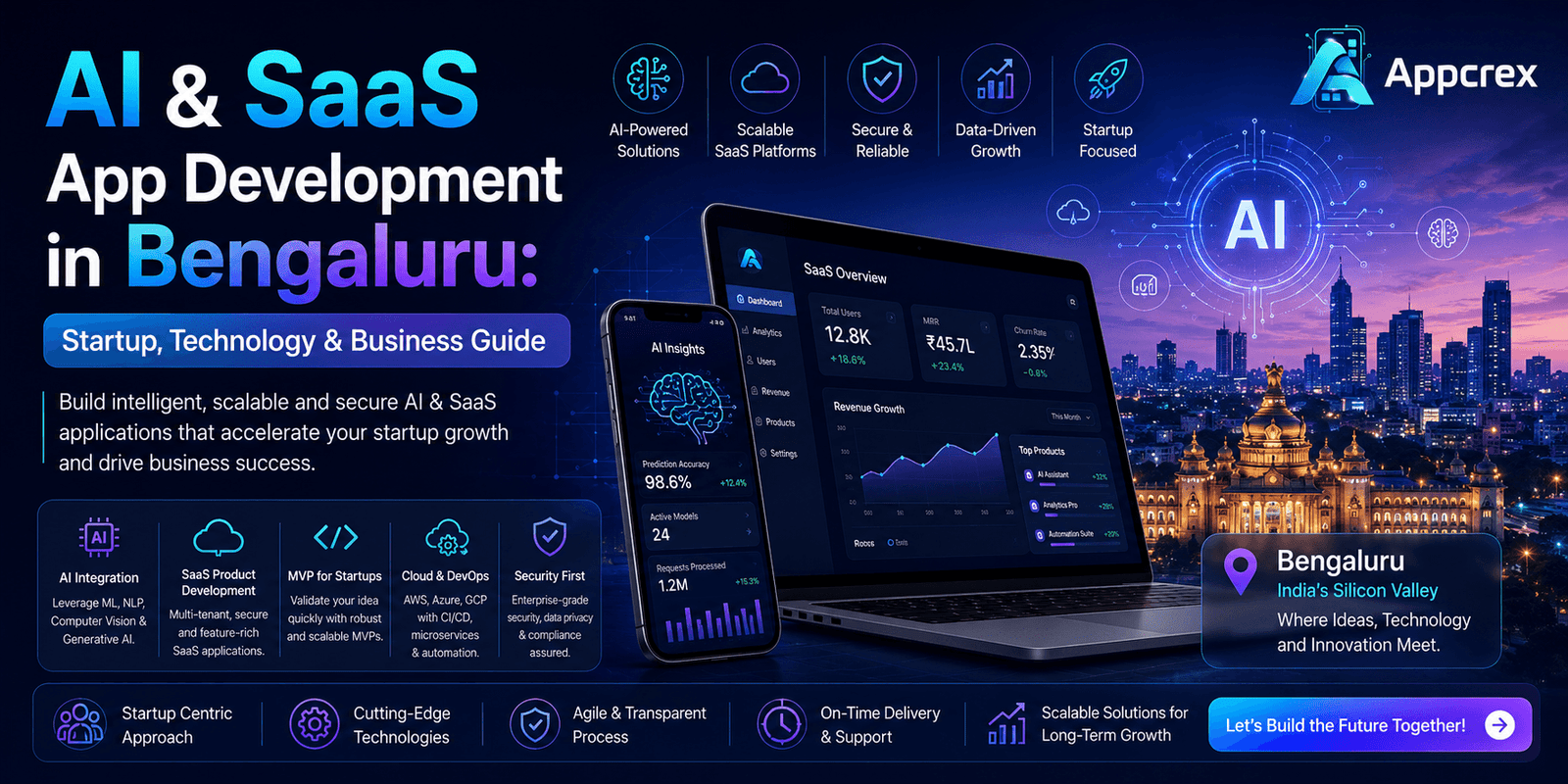
Bengaluru has moved far beyond being known simply as India’s IT capital. In 2026, the city is increasingly positioned around AI, SaaS, deep tech, Global Capability Centres (GCCs), enterprise software, and startup-led innovation.
The Karnataka government describes Bengaluru as a major startup and technology hub, while recent ecosystem reports highlight the city’s strength in AI application development, agentic workflows, SaaS, cloud infrastructure, and enterprise technology.
For businesses planning a new digital product, this creates an important opportunity: instead of developing a generic mobile application, companies can build AI-powered SaaS products, B2B platforms, intelligent business apps, automation tools, and enterprise solutions designed around specific market problems.
This guide explores Bengaluru’s technology ecosystem, the types of applications businesses can build, important technologies, development costs, timelines, AI opportunities, and how to choose the right development partner.
Just Read : What is SaaS Application Development? A Complete Guide (2026)
Bengaluru’s Technology Ecosystem
Bengaluru remains one of India’s strongest startup and technology markets.
Startup India identifies Bengaluru, Mumbai and NCR as India’s leading startup destinations, collectively accounting for a significant share of the country’s startup activity.
The city’s ecosystem is now becoming particularly interesting because several technology trends are converging:
- Artificial intelligence
- SaaS
- AI agents
- Enterprise software
- Cloud computing
- Data engineering
- Deep tech
- Robotics
- IoT
- Global Capability Centres
- Developer platforms
Karnataka’s startup infrastructure also includes incubators, accelerators, research organisations, technology centres and government-backed initiatives designed to support innovation and entrepreneurship.
Why AI & SaaS Are Important for Bengaluru Businesses?
Traditional software generally performs predefined tasks.
AI-powered software can interpret information, generate content, identify patterns and assist users with more flexible workflows.
This is creating a new category of products where:
Software + Data + AI + Automation = Intelligent Business Platform
For example, a traditional customer-support platform may simply store tickets.
An AI-enabled version could:
- Classify incoming requests
- Summarise conversations
- Identify customer sentiment
- Suggest responses
- Search internal knowledge
- Escalate high-priority cases
- Generate reports
This type of functionality is particularly relevant to Bengaluru’s large technology, enterprise and startup ecosystem.
What Types of Apps Can Be Developed in Bengaluru?
Rather than focusing on one industry, Bengaluru provides opportunities across multiple technology-driven product categories.
1. AI-Powered SaaS Platforms
Businesses can develop SaaS products where AI becomes part of the core workflow.
Examples include:
- AI CRM
- AI customer support
- AI sales automation
- AI marketing platforms
- AI analytics
- AI recruitment software
- AI document processing
- AI productivity tools
The Bengaluru Innovation Report highlights application-layer AI, including agentic workflows for SaaS, logistics, lending and customer support.
2. B2B Mobile Applications
Bengaluru’s business ecosystem creates demand for applications used by employees, sales teams, field workers and enterprise customers.
Possible products include:
- Sales apps
- Employee platforms
- Field-service applications
- Inventory management
- Procurement apps
- Business dashboards
- Partner portals
These applications can connect mobile users with a central cloud-based business system.
3. Enterprise Applications
Large organisations increasingly require custom software rather than one-size-fits-all products.
A custom enterprise application can combine:
Mobile App + Web Dashboard + APIs + Cloud + AI + Business Database
This approach can support internal workflows while connecting different departments and systems.
Also Read : Enterprise App Development Company: Complete Guide to Cost, Features & Process
AI Agents: A New Opportunity for SaaS Products
One of the biggest changes in modern software is the move from simple AI assistants toward AI agents.
An AI assistant may answer a question.
An AI agent can potentially perform a sequence of approved tasks.
For example:
User Request → AI Agent → Data Retrieval → Business Logic → Action → Confirmation
A sales platform could use an agent to:
- Find a customer record.
- Review recent interactions.
- Summarise the account.
- Identify pending actions.
- Prepare a follow-up.
- Ask for approval before sending.
The Bengaluru Innovation Report specifically points to agentic AI and application-layer development as important parts of the city’s emerging technology ecosystem.
SaaS Product Opportunities in Bengaluru
A SaaS business doesn’t necessarily need millions of users to become valuable.
A focused B2B product can target a specific business problem.
HR SaaS
Potential features:
- Employee management
- Recruitment
- Attendance
- Leave management
- AI resume analysis
- Employee analytics
Sales SaaS
Potential features:
- Lead management
- CRM
- Sales pipeline
- Automated follow-ups
- AI sales insights
Logistics SaaS
Potential features:
- Fleet tracking
- Delivery management
- Route planning
- Driver management
- AI-based optimisation
Finance SaaS
Potential features:
- Expense management
- Invoicing
- Financial dashboards
- Automated reporting
- Document processing
Marketing SaaS
Potential features:
- Campaign management
- Content generation
- Customer segmentation
- Analytics
- AI recommendations
Mobile Apps + SaaS: A Powerful Combination
Many modern products shouldn’t be viewed as “just an app.”
A better architecture may consist of multiple components:
Customer Mobile App
Used by customers or end users.
Business Dashboard
Used by administrators and managers.
SaaS Backend
Handles business rules, users and data.
API Layer
Connects the application with external services.
AI Layer
Provides intelligent features and automation.
Cloud Infrastructure
Provides scalability, storage and deployment.
This structure can turn a simple mobile product into a complete digital platform.
Technologies Used for Bengaluru App Development
The technology stack depends on the product requirements.
Mobile Development
Common options include:
- Flutter
- React Native
- Kotlin
- Swift
For startups, Flutter and React Native can be considered when cross-platform development is appropriate.
For platform-specific requirements, native Android or iOS development may be preferable.
Backend Development
Common backend technologies include:
- Node.js
- Python
- Java
- .NET
Python can be particularly useful where AI and data-processing capabilities are central to the product.
Database
Depending on the use case, teams may work with:
- PostgreSQL
- MySQL
- MongoDB
- Redis
- Cloud-native databases
Cloud Infrastructure
SaaS applications often require scalable cloud infrastructure using platforms such as:
- AWS
- Microsoft Azure
- Google Cloud
Cloud architecture can include:
- Containers
- Serverless services
- Object storage
- Managed databases
- Monitoring
- Automated deployment
Generative AI in Bengaluru SaaS Products
Generative AI is opening new possibilities for SaaS companies.
Instead of asking users to navigate complicated interfaces, products can provide conversational ways to interact with business information.
For example:
“Show me the sales performance of the Bengaluru region this month.”
The system could retrieve authorised data and generate a concise explanation.
Other applications include:
- AI report generation
- Document summarisation
- Content generation
- Natural-language search
- Meeting summaries
- Customer support
- Knowledge assistants
- AI-powered analytics
However, businesses should avoid adding AI simply because it is trending. The AI feature should solve a real user problem.
AI Integration vs Custom AI Development
This distinction is important when estimating project requirements.
AI API Integration
The application uses an existing AI model or service.
This can be appropriate for:
- Chatbots
- Summarisation
- Content generation
- Classification
- AI search
Custom AI Development
The business develops a specialised model or machine-learning system.
This may involve:
- Data collection
- Data preparation
- Model development
- Training
- Evaluation
- Deployment
- Monitoring
Custom AI generally requires significantly more expertise, time and budget.
How Much Does App Development Cost in Bengaluru?
There is no single fixed development cost because the requirements of a simple mobile app and an AI-powered SaaS platform are very different.
For initial planning, businesses can consider the following broad ranges:
| Product Type | Indicative Development Cost |
|---|---|
| Basic Mobile App | $15,000–$25,000 |
| Business App | $25,000–$45,000 |
| Advanced Mobile Platform | $45,000–$75,000+ |
| SaaS Platform | $40,000–$80,000+ |
| AI-Powered SaaS | $50,000–$120,000+ |
| Enterprise Platform | $75,000–$150,000+ |
These are indicative planning ranges rather than fixed Bengaluru market prices.
The final estimate depends on the product scope, development team, integrations, technology, security requirements and AI complexity.
What Increases the Development Budget?
Several elements can significantly affect the final cost.
Advanced AI
Custom AI models and sophisticated AI agents require more development than basic API integration.
Multiple Platforms
Android, iOS and web applications increase the overall scope.
Complex Backend
Advanced workflows, databases and integrations require additional engineering.
Third-Party APIs
Payment gateways, maps, communication tools, CRMs and enterprise systems may require additional integration work.
Security
Enterprise and business applications often require additional security architecture and testing.
Scalability
A product expected to serve thousands or millions of users requires architecture designed for future growth.
Development Timeline for AI & SaaS Apps
A realistic timeline depends on the scope.
| Product | Approx. Timeline |
|---|---|
| Basic Mobile MVP | 2–4 months |
| Business Application | 3–6 months |
| SaaS MVP | 4–7 months |
| AI-Powered SaaS | 5–9 months |
| Enterprise Platform | 8–14+ months |
Planning, UI/UX, integrations, testing and deployment should all be included in the project schedule.
A Smarter Way to Build a SaaS Product
A common mistake is attempting to launch a huge platform immediately.
A better strategy is:
Step 1: Identify One Core Problem
Don’t start with 50 features.
Start with the problem users are willing to pay to solve.
Step 2: Define the MVP
Select only the features necessary to deliver the core value.
Step 3: Design the Product
Create user flows, wireframes and interface designs.
Step 4: Develop the Core Platform
Build the mobile/web interface, backend and database.
Step 5: Add AI Where It Creates Value
Introduce AI into workflows where it can reduce manual work or improve decision-making.
Step 6: Launch
Release the product to a controlled group of users.
Step 7: Measure & Improve
Use real user behaviour to decide what to develop next.
Also Read : What Is an MVP in App Development? A Complete Guide
Bengaluru’s GCC Ecosystem and Enterprise Technology
Another important factor is Bengaluru’s strong Global Capability Centre ecosystem.
In June 2026, the Government of India reported that a GCC Conclave in Bengaluru brought together GCC leaders, R&D heads, innovation teams, startups, incubators and policymakers, with participation from organisations including Intel, IBM, Bosch, Amazon, SAP, NVIDIA, Samsung and others.
For software businesses, this means there is an opportunity not only to build consumer applications but also:
- Enterprise software
- Internal business platforms
- AI automation
- R&D tools
- Data platforms
- Developer tools
- Workflow systems
- Cloud applications
This strengthens the case for a Bengaluru-focused B2B, SaaS and enterprise technology content strategy.
Bengaluru’s Startup Environment
The startup ecosystem is another reason to focus on this market.
Karnataka’s startup ecosystem includes government-backed support, incubators, accelerators, funding networks, market-access programmes and technology-focused initiatives.
Recent Karnataka ecosystem reporting also highlights Bengaluru’s growing position in AI, startups and GCC-driven innovation.
This makes the city relevant for businesses at several stages:
Idea → MVP → Startup → Scale-up → Enterprise
Also Read : Mobile App Development in India: Cost, Technologies, Process & Business Opportunities
Who Should Consider Developing an App in Bengaluru?
This market is particularly relevant for:
Startups
Build and test new SaaS or AI products.
SMEs
Digitise internal operations.
Enterprise Businesses
Develop custom workflow and automation systems.
SaaS Companies
Create mobile companions for existing web platforms.
Global Companies
Build specialised products or R&D solutions.
Entrepreneurs
Turn a validated business concept into an MVP.
Also Read : Hire Mobile App Developers in India
How to Choose an App Development Company in Bengaluru?
The cheapest development quote isn’t necessarily the best option.
Before selecting a company, evaluate:
Technical Experience
Does the team understand your required technology?
Relevant Portfolio
Have they developed similar products?
AI Capability
If AI is important, determine whether they have genuine AI implementation experience rather than simply adding an AI API.
Architecture
Ask how the application will scale as users increase.
Security
Understand how authentication, data protection and access control will be implemented.
Communication
Establish how progress, changes and issues will be communicated.
Post-Launch Support
Clarify whether the team provides maintenance and future development.
Why AppCrex for Bengaluru App Development?
AppCrex helps startups and businesses build mobile applications, SaaS products and AI-powered digital platforms.
Depending on the project, the development team can support:
- Mobile app development
- Flutter development
- React Native development
- Android development
- iOS development
- SaaS development
- AI app development
- Generative AI integration
- AI agent development
- Backend development
- API integration
- Cloud development
- UI/UX design
- QA testing
- Maintenance
Instead of treating every project as a standard mobile app, AppCrex can structure development around the business model, target users, technology requirements and long-term product roadmap.
FAQs
Why is Bengaluru a good location for AI and SaaS development?
Bengaluru has a mature technology and startup ecosystem combined with strong AI, enterprise, R&D and GCC activity. Recent Karnataka ecosystem material also highlights the city’s application-layer AI and agentic-AI capabilities.
How much does it cost to build an AI SaaS platform in Bengaluru?
An initial planning range can be around $50,000–$120,000+, depending on AI complexity, integrations, platforms, security and scalability requirements.
How long does it take to develop a SaaS application?
A SaaS MVP can take approximately 4–7 months, while a more advanced platform can require considerably longer.
Can I build both a mobile app and SaaS platform?
Yes. A mobile application can be connected to a SaaS backend and web-based administration or business dashboard.
Should every SaaS product use AI?
No. AI should be introduced when it improves a measurable part of the product, such as automation, search, analysis, recommendations or customer support.
Can AI agents be integrated into SaaS products?
Yes. AI agents can be designed to perform controlled, multi-step workflows, provided access permissions, validation and human oversight are appropriately designed.
Can AppCrex develop an AI-powered SaaS product?
Yes. AppCrex can support product development across mobile, backend, SaaS, AI integration, APIs, cloud infrastructure and ongoing maintenance.
Final Thoughts
Bengaluru’s technology opportunity is becoming broader than traditional mobile app development.
The city’s combination of AI, SaaS, startups, enterprise technology, R&D and GCC activity makes it a strong market for businesses looking to build intelligent digital products. Karnataka’s recent ecosystem initiatives and technology programmes further support innovation and startup development.
For entrepreneurs, the biggest opportunity may not be another generic mobile application. It could be a focused AI SaaS product, B2B platform, enterprise workflow solution, automation system, or mobile-first business product addressing a specific market problem.
The most effective approach is to start with a clear business use case, build a focused MVP, validate it with real users and then introduce AI, automation and advanced functionality as the product grows.
Build Your AI or SaaS Product With AppCrex
Planning an AI-powered SaaS platform, mobile application or enterprise solution in Bengaluru?
AppCrex can help with the complete product journey—from idea validation and UI/UX design to mobile development, backend engineering, AI integration, cloud deployment, testing and long-term support.
Have a product idea? Let’s turn it into a scalable digital platform with AppCrex.