📌 Key Takeaways
- App development in Oman can cost $15,000–$120,000+, depending on complexity.
- AI, Generative AI, APIs, and advanced features can significantly increase the budget.
- MVP development is a practical way to launch with a controlled investment.
- Flutter and React Native can help businesses build for multiple platforms efficiently.
- Arabic/English support, security, and scalability should be planned from the beginning.
Oman’s digital economy is creating new opportunities for businesses to move services, sales, and customer experiences to mobile platforms. Companies across Muscat, Salalah, Sohar, Nizwa, and other growing business hubs are exploring mobile apps for eCommerce, tourism, logistics, healthcare, education, food delivery, transportation, FinTech, and enterprise operations.
But before starting development, businesses need a realistic understanding of the investment involved.
So, how much does mobile app development cost in Oman?
A mobile app can cost approximately $15,000 to $120,000+ depending on its features, complexity, platform, UI/UX design, backend architecture, integrations, security, AI capabilities, and development approach.
However, there is no single fixed price. A simple business app and an AI-powered marketplace may both be called “mobile apps,” but their development requirements are completely different.
This guide takes a practical look at mobile app development cost in Oman, what businesses actually pay for, development timelines, industry-specific costs, AI and Generative AI opportunities, technology choices, and ways to build a product without unnecessarily increasing the budget.
Mobile App Development Cost in Oman: Quick Estimate
Instead of looking at one price, it is better to divide projects into different levels.
| Project Category | Estimated Cost | Typical Timeline |
|---|---|---|
| Simple App | $15,000 – $25,000 | 2–3 months |
| Standard Business App | $25,000 – $45,000 | 3–5 months |
| Advanced App | $45,000 – $80,000 | 5–8 months |
| Complex Marketplace/Platform | $60,000 – $100,000+ | 6–10 months |
| Enterprise/AI-Powered App | $80,000 – $120,000+ | 8–12+ months |
These numbers are budgetary estimates, not fixed quotations. The final cost should be calculated after defining the product scope.
Why Does One App Cost More Than Another?
The development budget is usually driven by the amount of engineering required behind the interface.
For example:
App A
- 8–10 screens
- Basic login
- Company information
- Contact form
- Push notifications
This could be a relatively straightforward project.
App B
- Customer app
- Vendor dashboard
- Delivery app
- Admin panel
- Online payments
- GPS tracking
- Real-time chat
- AI recommendations
- Multiple APIs
Even if both products have a similar number of screens, App B requires substantially more backend development, testing, integrations, security, and infrastructure.
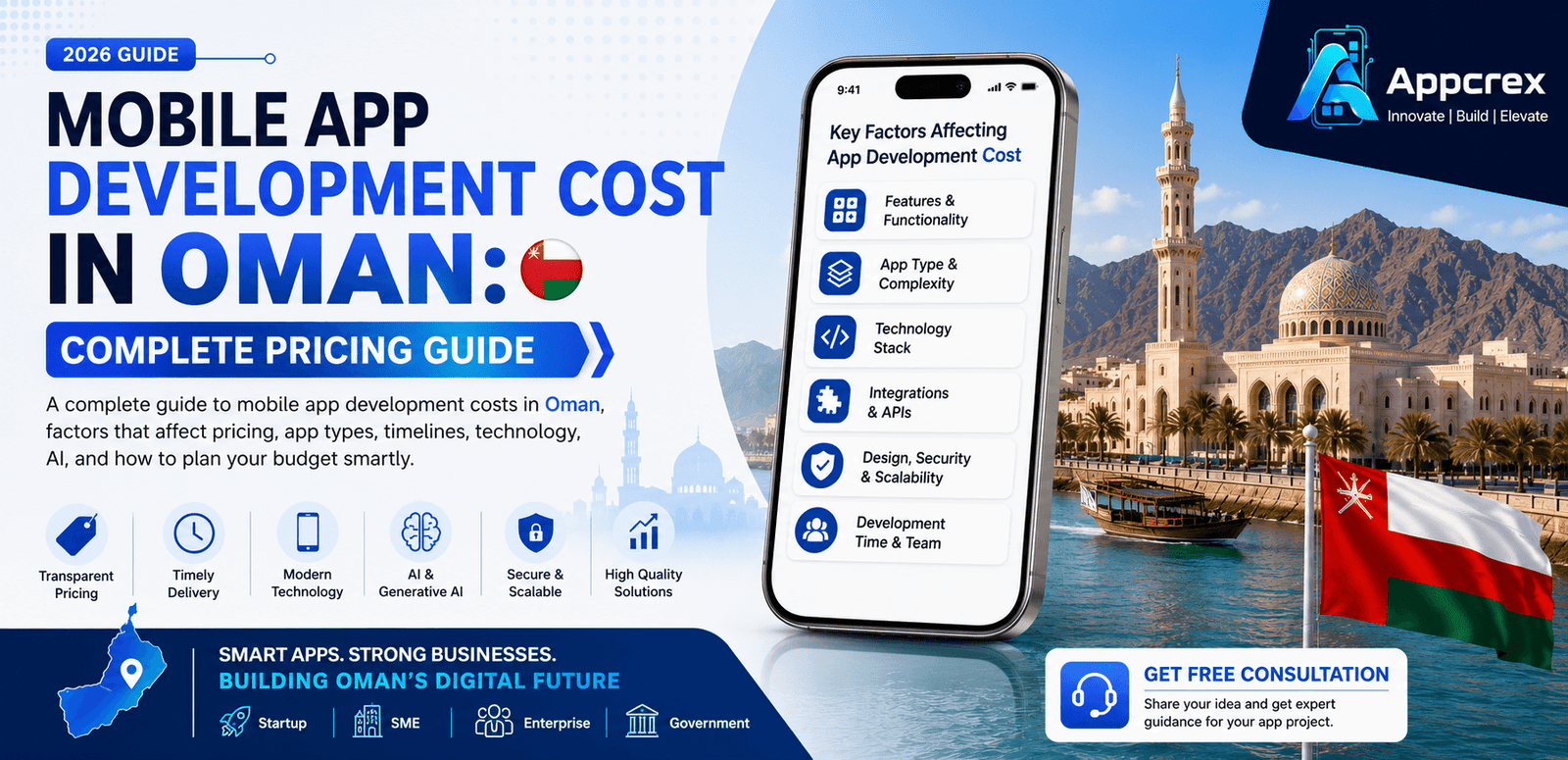
The major cost factors are therefore:
- Feature complexity
- Number of platforms
- Backend functionality
- UI/UX requirements
- API integrations
- Payment systems
- Real-time functionality
- AI/ML features
- Security
- Admin panels
- Cloud infrastructure
- Testing
- Maintenance
A Different Way to Look at App Development Pricing
Rather than asking only “How much does an app cost?”, businesses in Oman should break the investment into stages.
Product Strategy
Planning + market research + requirements
Experience Design
Wireframes + UX + UI + prototype
Engineering
Mobile app + backend + database + APIs
Intelligence
AI + automation + analytics + personalization
Quality
Testing + security + performance
Launch
Deployment + monitoring + support
This approach gives businesses a much clearer picture of where their budget is going.
Cost of Different Types of Mobile Apps in Oman
The industry and business model can significantly change development requirements.
eCommerce Apps
Oman’s retail businesses can use mobile commerce platforms to provide customers with a convenient way to browse products and place orders.
A typical eCommerce app may include:
- Product catalog
- Categories
- Search
- Filters
- Product variations
- Cart
- Checkout
- Payment gateway
- Order tracking
- Reviews
- Wishlist
- Coupons
- Loyalty rewards
Estimated cost: $25,000–$70,000+
A multi-vendor marketplace can cost considerably more because sellers require their own dashboards, product management, order processing, and payment-related functionality.
Food Delivery Apps
Food delivery platforms usually involve multiple applications rather than one.
A complete system can contain:
Customer App → Restaurant Dashboard → Delivery App → Admin Panel
Important features include:
- Restaurant discovery
- Digital menus
- Cart
- Checkout
- Online payments
- Delivery assignment
- GPS tracking
- Order status
- Offers
- Reviews
- Push notifications
Estimated cost: $35,000–$90,000+
Real-time tracking and multiple user roles are two of the biggest complexity factors.
Healthcare Apps
Healthcare businesses can use mobile solutions for appointments, telemedicine, patient engagement, and healthcare management.
Potential functionality includes:
- Doctor discovery
- Appointment booking
- Patient profiles
- Video consultation
- Medical information
- Prescription management
- Notifications
- Online payments
- Admin dashboard
Estimated cost: $35,000–$100,000+
Healthcare products require strong attention to data protection, authentication, authorization, and applicable regulatory requirements.
Tourism & Travel Apps
Tourism is another area where mobile technology can create useful customer experiences.
A tourism platform could combine:
- Destination discovery
- Hotel booking
- Activity booking
- Maps
- Itinerary creation
- Travel recommendations
- Reviews
- Notifications
- Offers
Estimated cost: $25,000–$75,000+
Adding AI-powered recommendations or intelligent itinerary planning can increase the development scope.
Logistics & Fleet Apps
Logistics businesses can use mobile applications to coordinate drivers, vehicles, shipments, and deliveries.
Features may include:
- Driver management
- Vehicle tracking
- GPS
- Route planning
- Shipment management
- Delivery status
- Proof of delivery
- Notifications
- Analytics
- Admin dashboard
Estimated cost: $40,000–$100,000+
IoT devices, real-time tracking, route optimization, and predictive analytics can increase the budget further.
What About AI-Powered Mobile Apps?
AI is no longer limited to standalone AI products.
Businesses can integrate AI directly into existing mobile applications to make them more intelligent.
For example:
eCommerce
AI can recommend products based on customer behavior.
Healthcare
AI can help organize information and provide intelligent navigation.
Logistics
Predictive models can help identify potential delivery delays.
Banking & FinTech
AI can assist with transaction analysis, personalization, and fraud monitoring.
Customer Service
AI assistants can answer common questions and automate support workflows.
Real Estate
AI can personalize property recommendations based on user preferences.
Depending on the implementation, AI can add $10,000 to $50,000+ to a project, while highly customized AI systems can require substantially more investment.
Generative AI: The Next Layer of Mobile App Intelligence
Generative AI can turn a conventional mobile app into an interactive digital assistant.
Instead of simply presenting predefined information, an application can understand natural-language requests and generate useful responses.
Businesses can use Generative AI for:
- AI chat assistants
- Intelligent search
- Content generation
- Document summarization
- Personalized recommendations
- Voice-based interactions
- Knowledge assistants
- AI customer support
- AI agents
- Automated workflows
For example, instead of searching through dozens of tourism categories, a user could ask:
“Plan a three-day trip around Oman based on my budget and interests.”
A Generative AI system could process the request and generate a personalized itinerary using connected business data and APIs.
Generative AI implementation can involve:
- LLM APIs
- RAG architecture
- Vector databases
- AI agents
- Prompt engineering
- Custom knowledge bases
- Backend orchestration
- Data security
- Monitoring
The cost depends heavily on how deeply AI is integrated into the product.
MVP Development: A Better Option for Startups
Not every business needs a $100,000 product on day one.
A startup can begin with an MVP (Minimum Viable Product) containing only the functionality required to validate the idea.
For example, a marketplace MVP might include:
- Registration
- Profiles
- Listings
- Search
- Booking/order functionality
- Payment
- Basic admin management
Advanced features such as AI recommendations, loyalty programs, subscriptions, advanced analytics, and automation can be added later.
Typical MVP budget: $15,000–$35,000+
This approach allows businesses to:
- Launch faster
- Test customer demand
- Collect feedback
- Identify popular features
- Reduce initial investment
- Plan future development based on real usage
Native vs Cross-Platform Development in Oman
Technology selection also affects the project budget.
Native Development
For dedicated platform development:
iOS → Swift
Android → Kotlin
Native development can provide excellent platform-specific performance and access to device functionality.
It can be suitable when an application has demanding performance requirements or requires deep platform integration.
Cross-Platform Development
Popular frameworks include:
- Flutter
- React Native
A shared codebase can help businesses launch on both iOS and Android while reducing duplicated development work.
For many startups and SMEs, cross-platform development can be a practical way to control development costs.
The final decision should depend on the application’s requirements rather than simply choosing whichever technology has the lowest initial price.
Arabic and English Support for Omani Apps
Businesses targeting customers in Oman may need both Arabic and English experiences.
This is particularly important for apps serving a broad customer base.
A multilingual product may require:
- Arabic translation
- English translation
- RTL support
- Localized content
- Localized notifications
- Date and number formatting
- RTL-friendly navigation
RTL should be considered during the design stage.
If Arabic support is added after the interface has already been developed, layouts may require substantial modification.
What Technology Stack Is Used?
A modern mobile application may combine several technologies.
Mobile Development
- Flutter
- React Native
- Swift
- Kotlin
Backend
- Node.js
- Python
- Java
- .NET
- PHP
Databases
- PostgreSQL
- MySQL
- MongoDB
- Firebase
Cloud
- AWS
- Microsoft Azure
- Google Cloud
AI
- Machine Learning
- Generative AI
- Large Language Models
- AI Agents
- Predictive Analytics
- Computer Vision
- Voice AI
The best stack depends on the product’s requirements, expected traffic, security needs, integrations, and long-term roadmap.
How Long Does It Take to Build an App in Oman?
There is no fixed timeline, but these ranges can help with planning:
| Development Level | Timeline |
|---|---|
| Simple App | 2–3 months |
| MVP | 2–4 months |
| Standard App | 3–6 months |
| Advanced App | 5–8 months |
| Enterprise App | 8–12+ months |
The development process generally includes:
Discovery → UX/UI → Development → Integration → Testing → Launch → Optimization
Adding new requirements during development can extend the timeline.
What Are the Ongoing Costs After Launch?
The development invoice is not the end of the investment.
Businesses should also consider:
Maintenance
Bug fixes, OS compatibility updates, security patches, and performance improvements.
Hosting
Cloud infrastructure costs depend on users, traffic, storage, and processing requirements.
Third-Party APIs
Maps, SMS, email, payment services, analytics, and AI APIs may have recurring charges.
AI Usage
Generative AI applications may have ongoing model/API costs based on usage.
Marketing
Launching the app does not automatically generate users. Businesses may need ASO, digital advertising, social media, and other acquisition strategies.
Future Features
Customer feedback may create the need for new features and product improvements.
How to Keep Your Oman App Development Budget Under Control?
The goal should not be finding the cheapest developer.
Instead, focus on getting the right product built efficiently.
1. Start With Business Goals
Define the problem the application is solving before creating a feature list.
2. Separate Essential and Optional Features
Put advanced functionality into a future roadmap if it isn’t required for launch.
3. Plan Integrations Early
Identify payment gateways, maps, CRM, ERP, AI, and other integrations before development starts.
4. Select Technology Carefully
Choose native or cross-platform development based on actual requirements.
5. Design Before Development
A prototype can expose UX problems before expensive engineering begins.
6. Build in Phases
Launch the core product, measure usage, and then expand.
7. Think About Scalability Early
A scalable architecture can prevent expensive redevelopment when the user base grows.
How to Choose an App Development Company in Oman?
A development partner should be evaluated on more than price.
Look for:
Relevant experience
Has the company built similar products?
Technical capabilities
Can it handle mobile, backend, APIs, cloud, AI, and security?
UI/UX expertise
Can it create a simple and engaging customer experience?
Communication
Are requirements, milestones, and deliverables clearly explained?
Testing methodology
Does the team test across devices and real-world scenarios?
Post-launch support
Can the same team maintain and improve the product?
A reliable mobile app development company in Oman should be able to explain the reasoning behind its estimate instead of simply giving you a number.
A Practical Development Roadmap
Instead of following the same development process for every business, the roadmap should be adapted to the product.
For a Startup
Idea → Market validation → MVP → Launch → Feedback → Scale
For an Established Business
Business analysis → UX redesign → Integration → Development → Migration → Launch
For an AI Product
Use case → Data strategy → AI architecture → MVP → Model/API integration → Testing → Production
For an Enterprise Platform
Discovery → Architecture → Multiple modules → Integrations → Security → Testing → Deployment → Optimization
This is why two projects with similar budgets may have completely different development processes.
Why AppCrex for Mobile App Development in Oman?
AppCrex works with businesses looking to build modern mobile and digital products across different industries.
Our capabilities include:
- Custom mobile app development
- Android app development
- iOS app development
- Flutter development
- React Native development
- AI app development
- Generative AI integration
- Machine learning solutions
- AI agent integration
- eCommerce app development
- FinTech app development
- Healthcare app development
- Logistics app development
- On-demand app development
- API integration
- Cloud solutions
- UI/UX design
- App maintenance
Whether you’re developing an MVP or a complex enterprise platform, AppCrex can help plan the product around your target users, business model, budget, technology requirements, and growth strategy.
FAQs
Q. How much does it cost to develop a mobile app in Oman?
Mobile app development in Oman can cost approximately $15,000–$120,000+, depending on features, complexity, platform, integrations, and technology.
Q. What is the cost of a basic app?
A basic application may cost approximately $15,000–$25,000.
Q. How much does an advanced app cost?
An advanced app can require around $45,000–$80,000+, while enterprise products can exceed $120,000.
Q. How much does an MVP cost in Oman?
An MVP can typically start around $15,000–$35,000+, depending on the product’s core functionality.
Q. Can AI be added to an existing mobile app?
Yes. AI can be introduced through APIs, machine learning models, Generative AI, AI agents, recommendation engines, predictive analytics, and other approaches.
Q. Is Arabic support necessary?
For applications targeting Arabic-speaking customers, Arabic and RTL support can improve usability and accessibility.
Q. Which is cheaper, Flutter or native development?
Cross-platform development can reduce duplicated development effort for iOS and Android, but the best choice depends on the project’s technical requirements.
Q. How long does mobile app development take in Oman?
A simple app may take 2–3 months, while advanced and enterprise applications can take 5–12+ months.
Final Verdict
There is no single answer to “What is the mobile app development cost in Oman?”
A simple application may require around $15,000, while a feature-rich marketplace, FinTech platform, logistics system, or AI-powered application can reach $80,000–$120,000+.
The smartest approach is to avoid estimating the project purely by the number of screens.
Instead, evaluate:
Business goals + Features + Technology + Integrations + Security + AI + Scalability
For startups, an MVP can provide a controlled starting point. For established organizations, a more comprehensive architecture may make sense from the beginning.
And with AI, Generative AI, predictive analytics, automation, and AI agents becoming increasingly accessible, businesses don’t necessarily need to build a separate AI product. Intelligent capabilities can be integrated directly into an existing mobile experience where they solve a genuine customer or operational problem.
Build Your Mobile App in Oman With AppCrex
Have an idea for a mobile app targeting Oman or the wider GCC market?
AppCrex can help you move from concept and product strategy to UI/UX design, mobile development, backend engineering, API integration, AI/Generative AI implementation, testing, deployment, and ongoing support.
Whether you’re planning an eCommerce app, FinTech product, healthcare platform, logistics solution, marketplace, tourism app, or AI-powered mobile experience, the development roadmap can be customized around your business objectives.
Start your Oman mobile app project with AppCrex and get a development plan tailored to your requirements.