📌 Key Takeaways
- FinTech API integration connects financial applications with banking, payment, wallet, KYC, AML, lending, and financial data services.
- Banking and payment APIs help businesses build financial features faster without developing every service from scratch.
- Security is critical and should include proper authentication, authorization, encryption, token management, webhook validation, and monitoring.
- API aggregation can help fintech platforms manage multiple financial service providers through a centralized integration layer.
- Integration costs vary based on the number of APIs, complexity, security requirements, platforms, integrations, and transaction workflows.
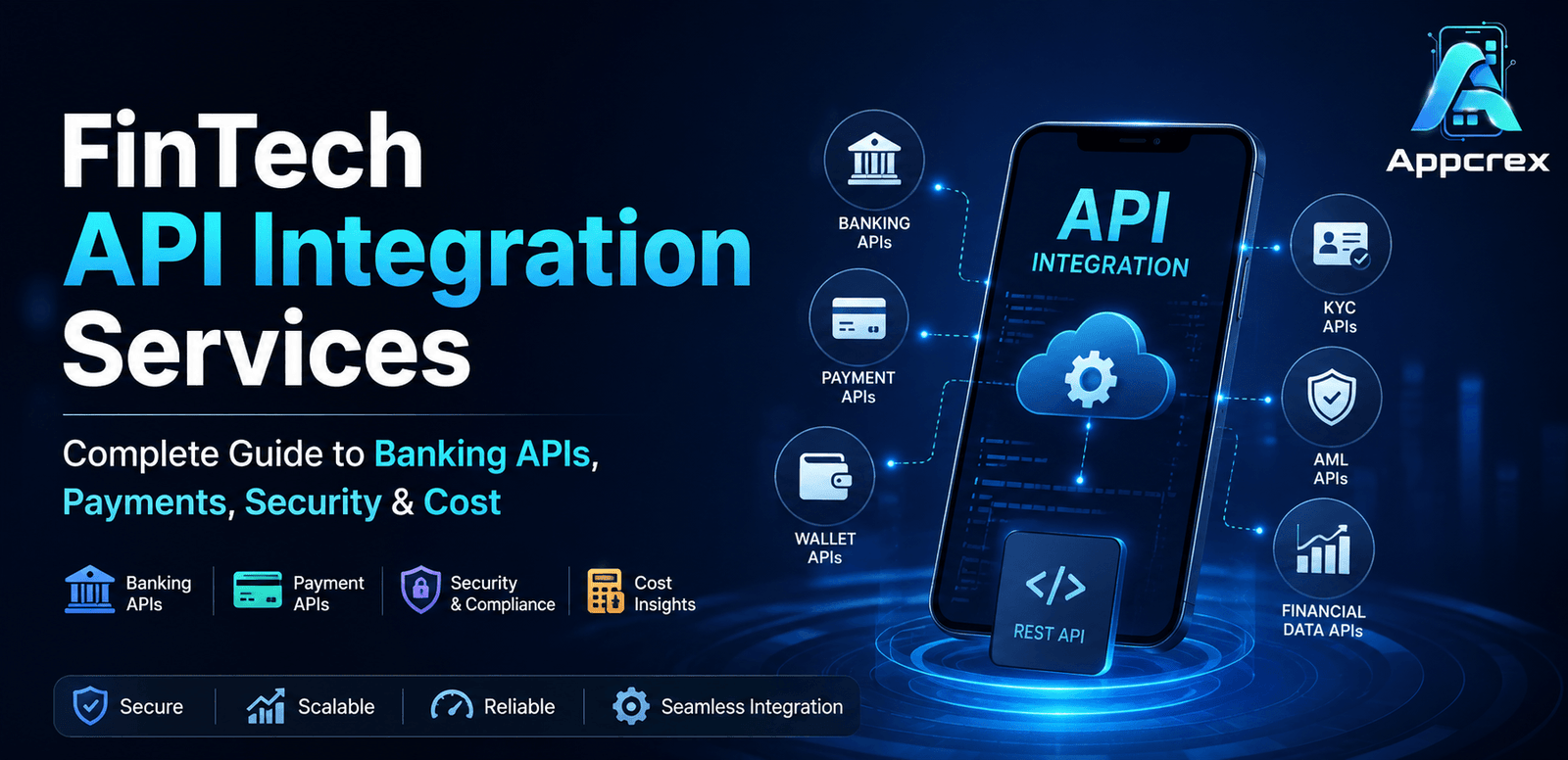
The financial technology industry is increasingly dependent on APIs to connect banking systems, payment gateways, digital wallets, lending platforms, investment services, and financial data providers. Instead of building every financial capability from scratch, businesses can use APIs to connect their applications with specialized financial infrastructure.
FinTech API Integration Services help businesses create these connections securely and efficiently. From banking APIs and payment gateways to open banking, KYC, AML, lending, and financial data APIs, the right integration architecture can turn multiple financial services into one connected digital platform.
AppCrex provides custom FinTech API Integration Services for startups, fintech companies, banks, payment providers, digital wallets, SaaS businesses, and enterprises.
Just Read : What is SaaS Application Development? A Complete Guide (2026)
What Is FinTech API Integration?
FinTech API integration is the process of connecting a financial application or software platform with external financial services through APIs.
An API, or Application Programming Interface, allows two different software systems to communicate with each other.
For example:
FinTech App → API → Banking/Payment Provider → Response → FinTech App
A fintech platform may use APIs to:
- Access bank account information
- Process payments
- Initiate transfers
- Verify customer identities
- Screen customers
- Access financial data
- Manage digital wallets
- Support lending workflows
- Connect investment services
- Monitor transactions
This approach allows businesses to build powerful financial products without developing every underlying financial service themselves.
Why Is FinTech API Integration Important?
Modern financial platforms rarely operate as standalone systems. They often depend on multiple third-party services for payments, banking, identity verification, financial data, compliance, and other functions.
A well-designed API integration strategy can help businesses:
- Connect multiple financial services
- Automate financial workflows
- Reduce development time
- Improve transaction processing
- Access real-time data
- Simplify customer onboarding
- Improve operational efficiency
- Build scalable fintech products
- Reduce manual processes
- Deliver better customer experiences
For businesses operating across multiple countries, APIs can also make it easier to connect with regional financial providers.
Just Read : What Is API Integration? A Complete Guide to Benefits, Types & Best Practices (2026)
Types of FinTech APIs Businesses Can Integrate
There are many types of APIs used throughout the fintech ecosystem.
Banking APIs
Banking APIs allow authorized applications to communicate with banking systems.
Depending on the provider, they may support:
- Account information
- Account verification
- Balance information
- Transaction history
- Fund transfers
- Payment initiation
- Beneficiary management
Banking API capabilities vary by provider, country, and regulatory framework.
Payment APIs
Payment APIs connect applications with payment service providers.
They can support:
- Payment processing
- Payment verification
- Refunds
- Payment status
- Recurring payments
- Transaction records
- Webhooks
Payment APIs are commonly used by eCommerce businesses, SaaS platforms, marketplaces, mobile apps, and fintech applications.
Open Banking APIs
Open banking APIs allow authorized third-party applications to access financial services or information with the appropriate customer permissions.
Potential use cases include:
- Account aggregation
- Account information
- Payment initiation
- Transaction data
- Financial management
- Account verification
Consent and data protection are important considerations when implementing open banking solutions.
Digital Wallet APIs
Digital wallet APIs can connect wallet functionality with mobile apps and web platforms.
Features may include:
- Wallet creation
- Balance management
- Fund transfers
- Deposits
- Withdrawals
- Transaction history
- Payment processing
KYC APIs
Know Your Customer APIs help businesses integrate identity verification into customer onboarding.
A KYC integration may support:
- Identity verification
- Document verification
- Customer matching
- Identity status
- Customer onboarding
- Risk-related information
AML APIs
Anti-Money Laundering APIs can help financial businesses integrate screening and monitoring services.
Depending on the provider, these APIs may support:
- Customer screening
- Sanctions screening
- Risk checks
- Transaction monitoring
- Alerts
Businesses should implement AML workflows according to the laws and regulations applicable to their specific market and business model.
Lending APIs
Lending businesses can integrate APIs for different stages of the lending lifecycle.
These may include:
- Customer verification
- Credit information
- Income verification
- Loan applications
- Risk assessment
- Payment processing
Investment APIs
Investment and wealth management platforms can use APIs to connect with financial data and investment services.
Possible functionality includes:
- Market data
- Portfolio information
- Account information
- Investment transactions
- Reporting
Also Read : Why Does Your Business Need Payment Gateway Integration Services?
Key Benefits of FinTech API Integration
1. Faster Product Development
Businesses can connect existing financial services instead of developing every capability from the ground up.
2. Reduced Development Complexity
APIs provide standardized ways to communicate with external services, reducing the amount of custom infrastructure required.
3. Improved Automation
Financial workflows such as payment verification, customer verification, transaction updates, and notifications can be automated.
4. Better Customer Experience
Customers can access payments, financial data, transfers, and other services from a single platform.
5. Scalability
A properly designed API architecture can support additional users, transactions, providers, and financial services as the business grows.
6. Easy Integration With Multiple Services
Businesses can connect banking, payments, KYC, AML, lending, wallet, and other financial systems within one ecosystem.
FinTech API Integration for Payments
Payments are one of the most common fintech API integration use cases.
A typical workflow looks like:
Customer → Checkout → Payment API → Payment Provider → Bank/Network → Transaction Result
Payment API integration can include:
- Payment creation
- Payment authorization
- Transaction verification
- Refund processing
- Payment status
- Recurring billing
- Webhooks
- Transaction history
A well-designed integration should also handle failed transactions, duplicate requests, provider errors, and asynchronous payment events.
FinTech API Integration for Banking
Banking API integration can connect financial applications with banking services.
Depending on the provider, businesses may implement:
- Account verification
- Account information
- Balance retrieval
- Transaction history
- Payment initiation
- Fund transfers
- Beneficiary management
This can be useful for:
- Neobanks
- Fintech applications
- Personal finance platforms
- Payment platforms
- Lending platforms
- Enterprise financial software
FinTech API Integration for Digital Wallets
Digital wallets require APIs to manage financial transactions and user balances.
A wallet integration can support:
User → Wallet → API → Payment/Banking Service → Transaction Update
Possible functionality includes:
- Wallet creation
- Balance management
- Deposits
- Withdrawals
- Transfers
- Payments
- Transaction history
- Notifications
FinTech API Integration for KYC & AML
Financial platforms often need identity verification and financial crime screening as part of customer onboarding and risk management.
KYC and AML API integrations can help connect fintech platforms with specialized providers.
A typical workflow can be:
Customer Registration → KYC API → Verification → Risk Screening → Account Activation
The exact workflow depends on the business model, jurisdiction, and compliance requirements.
FinTech API Security
Security is one of the most important considerations when integrating financial APIs.
Financial APIs may process sensitive customer, account, payment, or transaction information. The integration architecture should therefore include appropriate security controls.
1. Authentication
Authentication verifies the identity of applications, services, or users accessing the API.
2. Authorization
Authorization determines what a user or service is permitted to access or perform.
3. Encryption
Encryption helps protect sensitive information while it is being transmitted and, where appropriate, stored.
4. Tokenization
Tokenization can reduce exposure of sensitive payment information by replacing it with tokens where supported.
5. API Rate Limiting
Rate limiting helps control request volumes and can reduce abuse or accidental overload.
6. Webhook Verification
Payment and financial providers frequently use webhooks to send event notifications. These events should be verified before being processed.
7. Audit Logging
Important API and financial events should be logged appropriately to support monitoring, troubleshooting, and auditing.
API Aggregation for FinTech Platforms
Large fintech platforms may need to connect with multiple financial service providers.
Instead of integrating every provider separately throughout the application, businesses can create an API abstraction or aggregation layer.
For example:
FinTech Platform → API Layer → Provider A / Provider B / Provider C
This architecture can help businesses:
- Standardize API responses
- Manage multiple providers
- Centralize authentication
- Simplify application development
- Monitor provider performance
- Add or replace providers more efficiently
API aggregation can be particularly useful for businesses operating across different countries or financial ecosystems.
Also Read : Banking App Development Company: Complete Guide to Features, Cost & Process (2026)
FinTech API Integration Features
A customized fintech API integration solution can include:
- Banking API integration
- Payment API integration
- Open banking integration
- Digital wallet integration
- KYC API integration
- AML API integration
- Lending API integration
- Investment API integration
- Financial data integration
- Currency exchange APIs
- Transaction APIs
- REST API integration
- Webhooks
- OAuth-based authentication
- API monitoring
- Error handling
- Retry mechanisms
- Transaction reconciliation
- Notifications
- Audit logs
- API analytics
The final feature set should be determined by the platform’s business requirements and the capabilities of the selected providers.
FinTech API Integration for Mobile Apps
Mobile fintech applications need reliable API connections between the mobile interface and backend financial services.
AppCrex can integrate financial APIs with:
- Android applications
- iOS applications
- Flutter apps
- React Native apps
- Cross-platform applications
Mobile API integrations can support:
- Account information
- Payments
- Transfers
- Wallets
- KYC
- Notifications
- Transaction history
The backend should generally handle sensitive financial operations rather than exposing confidential provider credentials directly inside the mobile application.
FinTech API Integration for Web Applications
Financial APIs can also be integrated with web-based platforms.
Examples include:
- Online banking dashboards
- Payment platforms
- Lending portals
- Financial management software
- Investment platforms
- eCommerce platforms
- SaaS applications
Web integrations can include customer dashboards, admin panels, payment workflows, financial analytics, transaction management, and reporting.
FinTech API Integration Development Process
A structured development process helps reduce integration errors and improve reliability.
Step 1: Requirement Analysis
The first step is understanding:
- Business model
- Target users
- Financial workflows
- Required APIs
- Target countries
- Existing technology
- Security requirements
Step 2: API Provider Selection
The appropriate providers are evaluated based on:
- API capabilities
- Geographic availability
- Documentation
- Pricing
- Reliability
- Security
- Compliance requirements
Step 3: Architecture Planning
The integration architecture is designed around:
- API communication
- Authentication
- Data flow
- Database
- Error handling
- Webhooks
- Monitoring
Step 4: API Integration
Developers connect the required APIs with the website, mobile application, backend, or enterprise platform.
Step 5: Security Implementation
Security controls are implemented for authentication, authorization, encryption, tokens, access management, and webhook validation.
Step 6: Testing
The integration is tested for:
- API functionality
- Payment workflows
- Authentication
- Error handling
- Webhooks
- Performance
- Security
- Integration failures
Step 7: Deployment
The completed integration is deployed to the required cloud or infrastructure environment.
Step 8: Monitoring & Maintenance
After deployment, API performance, failures, provider updates, and transaction issues should be monitored.
Technology Stack for FinTech API Integration
The technology stack depends on your existing platform and integration requirements.
Backend
- Python
- Node.js
- Java
- .NET
- PHP
API Technologies
- REST API
- GraphQL
- Webhooks
- OAuth 2.0
Databases
- PostgreSQL
- MySQL
- MongoDB
- Redis
Cloud
- AWS
- Microsoft Azure
- Google Cloud
Security
- OAuth
- JWT
- API keys
- Encryption
- Role-based access control
The final technology stack should be selected based on transaction volume, latency, security, integrations, and scalability requirements.
How Much Does FinTech API Integration Cost?
The cost of fintech API integration depends on the number of APIs, complexity of financial workflows, security requirements, platforms, and third-party providers.
| Integration Type | Estimated Cost |
|---|---|
| Single FinTech API Integration | $3,000 – $8,000 |
| Payment API Integration | $4,000 – $12,000 |
| Banking API Integration | $7,000 – $20,000 |
| Multiple FinTech API Integrations | $15,000 – $40,000 |
| Enterprise FinTech API Platform | $30,000 – $80,000+ |
These figures are indicative development estimates. The actual cost depends on project requirements.
Factors Affecting FinTech API Integration Cost
- Number of APIs
- API complexity
- Number of platforms
- Transaction volume
- Security requirements
- KYC/AML integrations
- Real-time processing
- Data requirements
- API aggregation
- Custom backend development
- Testing requirements
- Compliance requirements
FinTech API Integration Company for Global Markets
FinTech businesses operate across different regulatory and technological environments. API integration therefore needs to be designed according to the target market.
USA
FinTech API integration for payments, banking, lending, financial data, digital wallets, and enterprise financial platforms.
UK
Open banking, payment, banking, KYC, AML, and financial data API integration.
Canada
Custom financial API integrations for fintech startups, payment companies, lenders, and enterprises.
Dubai & UAE
FinTech API integration for digital wallets, payment platforms, banking solutions, eCommerce, and financial businesses.
Saudi Arabia
Banking, payment, wallet, financial data, and fintech API integrations for businesses in Riyadh and across Saudi Arabia.
India
Payment, banking, wallet, financial data, KYC, lending, and other fintech API integrations.
Singapore
FinTech API integration for banking, payments, investment, financial data, and enterprise applications.
Australia
Custom banking, payment, lending, financial data, and fintech API integrations.
These are target service markets and do not imply a physical AppCrex office in every listed location.
FinTech API Integration Use Cases
FinTech API integration can be used across many digital financial products.
1. Digital Banking
Connect account information, transfers, payments, verification, and other banking services.
2. Payment Platforms
Integrate payment processing, refunds, transaction status, and payment notifications.
3. Lending Platforms
Connect identity verification, credit information, banking data, risk services, and payment systems.
4. Digital Wallets
Integrate wallet management, payments, transfers, deposits, and withdrawals.
5. Personal Finance Apps
Connect authorized financial data to provide account aggregation and financial insights.
6. eCommerce
Integrate payments, refunds, subscriptions, transaction verification, and fraud prevention services.
7. Investment Platforms
Connect financial data, market information, portfolio services, and investment workflows.
FinTech API Integration vs Building Financial Services From Scratch
Businesses generally have two approaches: build financial infrastructure internally or integrate specialized third-party APIs.
| Factor | API Integration | Build From Scratch |
|---|---|---|
| Development Time | Usually faster | Usually longer |
| Initial Development | Lower | Higher |
| Customization | Provider-dependent | High |
| Maintenance | Shared with provider | Fully internal |
| Scalability | Depends on provider | Internally controlled |
| Financial Expertise | Provider may supply infrastructure | Required internally |
For many startups and businesses, API integration can be a practical way to launch financial features faster. However, the right approach depends on the product, regulatory requirements, technical resources, and long-term strategy.
Common Challenges in FinTech API Integration
FinTech integrations can involve technical and operational challenges.
1. API Changes
Third-party providers may update APIs or deprecate older versions.
2. Different Data Formats
Different providers may return financial information in different structures.
3. Authentication Complexity
Financial APIs often require specific authentication and authorization mechanisms.
4. Transaction Failures
Networks, banks, payment providers, and applications can all experience failures.
5. Webhook Management
Asynchronous events need to be validated and processed correctly.
6. Compliance Requirements
Financial applications may be subject to country-specific security, privacy, and regulatory requirements.
7. Provider Dependency
Depending heavily on a single provider can create operational risk, which is why some platforms use abstraction or multi-provider architectures.
Why Choose AppCrex for FinTech API Integration Services?
1. FinTech Development Expertise
AppCrex develops financial technology solutions for businesses that need secure and scalable financial integrations.
2. Custom API Architecture
We design API integrations according to your existing application, financial workflows, and business requirements.
3. Security-Focused Development
Security controls are incorporated throughout the API architecture and integration lifecycle.
4. Multi-API Integration
Connect banking, payments, wallets, KYC, AML, lending, financial data, and other services within one platform.
5. Scalable Solutions
Build an integration architecture that can support growing transaction volumes and additional financial services.
6. Cross-Platform Development
Integrate financial APIs with mobile apps, websites, SaaS platforms, and enterprise applications.
7. Flexible Engagement Models
You can work with:
- FinTech developers
- API integration developers
- Dedicated development teams
- Full-time developers
- Part-time developers
- FinTech consultants
FAQs
Q. What are FinTech API Integration Services?
FinTech API integration services connect applications with banking, payment, financial data, wallet, KYC, AML, lending, and other financial services through APIs.
Q. What is a banking API?
A banking API enables authorized applications to communicate with banking services. Depending on the provider, it can support account information, payments, transfers, and other banking functions.
Q. How much does FinTech API integration cost?
A basic integration may cost around $3,000–$8,000, while multiple integrations or enterprise fintech API platforms can cost significantly more.
Q. Can multiple financial APIs be integrated into one application?
Yes. Multiple APIs can be integrated through a centralized backend or API aggregation layer.
Q. Can FinTech APIs be integrated into mobile applications?
Yes. Financial APIs can be connected with Android, iOS, Flutter, React Native, and other mobile applications.
Q. How do you secure FinTech API integrations?
Security can include authentication, authorization, encryption, token management, rate limiting, webhook validation, access controls, monitoring, and audit logging.
Can you integrate KYC and AML APIs?
Yes. KYC and AML providers can be integrated into customer onboarding and financial risk workflows where required.
How long does FinTech API integration take?
The timeline depends on the number of APIs, complexity, platforms, security requirements, and testing scope. A project-specific timeline can be provided after requirements analysis.
Conclusion
FinTech API integration has become an important part of modern financial software development. Banking APIs, payment APIs, open banking, digital wallets, KYC, AML, lending, investment, and financial data APIs allow businesses to build connected financial products without developing every service internally.
However, successful integration requires more than simply connecting an API. Businesses need a secure architecture, reliable data flow, proper authentication, error handling, webhook management, scalability, and ongoing monitoring.
With the right API integration strategy, fintech startups and established businesses can create flexible financial platforms that are easier to scale and expand.
Build Your FinTech Platform with AppCrex
AppCrex provides FinTech API Integration Services for startups, fintech companies, payment businesses, financial platforms, SaaS companies, and enterprises.
Whether you need banking API integration, payment API integration, open banking, digital wallet APIs, KYC/AML integration, lending APIs, or a multi-provider financial API architecture, our team can help you plan and implement the right solution.
Ready to Integrate Financial APIs?
Talk to AppCrex about building secure, scalable, and reliable FinTech API integrations tailored to your business.