Introduction
The real estate industry is rapidly moving toward digital property discovery, with buyers, renters, property owners, and real estate agents increasingly relying on mobile apps to search, list, compare, and manage properties. A well-designed property listing app can bring these users together on one platform while making property discovery faster, more convenient, and more personalized.
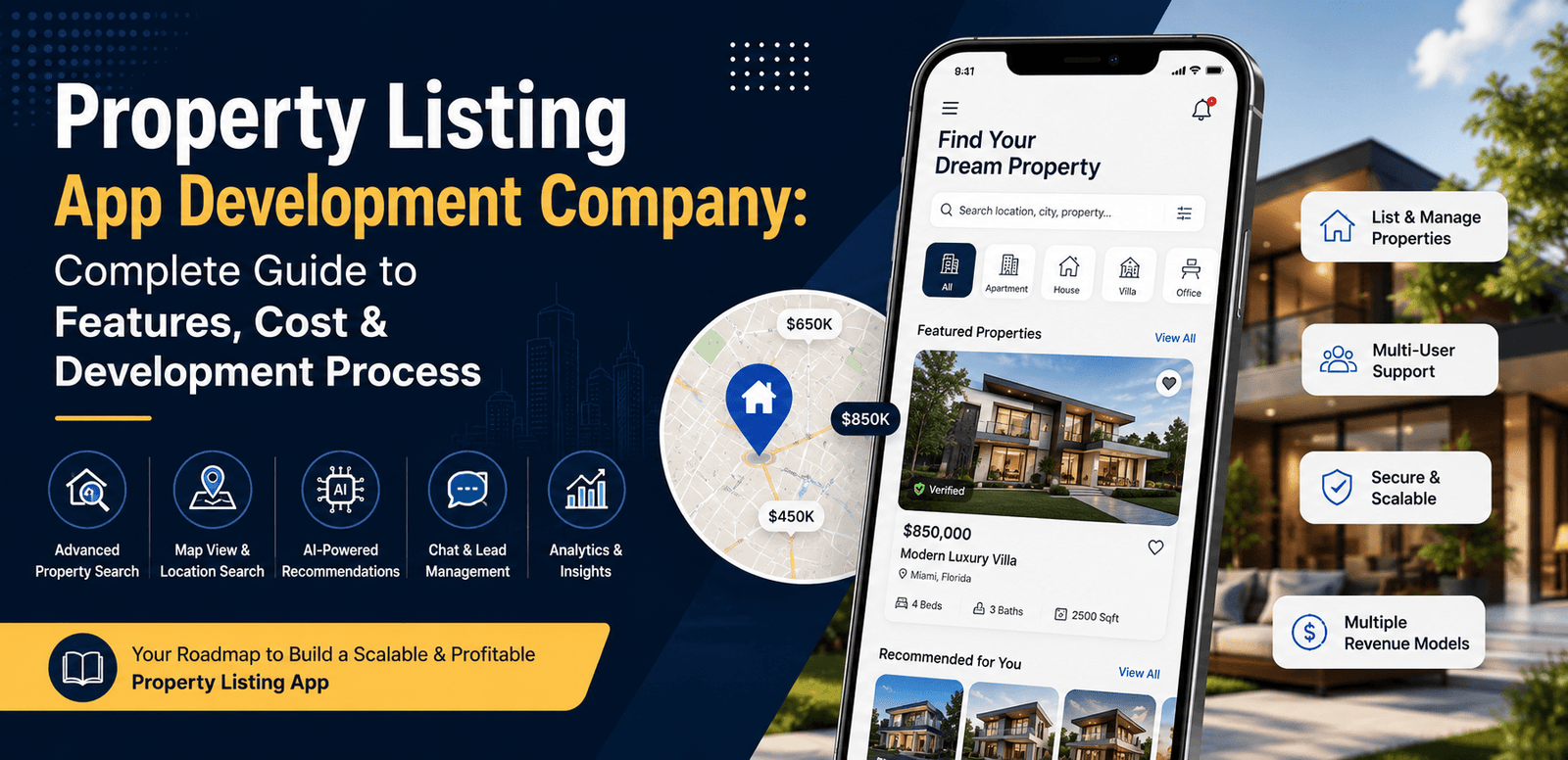
Modern property listing apps are no longer limited to property photos, prices, and contact details. Advanced platforms now offer map-based search, virtual tours, mortgage calculators, online appointments, agent dashboards, AI-powered recommendations, automated property descriptions, and intelligent search.
For real estate businesses, developing a custom property listing app can create new revenue opportunities while improving lead generation and customer engagement. For startups, it can provide the foundation for building a property marketplace similar to popular real estate platforms.
In this guide, we cover how to build a property listing app, essential features, AI capabilities, technology stack, development process, development cost, monetization models, and common mistakes to avoid.
What Is a Property Listing App?
A property listing app is a mobile or web platform that allows users to discover, list, manage, and inquire about residential or commercial properties.
Depending on the business model, the platform can connect:
- Buyers
- Renters
- Property Owners
- Real Estate Agents
- Brokers
- Property Developers
- Administrators
Users can search properties based on location, price, property type, number of bedrooms, amenities, and other preferences.
For example, a user searching for a two-bedroom apartment in Dubai can enter a location, set a budget, apply filters, view properties on a map, compare listings, and contact the property agent directly.
Why Invest in Property Listing App Development?
The increasing adoption of digital property search has created opportunities for real estate companies and startups to build specialized property platforms.
Reach More Property Buyers and Renters
A mobile app allows users to search for properties whenever and wherever they want. This gives real estate businesses an additional channel to reach potential customers.
Generate Qualified Leads
Property listing apps can collect inquiries, preferences, saved properties, and search behavior. Agents can use this information to identify and follow up with high-intent prospects.
Improve Property Discovery
Advanced filters, location-based search, maps, recommendations, and AI-powered search make it easier for users to find relevant properties.
Create Multiple Revenue Streams
A property marketplace can generate revenue through:
- Premium listings
- Featured properties
- Agent subscriptions
- Advertising
- Lead generation
- Property promotion
- Transaction commissions
Build a Scalable Real Estate Marketplace
A properly designed platform can start with one city and gradually expand into additional cities, property categories, and countries.
Types of Property Listing Apps
The right type of app depends on your target users and business model.
Property Marketplace App
A marketplace allows multiple property owners, agents, and brokers to list their properties.
Suitable for: Real estate startups and marketplace businesses.
Rental Property App
These platforms focus on rental apartments, houses, commercial spaces, and other properties.
Suitable for: Rental agencies and property marketplaces.
Real Estate Agent App
An agent-focused application helps brokers manage listings, leads, appointments, and customers.
Suitable for: Real estate agencies and brokerage companies.
Commercial Property App
These apps focus on:
- Offices
- Retail spaces
- Warehouses
- Industrial properties
- Commercial buildings
Luxury Property App
A premium property platform can offer high-end listings with professional photography, 360° virtual tours, video walkthroughs, and personalized services.
How to Build a Property Listing App?
Building a successful property listing application requires more than developing a mobile interface. The platform needs a scalable backend, property management system, search engine, maps, communication tools, security, and potentially AI capabilities.
1. Define the Business Model
First, determine whether the platform will focus on:
- Property sales
- Rentals
- Commercial properties
- Luxury properties
- Agent listings
- Multi-vendor marketplace
This decision determines the features and monetization strategy.
2. Identify Target Users
Define the roles that will use the platform:
- Buyers
- Renters
- Owners
- Agents
- Brokers
- Admins
Each user type should have an appropriate dashboard and feature set.
3. Conduct Market & Competitor Research
Study competing property platforms to identify:
- Popular features
- Pricing models
- User pain points
- Search experience
- Property verification methods
- Monetization strategies
The goal should not be to simply copy competitors but to identify opportunities for differentiation.
4. Design the UI/UX
Property apps need simple navigation because users often browse multiple listings in a single session.
Important screens include:
- Home
- Search
- Filters
- Map
- Property Details
- Favorites
- Chat
- Agent Profile
- Appointment Booking
- User Dashboard
5. Develop the MVP
Start with core functionality such as:
- Registration
- Property Listings
- Search
- Filters
- Maps
- Favorites
- Property Details
- Contact Agent
Additional AI and advanced features can be introduced after validating the MVP.
6. Integrate APIs and Services
Depending on requirements, integrations may include:
- Maps
- Payment Gateways
- Push Notifications
- Chat
- Video Calling
- Property Data APIs
- AI APIs
- Analytics
7. Test the Platform
Test:
- Search performance
- Listing accuracy
- Payment security
- API reliability
- App performance
- Device compatibility
- Data security
8. Launch & Improve
After deployment, analyze user behavior and continuously improve search, recommendations, listings, and conversion rates.
Must-Have Features of a Property Listing App
User Features
Registration & Login
Users should be able to register through:
- Phone number
- Apple
Advanced Property Search
Users can search properties using:
- Location
- Price range
- Property type
- Bedrooms
- Bathrooms
- Area
- Amenities
- Furnishing
- Availability
Map-Based Search
Map integration allows users to discover properties based on their preferred location and surrounding areas.
Property Details
Each listing should provide:
- Property images
- Videos
- Price
- Location
- Description
- Amenities
- Property size
- Bedrooms
- Bathrooms
- Agent information
Favorites
Users can save properties and access them later.
Property Comparison
Allow users to compare multiple properties based on:
- Price
- Location
- Size
- Bedrooms
- Amenities
- Property type
Agent Communication
Users should be able to contact agents through:
- In-app chat
- Phone
- Video calls
Property Visit Booking
Users can select available dates and schedule property visits directly through the app.
Push Notifications
Notifications can alert users about:
- New listings
- Price changes
- Saved property updates
- Appointment reminders
- Matching properties
Features for Property Owners and Agents
Property owners and agents need a dedicated dashboard to manage their listings and leads.
Listing Management
- Add Property
- Edit Property
- Delete Property
- Upload Photos & Videos
- Update Availability
- Manage Pricing
Lead Management
Agents can:
- View inquiries
- Track leads
- Contact prospects
- Schedule appointments
- Manage follow-ups
Property Analytics
Provide insights into:
- Listing Views
- Favorites
- Inquiries
- Leads
- Search Impressions
Featured Listings
Agents can pay to promote selected properties at the top of search results.
Admin Panel Features
The admin dashboard controls the entire marketplace.
Important features include:
- User Management
- Agent Management
- Property Approval
- Listing Moderation
- Property Verification
- Subscription Management
- Payment Management
- Complaint Management
- Analytics
- Reports
- Featured Listing Management
Property verification is particularly important because it can help reduce duplicate, inaccurate, or fraudulent listings.
AI Features in Property Listing Apps
AI can transform a traditional property directory into an intelligent real estate platform.
AI-Powered Property Recommendations
AI can analyze:
- Search history
- Saved properties
- Budget
- Preferred locations
- Property type
- User behavior
It can then recommend properties that are more relevant to each user.
Natural Language Property Search
Instead of applying multiple filters manually, users could type:
“Show me 2-bedroom apartments near Dubai Marina under AED 1.5 million.”
An AI-powered search system can interpret the request and return relevant listings.
AI Property Description Generator
Agents can provide basic property information, and AI can generate structured listing descriptions.
AI Price Prediction
Machine learning models can analyze historical and local property data to estimate potential property prices.
AI Lead Scoring
AI can identify high-intent leads based on user interactions, inquiries, saved listings, and engagement patterns.
Duplicate & Fraud Detection
AI can help identify suspicious or duplicate listings by analyzing property descriptions, images, locations, and listing patterns.
AI Real Estate Chatbot
An AI chatbot can answer questions about:
- Property availability
- Pricing
- Amenities
- Locations
- Viewing appointments
- Mortgage-related information
Advanced Features for a Modern Property Marketplace
To differentiate your platform from basic listing apps, consider adding:
- 360° Virtual Tours
- Video Property Tours
- AR Property Visualization
- Mortgage Calculator
- Property Valuation
- Digital Document Management
- E-Signatures
- Online Payments
- Video Calling
- Smart Property Alerts
- Geofencing
- AI Search
- Personalized Recommendations
Also Read : AI Chatbot Development Company: Complete Guide to Features, Benefits, Cost & Trends (2026)
Technology Stack for Property Listing App Development
Choosing the right technology stack is important for scalability, performance, security, and future AI integration.
| Development Area | Recommended Technologies |
|---|---|
| iOS Development | Swift, SwiftUI |
| Android Development | Kotlin |
| Cross-Platform Development | Flutter, React Native |
| Frontend Web | React.js, Next.js |
| Backend | Node.js, Python, Laravel, .NET |
| Database | PostgreSQL, MySQL, MongoDB |
| Search Engine | Elasticsearch, OpenSearch |
| Maps & Location | Google Maps Platform, Mapbox |
| AI & Machine Learning | Python, TensorFlow, PyTorch |
| LLM & Generative AI | OpenAI, Google Gemini, Anthropic Claude |
| Vector Database | Pinecone, Weaviate, pgvector |
| Cloud Infrastructure | AWS, Microsoft Azure, Google Cloud |
| Notifications | Firebase Cloud Messaging, Apple Push Notification Service |
| Real-Time Communication | WebSockets, Socket.IO |
| Payments | Stripe, PayPal, Regional Payment Gateways |
| Analytics | Firebase Analytics, Google Analytics |
| DevOps | Docker, Kubernetes, GitHub Actions |
The final stack should be selected according to the platform’s scale, target devices, integrations, security requirements, and AI functionality rather than using every technology listed above.
How Much Does It Cost to Develop a Property Listing App?
The cost depends on the number of platforms, features, integrations, backend complexity, AI capabilities, and development team.
| App Type | Estimated Development Cost | Approx. Timeline |
|---|---|---|
| Basic MVP | $25,000–$45,000 | 3–4 months |
| Standard Property App | $45,000–$80,000 | 4–6 months |
| Advanced Marketplace | $80,000–$150,000 | 6–9 months |
| AI-Powered Property Platform | $150,000–$300,000+ | 9–12+ months |
These figures are estimates. A detailed project scope is required to determine the actual development budget.
Factors Affecting Property Listing App Development Cost
Number of Platforms
Developing for iOS, Android, and web increases development and testing requirements.
Feature Complexity
Advanced search, chat, virtual tours, property comparison, booking, and analytics add to development time.
AI Integration
AI recommendations, natural-language search, price prediction, and fraud detection require additional data and engineering work.
Maps & Location
Real-time maps, geolocation, distance calculations, and location-based search require specialized integrations.
Backend Architecture
A large property marketplace needs a scalable backend capable of handling large numbers of listings, images, searches, users, and transactions.
Security
Secure authentication, encryption, access controls, and payment security are essential for protecting user and business information.
Property Listing App Development Process
A professional development process generally follows these stages:
Discovery → Planning → UI/UX Design → MVP Development → Backend Development → API Integration → AI Integration → Testing → Deployment → Maintenance
Each stage contributes to building a reliable and scalable property platform.
Property Listing App Revenue Models
A property listing platform can generate revenue through multiple channels.
Featured Listings
Charge property owners and agents to display their listings prominently.
Agent Subscriptions
Offer monthly or annual plans with advanced listing and lead-management features.
Lead Generation Fees
Charge agents for qualified buyer or renter leads.
Advertising
Allow relevant businesses such as mortgage providers, insurance companies, and moving services to advertise.
Commission
For platforms involved in property transactions, a percentage-based commission can provide an additional revenue stream.
Premium Property Promotion
Property owners can pay for:
- Homepage placement
- Search priority
- Verified badges
- Additional media
- Promotional campaigns
Common Mistakes to Avoid
Ignoring Property Verification
Unverified listings can damage marketplace credibility.
Poor Search Experience
Users should be able to find relevant properties quickly through filters, maps, and intelligent search.
Overloading the MVP
Adding every possible feature before validating the core product can increase costs unnecessarily.
Neglecting Mobile Performance
Property apps often contain many images and videos. Poor optimization can make the application slow.
Weak Lead Management
Agents need proper tools to organize and follow up with inquiries.
No Differentiation
Simply copying existing property portals makes it difficult to compete. AI search, verified listings, virtual tours, and personalized recommendations can create a stronger value proposition.
How to Make a Property Listing App Stand Out?
A successful property platform should focus on trust, discovery, personalization, and convenience.
Consider combining:
- Verified property listings
- AI-powered search
- Personalized recommendations
- 360° virtual tours
- Accurate location information
- Smart notifications
- Fast property comparison
- Instant agent communication
- Transparent pricing
- AI-powered lead management
Instead of trying to compete only through the number of listings, create a better property discovery experience.
Why Choose AppCrex for Property Listing App Development?
AppCrex provides end-to-end property listing app development services for startups, real estate agencies, brokers, property marketplaces, and enterprise businesses.
Our development capabilities include:
- Custom Property Listing Apps
- Real Estate Marketplace App Development
- iOS & Android Development
- Agent & Owner Dashboards
- AI & ML Integration
- Map & Location Integration
- Property Search Systems
- Payment Integration
- Chat & Video Calling
- Cloud Backend Development
- API Integration
- UI/UX Design
- Testing & Quality Assurance
- Post-Launch Maintenance
We can help transform your property marketplace concept into a scalable digital platform tailored to your target market.
FAQs
Q. How much does it cost to develop a property listing app?
A basic property listing MVP can cost approximately $25,000–$45,000, while an advanced AI-powered marketplace can cost $150,000–$300,000+ depending on functionality and complexity.
Q. How long does it take to build a property listing app?
A basic MVP may take around 3–4 months, while a feature-rich property marketplace can require 6–12 months or more.
Q. How to build a property listing app?
The process generally includes business planning, market research, UI/UX design, MVP development, backend development, API integrations, testing, deployment, and ongoing maintenance.
Q. Can AI be integrated into a property listing app?
Yes. AI can be used for property recommendations, natural-language search, price prediction, automated descriptions, lead scoring, chatbots, and duplicate or suspicious listing detection.
Q. How does a property listing app make money?
Common revenue models include featured listings, agent subscriptions, advertising, lead generation fees, premium property promotion, and transaction commissions.
Conclusion
A modern property listing app can do much more than display properties. With advanced search, maps, property comparison, virtual tours, AI recommendations, intelligent search, and agent communication, it can become a complete digital marketplace for the real estate industry.
The key is to start with a clearly defined business model, build an intuitive MVP, verify property data, and gradually introduce advanced technologies such as AI, machine learning, and virtual property experiences.
Whether you want to build a property marketplace, rental app, real estate agency platform, or AI-powered property discovery application, AppCrex can help you plan, design, develop, and scale your solution.
Ready to Build Your Property Listing App?
Have a property marketplace idea? AppCrex can help turn it into a secure, scalable, and AI-ready property listing platform with custom features for buyers, renters, agents, property owners, and administrators.
Contact AppCrex to discuss your property listing app development project and get a customized development plan and cost estimate.