📌 Key Takeaways
- Super Apps are becoming the future of digital business ecosystems by combining multiple services into one platform.
- Businesses can increase customer engagement and revenue by offering seamless all-in-one solutions.
- AI integration, cloud technology, and scalable architecture are essential for modern Super App development.
- Starting with an MVP approach helps businesses reduce risk and expand gradually.
- Choosing an experienced Super App Development Company ensures better performance, security, and long-term scalability.
Introduction
The digital world is rapidly moving toward integrated platforms where users can access multiple services from a single application. Instead of downloading separate apps for payments, shopping, transportation, healthcare, food delivery, and communication, customers now prefer an all-in-one digital ecosystem.
This growing demand has increased the popularity of Super Apps. A Super App combines multiple services, features, and business solutions under one platform, creating a seamless experience for users while helping businesses improve customer engagement and revenue opportunities.
Leading platforms such as WeChat, Gojek, Grab, and Careem have demonstrated how a single digital platform can transform multiple industries.
In 2026, businesses across fintech, healthcare, retail, logistics, travel, and education are investing in Super App Development to build scalable ecosystems that increase customer retention and create new revenue streams.
A professional Super App Development Company helps businesses design, develop, and launch feature-rich platforms with advanced technologies like Artificial Intelligence (AI), cloud computing, microservices architecture, and secure payment integrations.
What is a Super App?
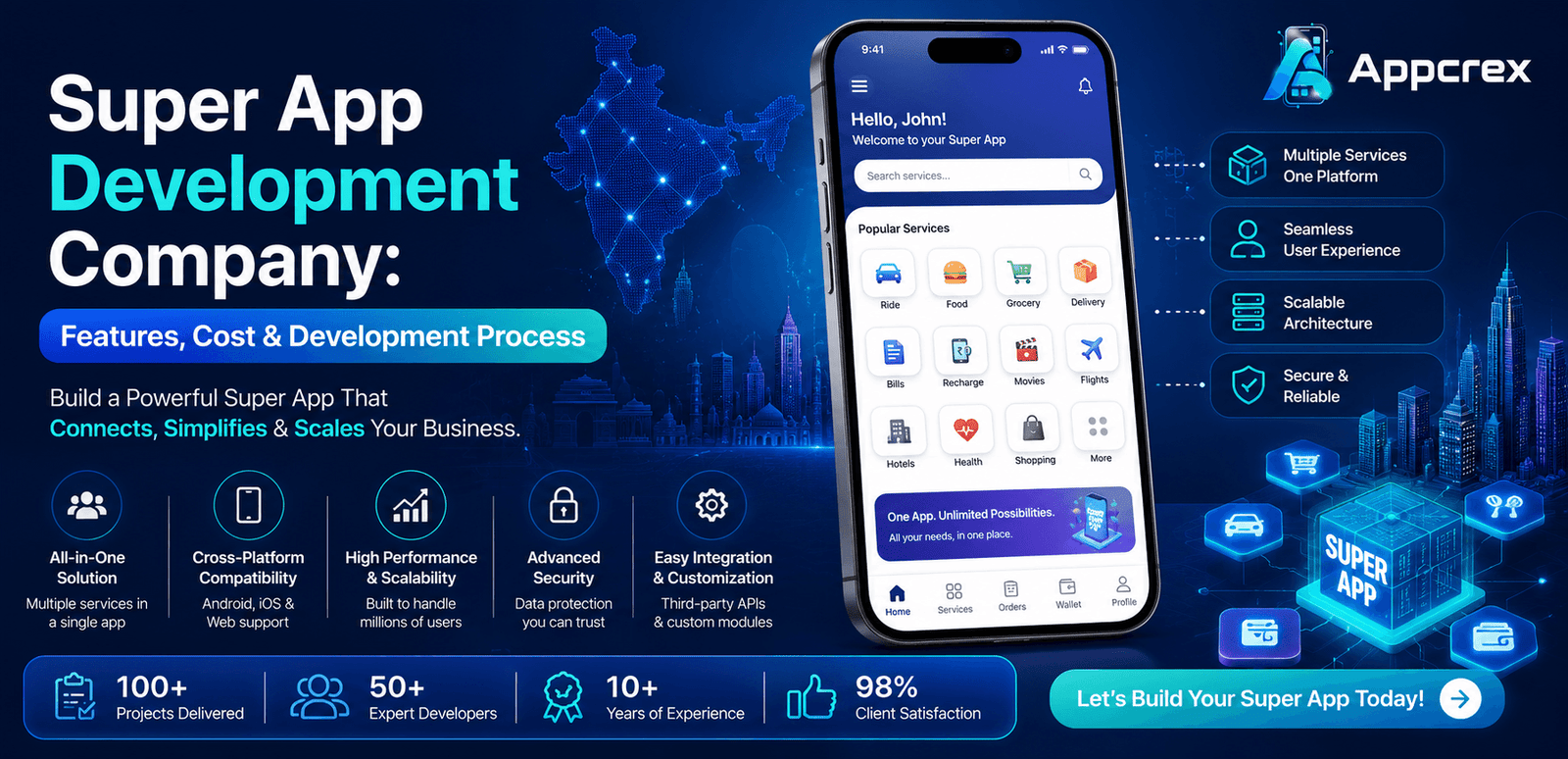
A Super App is a multi-service mobile platform that provides various digital services within a single application.
Unlike traditional mobile apps that focus on one specific purpose, a Super App works as a complete ecosystem where users can perform multiple activities without switching between different platforms.
For example, a Super App can include:
- Digital payments
- Online shopping
- Food delivery
- Ride booking
- Healthcare services
- Banking solutions
- Travel booking
- Insurance
- Messaging
- Loyalty programs
- Entertainment services
The main goal of a Super App is to provide users with a convenient, connected, and personalized digital experience.
Why Are Businesses Investing in Super App Development?
Businesses are adopting Super Apps because they provide long-term growth opportunities and stronger customer relationships.
1. Higher Customer Engagement
A traditional app may be used occasionally, but a Super App encourages users to return frequently because it offers multiple daily-use services.
For example:
A customer may use the same platform for:
- Morning food ordering
- Afternoon payments
- Evening shopping
- Weekend travel booking
This increases daily engagement and improves customer loyalty.
2. Multiple Revenue Opportunities
Super Apps allow businesses to generate income from different sources, including:
- Service commissions
- Subscription plans
- Advertising
- Transaction fees
- Premium features
- Partner integrations
A single platform can support multiple business models.
3. Better Customer Data & Personalization
Super Apps collect valuable user behavior insights that help businesses provide personalized experiences.
With AI-powered analytics, businesses can offer:
- Personalized recommendations
- Targeted promotions
- Smart notifications
- Customized offers
4. Reduced Customer Acquisition Cost
Instead of acquiring users for multiple applications, businesses can focus on growing one powerful ecosystem.
This reduces:
- Marketing expenses
- Maintenance costs
- Development efforts
Popular Super App Examples
| Super App | Industry | Key Services |
|---|---|---|
| Communication & Payments | Messaging, payments, shopping, services | |
| Gojek | On-Demand Services | Transport, food delivery, payments |
| Grab | Mobility & Fintech | Ride booking, food, wallet |
| Careem | Lifestyle Platform | Ride, delivery, payments |
| Paytm | Fintech | Wallet, payments, financial services |
| Tata Neu | Retail Ecosystem | Shopping, travel, finance |
These platforms show how businesses can expand from a single service into a complete digital ecosystem.
Industries That Can Benefit From Super App Development
1. Fintech Super Apps
Financial companies can build Super Apps that combine:
- Digital wallets
- Online banking
- Money transfers
- Insurance
- Investments
- Loans
- Payment gateways
Fintech Super Apps help users manage all financial activities from one place.
2. Healthcare Super Apps
Healthcare organizations can create platforms including:
- Doctor consultations
- Medicine delivery
- Lab test booking
- Health records
- Insurance services
- Online appointments
AI integration can further improve diagnosis support and patient engagement.
3. E-Commerce Super Apps
Retail businesses can combine:
- Product shopping
- Grocery delivery
- Digital payments
- Loyalty programs
- Discounts
- Customer support
This creates a complete shopping ecosystem.
4. Travel & Transportation Super Apps
Travel companies can offer:
- Cab booking
- Flight reservations
- Hotel booking
- Travel insurance
- Digital payments
- Location services
5. Education Super Apps
Education companies can integrate:
- Online courses
- Live classes
- Digital payments
- Student communities
- Learning management systems
- Certification programs
Must-Have Features of a Super App
A successful Super App requires a combination of multiple services, smooth user experience, secure infrastructure, and scalable technology. The features depend on the business model, but some essential functionalities are common across most Super Apps.
1. User Registration & Profile Management
A simple onboarding experience is important because users should be able to access multiple services quickly.
Key features:
- Email and phone number registration
- Social media login
- OTP verification
- User profile management
- Saved addresses
- Payment preferences
- User activity history
A personalized profile helps users manage all services from one account.
2. Multi-Service Dashboard
The main dashboard is the heart of a Super App. It allows users to access different services without installing separate applications.
Dashboard features:
- Service categories
- Personalized recommendations
- Search functionality
- Quick actions
- Offers and promotions
- Recent activities
Example:
A user can open the same app and access:
- Food delivery
- Wallet
- Shopping
- Transportation
- Healthcare
from one dashboard.
3. Digital Wallet & Payment Integration
Payments are one of the most important components of a Super App.
A complete payment system can include:
- Digital wallet
- Credit/debit card payments
- Bank transfers
- UPI integration
- Payment gateway integration
- Transaction history
- Refund management
- Secure payment authentication
Secure payment infrastructure improves customer trust and increases transactions.
4. AI-Powered Personalization
Artificial Intelligence is becoming a major part of modern Super Apps.
AI can help businesses provide:
- Personalized product recommendations
- Smart search suggestions
- User behavior analysis
- Customized offers
- Automated customer support
For example:
If a user frequently orders food, the Super App can automatically recommend restaurants, discounts, and related services.
5. Chat & Communication Features
Many Super Apps include built-in communication features.
Important features:
- In-app messaging
- Customer support chat
- Vendor communication
- AI chatbot assistance
- Notification system
This creates a complete ecosystem where users do not need external communication platforms.
6. Location-Based Services
Location technology is essential for many Super Apps.
Features include:
- GPS tracking
- Live location sharing
- Route optimization
- Nearby service discovery
- Delivery tracking
- Map integration
Industries like transportation, food delivery, and logistics depend heavily on location services.
7. Vendor & Partner Management
A Super App usually connects multiple businesses and service providers.
Vendor features:
- Vendor registration
- Product/service management
- Order management
- Inventory tracking
- Revenue reports
- Customer analytics
This allows businesses to create a complete marketplace ecosystem.
8. Loyalty Programs & Rewards
Customer retention is important for Super App success.
Reward features:
- Loyalty points
- Cashback
- Referral programs
- Membership plans
- Exclusive discounts
- Coupons
These features encourage users to stay within the ecosystem.
AI Features for Super Apps in 2026
AI is transforming Super App development by making platforms smarter, faster, and more personalized.
1. AI Chatbot Assistant
An AI chatbot can handle:
- Customer queries
- Order updates
- Payment issues
- Product recommendations
- Service guidance
This reduces customer support costs and improves response time.
2. Voice-Based AI Search
Voice assistants allow users to search services using natural language.
Examples:
“Book a taxi near me”
“Order my usual food”
“Show healthcare services”
This improves accessibility and user experience.
Also Read : Voice AI Integration: Complete Guide to Benefits, Use Cases, Cost & Implementation (2026)
3. AI Recommendation Engine
AI analyzes user behavior and suggests relevant services.
Examples:
- Shopping recommendations
- Food suggestions
- Travel deals
- Financial products
4. Fraud Detection & Security
AI helps protect Super Apps by identifying suspicious activities.
Applications:
- Payment fraud detection
- Account security monitoring
- Risk analysis
- Identity verification
5. Predictive Analytics
Businesses can use AI analytics to understand:
- Customer preferences
- Market trends
- Sales forecasting
- User retention patterns
Technology Stack for Super App Development
Building a scalable Super App requires modern technologies and a strong architecture.
Frontend Development
Popular technologies:
Flutter
Benefits:
- Single codebase
- Faster development
- Android and iOS support
- Smooth UI performance
React Native
Benefits:
- Cross-platform development
- Reusable components
- Faster updates
- Large developer community
Backend Development
Backend technologies:
- Node.js
- Python
- Java
- Laravel
- .NET
A strong backend manages:
- Users
- Payments
- Services
- APIs
- Data processing
Database Solutions
Common databases:
- PostgreSQL
- MySQL
- MongoDB
- Redis
Database selection depends on:
- User volume
- Data complexity
- Performance requirements
Cloud Infrastructure
Cloud platforms help Super Apps handle millions of users.
Popular options:
- AWS
- Microsoft Azure
- Google Cloud
Cloud benefits:
- Scalability
- High availability
- Data security
- Faster deployment
API Integration
Super Apps depend on multiple third-party integrations:
- Payment APIs
- Map APIs
- SMS APIs
- Social login APIs
- AI APIs
- Banking APIs
API-driven architecture helps connect different services smoothly.
Also Read : What Is API Integration? A Complete Guide to Benefits, Types & Best Practices (2026)
Super App Development Process
A professional Super App Development Company follows a structured development approach.
Step 1: Business Analysis & Planning
The first step is understanding:
- Business objectives
- Target audience
- Required services
- Revenue model
- Market competition
A clear strategy helps avoid unnecessary development costs.
Step 2: MVP Development
Instead of building all features immediately, businesses usually start with a Minimum Viable Product (MVP).
MVP includes:
- Core services
- Basic user features
- Essential integrations
After analyzing user feedback, additional modules can be added.
Also Read : What Is an MVP in App Development? A Complete Guide
Step 3: UI/UX Design
Super Apps require simple and user-friendly designs because they contain multiple services.
Design focuses on:
- Easy navigation
- Service categories
- Personalization
- Fast accessibility
- Consistent branding
Step 4: Backend & API Development
Developers create:
- Database architecture
- APIs
- Authentication systems
- Payment systems
- Microservices
A scalable backend ensures future expansion.
Step 5: Testing & Quality Assurance
Testing includes:
- Functional testing
- Security testing
- Performance testing
- Payment testing
- Device compatibility testing
This ensures a reliable user experience.
Step 6: Deployment & Maintenance
After successful testing, the Super App is launched on:
- Google Play Store
- Apple App Store
Continuous maintenance includes:
- Security updates
- New features
- Performance improvements
- Bug fixing
Also Read : App Store Optimization (ASO): Complete Guide to Improve App Visibility, Downloads & Rankings in 2026
How Much Does It Cost to Develop a Super App in 2026?
The Super App Development Cost depends on several factors, including the number of services, platform requirements, design complexity, integrations, security requirements, and technology stack.
Since a Super App combines multiple applications into one ecosystem, its development cost is generally higher than a normal mobile app.
A basic Super App with limited features may start around $25,000–$50,000, while an advanced enterprise-level Super App with AI, payments, multiple service modules, and scalable architecture can cost $120,000–$300,000+.
Super App Development Cost Breakdown
| Super App Type | Estimated Cost | Development Time |
|---|---|---|
| Basic MVP Super App | $25,000–$50,000 | 3–6 months |
| Medium-Level Super App | $50,000–$120,000 | 6–10 months |
| Enterprise Super App | $120,000–$300,000+ | 10–18+ months |
Factors Affecting Super App Development Cost
1. Number of Services & Features
The biggest factor affecting cost is the number of modules included.
For example:
A simple Super App may include:
- User registration
- Wallet
- Basic payments
- One service module
An advanced Super App may include:
- Food delivery
- Ride booking
- E-commerce
- Banking
- Healthcare
- AI assistant
- Vendor marketplace
- Loyalty system
More features require more development time and resources.
2. Platform Selection
The cost also depends on whether you want:
- Android app
- iOS app
- Web platform
- Admin dashboard
- Vendor application
Developing for multiple platforms increases development efforts.
Many businesses choose cross-platform technologies like Flutter and React Native to reduce cost and development time.
3. UI/UX Design Complexity
Super Apps need a simple interface because users access multiple services from one platform.
Design cost depends on:
- Number of screens
- User journeys
- Custom animations
- Branding requirements
- Design testing
A professional UI/UX design improves user adoption and retention.
4. Third-Party Integrations
Super Apps require several external integrations.
Examples:
- Payment gateways
- Maps
- SMS services
- AI APIs
- Banking APIs
- Social login
- Delivery tracking systems
Each integration requires development and testing.
5. AI Integration
Modern Super Apps use AI to improve user experience.
AI features that impact development cost:
- AI chatbot
- Recommendation engine
- Voice assistant
- Fraud detection
- Predictive analytics
- AI automation
Advanced AI capabilities require specialized developers and infrastructure.
How Do Super Apps Generate Revenue?
A major reason businesses invest in Super Apps is their ability to create multiple revenue streams.
1. Commission-Based Revenue
Businesses can earn commissions from:
- Vendors
- Restaurants
- Service providers
- Marketplace sellers
Example:
A food delivery module can charge restaurants a percentage from every order.
2. Subscription Plans
Super Apps can offer premium memberships.
Examples:
- Free delivery plans
- Premium customer benefits
- Exclusive discounts
- Business subscriptions
3. Advertising Revenue
Businesses can generate income by allowing brands to promote:
- Products
- Services
- Offers
- Sponsored listings
4. Transaction Fees
Financial services can generate revenue through:
- Payment processing fees
- Money transfer charges
- Financial services
- Loan processing
5. Marketplace Revenue
A Super App can become a marketplace connecting customers and service providers.
Revenue can come from:
- Seller fees
- Listing charges
- Partner subscriptions
Challenges in Super App Development
Building a Super App provides many opportunities, but businesses must also handle several challenges.
1. Complex Architecture
A Super App combines multiple services, which requires a scalable architecture.
Developers usually use:
- Microservices architecture
- Cloud infrastructure
- API-driven systems
This allows businesses to add new services without rebuilding the complete platform.
2. Performance Optimization
Since Super Apps contain many features, performance can become challenging.
Important considerations:
- Fast loading speed
- Smooth navigation
- Optimized database
- Efficient code structure
A slow app can negatively impact user experience.
3. Security & Data Privacy
Super Apps handle sensitive user information such as:
- Payment details
- Personal data
- Transaction records
Security measures include:
- Data encryption
- Secure authentication
- Two-factor verification
- Fraud monitoring
- Regular security testing
4. Managing Multiple Services
Managing different services inside one platform requires proper planning.
Businesses need:
- Service management systems
- Vendor dashboards
- Automated workflows
- Analytics tools
5. User Experience Management
A Super App should not feel complicated.
The biggest challenge is creating a simple experience while offering many services.
Successful Super Apps focus on:
- Easy navigation
- Personalized dashboards
- Smart recommendations
- Clear service categories
Benefits of Building a Super App for Businesses
1. Strong Customer Loyalty
Users prefer platforms where they can complete multiple tasks easily.
This increases:
- Engagement
- Retention
- Brand loyalty
2. Scalable Business Growth
Businesses can start with one service and gradually add more features.
Example:
Start:
Food Delivery App
Later add:
- Payments
- Grocery
- Healthcare
- Shopping
- Travel
3. Better Market Position
A Super App helps businesses compete in the growing digital ecosystem.
Companies can create a complete customer-centric platform instead of offering only one service.
4. Improved Data Insights
A Super App provides valuable business analytics.
Companies can understand:
- Customer behavior
- Buying patterns
- Popular services
- Market trends
This helps improve decision-making.
Why Choose AppCrex for Super App Development?
Building a successful Super App requires more than just mobile app development. It needs a strong technology strategy, scalable architecture, seamless integrations, and a deep understanding of user behavior.
AppCrex helps businesses build custom digital platforms with modern technologies, including AI integration, cloud solutions, secure payment systems, and cross-platform development.
Our Super App Development Approach Includes:
1. Custom Super App Solutions
Every business has different goals and requirements. AppCrex develops customized Super Apps based on:
- Business model
- Target audience
- Industry requirements
- Growth strategy
- Revenue objectives
Whether you need a fintech Super App, healthcare ecosystem, marketplace platform, or on-demand service solution, the development approach is customized according to your needs.
2. Scalable Architecture
A Super App must support future expansion.
AppCrex focuses on:
- Microservices architecture
- Cloud-based infrastructure
- API-driven development
- High-performance backend systems
This allows businesses to add new services without affecting existing functionality.
3. AI-Powered Super App Development
AI has become an important part of modern digital platforms.
AppCrex helps integrate AI capabilities such as:
- AI chatbots
- Smart recommendations
- Voice assistants
- Predictive analytics
- Automated customer support
- Intelligent search
AI-powered features help businesses improve personalization and customer engagement.
4. Cross-Platform App Development
Businesses can launch Super Apps for multiple platforms:
- Android
- iOS
- Web
Using technologies like Flutter and React Native helps reduce development time while maintaining quality performance.
5. Secure Payment Integration
Security is a critical requirement for Super Apps.
AppCrex focuses on:
- Secure payment gateways
- Data protection
- Authentication systems
- Transaction security
- Fraud prevention
This helps create a trustworthy digital environment for users.
Future Trends of Super App Development in 2026
The Super App market will continue growing as businesses look for better ways to connect with customers.
1. AI-First Super Apps
Future Super Apps will depend heavily on Artificial Intelligence.
AI will help with:
- Personalized user experiences
- Automated workflows
- Smart recommendations
- Predictive customer behavior
2. Embedded Finance
Financial services will become a major part of Super Apps.
Future platforms will include:
- Digital wallets
- Instant payments
- Insurance
- Lending
- Investment services
3. Voice & Conversational Interfaces
Users will increasingly interact with apps through voice commands.
Examples:
- “Book my doctor appointment”
- “Order groceries”
- “Pay my electricity bill”
Voice AI will make Super Apps easier to use.
4. Hyper-Personalization
Super Apps will use user data and AI to deliver customized experiences.
Examples:
- Personalized shopping
- Customized offers
- Relevant service suggestions
- Smart notifications
5. IoT Integration
Future Super Apps may connect with smart devices.
Examples:
- Smart homes
- Wearable devices
- Connected vehicles
- Healthcare monitoring devices
(FAQs)
1. What is a Super App?
A Super App is an all-in-one digital platform that provides multiple services like payments, shopping, transportation, healthcare, and communication within a single application.
2. How much does it cost to build a Super App?
The cost depends on features, complexity, platforms, integrations, and technology requirements.
A basic Super App may cost around $25,000–$50,000, while advanced enterprise solutions can cost $120,000–$300,000+.
3. How long does it take to develop a Super App?
Development time depends on the number of services and complexity.
Generally:
- MVP Super App: 3–6 months
- Medium Super App: 6–10 months
- Enterprise Super App: 10–18+ months
4. What industries can benefit from Super Apps?
Almost every digital industry can benefit from Super Apps, including:
- Fintech
- Healthcare
- E-commerce
- Travel
- Education
- Logistics
- Retail
5. Which technologies are used for Super App development?
Common technologies include:
Frontend:
- Flutter
- React Native
Backend:
- Node.js
- Python
- Java
- Laravel
Cloud:
- AWS
- Azure
- Google Cloud
Database:
- PostgreSQL
- MongoDB
6. Can AI be integrated into a Super App?
Yes. AI can improve Super Apps through:
- Chatbots
- Voice assistants
- Recommendations
- Fraud detection
- Analytics
- Automation
Also Read : AI Integration Services: Complete Guide to Benefits, Use Cases, Cost & Implementation (2026)
7. Should businesses start with an MVP Super App?
Yes. Starting with an MVP helps businesses:
- Test market demand
- Reduce initial investment
- Collect user feedback
- Add features gradually
8. How do Super Apps make money?
Super Apps generate revenue through:
- Commission fees
- Subscription plans
- Advertising
- Transaction charges
- Marketplace fees
Conclusion
The demand for Super Apps is increasing rapidly as customers prefer convenient platforms where they can access multiple services from a single place.
A successful Super App requires strategic planning, advanced technology, secure infrastructure, and a user-focused approach. From fintech and healthcare to e-commerce and transportation, businesses across industries can benefit from building their own digital ecosystem.
Partnering with an experienced Super App Development Company allows businesses to transform their ideas into scalable platforms that are ready for future growth.
With expertise in mobile development, AI integration, cloud solutions, and custom software development, AppCrex helps businesses create powerful Super Apps designed for modern digital markets.
Build Your Custom Super App with AppCrex
Looking to develop a scalable Super App for your business?
AppCrex provides end-to-end Super app Development Services including strategy, UI/UX design, mobile development, AI integration, API development, payment solutions, and post-launch support.
Whether you want to build a fintech Super App, healthcare ecosystem, marketplace platform, or an on-demand service application, our team can help you create a future-ready digital solution.
Contact AppCrex today and turn your Super App idea into a successful digital platform.