📌 Key Takeaways
- Supply chain ERP software streamlines procurement, inventory, logistics, and warehouse management.
- Custom ERP solutions improve operational efficiency, visibility, and business productivity.
- Real-time analytics and automation help reduce costs and enable faster decision-making.
- Development cost depends on features, integrations, technology stack, and project complexity.
- AppCrex builds secure, scalable, and custom ERP solutions tailored to modern supply chain businesses.
Introduction
In today’s competitive business environment, efficient supply chain management has become one of the most important factors for business growth. Companies across manufacturing, retail, healthcare, logistics, and eCommerce industries need powerful digital solutions to manage suppliers, inventory, transportation, warehouses, and customer demands effectively.
Traditional supply chain processes often involve manual operations, disconnected systems, inaccurate forecasting, and limited visibility. These challenges can lead to increased operational costs, delayed deliveries, inventory problems, and reduced customer satisfaction.
This is where Supply Chain Management ERP Software Development plays a crucial role.
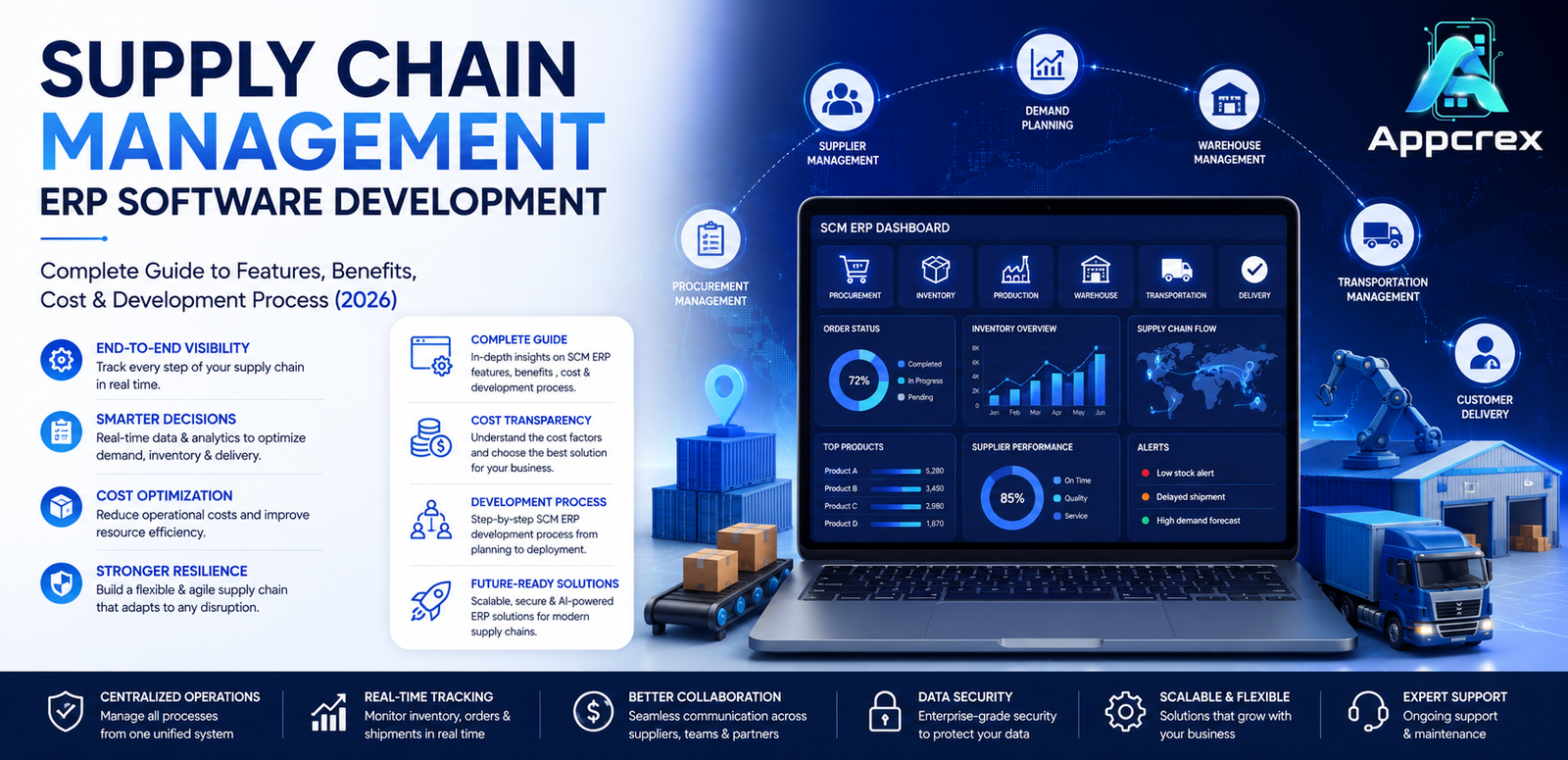
A Supply Chain ERP system combines enterprise resource planning capabilities with advanced supply chain management tools to create a centralized platform where businesses can monitor, automate, and optimize their complete supply chain operations.
From procurement and inventory management to warehouse operations, logistics tracking, supplier management, and analytics, a custom Supply Chain Management ERP solution enables businesses to improve efficiency and make data-driven decisions.
Companies looking to build such platforms often partner with an experienced ERP Software Development Company to develop customized solutions according to their specific business requirements.
What Is Supply Chain Management ERP Software?
Supply Chain Management ERP Software is an integrated business management solution designed to automate and manage all activities involved in the supply chain lifecycle.
It connects different departments, including:
- Procurement
- Inventory
- Warehouse Management
- Manufacturing
- Transportation
- Supplier Management
- Sales Operations
- Customer Service
- Finance
Unlike traditional software systems, ERP-based supply chain solutions provide a single source of information where businesses can access real-time data and improve operational performance.
For example, a manufacturing company can use a Supply Chain ERP system to automatically track raw materials, monitor supplier deliveries, predict inventory requirements, manage production schedules, and optimize distribution processes.
Why Businesses Need Supply Chain Management ERP Solutions in 2026?
The modern supply chain ecosystem has become more complex due to:
- Global supplier networks
- Increasing customer expectations
- Faster delivery requirements
- Market fluctuations
- Inventory challenges
- Rising operational costs
Businesses can no longer depend on manual processes or multiple disconnected tools.
A customized Supply Chain Management ERP system helps organizations:
Improve Operational Visibility
Businesses get real-time insights into inventory levels, supplier performance, order status, and logistics operations.
Reduce Operational Costs
Automation reduces manual work, minimizes errors, and improves resource utilization.
Enhance Inventory Management
ERP solutions help businesses maintain optimal inventory levels by preventing overstocking and shortages.
Make Data-Driven Decisions
Advanced analytics and reporting tools provide valuable insights for better planning.
Improve Customer Satisfaction
Faster order processing and accurate delivery tracking improve customer experiences.
How Supply Chain Management ERP Software Works?
A Supply Chain ERP platform connects multiple business operations through centralized modules.
Procurement Management
This module manages the complete purchasing process, including:
- Supplier selection
- Purchase orders
- Vendor contracts
- Approval workflows
- Procurement tracking
Businesses can automate purchasing activities and maintain better supplier relationships.
Inventory Management
Inventory management is one of the most important components of Supply Chain ERP software.
Features include:
- Real-time inventory tracking
- Stock level monitoring
- Barcode integration
- Automated stock alerts
- Warehouse visibility
This helps businesses avoid inventory shortages and unnecessary storage costs.
Warehouse Management
Warehouse operations become more efficient with ERP-powered warehouse management.
Businesses can manage:
- Product receiving
- Storage locations
- Order picking
- Packing processes
- Shipment preparation
Automation improves warehouse accuracy and reduces operational delays.
Logistics & Transportation Management
Supply Chain ERP solutions help businesses optimize transportation processes through:
- Shipment tracking
- Route optimization
- Delivery management
- Carrier management
- Transportation analytics
Companies can reduce delivery times and improve logistics efficiency.
Key Features of Supply Chain Management ERP Software
A modern Supply Chain Management ERP Software Development solution includes advanced features that help businesses automate operations, improve collaboration, and achieve better supply chain visibility.
1. Real-Time Inventory Management
Inventory accuracy is critical for every business. Supply Chain ERP software provides real-time tracking of stock levels across multiple locations.
Key capabilities include:
- Live inventory monitoring
- Automated stock updates
- Inventory forecasting
- Low-stock notifications
- Multi-location inventory management
- Batch and expiry tracking
This allows businesses to maintain the right inventory levels and avoid unnecessary storage costs.
2. Supplier & Vendor Management
Managing suppliers efficiently is essential for maintaining a smooth supply chain.
A custom Supply Chain ERP system helps businesses manage:
- Supplier profiles
- Vendor performance tracking
- Contract management
- Purchase history
- Supplier evaluation
- Communication records
Companies can analyze supplier performance and build stronger partnerships with reliable vendors.
3. Demand Forecasting & Planning
Modern supply chains require accurate demand prediction. ERP solutions use historical data, market trends, and analytics to forecast future requirements.
Demand forecasting helps businesses:
- Predict customer demand
- Optimize production planning
- Reduce excess inventory
- Improve resource allocation
- Prepare for market changes
With AI-powered forecasting, businesses can make smarter supply chain decisions.
4. Procurement Automation
Manual procurement processes can create delays and errors. ERP-based procurement automation simplifies purchasing activities.
Important features include:
- Automated purchase requests
- Approval workflows
- Purchase order generation
- Vendor comparison
- Invoice tracking
This reduces paperwork and improves procurement efficiency.
5. Warehouse Management System Integration
Warehouse management is a major part of supply chain operations.
ERP software can integrate with warehouse systems to provide:
- Automated inventory movement
- Warehouse optimization
- Smart picking and packing
- Product location tracking
- Order fulfillment management
This improves warehouse productivity and reduces operational mistakes.
6. Order Management System
A Supply Chain ERP solution helps businesses manage customer orders from placement to delivery.
Features include:
- Order processing automation
- Order tracking
- Customer notifications
- Return management
- Sales integration
Businesses can provide faster and more reliable services to customers.
7. Supply Chain Analytics & Reporting
Data plays an important role in improving supply chain performance.
Advanced ERP analytics provides:
- Real-time dashboards
- Performance reports
- Cost analysis
- Supplier insights
- Inventory reports
- Logistics analytics
Business leaders can identify problems quickly and improve decision-making.
8. Cloud-Based Supply Chain ERP
Cloud ERP solutions allow businesses to access supply chain data anytime and from anywhere.
Benefits include:
- Remote accessibility
- Lower infrastructure costs
- Automatic updates
- Better scalability
- Enhanced security
Cloud-based ERP systems are becoming the preferred choice for growing businesses.
AI Integration in Supply Chain Management ERP Software
Artificial Intelligence is transforming traditional supply chain operations by making them smarter, faster, and more predictive.
A modern Supply Chain ERP Software Development Company can integrate AI technologies to improve business performance.
Also read : AI Integration Services: Complete Guide to Benefits, Use Cases, Cost & Implementation (2026)
AI-Based Demand Prediction
AI algorithms analyze:
- Previous sales data
- Customer behavior
- Market trends
- Seasonal changes
This helps businesses predict future demand more accurately.
Automated Inventory Optimization
AI-powered systems automatically recommend:
- Ideal stock levels
- Reordering schedules
- Inventory distribution strategies
This reduces inventory waste and improves efficiency.
Intelligent Logistics Optimization
AI can analyze transportation data to suggest:
- Better delivery routes
- Faster shipping methods
- Reduced fuel costs
Businesses can improve delivery performance while reducing expenses.
AI Chatbots for Supplier Communication
AI-powered assistants can handle:
- Supplier queries
- Order updates
- Procurement status
- Internal requests
This improves communication speed and reduces manual workload.
Also Read : AI Chatbot Development Company: Complete Guide to Features, Benefits, Cost & Trends (2026)
Benefits of Custom Supply Chain Management ERP Software
Investing in custom Supply Chain ERP software provides several advantages compared to standard solutions.
1. Complete Business Automation
Custom ERP systems automate repetitive tasks such as:
- Inventory updates
- Purchase orders
- Reporting
- Supplier communication
- Order processing
Automation saves time and improves productivity.
2. Improved Supply Chain Visibility
A centralized ERP platform provides complete visibility into business operations.
Companies can track:
- Product movement
- Supplier activities
- Inventory status
- Customer orders
- Delivery progress
Better visibility allows businesses to identify issues before they become major problems.
3. Better Cost Management
Supply Chain ERP solutions help reduce unnecessary expenses through:
- Inventory optimization
- Automated processes
- Better supplier management
- Improved resource planning
Businesses can achieve higher profitability with better cost control.
4. Enhanced Decision Making
Real-time analytics and reporting help management teams make informed decisions.
ERP dashboards provide insights related to:
- Sales performance
- Supply chain efficiency
- Market demand
- Operational costs
5. Scalability for Future Growth
Custom ERP software can grow with your business.
Companies can add new features such as:
- New warehouses
- Additional suppliers
- More users
- Advanced analytics
- AI capabilities
This makes ERP solutions a long-term technology investment.
6. Improved Customer Experience
A well-managed supply chain directly improves customer satisfaction.
ERP software helps businesses provide:
- Faster delivery
- Accurate order tracking
- Better product availability
- Reliable service
Supply Chain Management ERP Development Process
Developing a successful Supply Chain ERP solution requires proper planning, technical expertise, and industry understanding.
Step 1: Requirement Analysis
The development team first understands business goals and operational requirements.
This includes:
- Business workflow analysis
- Required ERP modules
- User roles
- Integration requirements
- Custom features
Step 2: ERP Solution Planning
After gathering requirements, developers create a complete project roadmap.
Planning includes:
- Software architecture
- Technology selection
- Database structure
- Development timeline
- Feature priorities
Step 3: UI/UX Design
A user-friendly interface is designed for different users, including:
- Administrators
- Supply chain managers
- Warehouse staff
- Suppliers
The focus is on simplicity, accessibility, and efficient workflow management.
Step 4: Software Development
Developers build ERP modules based on approved designs.
Development may include:
- Backend development
- Frontend development
- Database integration
- API development
- Third-party integrations
Also Read : Custom Software Development Company: Complete Guide to Services, Process, Cost & Benefits (2026)
Step 5: Testing & Quality Assurance
Before deployment, the ERP system goes through detailed testing.
Testing includes:
- Functional testing
- Security testing
- Performance testing
- Integration testing
- User acceptance testing
Step 6: Deployment & Maintenance
After successful testing, the ERP system is deployed.
Ongoing support includes:
- Software updates
- Performance monitoring
- Security improvements
- Feature enhancements
How Much Does Supply Chain Management ERP Software Development Cost in 2026?
The cost of developing a Supply Chain Management ERP Software depends on various factors, including business requirements, software complexity, features, integrations, and customization needs.
A basic Supply Chain ERP solution may cost less, while a fully customized enterprise-level platform with AI, automation, analytics, and third-party integrations requires a larger investment.
Average Supply Chain ERP Development Cost:
| ERP Solution Type | Estimated Cost |
|---|---|
| Basic Supply Chain ERP System | $25,000 – $50,000 |
| Medium-Level Custom ERP Solution | $50,000 – $150,000 |
| Advanced Enterprise Supply Chain ERP | $150,000 – $500,000+ |
These prices can vary depending on development location, technology stack, team expertise, and project requirements.
Factors Affecting Supply Chain ERP Software Development Cost
1. Number of ERP Modules
The number of modules directly impacts development cost.
Common modules include:
- Inventory Management
- Procurement Management
- Warehouse Management
- Supplier Management
- Logistics Management
- Analytics Dashboard
- Finance Integration
- Customer Relationship Management
More modules require additional development time and resources.
2. Customization Requirements
Every business has different supply chain workflows.
Custom features such as:
- Automated approval systems
- Industry-specific workflows
- Custom reports
- AI-powered recommendations
- Advanced dashboards
can increase development costs.
3. Third-Party Integrations
Supply Chain ERP systems often require integration with external platforms.
Examples:
- Payment gateways
- Accounting software
- CRM platforms
- Shipping APIs
- IoT devices
- Barcode systems
The number and complexity of integrations affect the overall budget.
4. UI/UX Design Complexity
A simple ERP interface requires less investment compared to a highly customized dashboard with multiple user roles.
Design complexity depends on:
- Number of screens
- User experience requirements
- Data visualization needs
- Mobile responsiveness
5. Development Team Location
Development rates vary based on the location of the ERP software development company.
Approximate hourly rates:
- North America: $100–$200/hour
- Europe: $70–$150/hour
- Asia: $25–$75/hour
Choosing the right development partner helps maintain quality while managing costs.
Technology Stack for Supply Chain Management ERP Software Development
A modern Supply Chain ERP platform requires reliable and scalable technologies.
Frontend Technologies
Common frontend technologies include:
- React.js
- Angular
- Vue.js
- HTML5
- CSS3
- JavaScript
These technologies help create responsive and user-friendly ERP interfaces.
Backend Technologies
Popular backend technologies include:
- Node.js
- Python
- Java
- .NET
- PHP
Backend systems manage business logic, APIs, security, and data processing.
Database Technologies
ERP systems handle large amounts of business data.
Common databases include:
- PostgreSQL
- MySQL
- MongoDB
- Microsoft SQL Server
- Oracle Database
Cloud Platforms
Cloud infrastructure improves scalability and performance.
Popular platforms include:
- Amazon Web Services (AWS)
- Microsoft Azure
- Google Cloud Platform
Cloud ERP solutions provide flexibility, security, and easy expansion.
AI & Data Analytics Technologies
For intelligent supply chain solutions, businesses can integrate:
- Machine Learning
- Predictive Analytics
- Natural Language Processing
- Data Visualization Tools
- AI Recommendation Systems
These technologies help businesses optimize operations and forecast future trends.
How to Choose the Right Supply Chain ERP Software Development Company?
Selecting the right technology partner is important for building a successful ERP solution.
Consider these factors:
1. Industry Experience
Choose an ERP development company that understands supply chain operations and business workflows.
A company with industry experience can build solutions that match real business requirements.
2. Technical Expertise
The development partner should have expertise in:
- ERP development
- Cloud technologies
- Database management
- AI integration
- API development
- Enterprise software architecture
3. Custom Development Approach
Every business has unique supply chain requirements.
A reliable ERP development company should provide:
- Custom solutions
- Flexible architecture
- Scalable features
- Future upgrades
4. Security Standards
Supply Chain ERP systems handle sensitive business information.
Important security features include:
- Data encryption
- Role-based access control
- Secure authentication
- Regular security testing
- Backup solutions
5. Post-Development Support
ERP software requires continuous maintenance.
Choose a partner that provides:
- Technical support
- Software updates
- Bug fixes
- Performance improvements
- Feature enhancements
Why Choose AppCrex for Supply Chain Management ERP Software Development?
AppCrex helps businesses build customized ERP solutions designed to improve operational efficiency, automation, and business growth.
Our ERP development services focus on creating scalable and secure platforms with advanced features such as:
- Custom ERP modules
- Supply chain automation
- Inventory management solutions
- AI-powered analytics
- Cloud-based ERP systems
- Third-party integrations
By combining modern technologies with industry-focused strategies, AppCrex helps businesses develop future-ready Supply Chain ERP solutions.
(FAQs)
1. What is Supply Chain Management ERP Software?
Supply Chain Management ERP Software is an integrated platform that helps businesses manage procurement, inventory, logistics, warehouse operations, suppliers, and distribution through a centralized system.
2. How much does it cost to develop Supply Chain ERP Software?
The cost usually ranges from $25,000 to $500,000+, depending on features, customization, integrations, and project complexity.
3. How long does it take to develop a Supply Chain ERP system?
Development time depends on requirements.
- Basic ERP: 3–6 months
- Medium ERP: 6–12 months
- Enterprise ERP: 12+ months
4. What industries use Supply Chain ERP solutions?
Supply Chain ERP software is widely used in:
- Manufacturing
- Retail
- Healthcare
- Logistics
- eCommerce
- Automotive
- Food and beverage
- Wholesale businesses
5. Can Supply Chain ERP software integrate with existing systems?
Yes. Custom ERP solutions can integrate with existing tools such as CRM, accounting software, warehouse systems, payment platforms, and shipping solutions.
6. Why should businesses choose custom Supply Chain ERP software?
Custom ERP software provides:
- Better flexibility
- Industry-specific features
- Improved scalability
- Complete workflow control
- Better ROI compared to generic solutions
Conclusion
Supply Chain Management ERP Software has become essential for businesses looking to improve efficiency, reduce costs, and manage complex operations effectively.
A customized Supply Chain ERP solution helps organizations automate procurement, optimize inventory, improve logistics, and make smarter decisions through real-time data insights.
With advanced technologies such as AI, cloud computing, and analytics, modern ERP platforms are transforming traditional supply chains into intelligent and highly efficient ecosystems.
Partnering with an experienced ERP Software Development Company like AppCrex allows businesses to build secure, scalable, and future-ready Supply Chain Management solutions tailored to their unique requirements.
A well-designed Supply Chain ERP system is not just a software investment—it is a long-term strategy for business growth and operational excellence.