📌 Key Takeaways
- AI improves efficiency through automation and smarter decision-making.
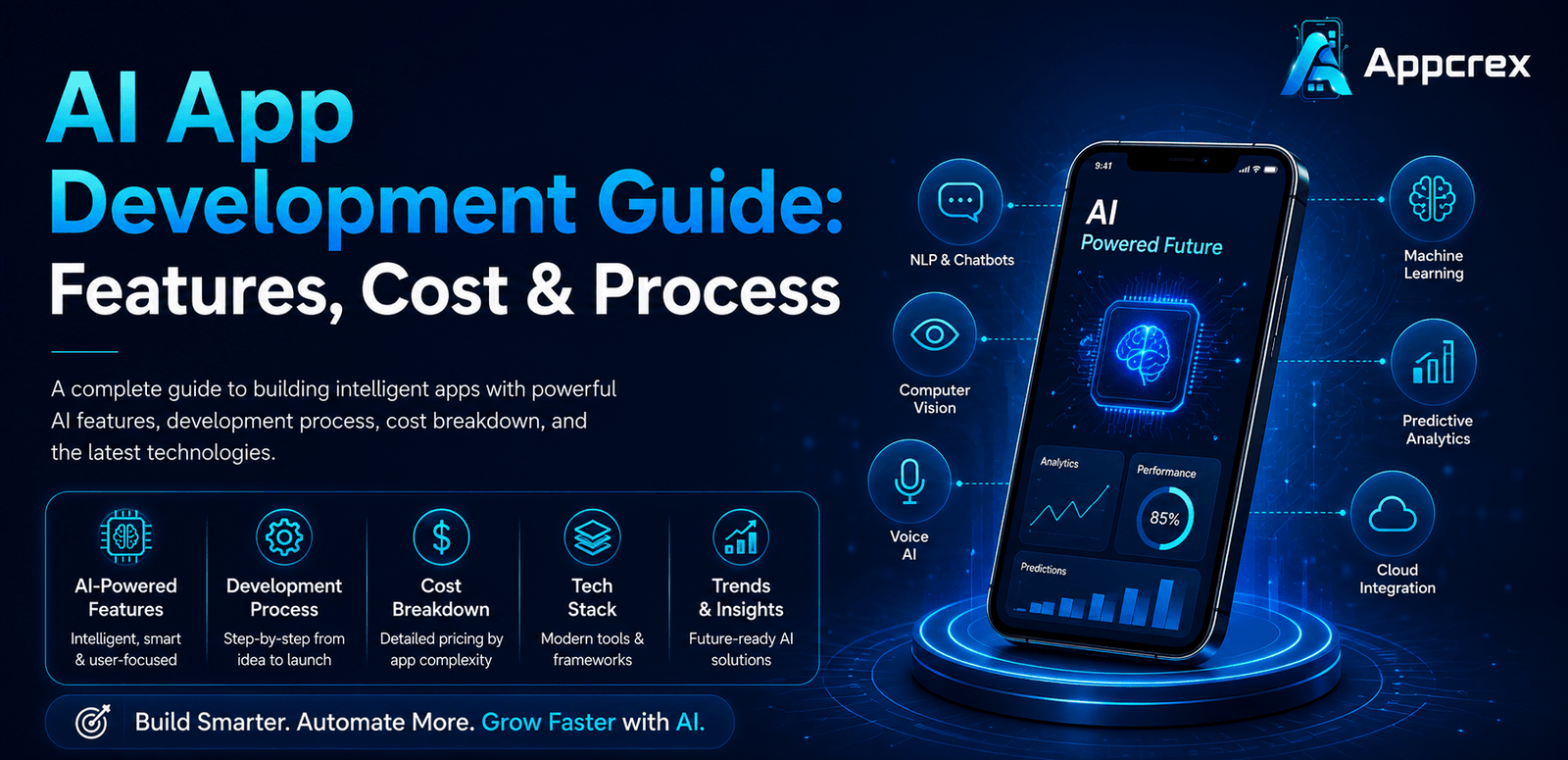
- Essential features include ML, NLP, chatbots, analytics, and cloud integration.
- A clear development process ensures scalable and successful AI apps.
- Development costs depend on app complexity, features, and AI capabilities.
- Choosing the right AI app development company is key to building secure, future-ready solutions.
Artificial Intelligence (AI) has evolved from being a futuristic concept into a powerful business tool that is transforming industries worldwide. From personalized shopping experiences and intelligent healthcare solutions to fraud detection and smart virtual assistants, AI-powered applications are redefining how businesses operate and engage with their customers.
As AI technologies continue to mature, organizations of all sizes are investing in intelligent mobile and web applications to improve efficiency, automate repetitive tasks, enhance customer experiences, and unlock valuable business insights. According to industry reports, the global AI market is expected to continue its rapid growth throughout 2026, making AI application development one of the most sought-after technology investments.
Whether you’re a startup with an innovative AI-powered idea or an enterprise looking to automate business operations, understanding the AI app development process is essential before starting your project.
In this comprehensive guide, you’ll learn:
- What AI app development is
- Key benefits for businesses
- Popular types of AI applications
- Essential features every AI app should include
- Step-by-step AI app development process
- Technologies and frameworks used
- AI app development cost in 2026
- Future trends shaping AI applications
- Tips for choosing the right AI app development company
Let’s dive in.
What is AI App Development?
AI app development is the process of creating software applications that use Artificial Intelligence technologies to simulate human intelligence. These applications can analyze data, recognize patterns, understand natural language, make predictions, automate workflows, and continuously improve their performance based on user interactions.
Unlike traditional applications that rely on predefined rules and logic, AI-powered applications can learn from historical data and adapt their behavior over time. This enables businesses to build smarter solutions capable of delivering personalized experiences, intelligent recommendations, and automated decision-making.
AI applications combine several advanced technologies, including:
- Machine Learning (ML)
- Deep Learning
- Natural Language Processing (NLP)
- Computer Vision
- Speech Recognition
- Generative AI
- Predictive Analytics
Together, these technologies enable applications to perform tasks that once required human intelligence.
Why AI App Development Matters in 2026
The demand for AI-powered applications has grown significantly as businesses seek innovative ways to improve operational efficiency and customer engagement.
Some key reasons why organizations are investing in AI app development include:
Increased Automation
AI automates repetitive and time-consuming tasks such as customer support, document processing, scheduling, and data entry. This allows employees to focus on higher-value activities while improving productivity.
Personalized User Experiences
AI analyzes customer behavior, preferences, and purchase history to deliver personalized recommendations, content, and services, increasing customer satisfaction and engagement.
Smarter Business Decisions
AI-powered analytics process large volumes of data in real time, helping businesses identify trends, forecast demand, optimize operations, and make data-driven decisions.
Cost Savings
Automating routine tasks and optimizing business processes can significantly reduce operational costs while improving efficiency.
Improved Customer Support
AI chatbots and virtual assistants provide 24/7 customer service, instantly answering queries and resolving common issues without human intervention.
Competitive Advantage
Businesses that adopt AI early can launch innovative products faster, improve customer experiences, and stay ahead of competitors in an increasingly digital marketplace.
Key Benefits of AI App Development
Developing an AI-powered application offers long-term advantages across multiple business functions.
1. Enhanced Customer Experience
AI applications understand user behavior and provide personalized experiences through intelligent recommendations, predictive search, and conversational interfaces.
2. Higher Operational Efficiency
Businesses can automate repetitive processes, streamline workflows, and reduce manual intervention, improving overall productivity.
3. Better Data Utilization
AI transforms raw data into actionable insights, helping organizations make informed business decisions and identify growth opportunities.
4. Faster Response Times
AI-powered virtual assistants and chatbots respond instantly to customer inquiries, improving service quality and reducing response times.
5. Increased Revenue Opportunities
Personalized recommendations, predictive marketing, and intelligent pricing strategies contribute to higher conversion rates and increased sales.
6. Scalable Business Solutions
AI applications continuously learn and improve, allowing businesses to scale their operations without significantly increasing costs.
Types of AI Applications
Artificial Intelligence is being used across virtually every industry. Here are some of the most common types of AI-powered applications.
1. AI Chatbot Applications
AI chatbots provide intelligent customer support by understanding user queries, offering personalized responses, and resolving common issues without human assistance.
Common use cases include:
- Customer support
- Lead generation
- Appointment scheduling
- Banking assistance
- Healthcare consultations
2. Generative AI Applications
Generative AI apps create original content, including text, images, videos, code, and audio. These applications are transforming industries such as marketing, education, software development, and design.
Examples include:
- AI writing assistants
- Image generators
- AI coding assistants
- Content creation tools
- Video generation platforms
3. AI Healthcare Applications
Healthcare organizations use AI to improve patient care, automate diagnoses, analyze medical images, and support telemedicine platforms.
Popular healthcare AI solutions include:
- Symptom checkers
- Medical imaging analysis
- Virtual health assistants
- Remote patient monitoring
- AI-powered telemedicine platforms
4. AI FinTech Applications
Financial institutions leverage AI to detect fraud, automate risk assessment, provide personalized financial advice, and improve customer service.
Common features include:
- Fraud detection
- Credit scoring
- Investment recommendations
- Automated loan approvals
- AI-powered banking assistants
5. AI eCommerce Applications
Online retailers use AI to deliver personalized shopping experiences, recommend products, forecast inventory, and automate customer support.
Popular capabilities include:
- Product recommendations
- Visual search
- AI shopping assistants
- Demand forecasting
- Dynamic pricing
6. AI Education Applications
Educational platforms use AI to personalize learning experiences, automate assessments, and improve student engagement.
Features often include:
- Personalized learning paths
- AI tutors
- Automated grading
- Language learning assistants
- Smart content recommendations
7. AI Productivity Applications
Businesses increasingly rely on AI-powered productivity tools to automate scheduling, summarize meetings, generate documents, and improve workplace collaboration.
Examples include:
- Meeting assistants
- Email automation
- Workflow management
- Document summarization
- AI-powered project management
Must-Have Features of an AI App
The success of an AI-powered application depends on much more than just integrating an AI model. Businesses need intuitive user experiences, secure infrastructure, seamless integrations, and intelligent automation to deliver real value.
Below are the essential features every modern AI application should include in 2026.
1. AI-Powered Chatbot
An AI chatbot serves as the first point of interaction for users by providing instant responses, resolving common queries, and offering personalized assistance around the clock.
Key Benefits
- 24/7 customer support
- Faster response times
- Reduced support costs
- Improved customer satisfaction
2. Natural Language Processing (NLP)
Natural Language Processing enables AI applications to understand, interpret, and generate human language. This technology powers chatbots, virtual assistants, search functionality, and content generation.
Common Use Cases
- Smart search
- Voice assistants
- Language translation
- AI writing assistants
- Sentiment analysis
3. Machine Learning Engine
Machine Learning allows applications to learn from user behavior and historical data instead of relying solely on predefined rules.
It helps businesses:
- Predict customer preferences
- Detect fraud
- Recommend products
- Improve decision-making
- Personalize user experiences
4. Personalized Recommendations
Modern users expect personalized experiences.
AI analyzes browsing history, purchase behavior, interests, and previous interactions to recommend products, services, or content tailored to each individual.
Examples include:
- Netflix recommendations
- Amazon product suggestions
- Spotify playlists
- YouTube video recommendations
5. Voice Recognition
Voice-enabled AI applications continue to gain popularity across industries.
Voice recognition enables users to:
- Search using voice
- Control smart devices
- Dictate messages
- Schedule appointments
- Navigate applications hands-free
6. Computer Vision
Computer Vision enables AI applications to analyze and understand images and videos.
Popular applications include:
- Face recognition
- Medical image analysis
- Object detection
- Document scanning
- QR code scanning
7. Predictive Analytics
Predictive analytics helps businesses anticipate future trends by analyzing historical data.
Businesses use predictive AI for:
- Sales forecasting
- Customer retention
- Inventory management
- Demand forecasting
- Risk assessment
8. Secure User Authentication
Security remains one of the highest priorities for AI applications.
Recommended authentication methods include:
- Multi-factor authentication (MFA)
- Biometric login
- Face recognition
- Fingerprint authentication
- Single Sign-On (SSO)
9. Cloud Synchronization
Cloud integration allows users to access their information across multiple devices while ensuring scalability and reliability.
Benefits include:
- Real-time synchronization
- Automatic backups
- Remote accessibility
- High availability
10. Analytics Dashboard
Business owners need visibility into how users interact with their applications.
A dashboard should display:
- Active users
- AI performance
- User engagement
- Revenue metrics
- Customer retention
- Conversion rates
11. Third-Party API Integrations
Modern AI applications rarely operate in isolation.
Common integrations include:
- Payment gateways
- CRM platforms
- ERP systems
- Maps
- Social media
- Cloud storage
- Calendar services
12. Push Notifications
AI can intelligently determine the best time to engage users through personalized notifications.
Examples include:
- Appointment reminders
- Product recommendations
- Payment alerts
- Health reminders
- Promotional offers
13. Admin Panel
A comprehensive admin dashboard enables businesses to manage application performance efficiently.
Functions typically include:
- User management
- AI model monitoring
- Content management
- Reports
- Notifications
- Analytics
- Access controls
AI Technologies Used in App Development
Artificial Intelligence is powered by several advanced technologies working together to create intelligent applications.
Machine Learning (ML)
Machine Learning enables applications to learn from data and continuously improve predictions without explicit programming.
Common applications:
- Recommendation engines
- Fraud detection
- Customer segmentation
- Predictive analytics
Deep Learning
Deep Learning is a subset of Machine Learning that uses neural networks to solve highly complex problems.
Examples include:
- Medical diagnosis
- Speech recognition
- Autonomous vehicles
- Image recognition
Natural Language Processing (NLP)
NLP enables computers to understand and generate human language.
Applications include:
- Chatbots
- AI assistants
- Translation
- Sentiment analysis
- Text summarization
Computer Vision
Computer Vision helps AI understand visual information.
Industries using Computer Vision:
- Healthcare
- Manufacturing
- Retail
- Security
- Automotive
Generative AI
Generative AI creates new content instead of simply analyzing existing information.
Examples include:
- Text generation
- Image generation
- Video generation
- Code generation
- Audio generation
Large Language Models (LLMs)
Large Language Models power advanced conversational AI experiences.
Popular LLM capabilities include:
- Content creation
- Customer support
- Coding assistance
- Research
- Business automation
Speech Recognition
Speech AI converts spoken language into text and enables voice-controlled applications.
Popular uses include:
- Voice assistants
- Customer support
- Accessibility
- Healthcare documentation
Predictive Analytics
Businesses leverage predictive analytics to anticipate future events based on historical data.
Examples:
- Customer churn prediction
- Revenue forecasting
- Inventory planning
- Marketing optimization
AI App Development Process
Developing an AI application requires careful planning, the right technology stack, and continuous optimization.
Step 1: Business Requirement Analysis
The first stage focuses on understanding business objectives.
Questions include:
- What problem does the app solve?
- Who are the users?
- Which AI capabilities are needed?
- What are the project goals?
Step 2: Market Research
Analyze competitors and identify opportunities to build a better solution.
Research includes:
- User expectations
- Competitor analysis
- Industry trends
- Feature benchmarking
Step 3: Define AI Strategy
Select the appropriate AI technologies based on project requirements.
Examples:
- Chatbot
- Recommendation engine
- Computer Vision
- Predictive analytics
- Voice AI
Step 4: UI/UX Design
Create an intuitive interface focused on user experience.
Deliverables include:
- Wireframes
- User flows
- Interactive prototypes
- High-fidelity designs
Step 5: Data Collection
AI models require high-quality datasets for training.
Sources include:
- Business data
- Public datasets
- User interactions
- APIs
- Third-party databases
Step 6: AI Model Development
AI engineers train, test, and optimize machine learning models to ensure accurate predictions and efficient performance.
Step 7: Application Development
Developers build the frontend, backend, APIs, databases, and AI integrations.
Step 8: Testing & Quality Assurance
Thorough testing ensures:
- Security
- Performance
- AI accuracy
- Compatibility
- Scalability
- User experience
Step 9: Deployment
The application is deployed to cloud infrastructure and published on platforms such as the App Store and Google Play.
Step 10: Maintenance & Continuous Improvement
AI applications require ongoing monitoring to improve model accuracy, add new features, optimize performance, and maintain security.
AI App Development Tech Stack
Choosing the right technology stack plays a vital role in the success of an AI-powered application.
| Category | Technologies |
|---|---|
| Frontend | Flutter, React Native, Swift, Kotlin |
| Backend | Python, Node.js, Django, FastAPI |
| AI Frameworks | TensorFlow, PyTorch, OpenAI API, LangChain, Hugging Face |
| Database | PostgreSQL, MongoDB, Firebase |
| Cloud | AWS, Microsoft Azure, Google Cloud |
| DevOps | Docker, Kubernetes, GitHub Actions |
AI App Development Cost in 2026
The cost of AI app development depends on project complexity, AI capabilities, platform selection, integrations, security requirements, and ongoing maintenance.
| App Complexity | Estimated Cost |
|---|---|
| Basic AI App | $15,000–$30,000 |
| Medium AI App | $30,000–$70,000 |
| Advanced AI App | $70,000–$150,000+ |
| Enterprise AI Platform | $150,000–$500,000+ |
Factors Affecting AI App Development Cost
- AI model complexity
- Number of features
- UI/UX design
- Android, iOS, or cross-platform development
- Third-party API integrations
- Cloud infrastructure
- Security and compliance
- Data preparation and model training
- Maintenance and support
Challenges in AI App Development
While AI offers immense opportunities, developing an AI-powered application comes with its own set of challenges. Understanding these challenges early helps businesses create scalable, secure, and high-performing AI solutions.
1. Data Quality
AI models are only as effective as the data they are trained on. Incomplete, outdated, or biased datasets can lead to inaccurate predictions and poor user experiences.
Best Practice: Use clean, diverse, and regularly updated datasets while implementing robust data governance policies.
2. Privacy and Security
AI applications often process sensitive information, including customer data, financial records, and healthcare information. Protecting this data is essential for maintaining user trust and meeting regulatory requirements.
Best Practice: Implement end-to-end encryption, multi-factor authentication (MFA), role-based access controls, and comply with regulations such as GDPR, HIPAA, or other industry standards.
3. AI Model Accuracy
An AI model must deliver reliable and consistent results. Poor training, insufficient data, or model drift can reduce accuracy over time.
Best Practice: Continuously monitor model performance, retrain models with updated data, and validate outputs using real-world testing.
4. Integration Complexity
Modern AI applications often need to integrate with CRMs, ERPs, payment gateways, cloud services, analytics platforms, and third-party APIs. Ensuring seamless communication between these systems can be challenging.
Best Practice: Use well-documented APIs, scalable architecture, and experienced integration specialists to reduce compatibility issues.
5. Scalability
As your user base grows, the application must maintain performance without increasing latency or downtime.
Best Practice: Adopt cloud-native architecture, auto-scaling infrastructure, load balancing, and microservices to support business growth.
6. Ongoing Maintenance
AI applications require continuous updates to improve model accuracy, introduce new features, and address evolving security threats.
Best Practice: Plan for long-term maintenance, performance monitoring, and periodic AI model retraining as part of your development roadmap.
Future Trends in AI App Development (2026)
Artificial Intelligence is advancing rapidly, and businesses that embrace emerging technologies will gain a competitive edge. Here are the key trends shaping AI app development in 2026.
1. AI Agents
AI agents can autonomously perform complex tasks such as scheduling, research, customer support, and workflow automation with minimal human intervention.
2. Generative AI
Generative AI continues to transform industries by creating text, images, videos, code, and audio. Businesses are integrating these capabilities into applications to boost productivity and creativity.
3. Multimodal AI
Multimodal AI combines text, images, audio, and video understanding into a single intelligent system, enabling more natural and context-aware user interactions.
4. Voice AI
Voice-enabled applications are becoming more sophisticated, offering conversational experiences for healthcare, banking, eCommerce, automotive, and smart home solutions.
5. Edge AI
Edge AI processes data directly on devices instead of relying solely on cloud servers. This reduces latency, improves privacy, and enables real-time decision-making.
6. Explainable AI (XAI)
Businesses increasingly demand AI systems that provide transparent explanations for their decisions, especially in regulated industries such as healthcare and finance.
7. Hyper-Personalization
AI analyzes user behavior in real time to deliver highly personalized recommendations, offers, and experiences that improve engagement and customer loyalty.
8. AI-Powered Automation
Organizations are leveraging AI to automate customer support, document processing, supply chain management, marketing campaigns, and other repetitive business processes.
Also Read : Why Does Your Business Need Payment Gateway Integration Services?
Why Choose AppCrex for AI App Development?
Choosing the right development partner is crucial to the success of your AI project. At AppCrex, we combine technical expertise, industry knowledge, and a customer-focused approach to deliver AI solutions that drive measurable business outcomes.
1. Custom AI Solutions
Every business has unique requirements. We design and develop tailor-made AI applications that align with your goals, workflows, and target audience.
2. Experienced AI Developers
Our team specializes in machine learning, deep learning, natural language processing, computer vision, and Generative AI technologies to build intelligent and scalable applications.
3. End-to-End Development
From idea validation and UI/UX design to AI model integration, testing, deployment, and ongoing maintenance, we provide complete AI app development services under one roof.
4. Scalable Architecture
We build cloud-ready, future-proof AI applications capable of handling increasing user demands while maintaining optimal performance.
5. Security-First Approach
Our solutions incorporate industry best practices for data security, encryption, compliance, and secure API integrations to protect your business and user information.
6. Agile Development Methodology
Using an agile development process, we ensure transparency, faster delivery, continuous feedback, and flexibility throughout the project lifecycle.
Whether you’re building an AI-powered mobile application, enterprise platform, or industry-specific solution, AppCrex is committed to delivering innovative, secure, and scalable AI applications that help your business grow.
Conclusion
Artificial Intelligence is no longer a future technology—it’s a present-day business necessity. From automating routine tasks and enhancing customer experiences to enabling data-driven decision-making, AI-powered applications are transforming the way organizations operate across industries.
However, building a successful AI application requires more than integrating an AI model. It involves strategic planning, choosing the right technology stack, developing an intuitive user experience, ensuring data security, and continuously optimizing AI performance.
Whether you’re a startup exploring innovative AI ideas or an enterprise looking to modernize operations, investing in AI app development can unlock new opportunities, improve efficiency, and strengthen your competitive position.
Partnering with an experienced AI app development company like AppCrex ensures your project is built with scalability, security, and long-term success in mind. From concept to deployment and beyond, the right development partner can help turn your AI vision into a high-performing digital solution.
Frequently Asked Questions (FAQs)
1. What is AI app development?
AI app development is the process of creating applications that use Artificial Intelligence technologies such as machine learning, natural language processing, computer vision, and predictive analytics to perform intelligent tasks and improve user experiences.
2. How much does AI app development cost?
The cost varies based on project complexity, features, AI models, and integrations. A basic AI app may cost between $15,000 and $30,000, while enterprise-grade solutions can exceed $150,000.
3. How long does it take to develop an AI app?
Development timelines depend on the scope of the project. A simple AI application may take 3–4 months, while advanced enterprise solutions typically require 6–12 months or more.
4. Which industries benefit the most from AI applications?
AI is widely used across healthcare, finance, retail, education, logistics, manufacturing, travel, real estate, and media, helping businesses automate processes and improve customer experiences.
5. What technologies are commonly used in AI app development?
Popular technologies include Python, TensorFlow, PyTorch, OpenAI APIs, LangChain, Flutter, React Native, AWS, Microsoft Azure, and Google Cloud.
6. Can AI apps be developed for both Android and iOS?
Yes. Businesses can choose native development for each platform or use cross-platform frameworks like Flutter or React Native to build applications for Android and iOS simultaneously.
7. Is AI app development suitable for startups?
Absolutely. AI can help startups automate operations, personalize customer experiences, reduce costs, and create innovative products that stand out in competitive markets.
8. How do I choose the right AI app development company?
Look for a company with proven AI expertise, a strong portfolio, transparent communication, scalable development practices, security-focused solutions, and post-launch support.
9. What are the biggest challenges in AI app development?
Some common challenges include ensuring high-quality data, maintaining model accuracy, protecting user privacy, integrating with existing systems, and scaling the application as user demand grows.
10. What are the latest trends in AI app development?
Key trends include Generative AI, AI agents, multimodal AI, voice AI, Edge AI, Explainable AI, hyper-personalization, and intelligent business automation.
11. How can businesses ensure AI applications remain accurate over time?
Regular monitoring, retraining AI models with updated datasets, collecting user feedback, and continuous performance optimization help maintain accuracy and relevance.
12. Why should I choose AppCrex for AI app development?
AppCrex provides end-to-end AI app development services, combining advanced technologies, experienced developers, secure development practices, agile methodologies, and ongoing support to deliver scalable AI solutions tailored to your business goals.
Ready to Build an AI-Powered Application?
Whether you’re planning an AI chatbot, a recommendation engine, a healthcare platform, or a custom enterprise solution, AppCrex can help you transform your vision into reality. Our experienced AI developers create secure, scalable, and feature-rich applications that deliver measurable business value.
Contact AppCrex today to discuss your AI app development project and discover how intelligent technology can accelerate your business growth.