📌 Key Takeaways
- On-demand beauty apps connect customers with salons and beauty professionals.
- Key features include booking, payments, reviews, and notifications.
- Development costs depend on app complexity and features.
- Revenue comes from commissions, subscriptions, and service fees.
- Choose a development company with the right technical expertise.
Introduction
The beauty and personal care industry is adopting digital solutions to make services easier to find and book. Customers want convenient ways to schedule salon appointments, hire makeup artists, arrange at-home beauty treatments, and compare professionals without making multiple phone calls. On-demand beauty apps bring these services together through a single digital platform.
For startups, salon chains, beauty professionals, and entrepreneurs, developing a beauty booking app creates opportunities to simplify appointment management, reach new customers, and establish a digital business model. Customers get a convenient booking experience, professionals gain tools to manage their schedules, and platform owners receive a central system for overseeing daily operations.
An on-demand beauty app development company helps businesses turn these requirements into a working mobile application. The process involves planning the business model, designing user journeys, developing booking and payment features, integrating third-party services, and preparing the app for launch.
This guide explains on-demand beauty app development, essential features, app types, technology choices, development costs, revenue models, common challenges, and the steps involved in building a beauty services platform.
What Is On-Demand Beauty App Development?
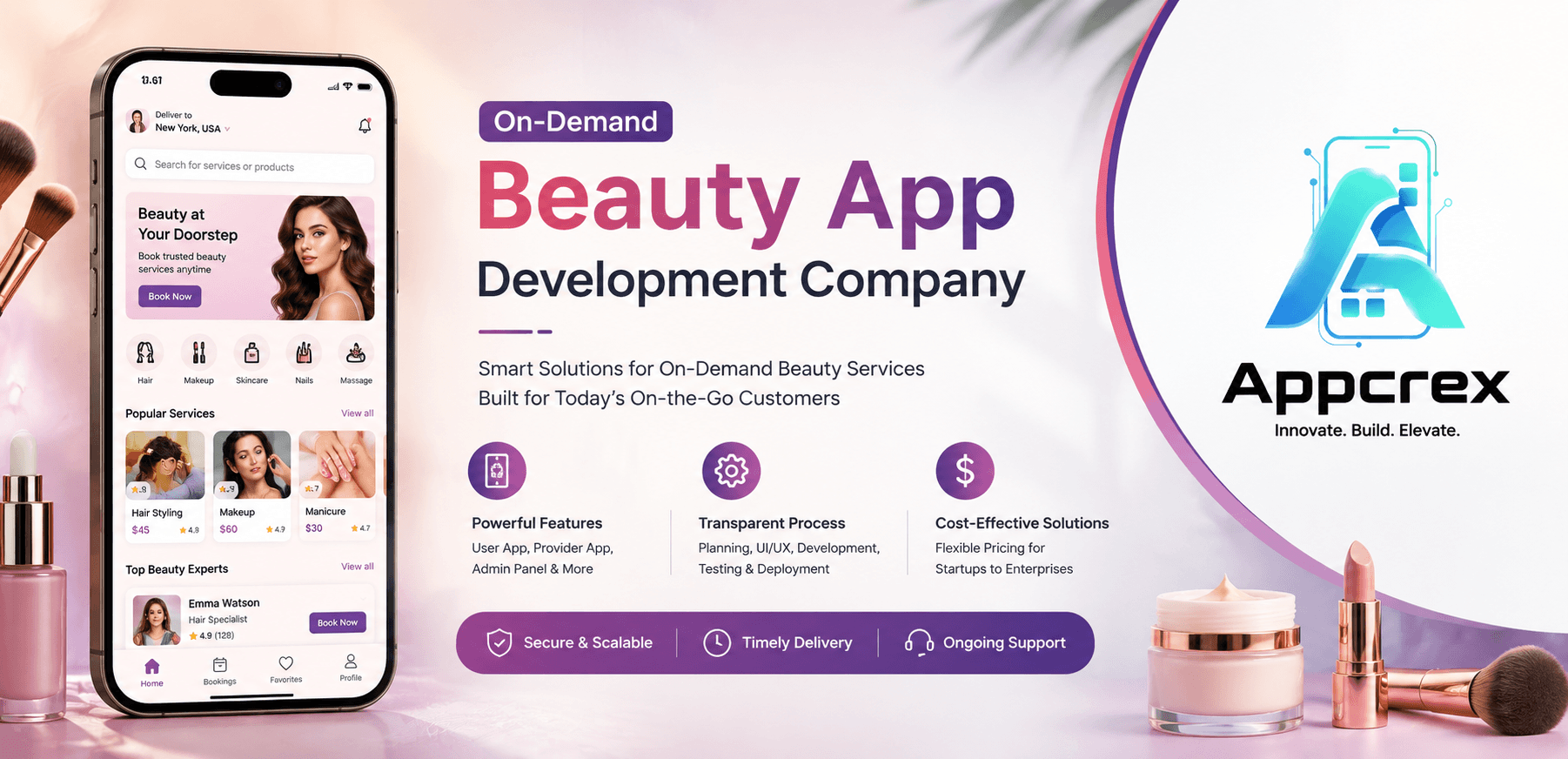
On-demand beauty app development involves creating applications that connect customers with salons, beauticians, makeup artists, hairstylists, skincare professionals, and other personal care providers.
Through the app, customers browse available services, compare professionals, view prices, select appointment times, and confirm bookings. Depending on the business model, users might book services at a salon or request a professional to visit their home.
A complete platform generally includes three main components:
- Customer application: Allows users to discover services, book appointments, pay online, and manage reservations.
- Beauty professional application: Helps providers manage availability, accept bookings, update services, and track earnings.
- Admin dashboard: Enables platform owners to manage users, professionals, services, payments, commissions, and reports.
For example, an entrepreneur launching a home beauty service app needs location-based search, service-area management, provider scheduling, and appointment coordination. A salon chain might prioritise branch management, staff calendars, customer profiles, and repeat bookings.
Defining the business model before development helps determine which features are essential and which should be added later.
Just Read : How to Develop an On-Demand Medicine Delivery App: Features, Cost & Development Process
Why Invest in an On-Demand Beauty Services App?
Traditional booking methods often rely on phone calls, social media messages, or manual calendars. These processes become harder to manage as the number of customers, professionals, and service locations increases.
A beauty services app brings important activities into one organised system.
1. Simplify Appointment Booking
Customers browse available services and select a suitable professional, date, and time. Automated confirmations and reminders reduce the need for repeated calls and messages.
2. Reach More Customers
A digital platform gives salons and independent professionals another channel for presenting their services. Location-based discovery helps customers find providers who serve their area.
3. Improve Operational Efficiency
Centralised booking management helps businesses track appointments, cancellations, provider availability, and customer details. Automated workflows also reduce repetitive administrative work.
4. Support At-Home Beauty Services
Customers who prefer home treatments need a convenient way to find professionals who serve their location. An app helps coordinate addresses, service areas, appointment times, and booking updates.
5. Encourage Repeat Bookings
Customer profiles, booking history, loyalty programmes, memberships, and personalised offers support ongoing customer relationships.
6. Make Business Performance Easier to Measure
An admin dashboard provides visibility into booking volume, popular services, cancellations, customer activity, and provider performance. These insights help owners identify operational problems and plan improvements.
The results depend on service quality, pricing, provider availability, local demand, and customer acquisition. An app supports business operations, but long-term growth also requires a reliable service model.
Types of On-Demand Beauty Apps
The right app model depends on the services you offer, your target customers, and how professionals deliver treatments.
Salon Booking App
A salon booking app allows customers to schedule appointments at a specific salon or across multiple branches. Users select services, choose staff members, and book available time slots.
Useful features include staff calendars, service menus, appointment reminders, customer profiles, and branch management. This model suits hair salons, nail studios, spas, and established beauty businesses.
At-Home Beauty Service App
An at-home beauty app connects customers with professionals who travel to their homes or other selected locations.
The platform needs address management, service-area checks, provider matching, travel-time planning, and booking notifications. Businesses should also define policies for travel fees, cancellations, provider safety, and late arrivals.
Beauty Marketplace App
A beauty marketplace brings multiple salons and independent professionals together on one platform. Customers compare services, prices, ratings, portfolios, and availability.
The platform owner manages provider onboarding, commissions, payments, disputes, and listing quality. This model offers flexibility but requires more operational controls than a single-salon application.
Makeup Artist Booking App
A makeup artist booking app focuses on bridal makeup, parties, photoshoots, special events, and other occasion-based services.
Features might include portfolio galleries, package pricing, availability calendars, location details, advance payments, and booking enquiries.
Spa and Wellness Booking App
A spa and wellness app supports scheduled treatments, therapy sessions, memberships, gift cards, and treatment packages. Appointment duration, therapist availability, and room scheduling might also need to be managed.
Multi-Branch Beauty Business App
Businesses operating several salons can use a shared platform for appointments, customer information, staff schedules, and branch-level reporting.
Customers select a preferred location, while administrators manage services, prices, staff, and availability across branches.
Essential Features of a Beauty Booking App
Feature planning should focus on the main user journeys rather than adding every possible function at launch.
Customer App Features
User registration and profiles: Customers create accounts, manage contact details, save locations, and review their booking history.
Service categories and search: Users browse haircare, skincare, makeup, nail care, spa treatments, and other services. Filters help narrow results by price, location, rating, and availability.
Professional profiles: Profiles display service descriptions, prices, working hours, relevant experience, portfolios, and customer reviews.
Appointment scheduling: Customers select services and available time slots. The system checks staff availability, treatment duration, breaks, and existing bookings to prevent scheduling conflicts.
Online payments: Suitable payment integrations support transactions, booking deposits, refunds, and payment status updates.
Notifications: Customers receive booking confirmations, appointment reminders, payment updates, and cancellation notifications.
Ratings and reviews: Customers share feedback after completed appointments. Moderation tools help manage inappropriate or fraudulent reviews.
Offers and loyalty rewards: Promotional codes, memberships, referral programmes, and reward points support customer retention.
Booking history: Users review upcoming and previous appointments and manage changes according to the business’s booking policy.
Beauty Professional App Features
The provider application should help beauticians, makeup artists, and salons manage daily operations.
Important features include:
- Provider registration and verification.
- Service and price management.
- Booking requests and appointment updates.
- Availability calendars and working-hour settings.
- Home-service coverage and location details.
- Earnings, commission, and payout information.
- Booking-related customer communication.
- Ratings and performance summaries.
For home visits, provider scheduling should account for travel time and service locations. A professional should not receive overlapping appointments that cannot be completed within the scheduled period.
Admin Dashboard Features
The admin dashboard provides oversight of the complete platform. It should include user management, provider approval, service listings, booking oversight, payment tracking, commission configuration, refund handling, promotions, review moderation, and operational reports.
Role-based access helps ensure employees only access the information needed for their responsibilities. Audit records also help administrators investigate important account and booking changes.
Also Read : How Do On-Demand Grocery Apps Work in the USA? Features, Cost & Development Guide
Advanced Features for Beauty App Development
Advanced functionality should solve a specific customer or operational problem.
AI-Based Service Recommendations
Recommendation systems suggest relevant services based on preferences and booking history. Their usefulness depends on available data, recommendation quality, and appropriate handling of customer information.
Virtual Beauty Try-On
Augmented reality features allow users to preview selected makeup shades or beauty looks through compatible devices. These features require suitable visual assets, testing, and additional development effort.
Smart Provider Matching
Matching systems recommend professionals based on location, skills, availability, ratings, and service requirements. Home-service platforms should also account for travel time and service coverage.
Dynamic Pricing
Businesses might adjust prices based on appointment timing, demand, location, or service packages. The app should display the final price and applicable charges before customers confirm a booking.
Memberships and Subscription Plans
Recurring plans provide benefits such as discounted treatments, priority booking, or monthly service packages. The platform needs clear renewal, billing, cancellation, and refund processes.
CRM and Marketing Integrations
Customer relationship management tools help businesses organise customer records, manage communication preferences, and coordinate marketing campaigns. Integrations should respect applicable privacy and messaging requirements.
How Much Does On-Demand Beauty App Development Cost?
The cost of on-demand beauty app development depends on the required features, number of user roles, platforms, integrations, design complexity, and launch markets.
The following figures are illustrative planning estimates in USD, not an AppCrex quotation.
| App complexity | Estimated budget | Typical scope |
|---|---|---|
| Basic booking app | $5,000–$15,000 | Service listings, customer accounts, appointments, basic admin tools |
| Mid-level platform | $15,000–$40,000 | Customer and provider workflows, payments, notifications, reviews |
| Advanced marketplace | $40,000–$100,000+ | Complex payouts, multiple locations, advanced matching, detailed analytics |
Actual prices vary according to development rates, project requirements, quality standards, and ongoing support needs. Obtain a scoped proposal before setting a final budget.
Factors Affecting Development Cost
Platform selection: Separate native iOS and Android applications might require more work than a shared cross-platform codebase, depending on functionality and architecture.
Feature complexity: Advanced scheduling, provider matching, subscriptions, loyalty systems, and reporting increase development effort.
Number of user roles: Customer apps, provider apps, and admin dashboards need separate workflows and access controls.
Third-party integrations: Payment gateways, maps, messaging services, analytics, and CRM systems introduce integration and usage costs.
UI/UX design: Custom interfaces, accessibility requirements, and user testing affect project scope.
Security and testing: Authentication, data protection, payment handling, compatibility testing, and performance checks require appropriate resources.
Maintenance: Hosting, monitoring, bug fixes, operating system updates, and future enhancements require an ongoing budget.
For a useful estimate, define your business model, launch region, user roles, core features, and expected booking volume before requesting a proposal.
How Long Does Beauty App Development Take?
Development time depends on the feature set, team size, integrations, and testing requirements.
As a broad planning estimate, a basic booking app might take around 6–12 weeks, a mid-level platform around 3–5 months, and a complex marketplace five months or longer.
These estimates are not guaranteed timelines. Projects involving complex payment workflows, location management, external approvals, or regulatory requirements might take longer.
A minimum viable product (MVP) focuses on the essential features needed to test the business model. After launch, the team can use customer feedback and usage data to prioritise improvements.
How to Develop an On-Demand Beauty App?
Step 1: Research the Market
Identify your target customers, service providers, competitors, and launch locations. Decide whether the app will serve one salon, several branches, or a marketplace of independent professionals.
Step 2: Define the Business Model and MVP
Choose the revenue model and prioritise features for the first release. Focus on service discovery, scheduling, booking confirmation, payments where required, and basic administration.
Step 3: Design the User Experience
Create wireframes and screen designs for customers, professionals, and administrators. Test the main booking journey to identify confusing steps before development begins.
Step 4: Choose the Technology Stack
Select technologies based on app requirements, team expertise, integrations, scalability, and maintenance. The architecture should support reliable bookings and appropriate access controls.
Step 5: Build the Application
Develop the mobile interfaces, backend services, database, booking engine, payment workflows, and admin dashboard. Pay special attention to availability, cancellations, refunds, and scheduling conflicts.
Step 6: Integrate Third-Party Services
Connect payment providers, maps, notifications, analytics, and other required tools. Confirm regional availability, service fees, and data-handling requirements.
Step 7: Test the App
Test complete booking journeys, payment failures, duplicate bookings, device compatibility, security, and performance. Fix critical issues before release.
Step 8: Deploy and Maintain
Prepare the production builds, app store listings, privacy information, and required declarations. After launch, monitor errors, booking completion, cancellations, customer feedback, and provider performance.
How Do Beauty Booking Apps Make Money?
An on-demand beauty platform might use one or more revenue models.
Booking commissions: Charge a percentage or fixed fee on eligible bookings.
Provider subscriptions: Offer paid plans to salons and professionals for platform access or additional business tools.
Customer memberships: Charge recurring fees for discounts, priority booking, or bundled treatments.
Featured listings: Offer clearly labelled promotional placements to providers.
Service fees: Charge a disclosed booking or convenience fee where appropriate.
Beauty product sales: Extend the platform to skincare, haircare, makeup, or related products. This requires additional catalogue, inventory, delivery, and returns functionality.
Choose a revenue model based on customer demand, provider economics, and operating costs. Keep fees transparent for both customers and professionals.
Also Read : How to Develop an On-Demand Medicine Delivery App: Features, Cost & Development Process
Technology Stack for Beauty App Development
The technology stack depends on performance requirements, platform needs, integrations, and long-term maintenance.
| Component | Example technologies |
|---|---|
| iOS development | Swift |
| Android development | Kotlin |
| Cross-platform apps | Flutter, React Native |
| Backend | Node.js, Python, Java |
| Database | PostgreSQL, MySQL |
| Cloud infrastructure | AWS, Microsoft Azure, Google Cloud |
| Maps and location | Google Maps Platform, Mapbox |
| Notifications | Firebase Cloud Messaging, Apple Push Notification service |
These are examples rather than mandatory choices. Select technologies based on the product’s actual requirements and the team’s ability to maintain them.
Common Challenges in Beauty App Development
Managing Provider Availability
Overlapping appointments, different treatment durations, and home-service travel can create scheduling conflicts.
Solution: Use a booking engine that checks working hours, service duration, breaks, existing appointments, and travel time.
Building Customer Trust
Customers want reliable professionals, transparent pricing, and clear service information.
Solution: Provide appropriate provider verification, detailed profiles, transparent policies, verified reviews, and a process for handling complaints.
Handling Cancellations and No-Shows
Late cancellations affect revenue and provider schedules.
Solution: Establish clear cancellation windows, automated reminders, deposit rules where appropriate, and fair refund policies.
Protecting Customer Information
Beauty platforms might store contact details, addresses, and booking histories.
Solution: Apply secure authentication, role-based access, data minimisation, suitable encryption, and appropriate retention practices.
Expanding to New Locations
Additional cities introduce differences in provider coverage, travel distances, service prices, and customer demand.
Solution: Start with a manageable service area, measure booking performance, and expand when the operating model is stable.
How to Choose an On-Demand Beauty App Development Company
Selecting the right development partner affects technical quality, delivery planning, and long-term maintenance.
Consider these factors before choosing a company:
- Technical expertise: Ask how the team will approach scheduling, payments, provider management, and marketplace operations.
- Clear project scope: Request a written feature list, milestones, deliverables, and exclusions.
- User experience: Review the planned booking journeys and approach to usability testing.
- Security: Ask about access controls, data protection, payment handling, and testing.
- Transparent pricing: Separate development costs from hosting, third-party fees, and maintenance.
- Ownership: Clarify ownership of source code, design files, accounts, and deployment credentials.
- Post-launch support: Define maintenance coverage, bug-fix responsibilities, and future enhancement arrangements.
Compare proposals based on your business requirements rather than headline price alone.
How AppCrex Supports Beauty App Development
Businesses planning a beauty booking platform need a clear scope covering customer experiences, provider workflows, payments, scheduling, and administration.
AppCrex supports mobile app development planning for businesses exploring digital products. The proposed approach should reflect your target market, service model, integrations, and budget.
Before development begins, define the core booking journey, provider responsibilities, payment rules, and post-launch support requirements. These details help establish a practical scope and a more reliable project estimate.
Contact AppCrex to discuss your on-demand beauty app idea and the requirements for your project.
FAQs
Q. What is an on-demand beauty app?
An on-demand beauty app connects customers with salons and beauty professionals for services such as makeup, hairstyling, skincare, and at-home treatments.
Q. How much does it cost to develop a beauty booking app?
A basic booking app might cost $5,000–$15,000 as an illustrative planning range, while a complex marketplace might cost $40,000–$100,000 or more. Actual costs depend on features, integrations, platforms, and project scope.
Q. How long does it take to build a beauty app?
A basic solution might take 6–12 weeks, while a mid-level platform often takes several months. Complex marketplaces typically require more development and testing time.
Q. What features should a beauty booking app include?
Core features include service search, professional profiles, appointment scheduling, payments, notifications, reviews, booking management, and an admin dashboard.
Q. Can an on-demand beauty app support home appointments?
Yes. The app might include address selection, service-area checks, provider matching, travel-time planning, and appointment status updates.
Q. Which technology is suitable for beauty app development?
Flutter and React Native are common cross-platform options. Swift and Kotlin support native iOS and Android development. The best choice depends on app requirements, integrations, and maintenance needs.
Q. How do beauty booking apps generate revenue?
Common revenue models include booking commissions, provider subscriptions, customer memberships, service fees, featured listings, and beauty product sales.
Q. Should I build separate customer and provider apps?
Separate apps offer tailored experiences for customers and professionals. A shared app with role-based interfaces or a provider web portal might also suit some business models.
Conclusion
On-demand beauty app development helps businesses bring service discovery, appointment booking, payments, and provider management into one digital platform. A successful project starts with a clear business model, practical feature planning, reliable scheduling, and a convenient customer experience.
If you are evaluating an on-demand beauty app development company, compare technical expertise, project scope, ownership, pricing, and ongoing support. A focused first release helps test demand and provides a foundation for future improvements.