📌 Key Takeaways
- Foldable readiness is primarily an adaptive design and architecture challenge, not simply a screen-size change.
- Size classes, flexible layouts and modern navigation are more reliable than hardcoded dimensions and orientation-based assumptions.
- Existing UIKit applications do not necessarily need a complete rewrite; many can be modernized incrementally.
- Testing across multiple device poses and screen configurations is essential for a reliable foldable experience.
- Modernizing now can future-proof your iOS application for increasingly flexible Apple computing environments.
Introduction
Apple’s move into foldable smartphones changes more than the hardware market. It also creates a new requirement for iOS developers: existing applications need to become more adaptive, flexible and responsive to significantly different screen configurations.
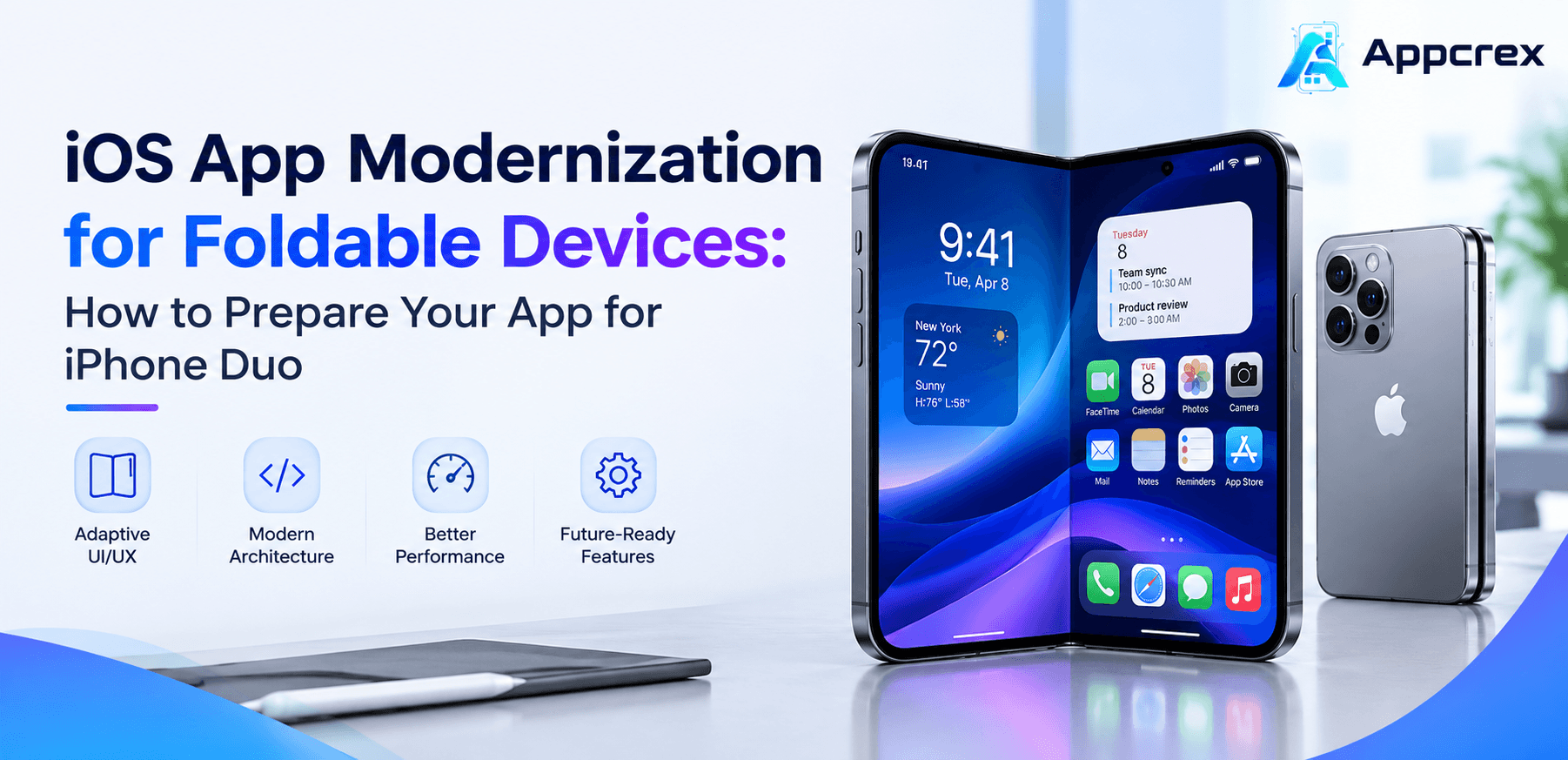
Apple has introduced the iPhone Duo, its first foldable iPhone, with an outer display and a larger internal display. Apple is also providing developers with new guidance around flexible layouts, size classes, safe areas, reserved regions, navigation and testing.
For businesses that already have an iOS application, this means the question is no longer simply whether the app will launch on a foldable device. The bigger question is:
Will the existing app actually deliver a good experience when the screen changes shape, size and available space?
That is where iOS app modernization becomes important.
This guide explains how businesses can prepare an existing iOS app for foldable devices, what parts of an application need to be audited, which technologies can help, common modernization challenges, development costs and how to build a future-ready iOS application.
Why iOS Apps Need to Be Modernized for Foldable Devices
Traditional iPhone applications are often designed around assumptions such as a fixed screen size, portrait orientation and a single primary display.
Foldable devices challenge those assumptions.
An application may need to work across:
- A compact outer display
- A larger unfolded display
- Partially folded states
- Different available screen dimensions
- Split-view experiences
- Asymmetric safe areas
- Camera or hinge reserved regions
- Different navigation arrangements
Apple’s current developer guidance specifically recommends designing around available space instead of relying on fixed screen assumptions. It also recommends using size classes and adaptive system containers rather than making layout decisions based only on device type or orientation.
This is particularly important for older applications that contain hardcoded dimensions, legacy UIKit patterns or custom layouts that were never designed to resize dynamically.
A modernization project therefore should not be treated as simply “adding foldable support.” It should be approached as a broader app modernization and adaptive UI project.
What Changes When an iPhone App Becomes Foldable-Ready?
The biggest change is the amount of available space.
A traditional iPhone screen gives developers a relatively predictable layout environment. A foldable device can transition between compact and expanded states.
That creates opportunities as well as challenges.
For example, an e-commerce application could show:
Closed:
Product image → price → add-to-cart button
Open:
Product categories → product image → product details → reviews → recommendations → cart
Similarly, a travel application could use the expanded display to show search filters alongside flight or hotel results instead of forcing users to move between multiple screens.
A financial application could show portfolio categories on one side and detailed charts or transaction information on the other.
The objective is not to simply stretch the existing UI. It is to rethink how content is arranged when more space becomes available.
Apple’s guidance highlights adaptive navigation components such as NavigationSplitView, UISplitViewController, TabView and UITabBarController, which can adjust their presentation as available space changes.
The First Step: Audit Your Existing iOS Application
Before changing code, developers should perform a complete technical audit.
This is particularly important for businesses with applications that have been developed over several years.
The audit should examine:
- UIKit architecture
- SwiftUI implementation
- Auto Layout
- Hardcoded frame sizes
- Screen references
- Orientation checks
- Device-specific conditions
- Navigation architecture
- Custom components
- Safe-area handling
- Image scaling
- Typography
- Modal presentations
- API behavior
- Performance
- Third-party SDK compatibility
Apple’s 2026 modernization guidance identifies several legacy assumptions that developers should address, including application lifecycle patterns, direct main-screen references, user-interface idiom checks and orientation-based layout decisions.
This audit helps determine whether your application needs a small UI modernization or a deeper architectural upgrade.
Replace Fixed Layouts With Flexible Layouts
One of the most common problems in older iOS applications is the use of fixed dimensions.
For example, a developer may have designed a component around a specific screen width:
button width = fixed value
image width = fixed value
container height = fixed valueModern applications should allow the interface to respond dynamically.
For UIKit applications, Auto Layout and trait-based layouts are important. For SwiftUI applications, developers can use environment information, flexible containers and adaptive views.
Apple recommends building interfaces that respond to the available environment rather than assuming a specific display configuration.
The goal should be:
Fixed design → Responsive design → Adaptive experience
This is one of the most important parts of iOS app modernization.
Use Size Classes Instead of Depending on Orientation
Another important modernization area is orientation logic.
Older applications may contain code such as:
- If portrait → display layout A
- If landscape → display layout B
- If iPhone → use layout A
- If iPad → use layout B
That approach becomes less reliable as applications operate in more resizable environments.
Apple now recommends using size classes and available space for layout decisions rather than relying on interface orientation or device idiom.
This allows an application to determine what type of layout is appropriate based on the actual space available.
For example:
Compact width:
Use a single-column experience.
Regular width:
Show additional navigation or supporting information.
Large available area:
Use multiple columns, sidebars or split layouts.
This makes the same application more adaptable across future Apple devices and environments.
Modernize SwiftUI and UIKit Components
A foldable-ready application does not necessarily need to be completely rewritten.
In many cases, existing UIKit or SwiftUI components can be modernized incrementally.
For SwiftUI Applications
Developers can focus on:
- Flexible stacks
- Adaptive grids
- Dynamic spacing
- Size-class awareness
- NavigationSplitView
- Arrangement-based layouts
- Flexible sheets and popovers
- Dynamic typography
For UIKit Applications
Developers should review:
- Auto Layout constraints
- Trait collections
- Scene lifecycle
- UISplitViewController
- Adaptive navigation
- Safe areas
- Dynamic view sizing
- Custom container controllers
Apple’s 2026 developer sessions specifically cover modernization of UIKit applications and adaptive behavior for resizable iPhone environments.
For businesses with a large legacy application, incremental modernization can often be more practical than rewriting the entire application from scratch.
Design Around the Fold, Camera and Reserved Areas
Foldable devices introduce another UI consideration: not every part of the expanded display is necessarily an ideal location for interactive content.
The hinge area, camera regions and system UI can affect how content should be positioned.
Apple has introduced the concept of reserved regions for iPhone Duo so developers can determine where custom UI should and should not occupy space.
This is particularly important for:
- Video applications
- Games
- Financial dashboards
- Maps
- Editing applications
- E-commerce
- Productivity tools
- Custom navigation interfaces
For example, placing a critical button directly in a region affected by the fold can make it difficult to use.
A modern design should instead intelligently reposition content.
A foldable display provides more room for navigation.
A traditional mobile application might use:
Home → Category → Product → Details
On a larger display, the same experience could become:
Sidebar | Product List | Product Details
This reduces unnecessary navigation and allows users to see more information simultaneously.
For business applications, this can make a significant difference.
Consider a CRM application.
On a compact display:
Customers → Customer → Activity
On a larger display:
Customer List | Customer Profile | Activity
This is a much more productive use of the available screen.
Apple recommends adaptive navigation components that can collapse, expand or rearrange according to available space.
Make Your App Work Across Different Foldable Poses
A foldable device can be used in different physical configurations.
Your app should therefore be tested in multiple states instead of testing only:
Portrait + Landscape
Testing should consider:
- Closed state
- Fully open state
- Partially folded state
- Different orientations
- Split-screen scenarios
- Different available widths
- Different safe-area configurations
Apple’s developer resources specifically provide tools for simulating different iPhone Duo poses and testing layouts using Xcode’s Device Hub.
This is important because a screen that looks perfect when fully open may behave differently when the device is partially folded.
Testing Is a Major Part of Foldable App Modernization
A foldable-ready application needs more than standard functional testing.
Your QA process should include:
UI Testing
Check whether:
- Buttons remain accessible
- Text does not overlap
- Images scale correctly
- Navigation remains usable
- Cards resize correctly
- Forms remain readable
Device-State Testing
Test:
- Closed
- Open
- Partially folded
- Portrait
- Landscape
- Resized environments
Performance Testing
Check:
- Memory consumption
- Animation performance
- Scrolling
- Video playback
- Large image rendering
- Background tasks
- Network transitions
Accessibility Testing
Ensure that:
- Dynamic Type works
- VoiceOver remains usable
- Touch targets remain accessible
- Content order makes sense
- Navigation remains understandable
A visually impressive foldable interface is not enough if users cannot comfortably interact with it.
Modernizing an iOS App Is Also an Architecture Upgrade
Foldable support can expose architectural weaknesses that may already exist in an application.
For example, an application with tightly coupled UI and business logic may become difficult to adapt.
A better architecture separates:
- Presentation
- Business logic
- Data layer
- Networking
- Authentication
- State management
- UI components
This makes it easier to create multiple layouts without duplicating business logic.
For large applications, modernization can also involve:
- API modernization
- Dependency upgrades
- Modularization
- CI/CD improvements
- Automated testing
- Cloud optimization
- Security improvements
- Analytics modernization
This means a foldable-readiness project can become an opportunity to improve the entire technical foundation of the application.
How Much Does iOS App Modernization for Foldable Devices Cost?
There is no single fixed price because the cost depends heavily on the condition of the existing application.
A rough planning range can look like this:
| Modernization Scope | Estimated Cost | Typical Timeline |
|---|---|---|
| UI Adaptation | $8,000–$20,000 | 4–8 weeks |
| Medium App Modernization | $20,000–$45,000 | 2–4 months |
| Complex iOS Application | $40,000–$80,000+ | 3–6 months |
| Large Enterprise App | $80,000–$150,000+ | 5–9+ months |
| Full Modernization + AI + Foldable UX | $100,000–$200,000+ | 6–12+ months |
These are planning ranges rather than fixed market prices. The actual cost depends on code quality, number of screens, UIKit/SwiftUI architecture, third-party dependencies, backend complexity, testing requirements and the amount of redesign required.
A simple application with 15–20 screens may only need adaptive UI changes.
A large banking, healthcare, travel or enterprise application could require substantial architectural modernization.
What Factors Affect Modernization Cost?
The biggest cost factors include:
Age of the application:
Older codebases may require more refactoring.
UIKit vs. SwiftUI:
Modern SwiftUI-based interfaces can be easier to adapt, although existing UIKit applications can also be modernized.
Number of screens:
More screens mean more layout and testing work.
Custom components:
Highly customized interfaces can require significant redevelopment.
Third-party libraries:
Outdated SDKs and dependencies may need replacement.
Backend architecture:
Foldable UI modernization may reveal API or state-management limitations.
Testing requirements:
More device states mean more QA combinations.
AI integration:
If modernization also includes Apple Intelligence or other AI capabilities, additional development work may be required.
Apple’s 2026 modernization guidance also highlights preparing applications for Apple Intelligence capabilities as part of broader app modernization.
Should You Rebuild the App or Modernize It?
This is one of the most important decisions for businesses.
Modernize the Existing App When:
- The codebase is reasonably healthy
- Backend infrastructure is stable
- Existing users depend on the application
- Core business logic works well
- Only UI and architecture need improvement
Consider a Partial or Full Rebuild When:
- The application has heavily outdated architecture
- The code is difficult to maintain
- Dependencies are no longer supported
- Performance is poor
- Security architecture is outdated
- UI components are heavily hardcoded
- New functionality requires major structural changes
In many cases, a phased modernization strategy is better than an expensive complete rewrite.
You can modernize the highest-value screens first, test them, measure performance and then continue across the application.
A Practical iOS Foldable Modernization Roadmap
A business can approach the project in the following stages.
Stage 1 — Technical Audit
Review the existing application, architecture, dependencies and UI.
Stage 2 — Adaptive Design Strategy
Define how each screen should behave across compact and expanded layouts.
Stage 3 — Architecture Modernization
Move away from legacy lifecycle, hardcoded screen assumptions and orientation-dependent logic.
Stage 4 — UI Development
Implement adaptive SwiftUI or UIKit layouts.
Stage 5 — Foldable-Specific Optimization
Handle safe areas, reserved regions, navigation changes and different device poses.
Stage 6 — Testing
Test every major screen across multiple display configurations.
Stage 7 — Performance Optimization
Improve rendering, memory usage, animation and network behavior.
Stage 8 — Release
Deploy the updated application and monitor crashes, performance, user behavior and feedback.
This phased approach allows businesses to modernize without unnecessarily disrupting the existing product.
Why Foldable-Ready Design Is Bigger Than iPhone Duo
The most important reason to modernize now is not simply one device.
The broader trend is toward adaptive computing environments.
Apple is already making iOS applications more resizable across iPhone Mirroring and iPad environments. Apple says applications should dynamically adjust to the available scene size rather than relying on fixed assumptions.
That means the investment in adaptive architecture can benefit your application beyond a single foldable model.
Instead of designing:
One device → One layout
the future-oriented approach is:
One application → Multiple screen environments → Adaptive experiences
This can improve the longevity of your iOS application.
How an iOS App Development Company Can Help
Modernizing a large application internally can be difficult when the existing team is already focused on daily product development.
An experienced iOS app development company can handle the modernization process from technical audit to deployment.
The development team should ideally have experience with:
- Swift
- SwiftUI
- UIKit
- Auto Layout
- Adaptive layouts
- Size classes
- iOS architecture
- API integration
- App Store deployment
- Automated testing
- Performance optimization
- AI integration
- Enterprise application modernization
For businesses with older applications, it is particularly important to choose developers who understand legacy-to-modern migration, rather than developers who only build new iOS applications.
FAQs
Q. What does iOS app modernization for foldable devices mean?
It means updating an existing iOS application so its interface, architecture and functionality can adapt to different screen sizes, display configurations and device states.
Q. Does my existing iOS app need to be rebuilt for iPhone Duo?
Not necessarily. Apple states that existing apps can run on iPhone Duo, but optimizing the application with modern SDKs and adaptive layouts allows it to use the available display more effectively.
Q. Can a UIKit app be made foldable-ready?
Yes. UIKit applications can be modernized using adaptive layouts, Auto Layout, trait collections, modern navigation components and appropriate scene-based architecture.
Q. Is SwiftUI better for foldable app development?
SwiftUI provides many modern adaptive layout capabilities, but UIKit applications can also be made highly adaptive. The right approach depends on the existing codebase and modernization goals.
Q. How much does it cost to modernize an iOS app for foldable devices?
A smaller UI-focused modernization may start around $8,000–$20,000, while complex enterprise applications can require $80,000–$150,000+ depending on architecture, number of screens and testing requirements.
Q. Can AI be added during iOS app modernization?
Yes. A modernization project can also include AI-powered features, Apple Intelligence-related capabilities, intelligent search, recommendations, assistants or automation where appropriate.
Conclusion
The arrival of foldable iPhone hardware makes iOS app modernization more important for businesses with established mobile products.
The goal should not be to make an existing application simply “fit” on a larger display. The better approach is to build an adaptive experience that understands available space, changes navigation intelligently, respects safe areas and provides the right interface for each device state.
Businesses that modernize their applications now can also benefit from broader improvements in iOS resizability, iPad experiences, iPhone Mirroring and future device formats.
If your existing application was designed around fixed screen dimensions or older UIKit patterns, this is a good time to conduct a technical audit and start modernization in phases.
Modernize Your iOS App with AppCrex
AppCrex helps businesses with iOS app development, legacy app modernization, Swift and SwiftUI development, adaptive UI,cross-platform app development, AI integration and enterprise mobile application development.
Whether you need to modernize an existing iOS application for foldable devices or build a new adaptive mobile product, the development approach can be planned around your existing codebase, users, business requirements and future scalability.