📌 Key Takeaways
- An MVP (Minimum Viable Product) helps businesses validate app ideas by launching with only the essential features.
- MVP app development reduces costs, shortens development time, and enables early user feedback.
- A structured MVP process includes market research, feature prioritization, design, development, testing, launch, and continuous improvement.
- Starting with an MVP minimizes business risk and provides valuable insights before investing in a full-featured product.
- Partnering with an experienced MVP app development company ensures strategic planning, scalable architecture, and long-term success.
Launching a successful mobile application requires more than just a great idea. It demands careful planning, market validation, and efficient use of resources. One of the smartest ways to reduce risk and validate your concept is through MVP app development.
An MVP (Minimum Viable Product) is the first version of a mobile app that includes only the essential features needed to solve a core user problem. Instead of spending months or even years building a feature-rich application, businesses launch a simplified version to test the market, gather user feedback, and improve the product based on real-world insights.
This approach has become the preferred strategy for startups, entrepreneurs, and even established enterprises. Many globally recognized companies, including Airbnb, Uber, Dropbox, and Instagram, began with an MVP before evolving into the platforms we know today.
Whether you’re a startup validating a new business idea or an enterprise exploring a new digital product, MVP development helps reduce costs, shorten development time, and increase the chances of long-term success.
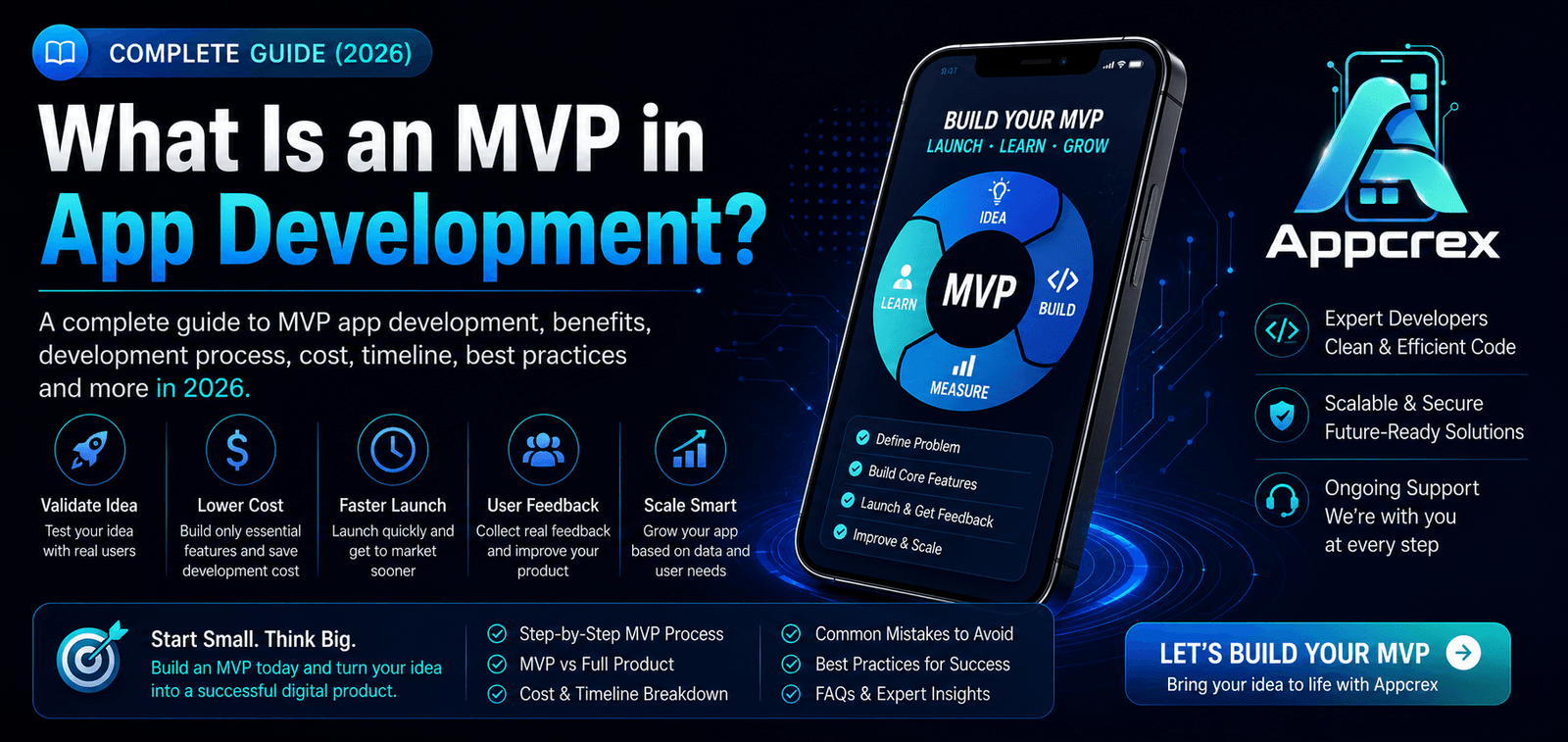
In this guide, we’ll explain everything you need to know about minimum viable product development, including its benefits, development process, costs, timelines, best practices, and how to choose the right MVP app development company.
What Is an MVP in App Development?
An MVP (Minimum Viable Product) is the earliest functional version of a software application that contains only the essential features required to solve a specific user problem.
Rather than building every planned feature before launch, businesses release a simplified product that allows them to:
- Validate their business idea
- Test market demand
- Collect user feedback
- Identify improvement opportunities
- Reduce financial risk
- Launch faster
The primary objective of an MVP is not to create a perfect application but to determine whether users find value in the core concept.
For example, if you’re developing a food delivery app, your MVP might include:
- User registration
- Restaurant listings
- Food ordering
- Online payment
- Order tracking
Advanced features like loyalty programs, AI recommendations, multilingual support, and subscription plans can be introduced in future updates after validating user demand.
Why Is MVP App Development Important?
Developing a full-featured application without validating the idea can be expensive and risky. Businesses may invest substantial time and resources only to discover that the product doesn’t meet market needs.
MVP app development helps reduce this risk by enabling businesses to test their concept with real users before committing to a larger investment.
Key advantages include:
- Faster product launch
- Lower development costs
- Early customer feedback
- Reduced business risk
- Better investment decisions
- Faster time-to-market
- Continuous product improvement
This iterative approach allows businesses to refine their application based on actual user behavior rather than assumptions.
Benefits of MVP App Development
1. Faster Time to Market
One of the biggest advantages of building an MVP is speed.
Since only essential features are developed initially, businesses can launch their application much sooner than if they attempted to build a complete product.
Early market entry also provides a competitive advantage by allowing businesses to:
- Attract early adopters
- Gather customer feedback
- Build brand awareness
- Start generating revenue sooner
2. Lower Development Costs
Developing a fully featured application requires significant time, resources, and investment.
By focusing only on essential functionality, MVP development reduces:
- Design costs
- Development costs
- Testing efforts
- Infrastructure requirements
- Overall project risk
Businesses can invest in additional features only after validating market demand.
3. Validate Your Business Idea
One of the primary goals of a Minimum Viable Product is validation.
Instead of relying on assumptions, businesses receive real feedback from users regarding:
- Product usefulness
- User experience
- Feature priorities
- Market demand
- Customer expectations
This information helps teams make informed product decisions.
4. Attract Investors
Investors are more likely to support businesses that demonstrate market validation rather than just presenting an idea.
An MVP provides tangible evidence of:
- User adoption
- Customer engagement
- Product-market fit
- Revenue potential
This increases credibility and strengthens funding opportunities.
5. Continuous Improvement
An MVP is designed to evolve.
After launch, businesses can analyze:
- User behavior
- App analytics
- Customer feedback
- Feature usage
- Performance metrics
These insights guide future updates and ensure resources are invested in features users actually want.
6. Reduced Business Risk
Building a complete product without validating demand can result in substantial financial losses.
An MVP minimizes this risk by allowing businesses to:
- Test assumptions
- Identify challenges early
- Adjust product strategy
- Improve based on feedback
This makes MVP app development a safer and more strategic approach.
7. Better Resource Allocation
Instead of spending budget on low-priority features, businesses can focus on delivering the core functionality that provides immediate value.
This results in:
- More efficient development
- Better budget control
- Faster iterations
- Higher ROI
Who Should Build an MVP?
An MVP is suitable for:
- Startups launching a new app
- Entrepreneurs validating business ideas
- SaaS companies testing new products
- Enterprises exploring new digital services
- Businesses entering new markets
- Companies launching innovative features
Whether you’re building a healthcare app, fintech platform, eCommerce marketplace, or on-demand service, starting with an MVP can significantly improve your chances of success.
Also Read : How Much Does It Cost to Develop an App in 2026? Complete Pricing Guide
MVP Development Process: Step-by-Step Guide
A successful MVP app development project follows a structured process that helps validate your idea while minimizing risks and development costs. Instead of building a feature-rich application from the start, the focus is on delivering a functional product that solves a core user problem.
Below is a proven step-by-step MVP development process.
Step 1: Identify the Problem
Every successful app starts by solving a real problem.
Before writing a single line of code, ask yourself:
- What problem does my app solve?
- Who is my target audience?
- Why will users choose my app?
- What makes my solution different?
A clearly defined problem lays the foundation for a successful MVP.
Step 2: Conduct Market Research
Before investing in MVP development, study your competitors and understand market demand.
Research should include:
- Competitor analysis
- Target audience
- Industry trends
- Customer pain points
- Existing solutions
- Market gaps
This helps you create an app that offers genuine value instead of duplicating existing products.
Step 3: Define Your Unique Value Proposition (UVP)
Your MVP should communicate why users should choose your application.
Examples include:
- Faster service
- Better user experience
- Lower pricing
- AI-powered recommendations
- Greater convenience
- Improved security
A strong value proposition helps differentiate your product in a competitive market.
Step 4: Prioritize Core Features
One of the biggest mistakes startups make is trying to include every possible feature in the first version.
Instead, identify only the features required to solve your users’ primary problem.
Ask:
- Is this feature essential?
- Does it help users achieve the main goal?
- Can it wait until later?
This keeps development focused and cost-effective.
Step 5: Create Wireframes & UI/UX Design
Before development begins, designers create:
- User flows
- Wireframes
- Interactive prototypes
- Visual designs
Good UI/UX ensures users can navigate the app easily and complete key tasks without confusion.
Investing in user experience early often reduces redesign costs later.
Step 6: Develop the MVP
Once planning and design are complete, development begins.
Typical development phases include:
- Frontend Development
- Backend Development
- Database Setup
- API Integration
- User Authentication
- Admin Dashboard
- Notifications
- Security Implementation
The goal is to create a stable, functional product—not a feature-complete application.
Step 7: Test Thoroughly
Quality assurance is essential before launch.
Testing should cover:
- Functional Testing
- UI Testing
- Performance Testing
- Security Testing
- Device Compatibility
- Bug Fixing
Launching a reliable MVP creates a positive first impression and encourages early user adoption.
Step 8: Launch and Collect Feedback
After testing, release the MVP to real users.
Collect feedback through:
- User interviews
- Reviews
- Surveys
- Analytics
- Customer support requests
- Feature requests
This real-world data helps shape future product updates.
Step 9: Improve and Scale
An MVP is only the beginning.
Based on user feedback, you can:
- Add new features
- Improve performance
- Enhance security
- Expand to new platforms
- Optimize user experience
This iterative approach reduces risk and supports sustainable product growth.
Essential Features to Include in an MVP
While every application is different, most MVPs include a small set of core features that provide immediate value.
Common MVP features include:
- User Registration
- Login & Authentication
- User Profile
- Dashboard
- Search
- Notifications
- Basic Settings
- Contact Support
- Analytics
- Admin Panel
Only include features that are necessary for validating your product idea.
Features You Can Add Later
Many advanced features can be postponed until after market validation.
Examples include:
- AI Recommendations
- Chatbots
- Video Calling
- Loyalty Programs
- Referral Systems
- Subscription Plans
- Gamification
- Multi-language Support
- AR/VR
- Advanced Analytics
Adding these later allows you to prioritize development resources effectively.
Also Read : How to Upload an App to the Apple App Store: Step-by-Step Guide (2026)
Types of MVPs
Not every MVP looks the same. Depending on your business goals, different MVP approaches may be appropriate.
Single Feature MVP
Focuses on solving one primary problem exceptionally well.
Example:
A ride-booking app may initially offer only ride booking without wallet integration or rewards.
Landing Page MVP
A landing page explains your product concept and measures interest through sign-ups or pre-orders before development begins.
This is a cost-effective way to validate demand.
Concierge MVP
Instead of automating everything, services are delivered manually behind the scenes.
Example:
A meal delivery startup may coordinate orders manually before building a full application.
Wizard of Oz MVP
Users believe the app is fully automated, while many operations are handled manually by the business.
This approach helps validate ideas before investing in complex technology.
Piecemeal MVP
Combines existing tools and third-party services instead of developing everything from scratch.
Examples include using:
- Google Forms
- Stripe
- Airtable
- Shopify
- Zapier
This significantly reduces development costs and accelerates launch.
MVP vs Full Product
Understanding the difference between an MVP and a fully developed application is essential.
| Feature | MVP | Full Product |
|---|---|---|
| Core Features | ✔ | ✔ |
| Advanced Features | Limited | Extensive |
| Development Time | Short | Long |
| Initial Cost | Lower | Higher |
| Market Validation | Primary Goal | Already Validated |
| User Feedback | Early Stage | Continuous |
| Scalability | Basic | Enterprise Ready |
An MVP focuses on validating the business idea, while a full product delivers a complete experience with advanced functionality.
Real-World Examples of Successful MVPs
Many of today’s leading technology companies started with a simple MVP before expanding their offerings.
Airbnb
Airbnb began as a basic website where the founders rented out space in their apartment to test whether people were willing to pay for short-term accommodations.
Dropbox
Instead of building a complete product immediately, Dropbox released a demo video explaining the concept. The strong response validated market demand before full-scale development.
Instagram initially focused only on photo sharing with filters. Features like Stories, Reels, and messaging were introduced later.
Uber
Uber’s first version was a simple app that connected riders with drivers in a single city. It expanded gradually based on user demand and market success.
These examples demonstrate that successful products often begin with a focused MVP rather than a fully featured application.
Also Read : What Is API Integration? A Complete Guide to Benefits, Types & Best Practices
How Much Does MVP App Development Cost?
One of the biggest advantages of MVP app development is its cost-effectiveness. Instead of investing heavily in a fully featured application, businesses can launch a functional product with only the essential features needed to validate their idea.
However, there is no fixed price for building an MVP. The total cost depends on factors such as app complexity, platform, design, technology stack, development team, and third-party integrations.
Below is a general estimate of MVP app development costs in 2026.
| MVP Type | Estimated Cost | Timeline |
|---|---|---|
| Basic MVP | $10,000–$20,000 | 2–3 Months |
| Medium MVP | $20,000–$50,000 | 3–5 Months |
| Advanced MVP | $50,000–$100,000+ | 5–8 Months |
These estimates include planning, UI/UX design, development, testing, and deployment.
Factors That Affect MVP Development Cost
Several factors influence the overall MVP app cost.
1. Number of Features
The more features you include, the higher the development cost.
Essential features typically include:
- User Registration
- Login
- Dashboard
- User Profile
- Search
- Notifications
Avoid adding advanced functionality during the first release unless it directly supports your core value proposition.
2. Platform Selection
The platform you choose has a direct impact on cost.
Native Development
Building separate Android and iOS applications provides the best performance but generally requires more time and investment.
Cross-Platform Development
Frameworks like Flutter and React Native allow developers to create apps for both Android and iOS from a single codebase, often reducing development time and cost.
3. UI/UX Design
A clean and intuitive interface improves user engagement and reduces friction.
Professional UI/UX design includes:
- User research
- Wireframes
- Interactive prototypes
- Visual design
- User testing
Investing in good design early can improve adoption and reduce costly redesigns later.
4. Backend Infrastructure
Many MVPs require backend services for:
- User authentication
- Databases
- APIs
- Notifications
- Cloud storage
More complex backend requirements generally increase development costs.
5. Third-Party Integrations
Common integrations include:
- Payment gateways
- Google Maps
- Firebase
- Social login
- SMS services
- Analytics platforms
Each integration requires development, testing, and ongoing maintenance.
How Long Does It Take to Build an MVP?
The development timeline depends on your app’s scope and complexity.
Basic MVP
Timeline: 2–3 Months
Ideal for:
- Startup ideas
- Landing-page-based products
- Business apps
- Appointment booking apps
Medium MVP
Timeline: 3–5 Months
Suitable for:
- Food delivery apps
- Fitness apps
- Education platforms
- Marketplace apps
Advanced MVP
Timeline: 5–8 Months
Often includes:
- AI capabilities
- Video streaming
- Real-time messaging
- Advanced analytics
- Enterprise integrations
Planning, feedback cycles, and testing can influence the final timeline.
Common MVP Development Mistakes
Many startups fail not because of poor ideas but because of avoidable development mistakes.
1. Building Too Many Features
The most common mistake is trying to build a full product instead of an MVP.
Focus only on features that solve the primary user problem.
2. Ignoring Market Research
Without understanding customer needs, even a technically sound app may fail to gain traction.
Validate your assumptions before development begins.
3. Skipping User Feedback
An MVP exists to learn from users.
Ignoring feedback means missing valuable insights that can improve your product and strengthen product-market fit.
4. Poor UI/UX Design
Users expect intuitive and visually appealing experiences.
Complicated navigation or inconsistent design can lead to low engagement and poor retention.
5. Choosing Technology Without a Long-Term Strategy
Selecting the wrong technology stack may create scalability challenges as your product grows.
Consider future expansion when making architectural decisions.
6. Inadequate Testing
Releasing an MVP doesn’t mean releasing a buggy product.
Test thoroughly for:
- Functionality
- Performance
- Security
- Device compatibility
- Usability
A stable MVP builds trust with early adopters.
7. Delaying Security
Security should be incorporated from the beginning.
Protect user data through:
- Secure authentication
- Data encryption
- HTTPS communication
- Secure API access
This is especially important for healthcare, fintech, and eCommerce applications.
Best Practices for Successful MVP Development
Following proven best practices can improve your chances of launching a successful MVP.
Start with a Clear Business Goal
Define exactly what success looks like.
Examples include:
- Number of users
- Customer feedback
- Revenue targets
- Investor interest
Focus on Solving One Core Problem
The best MVPs solve one problem exceptionally well instead of addressing multiple challenges at once.
Launch Quickly
Avoid waiting for perfection.
A faster launch enables earlier feedback and quicker iterations.
Measure User Behavior
Track key metrics such as:
- Downloads
- Active users
- Session duration
- Retention rate
- Conversion rate
- Customer feedback
These insights help prioritize future improvements.
Continuously Improve
An MVP is only the starting point.
Use real-world data to:
- Refine existing features
- Introduce new functionality
- Improve performance
- Expand your product roadmap
How to Reduce MVP Development Costs
If you’re working with a limited budget, these strategies can help reduce costs while maintaining quality.
- Prioritize essential features.
- Use cross-platform frameworks when appropriate.
- Reuse reliable third-party services instead of building everything from scratch.
- Define detailed project requirements before development.
- Avoid frequent scope changes during development.
- Launch with an MVP and expand gradually based on user feedback.
- Partner with an experienced MVP app development company to benefit from proven processes and technical expertise.
MVP Development Checklist
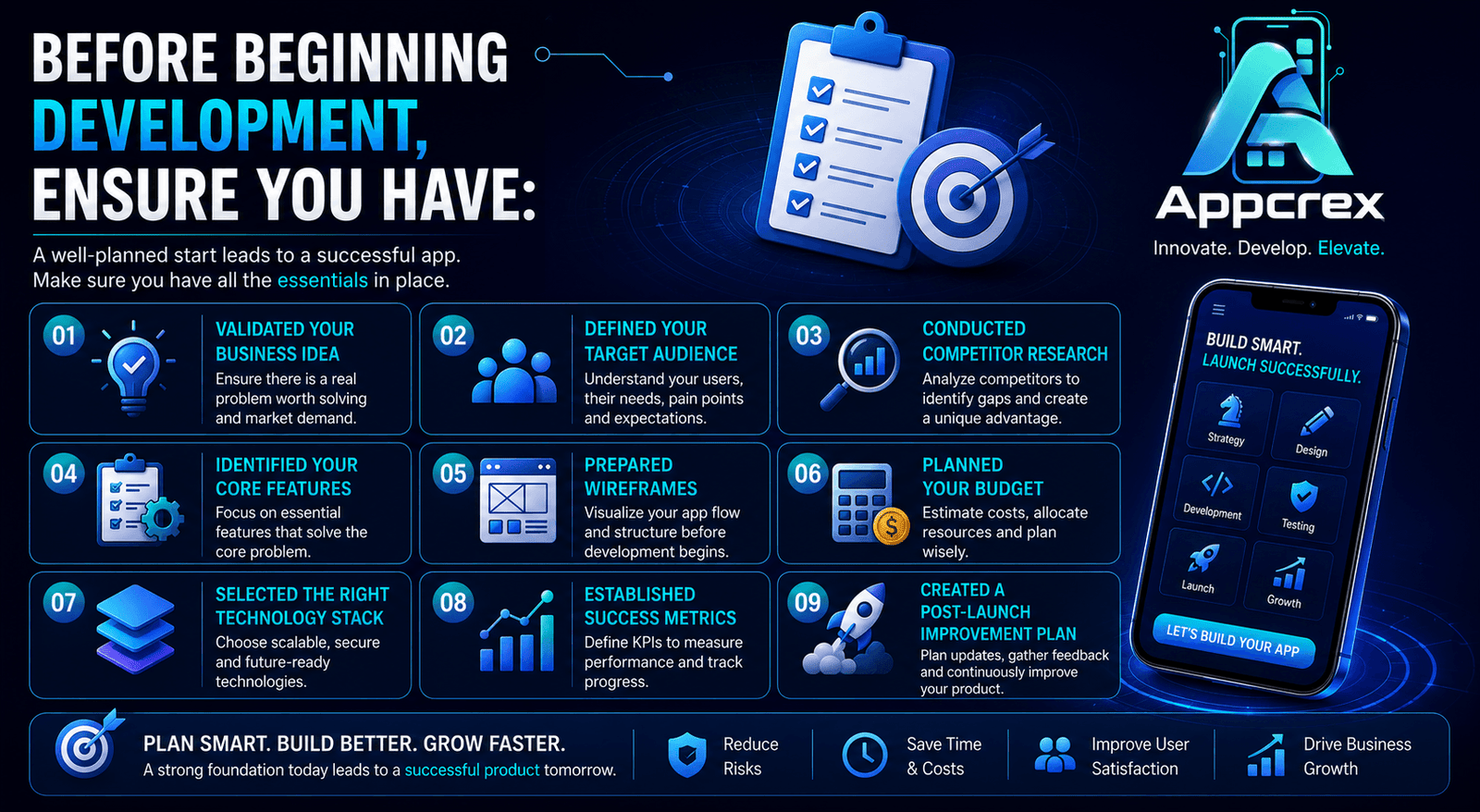
This checklist helps keep your project focused and increases the likelihood of a successful launch.
Why Hire an MVP App Development Company?
Building a Minimum Viable Product (MVP) is more than creating a basic version of your app. It requires strategic planning, market validation, technical expertise, and a scalable architecture that supports future growth. Partnering with an experienced MVP app development company can help you launch faster, reduce risks, and make better use of your budget.
Whether you’re a startup, entrepreneur, or enterprise, working with professionals ensures your MVP is built with the right technologies, user experience, and long-term scalability in mind.
1. Faster Time to Market
Speed is one of the biggest advantages of MVP development.
An experienced development company follows proven workflows, Agile methodologies, and efficient project management practices to reduce development time and launch your product quickly.
A faster launch allows you to:
- Validate your idea earlier
- Collect user feedback
- Attract investors
- Stay ahead of competitors
2. Access to a Complete Team
Instead of hiring multiple specialists separately, an MVP app development company provides a dedicated team that typically includes:
- Business Analysts
- Project Managers
- UI/UX Designers
- Android Developers
- iOS Developers
- Flutter Developers
- Backend Developers
- QA Engineers
- DevOps Specialists
This collaborative approach ensures every stage of the project is handled by experienced professionals.
3. Better Product Strategy
A successful MVP focuses on solving one core problem rather than including every possible feature.
A professional development team helps you:
- Define the product vision
- Prioritize essential features
- Identify user needs
- Validate business assumptions
- Create a scalable roadmap
This strategic planning helps prevent unnecessary development costs.
4. Scalable Architecture
Although an MVP starts with limited functionality, it should be designed for future expansion.
Experienced developers build applications that can easily support:
- New features
- More users
- Additional integrations
- Multiple platforms
- Performance optimization
Scalable architecture reduces redevelopment costs as your business grows.
5. Long-Term Support
Launching your MVP is just the beginning.
A reliable MVP development company can continue supporting your product through:
- Performance monitoring
- Bug fixes
- Security updates
- Feature enhancements
- OS compatibility updates
- Cloud optimization
This ongoing support ensures your application continues to evolve with user needs and market trends.
Cost Summary
Below is a quick overview of estimated MVP app development costs in 2026.
| MVP Type | Estimated Cost | Timeline |
|---|---|---|
| Basic MVP | $10,000–$20,000 | 2–3 Months |
| Medium MVP | $20,000–$50,000 | 3–5 Months |
| Advanced MVP | $50,000–$100,000+ | 5–8 Months |
The actual investment depends on your feature requirements, technology stack, integrations, platform, and development partner.
Frequently Asked Questions (FAQs)
Q. What is an MVP in app development?
An MVP (Minimum Viable Product) is the first functional version of an application that includes only the essential features needed to solve a core user problem and validate the business idea.
Q. Why should startups build an MVP first?
An MVP helps startups reduce development costs, validate product-market fit, gather real user feedback, and launch faster without investing in unnecessary features.
Q. How much does MVP app development cost?
The cost of MVP app development typically ranges from $10,000 to $100,000+, depending on app complexity, platform, features, and development requirements.
Q. How long does it take to build an MVP?
Most MVPs can be developed within 2 to 8 months, depending on project scope and technical complexity.
Q. What features should an MVP include?
An MVP should include only the features necessary to solve the primary problem for users, such as:
- User registration
- Login
- Core functionality
- Basic dashboard
- Search
- Notifications
Additional features can be introduced after validating the product.
What is the difference between an MVP and a full product?
An MVP focuses on validating an idea with essential features, while a full product offers a complete user experience with advanced functionality, scalability, and continuous improvements.
Can an MVP become a full application?
Yes. Most successful digital products begin as MVPs and gradually evolve into full-featured applications based on user feedback and business growth.
Why hire an MVP app development company?
An experienced MVP app development company helps you define the right features, build a scalable product, reduce development risks, accelerate time to market, and provide ongoing technical support.
Final Thoughts
Developing a successful mobile application doesn’t require launching with every feature imaginable. In many cases, starting with a Minimum Viable Product (MVP) is the smartest way to validate your idea, reduce costs, and minimize business risk.
By focusing on essential functionality, collecting user feedback, and continuously improving your application, you can build a product that truly meets market needs. This iterative approach enables businesses to make data-driven decisions, prioritize the right features, and scale with confidence.
Whether you’re creating a new startup, expanding an existing business, or exploring an innovative digital product, MVP app development provides a practical foundation for long-term success.
Partnering with an experienced MVP app development company can further streamline the process by offering expert guidance, efficient development practices, and scalable solutions tailored to your goals.
Ready to Turn Your App Idea into Reality?
If you have an innovative app idea but aren’t sure where to begin, starting with an MVP is a smart first step.
At Appcrex, we help startups, entrepreneurs, and enterprises transform ideas into market-ready digital products. Our team specializes in MVP strategy, UI/UX design, Android and iOS development, cross-platform solutions, quality assurance, and post-launch support.
Whether you’re validating a new concept or preparing to scale an existing product, we can help you build an MVP that aligns with your business objectives and accelerates your journey to market.
Contact Appcrex today to discuss your project and start building your MVP with confidence.